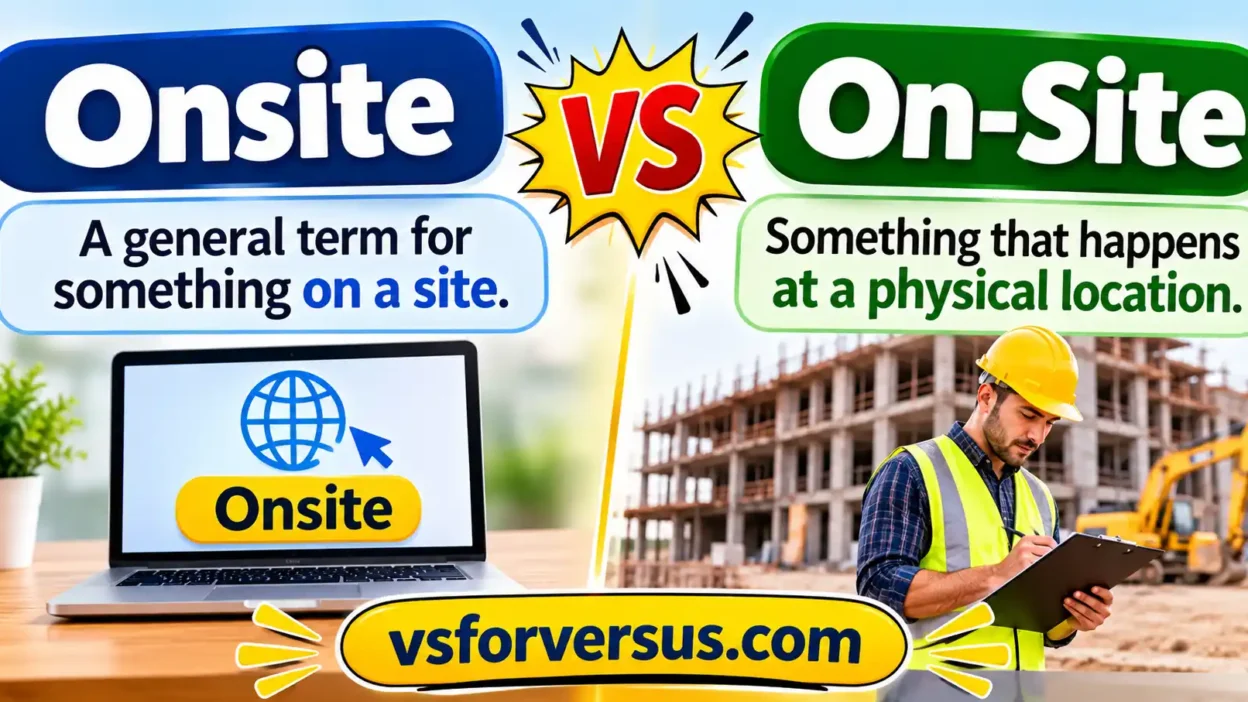
Onsite vs On-Site is a small spelling question that trips up many writers, especially in business emails, job listings, and project documents, where the term appears constantly. Both versions describe something happening at a specific location, yet the hyphen changes how the word is used.
Onsite is the single word form, commonly used as an adjective or adverb in modern, informal, and technical writing, as in “the team offers onsite training.” On-site is the hyphenated form, preferred by many style guides when it acts as an adjective before a noun, as in “an on site inspection.”
Both are widely understood, so the real goal is consistency across your content. In this guide, you’ll learn the correct usage, the style differences, common mistakes to avoid, and clear examples that make the right choice easy every time.Onsite vs On-site both describe something that happens at a specific location, so the difference is mostly about style, not meaning.
Quick Answer:
Onsite vs On-site is a matter of spelling style, not meaning. On site (hyphenated) is the form Merriam Webster lists and the safer choice for formal writing; onsite (one word) is a common business and tech variant. Both mean “at the location where something happens.” The open form “on site” is correct after a verb: “the team is on site.”Onsite vs On-Site both mean “at the location,” so the difference is mostly about style and hyphen usage, not meaning.
Onsite, On-Site, vs On Site at a Glance
Here are the forms you’ll meet in the wild, side by side.
| Word | Part of speech | Meaning | Example |
| on site | Adjective or adverb | At the location where something happens | “The hotel has an on site restaurant.” |
| onsite | Adjective or adverb (one word variant) | Same meaning as on site | “We offer onsite training for new hires.” |
| on site | Adverbial phrase (preposition + noun) | At the location, written as two words | “The inspector stayed on site all afternoon.” |
| onsite (informal noun) | Noun, mostly in tech hiring | The in person interview round | “My onsite is next Friday.” |
The last row is informal, so keep it out of formal writing.Onsite vs On-Site becomes easier to understand when you see that “on-site” is often used as a hyphenated adjective before a noun, as in “an on-site inspection.”

What Does “On-Site” Mean?
On-site means at a particular place, especially a business location. Merriam Webster lists it as both an adjective and an adverb, so it works before a noun (“an on-site inspection”) and after a verb (“we’ll be working on-site next week”). As a compound adjective, it takes a hyphen because the two words act as a single modifier. Some writers drop the hyphen once the phrase follows a verb, but the hyphenated form is the one the dictionary gives.Onsite vs On-Site appears in job listings all the time, such as “onsite interviews” or “on-site training,” and both forms are widely understood.
Here’s how it sounds in everyday use:
- “The university guarantees on-site housing for first year students.”
- “Parking is on-site, but it fills up by eight.”
- “Registration opens at 7:30, and you can also check in on site.”
- “An on-site inspector will review the wiring before we close the walls.”
- “We’ll schedule your on-site interview for Thursday morning.”
You’ll see it most in contracts, reports, news articles, event pages, and academic writing.
What Does “Onsite” Mean?
Onsite means the same thing with the hyphen dropped. English does this all the time: a compound starts as two words, picks up a hyphen, and eventually closes up, the way “e mail” became “email.” A word written as a single unit like this is called a closed compound, and onsite is one. You’ll run into it often in tech, HR, and marketing copy.
So is onsite a word? In everyday use, yes. People read it, write it, and understand it without effort. Dictionaries, however, are not unanimous. Merriam Webster lists on site, while other dictionaries vary on the one word form, so a red squiggle under the word isn’t a verdict either way.Onsite vs On-Site should be chosen based on your style guide, since some publishers prefer the hyphen and others accept the single word.
- “This role is fully onsite, five days a week.”
- “Our onsite team had the booth up in two hours.”
- “The company runs an onsite gym, which is honestly why I took the job.”
- “Technicians are available onsite throughout the weekend.”
- “Anyone onsite tomorrow who can let the delivery driver in?”
What About “On-Site” as Two Words?
“On-site” is just the preposition “on” followed by the noun “site.” It’s correct when “site” is literally a site, and it’s common after a verb.
- “The electrician arrived on site at nine and left by noon.”
- “Please wear your badge whenever you’re on site.”
- “I found more details on site number two in the appendix.”
The trap comes before a noun. When the phrase means “at the location” and sits in front of a noun, hyphenate it: “on site parking,” not “on site parking.”Onsite vs On-Site can also be used as an adverb, as in “the technician will work on-site tomorrow,” where many writers leave out the hyphen.
The Informal Noun: “My Onsite Is on Thursday”
Job seekers in tech often meet a fourth use of the word: onsite as a noun meaning the in person interview round. “I passed the phone screen, so my onsite is next Friday.” Here the word names an event rather than a place. It works in recruiting chats and friendly emails, but it’s informal, so keep it out of contracts and reports. In professional writing, say “on site interview” instead: “Your on site interview is next Friday.”
Where You’ll See Each Form (and Related Terms)
Job posts are where most people first meet the word, usually in a trio: remote, hybrid, and on site. A line like “Hybrid: three days on site” tells candidates how often they’ll be in the building. That remote vs on site split is all about location.Onsite vs On-Site is a good example of why consistency matters more than picking one “perfect” spelling.
“In person” overlaps with on site but isn’t identical. In person describes people meeting face to face, while on site describes being at a particular place, such as a plant, a campus, or a client’s office. A team can meet in person at an off site retreat without anyone being on site.
Emails and event pages use the word for logistics. A typical reminder reads, “Thursday’s workshop is on site at the Denver office, and lunch is provided.” In contracts, it defines where a service is delivered, so consistency matters most there.
Some writers also confuse it with “on premises,” which usually describes software or equipment running in a company’s own building rather than in the cloud. The two can overlap, but they aren’t interchangeable.
Onsite vs On-Site: Key Differences
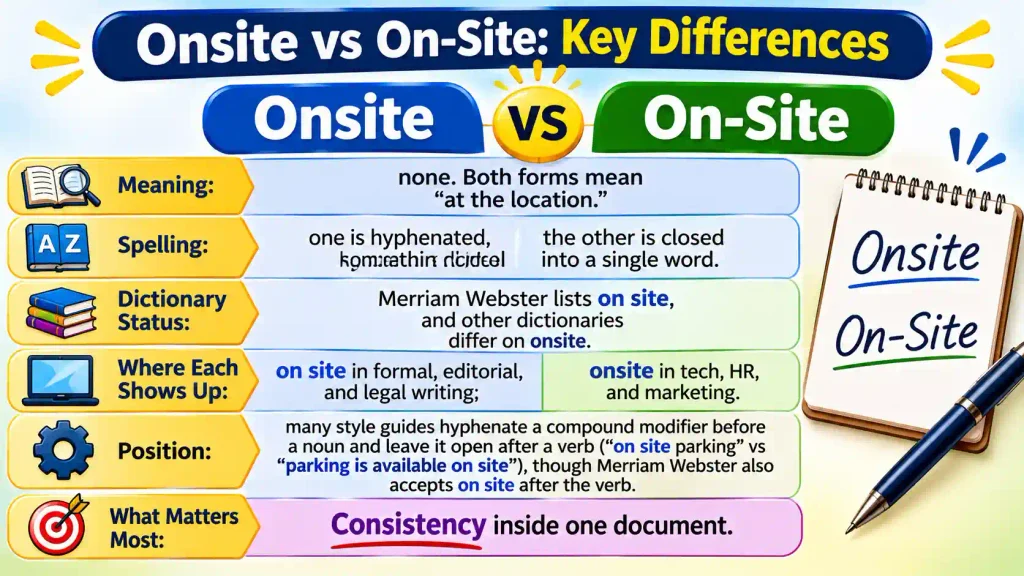
- Meaning: none. Both forms mean “at the location.”
- Spelling: one is hyphenated, the other is closed into a single word.
- Dictionary status: Merriam Webster lists on site, and other dictionaries differ on onsite.
- Where each shows up: on site in formal, editorial, and legal writing; onsite in tech, HR, and marketing.
- Position: many style guides hyphenate a compound modifier before a noun and leave it open after a verb (“on site parking” vs “parking is available on site”), though Merriam Webster also accepts on site after the verb.
- What matters most: consistency inside one document.
Why Do Guides Disagree?
Search for the answer, and you’ll find advice pointing in opposite directions. Some guides teach that onsite is the adjective and on site is the adverb. Others call onsite the modern default and on site the old fashioned form. Dictionaries don’t back the first rule, since Merriam Webster treats on site as working in both roles.
The disagreement exists because the word is mid transition. The Chicago Manual of Style usually follows Merriam Webster on hyphenation, which points to on site, while plenty of tech and recruiting writing uses the closed form. “Email” and “e mail” went through the same tug of war before one won out, as we explain in email vs e mail. So the onsite vs on site debate shows a language still making up its mind, and nobody in it is making a mistake.
Readers rarely notice which form you choose. They notice when it changes. If your company has a style guide, it wins. Without one, on site is the lower risk choice for anything formal, and on site is fine where your field has adopted it.
An Easy Way to Remember Which to Use
Think of the hyphen as a handshake: it joins two words that are working as one. With that picture in mind, three shortcuts cover nearly every situation.
Match the opposite. On site’s partner is off site, and the two should be treated alike. If you write on site, write off site; if you write onsite, write offsite. We cover that pair in offsite vs off site. Catching yourself mixing the pair is your cue to fix one.
Search before you send. Look through your draft for “onsite,” “on site,” and “on site,” and check that every instance meaning “at the location” uses the same form. It takes ten seconds, and it catches the drift that proofreading by eye often misses.
When in doubt, hyphenate. Hyphenating a compound before a noun is rarely wrong under Chicago’s rules, and the hyphenated form is the one Merriam Webster lists. If you’re settling onsite vs on site on a deadline, hyphenate and move on.
Common Mistakes (Wrong vs Correct)
Even careful editors slip here. You hyphenate in paragraph one, then type the one word form by paragraph six, because both look right while you’re typing. Picking either form is fine. What trips people up with onsite vs on site is drifting between them.

| Wrong | Correct | Why |
| We offer on site parking and onsite security. | We offer on site parking and on site security. | Mixed forms in one document |
| The event has on site registration and offsite tours. | The event has on site registration and off site tours. | Mismatched pair |
| Please book on site parking before you arrive. | Please book on site parking before you arrive. | Hyphenate before a noun |
| The inspector arrived on sight at noon. | The inspector arrived on site at noon. | Homophones: “sight” and “site” sound alike (see site vs sight vs cite) |
| Our in site support team is available. | Our on site support team is available. | “In site” isn’t a standard form |
The same open versus closed logic explains why “set up” is a verb and “setup” is a noun (see set up vs setup), so this isn’t a quirk of one word.
Test Yourself: 5 Question Quiz.
- Which sentence is consistent? (a) “We have on site parking and onsite security.” (b) “We have on site parking and on site security.”
- Complete the pair: “on site meeting, ____ storage.”
- Choose the right word: “The inspector arrived on ____ at noon.” (site/sight)
- Which is safest before a noun in formal writing? (a) on site parking (b) on site parking (c) in site parking
- True or false: onsite and on site have different meanings.
Answers: 1. (b), because both forms match. 2. Off site, the matching partner. 3. Site, the place; “sight” is vision. 4. (b), the hyphenated compound. 5. False, since the meaning is identical.
Frequently Asked Questions
Is it onsite or on site?
Both onsite and on site appear in everyday writing, and both mean “at the location.” Merriam Webster lists on site, which makes it the safer choice for formal work. Onsite is a common one word variant in tech and business writing. Choose one form and keep it consistent.
Is onsite vs on-site a spelling or grammar issue?
The difference between onsite and on site is mostly a spelling style. Both forms can act as adjectives or adverbs, so the grammar doesn’t change. The real variable is whether the writer hyphenates or closes the compound, which is why dictionaries, style guides, and industries sometimes disagree.
Is onsite one word or two?
Onsite is written as one word. The hyphenated form is on site, and the open form is “on site.” All three appear in real writing, but only on site is the form Merriam Webster lists, so it’s the safest choice in formal work.
Is on site hyphenated?
Yes, Merriam Webster hyphenates on site. Write it with a hyphen before a noun, as in “on site parking.” After a verb, many writers leave it open (“the team is on site”), though Merriam Webster also accepts the hyphenated form there. Whatever you choose, apply it throughout the document.
Is “on-site” correct?
Yes, “on-site” is correct as two words after a verb (“the technician is on site”) or when “site” is literally a site (“details on site number two”). Before a noun meaning “at the location,” write it with a hyphen: “on site parking,” not “on site parking.”
Is onsite acceptable in formal writing?
Onsite is widely understood, but the onsite vs on site choice leans toward on site in formal work, since dictionaries list it. If a style guide or client template specifies a form, follow that instead.
What is the opposite of on site?
The opposite of on site is off site, or offsite when closed up. Treat the pair alike by hyphenating both or neither. Off site means away from the place where an activity happens.
Final Thought
Onsite vs on-site mean the same thing, so the only real mistake is mixing them. Use on site when you want the form dictionaries list, onsite where your field has adopted it, and “on site” when “site” is literally a site or your style guide leaves it open after a verb. Settle the onsite vs on site choice once, apply it everywhere, and the word stops being a problem.
The next time a recruiter, a client, or a red squiggle makes you second guess it, remember that the question was never about meaning. It was about consistency. Put the same habit to work on the next pair in our series, in person vs in person.
To read more: Peel vs Peal: 5 Shocking Differences You Can’t Ignore

Elena covers lifestyle and consumer comparisons — everything from mattresses to meal kits — drawing on a background in market research. She’s known for digging past marketing copy to find the one detail that actually decides a purchase, and for admitting when two options are basically a coin flip.