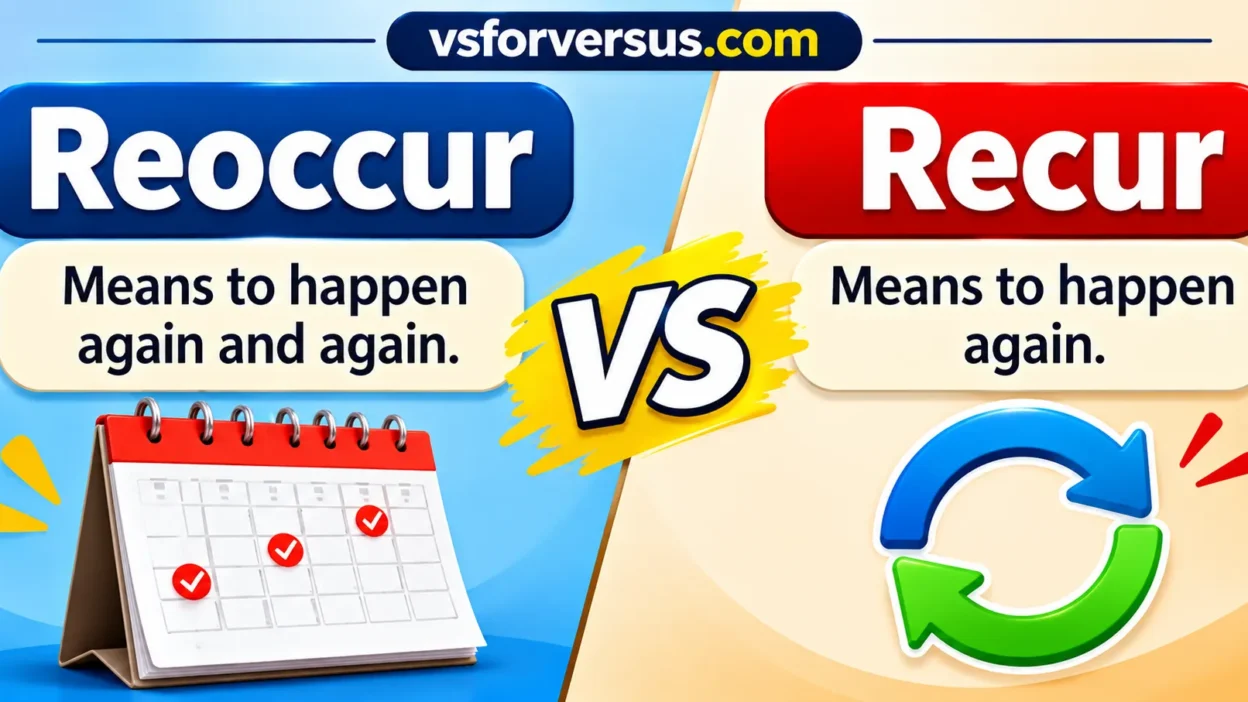
Reoccur vs Recur is a verb pair that looks like a simple spelling choice, yet it raises a question many writers never stop to ask: do these two words actually mean different things? Recur is the standard, more established verb, meaning to happen again, often repeatedly or at regular intervals, as in “the same error recurs every spring.”
Reoccur is a newer, less formal variant, usually meaning to occur one more time, as in “if the problem reoccurs, call support.” Many dictionaries treat them as near synonyms, but editors and style guides often prefer “recur” in formal, medical, and academic writing. In this guide, you’ll learn the correct usage, the related noun forms, common mistakes to avoid, and clear examples that make the right choice easy every time.
Quick Answer:
Reoccur vs Recur: both are correct verbs meaning “to happen again.” Recur is the standard choice, especially in formal writing, and often signals repetition or a regular pattern. Reoccur means “occur again” with no pattern implied, so writers who feel unsure should use recur.
Reoccur vs Recur at a Glance
The table below lays out the main forms of both words, from the verbs to the nouns. Noun forms get their own guide: recurrence vs reoccurrence.
| Word | Part of Speech | Meaning | Example |
| recur | Verb (intransitive) | To happen again, often repeatedly or at intervals | The sync error recurs whenever traffic spikes. |
| reoccur | Verb (intransitive) | To occur again, with no pattern implied | I hope the power outage doesn’t reoccur tonight. |
| recurring | Adjective / present participle | Happening repeatedly or on a schedule | Please cancel my recurring donation. |
| reoccurring | Adjective / present participle | Happening again | The reoccurring glitch finally stopped. |
| recurrence | Noun | A return or repeat of something | Doctors watch for recurrence after treatment. |
| reoccurrence | Noun | A second or later occurrence | We need a plan to prevent the reoccurrence of the leak. |
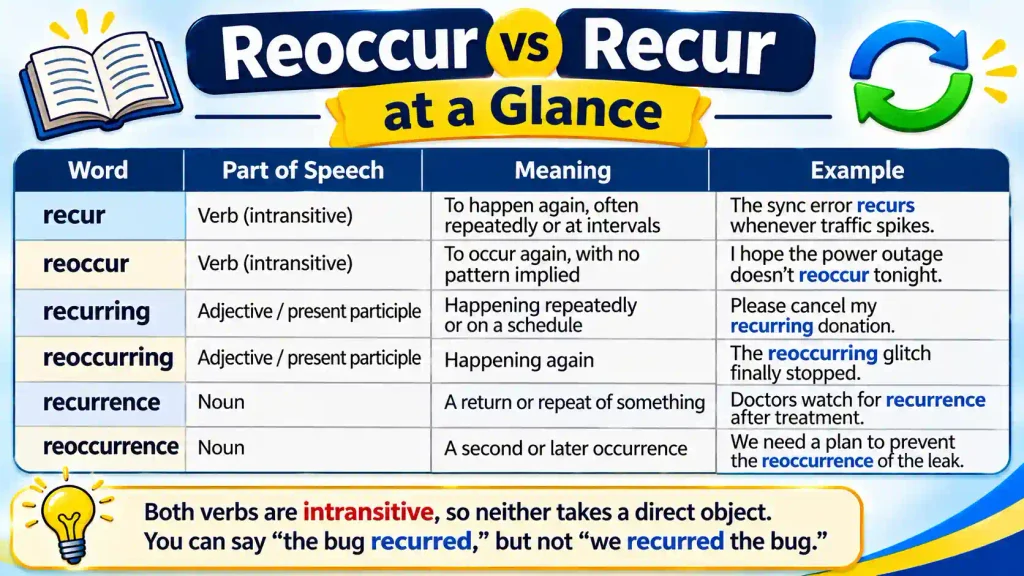
Both verbs are intransitive, so neither takes a direct object. You can say “the bug recurred,” but not “we recurred the bug.” The past tenses are recurred and reoccurred, and the final r doubles before ed and ing.
What Does “Recur” Mean?
Recur means to happen again, usually with a sense that the thing keeps coming back, whether on a schedule or every so often. Dictionaries also list a second sense: to come back to mind, like a thought that recurs. The word entered English in the early 1500s from Latin recurrere, “to run back,” which explains the feeling of something circling back. Say it as ri KUR.
- “Heads up: the sync error recurs whenever someone edits the sheet on mobile.”
- “My knee pain tends to recur after long runs, so I’m booking a physical therapy appointment.”
- “The motif of water recurs in every chapter of the novel.”
- “Your subscription recurs on the 5th of each month.”
Common contexts: scheduling and billing (recurring meeting, recurring payment, recurring charge), medical writing (recurring symptoms, recurrence), literary analysis (a recurring theme), and IT reports.
What Does “Reoccur” Mean?
Reoccur is built from the prefix re , meaning “again,” plus occur. Take it apart, and you get exactly what it says: occur again. Merriam Webster lists it, so nobody can honestly tell you it isn’t a word. English speakers formed it in the 1700s, with the earliest citation in the Oxford English Dictionary dated 1734, long after recur was established. In speech, it comes out as ree uh KUR.
- “Fingers crossed the leak doesn’t reoccur before the landlord gets here.”
- “The rash cleared in a week but recurred in March.”
- “We changed the process so the outage would not recur.”
- “If the issue reoccurs, restart the router and message me.”
Common contexts: spoken English, quick incident updates, and news writing. None of these sentences implies a schedule. They just say “again.”
Recur vs Reoccur: Key Differences
The reoccur vs recur comparison, in scannable form:
- Both are valid. Each means “to happen again.”
- Recur is older and more common. It dates to the early 1500s, while reoccur arrived in the 1700s.
- Recur often implies repetition or intervals. Reoccur says nothing about frequency.
- Style guides lean toward recur. The AP Stylebook lists recur, recurred, and recurring, and says not reoccur.
- Fixed phrases use recur. Recurring payment, recurring meeting, and recurring theme are the standard forms.
- Nouns differ in frequency. Recurrence is standard, while reoccurrence is real but rarer.
- Safe rule: when in doubt, choose recur.
Same Sentence, Two Words
- “The outage recurs every Friday.” The schedule is the point, so recur fits.
- “The outage reoccurred last night.” It happened once more with no schedule claimed, so reoccur fits.
- “Recurring charge” is what software and finance teams expect, so skip “reoccurring charge.”
Does the “Regular vs Irregular” Rule Hold?
Some guides teach a tidy rule: recur means regular, reoccur means irregular. Real usage is messier. Merriam Webster notes that both words can mean plain “happen again,” and that reoccur is mostly used that way, while recur can also suggest periodic or frequent repetition. So treat the rule as a tendency, not a law.
Recurrent, Repeat vs Other Near Neighbors
Recurrent is a close cousin of recurring (see recurrent vs recurring). It means happening repeatedly and appears most often in medical writing, as in recurrent infections. Repeat is different again: you repeat a step on purpose, but a problem recurs by itself. When someone does it deliberately, repeat is the word you want.
Reoccur vs Recur in Real Life
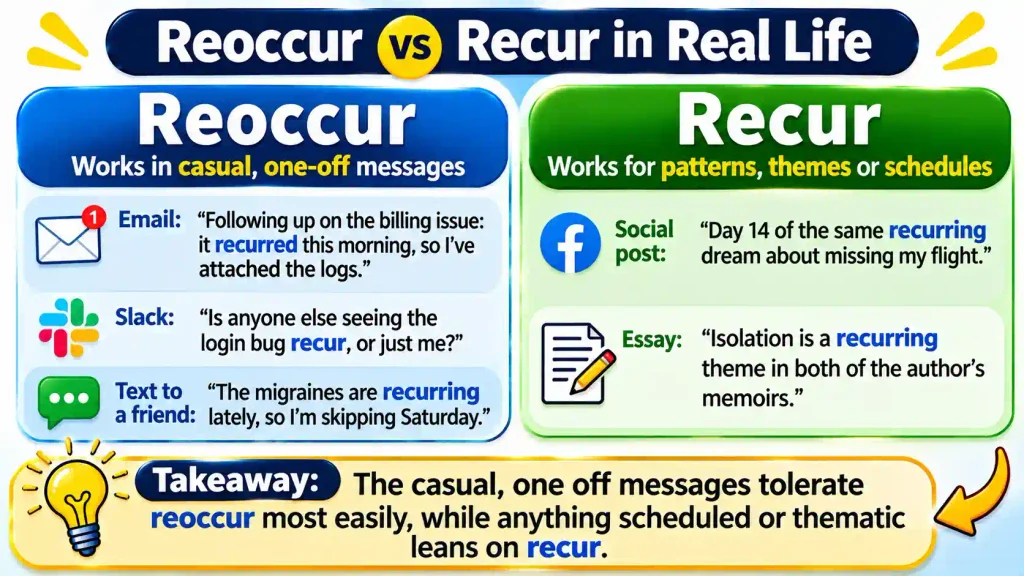
In the messages you probably write every week, the two words sound like this:
- Email: “Following up on the billing issue: it recurred this morning, so I’ve attached the logs.”
- Slack: “Is anyone else seeing the login bug recur, or just me?”
- Text to a friend: “The migraines are recurring lately, so I’m skipping Saturday.”
- Social post: “Day 14 of the same recurring dream about missing my flight.”
- Essay: “Isolation is a recurring theme in both of the author’s memoirs.”
The casual, one off messages tolerate reoccur most easily, while anything scheduled or thematic leans on recur.
Reoccur or Recur? A Guide by Profession
Writers hit reoccur vs recur most often at work, so it helps to see how the choice plays out field by field.
- Business and finance: Recurring is the word. “Finance flagged a recurring charge of $49 that nobody remembered approving.”
- IT and support: Recur keeps tickets tidy. “If the error recurs, escalate to tier two.”
- Medical writing: Recur, recurrent, and recurrence are the standard terms. “Patients should report any recurring chest pain right away.”
- Legal and contracts: Recurring suits scheduled obligations because it signals the pattern. “The recurring fee is due monthly.”
- Academic writing: Recurring is the norm for themes and patterns. “Fear of change is a recurring theme across the interviews.”
Why You Say “Reoccur” but Never Write It
Many people admit they say “reoccur” out loud but would never type it. That gap explains why reoccur vs recur trips up even confident writers. In speech, the longer word comes out easily, and listeners rarely object. On the page, the spellchecker sometimes underlines it, and the doubt starts: is reoccur a word at all?
It is. Register matters, though. Reoccur is fine in casual messages and spoken English, while formal writing is safer with recur. If your spellchecker flags reoccur, that doesn’t make it wrong. The tool often just prefers the more common form, so take the squiggle as a nudge toward recur rather than a verdict.
Even experienced writers slip here. Reoccur has appeared in Forbes and U.S. News & World Report, and it turns up in professional writing regularly. A slip like this says little about someone’s English. Usually, the habit of speech just reached the page unchecked.
A Memory Trick for Reoccur vs Recur
When you’re stuck mid sentence, try this:
- Break the word apart. Re plus occur means “occur again.” That’s reoccur, and nothing more.
- Think of things that keep coming back. A recurring bill, a recurring meeting, a recurring nightmare. All of them run back to you, just as recurrere suggests.
- Run the swap test. Replace the word with “happen again.” Then try “happen again and again.” If only the second version sounds right, use recur.
If none of that settles it, default to recur.
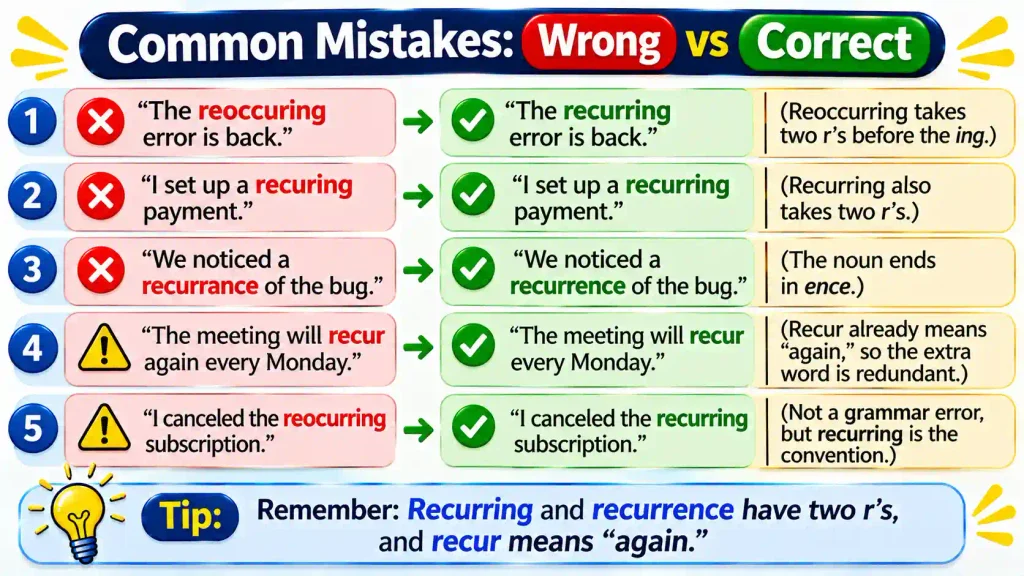
Common Mistakes: Wrong vs Correct
- ❌ “The reoccuring error is back.” → ✅ “The recurring error is back.” (Reoccurring takes two r’s before the ing.)
- ❌ “I set up a recuring payment.” → ✅ “I set up a recurring payment.” (Recurring also takes two r’s.)
- ❌ “We noticed a recurrance of the bug.” → ✅ “We noticed a recurrence of the bug.” (The noun ends in ence.)
- ⚠️ “The meeting will recur again every Monday.” → ✅ “The meeting will recur every Monday.” (Recur already means “again,” so the extra word is redundant.)
- ⚠️ “I canceled the reoccurring subscription.” → ✅ “I canceled the recurring subscription.” (Not a grammar error, but recurring is the convention.)
Quick Quiz: Test Yourself
- Your calendar app can repeat a meeting every week. What’s that setting called? Answer: recurring. It’s the standard word for scheduled repeats.
- What is the standard noun for recur? Answer: recurrence.
- Which is the misspelling: recurring, reoccurring, or reocurring? Answer: reocurring, which is missing a c.
- Fix this sentence: “The problem might recur again.” Answer: “The problem might recur.” The word “again” is redundant.
- Which word belongs in a contract clause about a fee charged every month? Answer: recurring, because it signals the repeating schedule.
Frequently Asked Questions
Is “reoccur” a real word? Yes, “reoccur” is a real word. Merriam Webster and the Oxford English Dictionary both list it as a verb meaning “to occur again.” It is less common than recur, which is why spellcheckers sometimes flag it. A line like “I hope the issue doesn’t reoccur” is fine in a casual message.
Reoccur vs recur: can you use them interchangeably? Reoccur and recur can often be used interchangeably, because both mean “happen again.” Recur is safer, especially for repeated or scheduled events, and it is the form style guides prefer. The one thing to avoid is switching between the two inside the same document, which looks careless.
Which is more correct, recurring or reoccurring? Recurring and reoccurring are both correct, but recurring is far more common and preferred in formal writing. For payments, meetings, and themes, recurring is the standard phrase.
Is “reoccurring” grammatically correct? Yes, “reoccurring” is grammatically correct. It is the adjective and present participle of reoccur. Just remember the spelling: two c’s and two r’s. The common slip is “reoccuring,” with a single r, which a spellchecker will usually catch.
What is the past tense of recur? The past tense of recur is recurred, with a doubled r. The same doubling gives recurring. For reoccur, the past tense is reoccurred. A quick example: “The error recurred twice last night.”
Should I say recurring or reoccurring in a work email? In a work email, say recurring. Phrases such as “recurring meeting” and “recurring invoice” are what colleagues and software expect, and recurring avoids any doubt about repetition. If you’re describing a one off return of a problem, “if it happens again” is a friendly alternative.
Final Thought
Settling reoccur vs recur comes down to one habit: reach for recur unless you specifically mean “happen once more.” The two words are legitimate, but recur is clearer, more standard, and safer in contracts, reports, and emails. If you remember only one thing, remember the freelancer’s contract: the pattern is the point, and recurring is the word that carries it.
Related reading: Recurrence vs Reoccurrence · Recurrent vs Recurring · Continual vs Continuous · Occur vs Occurrence · Commonly Confused Words
To read more: Rational vs Rationale: What’s the Ultimate Difference?2026