
Ever wondered why some people say “Mama” while others say “Momma”? At first glance, these two words seem almost identical, but small differences in spelling and pronunciation often reflect regional accents, cultural background, or simply personal and family habits.
“Mama” is widely used across many English speaking countries and tends to sound slightly softer and more universal, often taught to children as one of their very first words.
“Momma,” meanwhile, carries a distinctly American, informal, and affectionate tone, frequently heard in casual conversation, southern dialects, or warm family settings. Neither version is grammatically “more correct” than the other; both are informal, endearing terms for one’s mother. Choosing between them usually comes down to habit, upbringing, or the emotional warmth a person wants to express when addressing their mom.
Quick Answer
Momma and mama are both correct, informal English words meaning “mother.” In the momma vs mama comparison, the difference comes down to spelling and regional variation, not a grammar error. Mama is the more standard, globally recognized spelling, while momma is a phonetic variant tied to Southern American English with a warmer, more nostalgic tone. Neither word belongs in formal or professional writing, where “mother” is the right choice.
Momma vs Mama at a Glance
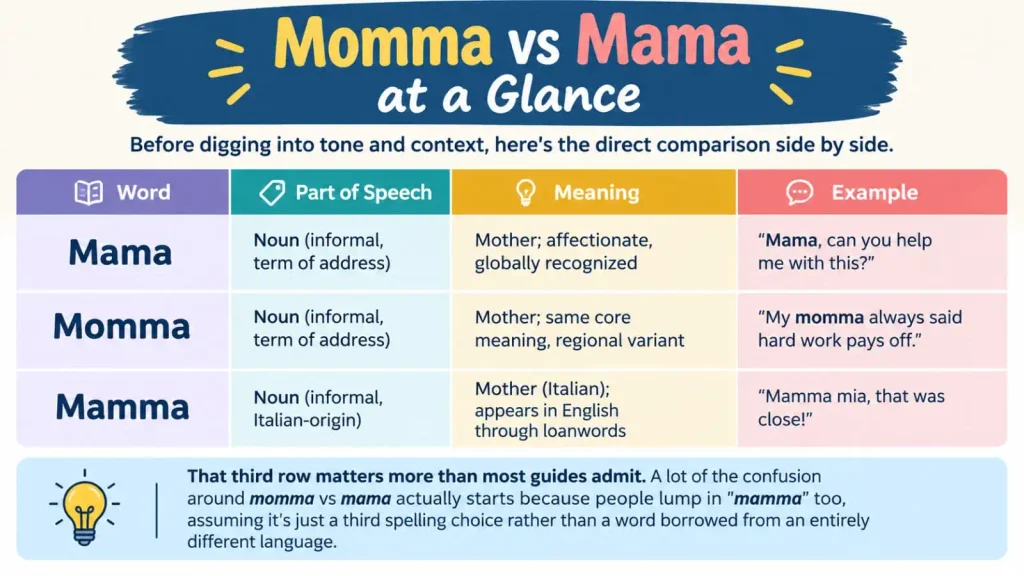
Before digging into tone and context, here’s the direct comparison side by side.
| Word | Part of Speech | Meaning | Example |
| Mama | Noun (informal, term of address) | Mother; affectionate, globally recognized | “Mama, can you help me with this?” |
| Momma | Noun (informal, term of address) | Mother; same core meaning, regional variant | “My momma always said hard work pays off.” |
| Mamma | Noun (informal, Italian-origin) | Mother (Italian); appears in English through loanwords | “Mamma mia, that was close!” |
That third row matters more than most guides admit. A lot of the confusion around momma vs mama actually starts because people lump in “mamma” too, assuming it’s just a third spelling choice rather than a word borrowed from an entirely different language.
What Does “Mama” Mean?
Mama is the most widely used informal word for mother in English. It’s typically one of the first words children learn, and versions of it appear across dozens of unrelated languages, which is part of why it feels so universally familiar.
Here’s how “mama” shows up in everyday writing:
- “Mama, I’m running late, can you grab the kids from practice?”
- “She’s a proud mama of three now, and it shows in everything she posts.”
- “I texted Mama the second I got the offer letter.”
- “Being a mama has taught me more patience than any job ever did.”
You’ll see “mama” in children’s books, parenting blogs, personal essays, song lyrics, and casual social captions. It reads as warm without sounding regionally specific, which is exactly why writers reach for it when they want affection without a strong dialect attached.
What Does “Momma” Mean?
Momma carries the same core meaning as mama (mother), but it reflects a different spelling tradition, one closely tied to Southern American English and to how the word is often actually pronounced in that region.
Natural examples of “momma” in context:
- “My momma raised five kids on one income and never once complained about it.”
- “Ask your momma before you tell me yes.”
- “Momma’s cooking on Sundays was the only thing that got us all in one room.”
- “I’m driving down to see momma this weekend. It’s been too long.”
“Momma” shows up in dialogue, memoirs, country music, and storytelling where the writer wants the reader to hear a specific voice, not just read a neutral word. It’s less about correctness and more about capturing how someone actually talks.
What About “Mamma”?
This is where the confusion usually starts, even for people who’ve spoken English their whole lives. “Mamma,” with its doubled m, isn’t a third English variant sitting between momma and mama. It’s the Italian word for mother, most familiar to English speakers through phrases like “Mamma mia!” It occasionally shows up in older British writing too, but it’s not interchangeable with the American “mama” or “momma” in everyday use.
If you’re writing in standard English and reach for “mamma” out of habit, you’ve likely picked up a loanword spelling rather than a true regional variant, and it’s worth catching before it slides into a formal draft.
Where Does “Mama” Actually Come From?
Part of what makes the momma vs mama debate feel so unresolvable is that neither word ever went through a formal spelling standardization the way most English vocabulary did. Language historians trace “mama” back to the natural sounds babies make while feeding, long before they can form real words. According to etymological records, “mama” entered recorded English usage around 1707, with “mum” following roughly a century later, then “mommy,” “momma,” and finally “mom” all emerging across the 1800s as regional pronunciations solidified into distinct written forms.
Merriam Webster lists “mama” as the primary entry, with “momma” recognized as a standard variant spelling rather than an error. That’s a meaningful distinction: it means the debate was never really about correctness, but about which branch of that centuries-long spelling split your family happened to inherit.
Key Differences Between Momma and Mama
Here’s the momma vs mama comparison boiled down to the essentials:
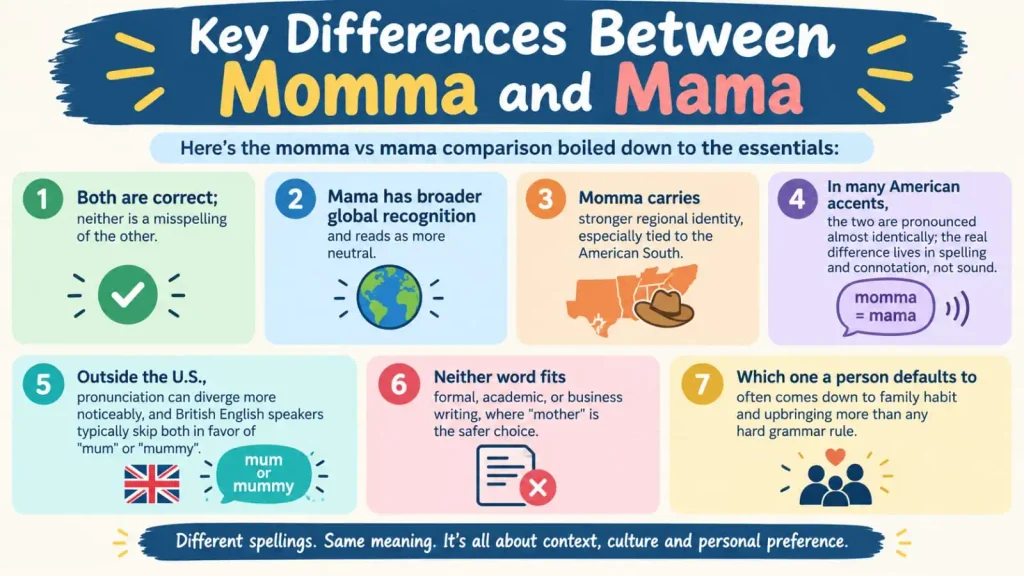
- Both are correct; neither is a misspelling of the other.
- Mama has broader global recognition and reads as more neutral.
- Momma carries stronger regional identity, especially tied to the American South.
- In many American accents, the two are pronounced almost identically; the real difference lives in spelling and connotation, not sound.
- Outside the U.S., pronunciation can diverge more noticeably, and British English speakers typically skip both in favor of “mum” or “mummy”
- Neither word fits formal, academic, or business writing, where “mother” is the safer choice.
- Which one a person defaults to often comes down to family habit and upbringing more than any hard grammar rule.
Memory Trick: How to Remember Which Is Which?
If you keep second guessing yourself in the middle of the momma vs mama decision, try this: momma has more letters because it carries more twang. The extra “m” mirrors the drawn out, folksy sound of Southern pronunciation. Mama, shorter and cleaner, matches its role as the more universal, neutral spelling recognized worldwide. The longer word carries more local flavor; the shorter one has the wider reach.
When Spelling Actually Matters: Permanent and High Stakes Writing
Most of the time, choosing between mama and momma is low stakes: a text message, a caption, a line of dialogue you can always edit later. But the calculation changes the moment the word becomes permanent. That includes tattoos, engraved jewelry, a dedication page in a book, or the wording on a memorial plaque.
In those situations, the “safer, more universal” answer isn’t necessarily the right one. If your family has always said “momma” at the dinner table, a tattoo reading “Mama’s Boy” might technically be the more common phrase, but it won’t sound like your actual life.
This is a real dilemma people run into: deciding between “mama’s boy” and “momma’s boy” for something they’ll wear on their skin forever, not just type in a caption. When the writing is permanent, match the word to how your family actually speaks, not to whichever spelling shows up more often in a search result. For everyday writing, though, tone rules apply the same way they do with any other formal vs. informal word choice; context decides, not personal preference alone.
Common Mistakes to Avoid
The most common momma vs mama slip-up happens when writers forget which context they’re in.
| ❌ Wrong or Awkward | ✅ Better |
| “My momma will be presenting the quarterly results.” | “My mother will be presenting the quarterly results.” |
| Switching between “mama” and “momma” randomly within the same essay or article | Pick one spelling and stay consistent unless you’re directly quoting someone |
| Assuming “momma” is simply an error | Recognizing it as a valid, regionally rooted spelling |
| Treating “mamma” as interchangeable with momma or mama | Remembering “mamma” is the Italian-origin form, not a casual English variant |
Even experienced writers slip on that first one, swapping in “momma” or “mama” inside a professional email or report because it feels natural in speech and forgetting that formal writing calls for “mother” instead. It’s such an easy habit to carry over from casual texting that it sneaks past a first read-through more often than you’d expect.
Quick Quiz: Momma or Mama?
Test what you’ve picked up so far:
- Which spelling is more globally recognized: mama or momma?
- Fill in the blank for a Southern-dialect story: “___ always knows best.”
- True or False: Momma and mama are always pronounced identically, everywhere.
- Which phrase is more universally recognized, “mama’s boy” or “momma’s boy”?
- Which word belongs in a formal business email: mama, momma, or mother?
(Answers: 1. Mama · 2. Momma · 3. False · 4. Mama’s boy · 5. Mother)
Want more practice like this? Try our confusable words quiz hub for similar spelling and usage challenges.
Frequently Asked Questions
Is momma a real word?
Yes. It’s a recognized informal variant of “mama,” not a misspelling, and it’s fully accepted in casual and dialect-based writing.
Which is correct, mama or momma?
Both are correct informal spellings for mother. “Mama” is the more standard, widely used version, while “momma” is a regional variant most associated with the Southern United States. This is really the heart of the momma vs mama question: it’s a style choice, not a grammar rule.
Is it “mama’s boy” or “momma’s boy”?
“Mama’s boy” is the more commonly recognized phrase overall, though “momma’s boy” appears frequently in informal and regional speech.
Do mama and momma sound the same?
Often, yes, especially in many American accents, where the two are nearly indistinguishable in speech. Outside the U.S., pronunciation can differ more noticeably between them.
Can I use mama or momma in professional writing?
No. Stick with “mother” in formal, academic, or business contexts, where both mama and momma will read as too casual. If you’re unsure where a word falls on that scale, our guide to regional dialect spelling differences covers several similar cases.
Is “mamma” the same as “momma”?
Not quite. In the broader momma vs mama picture, “mamma” is the outlier: it’s the Italian-origin spelling, familiar from phrases like “Mamma mia,” and it isn’t typically interchangeable with the English “mama” or “momma” in standard American writing.
Final Thought
Choosing between momma vs mama was never really about right versus wrong; it’s about matching the word to the voice you’re trying to capture, whether that’s a global, neutral tone or something rooted in a specific place and family. Once you see it as a tone decision rather than a spelling test, the choice tends to make itself.
