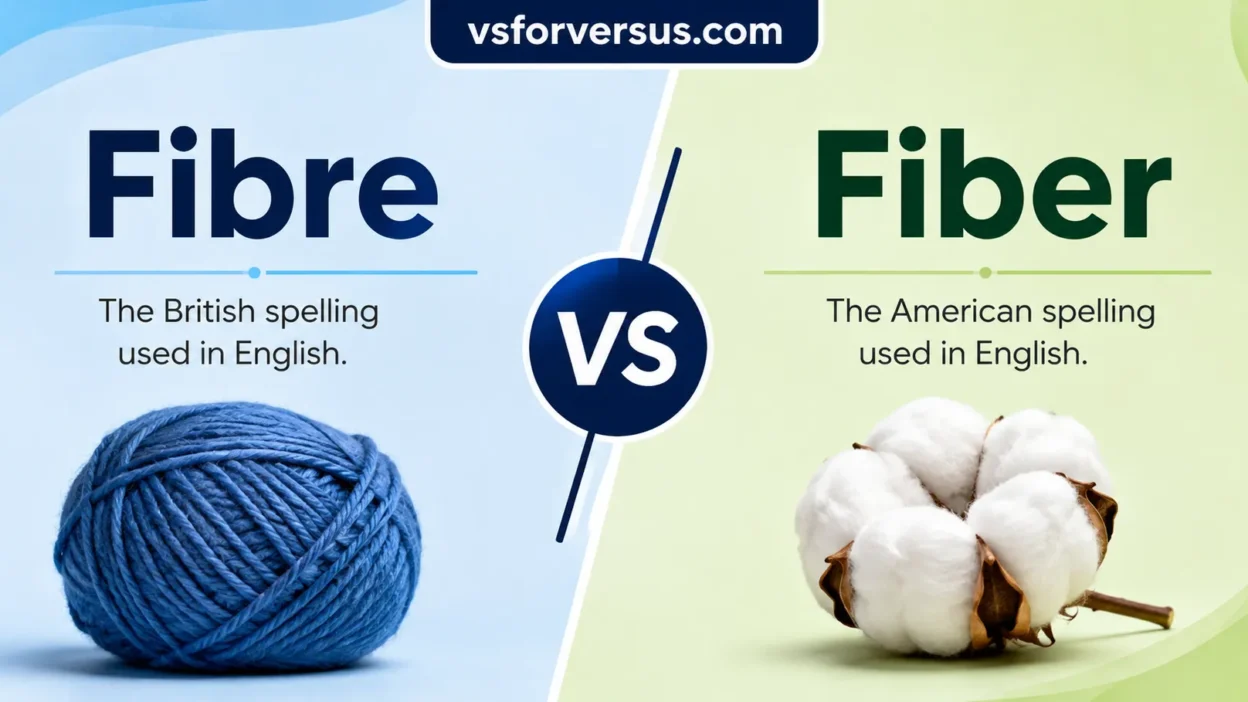
If you have ever wondered whether fibre vs fibre mean different things, the answer is surprisingly simple: they mean the same thing but use different regional spellings. Fibre is the spelling commonly used in British English, while fiber is preferred in American English. Both words refer to a thin thread, strand, or material, and they can also describe the part of plant foods that supports healthy digestion.
So, the main difference between fibre vs fibre is not meaning, pronunciation, or usage; it is spelling based on the variety of English you are writing in. Understanding this distinction can help you choose the correct form for your audience.
Quick Answer
Fibre vs Fiber are the same word with two regional spellings: “fiber” is standard American English, and “fibre” is standard British English (also the standard spelling in Ireland, Australia, and Canada, and used across most Commonwealth countries).
Both spellings carry identical meanings, and the only real difference in how they sound comes down to normal accent variation; American English is rhotic (the “r” is pronounced). At the same time, British English is generally non rohtic (it isn’t), so the fibre vs fiber choice comes down purely to which audience and regional style guide you’re writing for, not to any difference in definition.
Fiber vs Fibre at a Glance
| Word | Part of Speech | Meaning | Example |
| Fiber | Noun | Thread-like strand of material; also dietary roughage | “This granola bar has 6g of fiber per serving.” |
| Fibre | Noun | Same meaning as “fiber”, British spelling | “This granola bar has 6g of fibre per serving.” |
| Fibrous | Adjective | Made of or resembling fiber(s) | “The stem felt tough and fibrous.” |
| Fiber optic / Fibre optic | Adjective | Relating to optical fiber technology | “We’re finally getting fiber optic internet.” (US) / “fibre optic broadband” (UK) |
Whichever side of the fibre vs fiber divide you land on, the table above is really the only thing you need to memorize; everything else in this guide is context for applying it correctly, and for catching the small fibre vs fiber slip ups that even careful writers make.
What Does “Fiber” Mean? (American English)
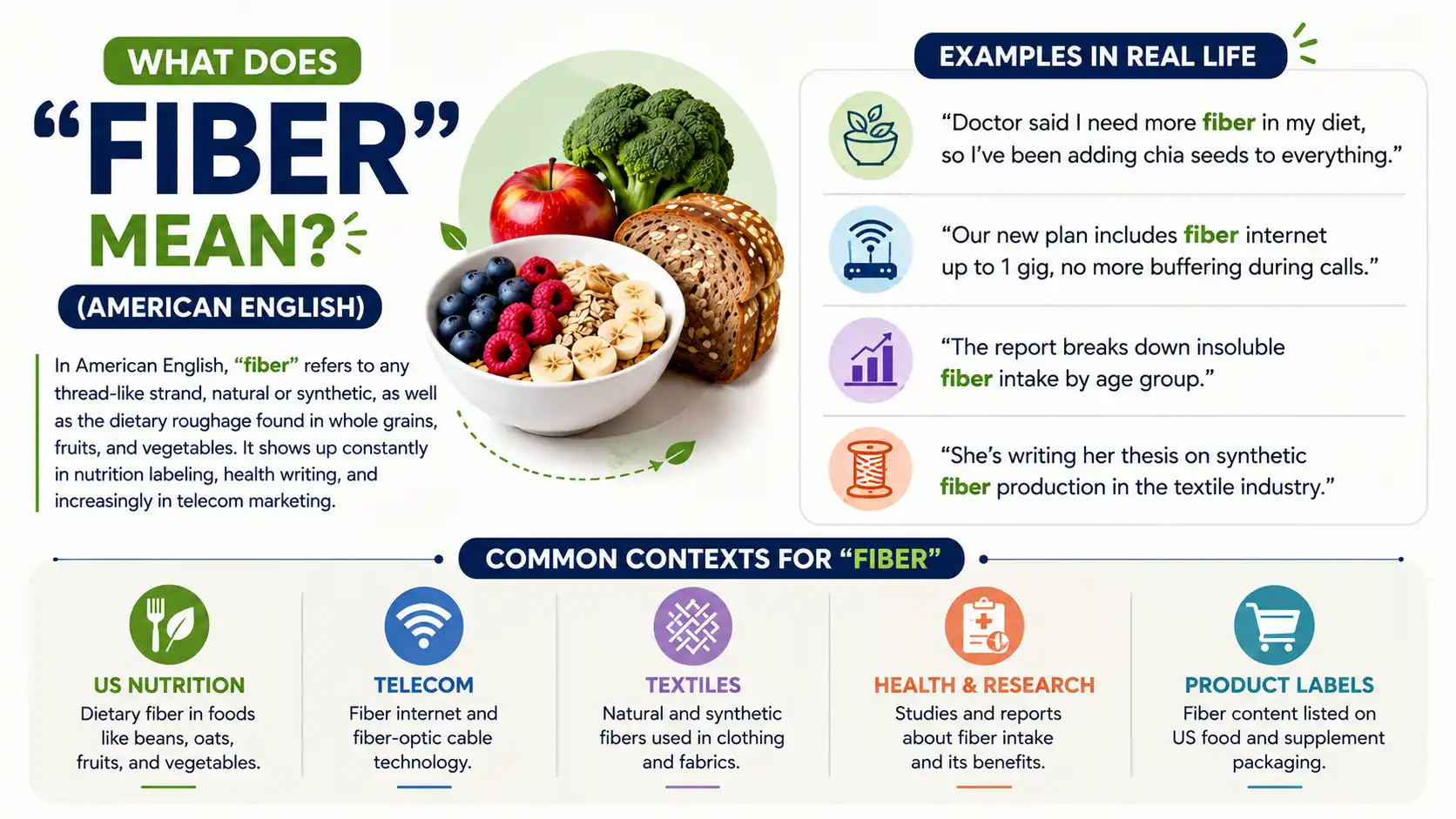
In American English, “fiber” refers to any thread like strand, natural or synthetic, as well as the dietary roughage found in whole grains, fruits, and vegetables. It shows up constantly in nutrition labeling, health writing, and increasingly in telecom marketing.
A few examples of how it actually gets used, not textbook sentences:
- “Doctor said I need more fiber in my diet, so I’ve been adding chia seeds to everything.”
- “Our new plan includes fiber internet up to 1 gig, no more buffering during calls.”
- “The report breaks down insoluble fiber intake by age group.”
- “She’s writing her thesis on synthetic fiber production in the textile industry.” (a US based student, so American spelling applies even though the topic itself is international)
Common contexts for “fiber”: US nutrition labels, US healthcare and wellness content, American resumes and academic papers, and US telecom/broadband marketing. It also turns up constantly in casual writing, group chats about meal prep, gym forums debating protein to fiber ratios, and product reviews on US retail sites, which is part of why the spelling feels so automatic to American writers that they rarely stop to think about it.
What Does “Fibre” Mean? (British English)
“Fibre” carries the same meaning; it’s not a different word, just the British spelling convention, following the same re pattern as “centre” and “theatre.” You’ll see it across the UK, Ireland, Australia, Canada, and most of the Commonwealth.
Natural examples:
- “Get more fibre into your breakfast, porridge is a good start.”
- “BT is rolling out full fibre broadband across the village next spring.”
- “My dissertation supervisor flagged three places where I’d accidentally written ‘fiber’ instead of ‘fibre’, old habits from an American textbook, apparently.”
- “The packaging says ‘source of fibre,’ which is a regulated claim under UK food labeling rules.”
Common contexts for “fibre”: UK/Irish/Australian/Canadian nutrition labels, UK dissertations and academic writing, British broadband and telecom marketing, and EU facing product packaging. It’s also the spelling you’ll see in NHS dietary guidance, UK newspaper health columns, and Australian and Irish school textbooks, all of which follow the same British convention even though they’re separate countries with separate style guides.
Key Differences Between Fiber and Fibre
- Region: Fiber is used in the US; fibre is used in the UK, Ireland, Australia, Canada, and most Commonwealth countries.
- Meaning: There is no difference; both refer to the identical concept, whether physical strands or dietary content.
- Pronunciation: Effectively identical; any perceived difference is just ordinary rhotic vs non rhotic accent variation, not something tied to the spelling itself.
- The adjective “fibrous”: Doesn’t follow the split; it’s spelled the same way in both American and British English.
- Compound terms: “Fiber optic” and “fibre optic” follow the same regional rule as the base noun.
- International packaging: Many global brands default to “fiber” simply because of US market dominance, even when shipping to UK or European markets, which can look inconsistent to local readers.
- Style guides: The Associated Press and Chicago Manual of Style (US) specify “fiber,” while UK focused style guides (such as New Hart’s Rules and most British newspaper style guides) specify “fibre”, so if your organization already follows one of these, the spelling decision is effectively made for you.
Even experienced copywriters slip here; it’s common to see “fibre” used correctly through an entire UK product page, only for “fiber” to sneak into a single line copied from a US written template, or vice versa on a US site built on a British made theme.
The inconsistency is rarely intentional; it’s almost always a leftover from mixed source material, a translated brief, or a freelancer working across both markets without a style sheet to check against.
Memory Trick: How to Never Mix Them Up Again
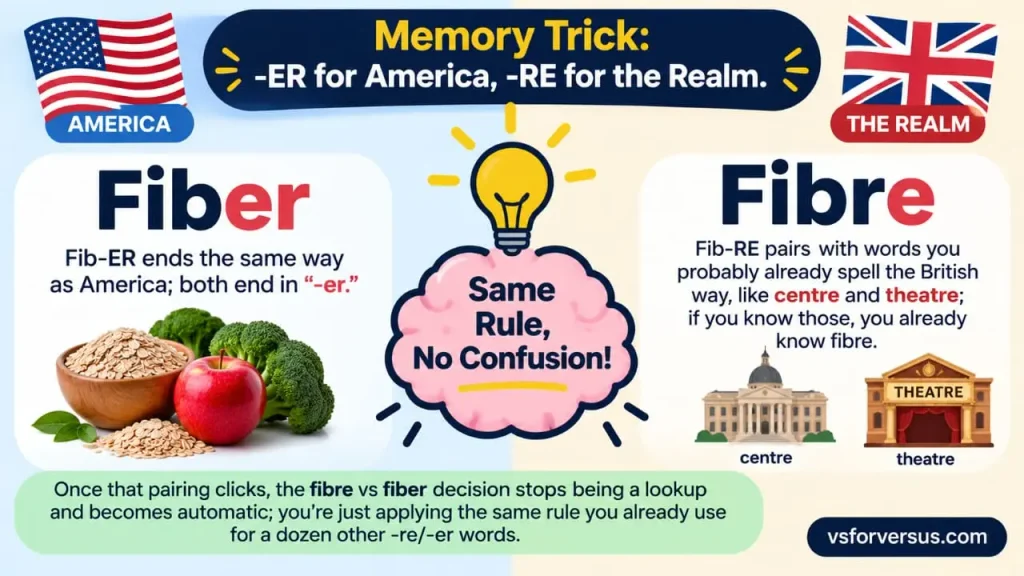
Here’s a two sided version that works for both spellings, not just the American one:
“ER for America, RE for the Realm.”
- FibER ends the same way as America; both end in “er.”
- FibRE pairs with words you probably already spell the British way, like centre and theatre; if you know those, you already know fibre.
Once that pairing clicks, the fibre vs fiber decision stops being a lookup and becomes automatic; you’re just applying the same rule you already use for a dozen other re/er words.
Common Mistakes with Fiber vs Fibre
| ❌ Common Mistake | ✅ Correct Usage |
| “This yogurt has lots of fibre” on a label printed for the US market | “This yogurt has lots of fiber”, match the spelling to the market |
| “It’s in our fibers” (idiomatic, figurative use) | “It’s in our fibre” or “it’s in our fiber”, the figurative sense is almost always singular |
| “Fiberous” | “Fibrous”, no regional split on this word |
| Switching spellings mid-document (fiber in paragraph one, fibre by paragraph four) | Pick one regional spelling and hold it consistently across the whole piece |
| Trusting spell-check to catch it | Spell-checkers default to whatever locale your device is set to, which is frequently US English by default, this is one of the most common reasons “fiber” ends up in UK-audience writing without anyone noticing |
One easy to miss detail: when people use the word figuratively, “it’s in our fibre to help others,” “honesty is in his fiber”, the noun is almost always singular. “In our fibers” reads as slightly off to most native speakers, even though the plural is grammatically defensible.
It’s a small distinction, but it’s exactly the kind of thing that trips up otherwise careful writers who’ve mastered the regional spelling split but never thought about the idiom separately.
The figurative sense describes an inherent quality, character, instinct, resolve, and English tends to treat those inherent qualities as a single, whole trait rather than a countable set of strands, which is why the singular sounds right even to people who couldn’t explain the grammar behind it.
Quick Reference: Which Spelling Should You Use?
| Writing for… | Use |
| A US resume, US company, or US nutrition label | Fiber |
| A UK dissertation, or a UK/Irish/Australian/Canadian audience | Fibre |
| International product marketing | Match the market you’re actually shipping to |
| A company with both US and UK offices | Set one house style and apply it consistently, rather than mixing within a single document |
Quick Quiz: Test Yourself
- Which spelling belongs on a UK dissertation, fiber or fibre?
- True or false: “fibrous” changes spelling between American and British English.
- Fill in the blank: “Kindness is in her “, singular or plural, fiber(s) or fibre(s)?
- Which spelling would a US cereal box use?
- Do “fiber” and “fibre” reflect a real difference in the word itself, or just accent and spelling convention?
If you got all five without hesitating, you’ve genuinely internalized the fibre vs fiber rule, not just memorized the table above. (Want a printable version to keep at your desk? A one page fiber vs fibre cheat sheet covering the table, the mnemonic, and the common mistakes above works well pinned next to a keyboard.)
FAQ: Fiber vs Fibre
Is fiber or fibre the correct spelling? Both are correct. “Fiber” is the American English spelling and “fibre” is the British English spelling; neither is more correct than the other; the right choice for any fibre vs fiber decision depends entirely on your audience’s regional convention.
How do you pronounce fibre? “Fibre” and “fiber” are pronounced almost identically. The only real variation is accent driven: American English pronounces the “r” sound, while British English typically doesn’t. The spelling itself doesn’t change how the word sounds.
Is “fibrous” spelled differently in UK vs US English? No. “Fibrous” keeps the same spelling on both sides of the Atlantic; only the base noun and its compounds (like “fiber optic/fibre optic”) follow the regional split.
Which spelling should international product packaging use? It depends on the primary market: “fiber” for US facing packaging, “fibre” for UK, Irish, Australian, or Canadian markets. Plenty of global brands default to “fiber” out of habit, even on UK adjacent products, which can read as a minor inconsistency to local shoppers.
Why does my spell checker keep changing fibre to fiber? Most spell checkers and browsers default to whatever English locale is set on the device, frequently US English by default, which is one of the most common reasons writers end up with the “wrong” regional spelling without ever consciously choosing it.
Checking your document language setting before you start writing (rather than after you spot the error) is the simplest fix, and it’s worth doing once per document template rather than trusting memory each time.
Is fiber replacing fibre in British usage over time? There’s some evidence that US spelling conventions are creeping into global digital content, largely due to US media and software defaults, but “fibre” remains the standard in formal UK, Irish, Australian, and Canadian writing. It’s a gradual influence, not an official shift in British style guides, so the fibre vs fiber distinction is still worth getting right today.
Final Thoughts
Fibre vs Fiber aren’t two different words; they’re the same word wearing two different regional outfits. Get the region right, keep it consistent across a single piece of writing, and the fibre vs fiber question stops being something you have to think about at all.
The mistake rarely comes from not knowing the rule; it comes from switching between templates, copying old copy into a new market, or trusting a spell checker set to the wrong locale. The fix is simple and takes less effort than the mistake does: check your document’s language setting before you start, keep one house style per audience, and hold that style consistently from the first line to the last.
The same logic carries over almost exactly to other US/UK spelling pairs, center/centre, theater/theatre, and the wider family of er/re words all follow the same “ER for America, RE for the Realm” pattern. Learn the rule once here, and you’ve effectively learned it for all of them.
To read more: Addenda vs Addendum: The Powerful Guide to the Correct Usage 2026