
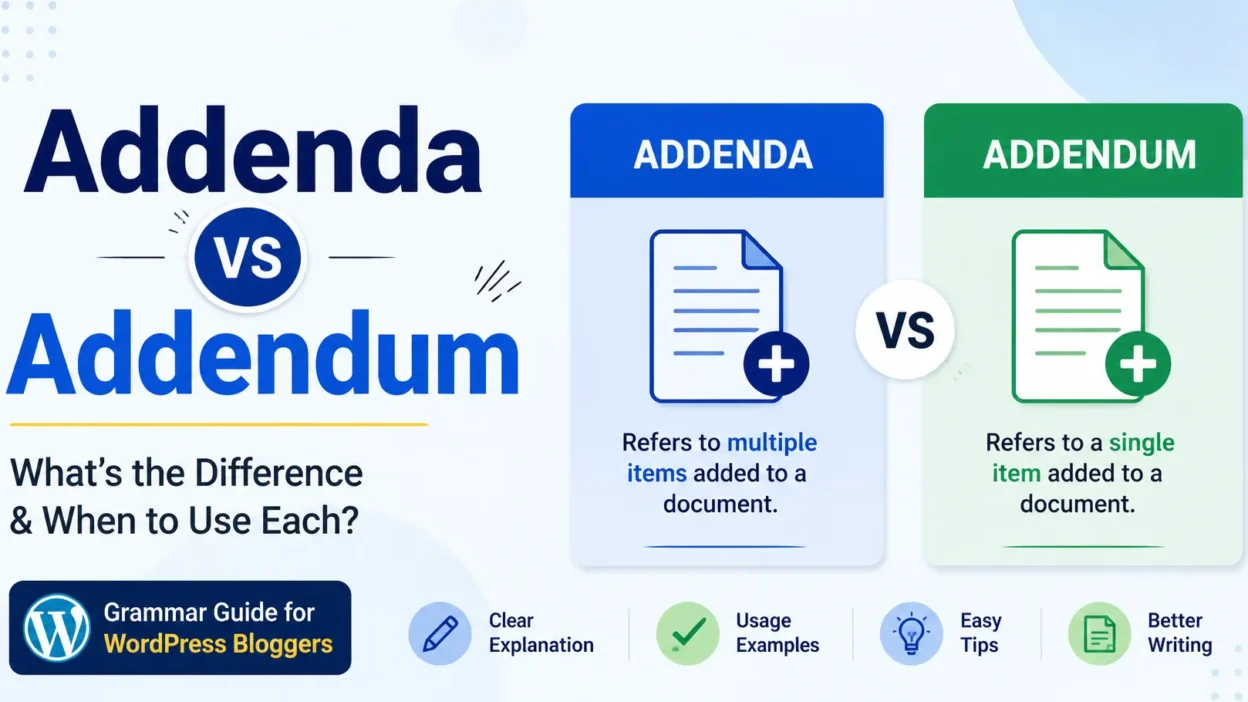
Addenda vs addendum is one of the most common word pair confusions in professional and academic English, and it comes down to a simple question: are you talking about one added item, or more than one? Addendum is the singular form. It means a single item, section, or clause added to something that already exists, whether that’s a contract, a book, a report, or an email.
Addenda is the plural form of that same word, used the moment you’re referring to two or more of these added items together, not just one. Both words share the same core meaning; the only real difference is quantity: one versus many. That single distinction is the entire addenda vs addendum question, and it’s also where most writers slip up, because English doesn’t usually pluralize a word this way.
Quick Answer
Addendum is the singular form, referring to one item or section added to a document. Addenda is the plural form, used when two or more items have been added. Both words come from the Latin verb addere (“to add”), which is why the plural doesn’t simply add an “s”; it follows the same
In modern usage, “addendums” is also accepted as an informal English plural, though addenda remains the preferred form in legal and academic writing.
Addenda vs Addendum at a Glance
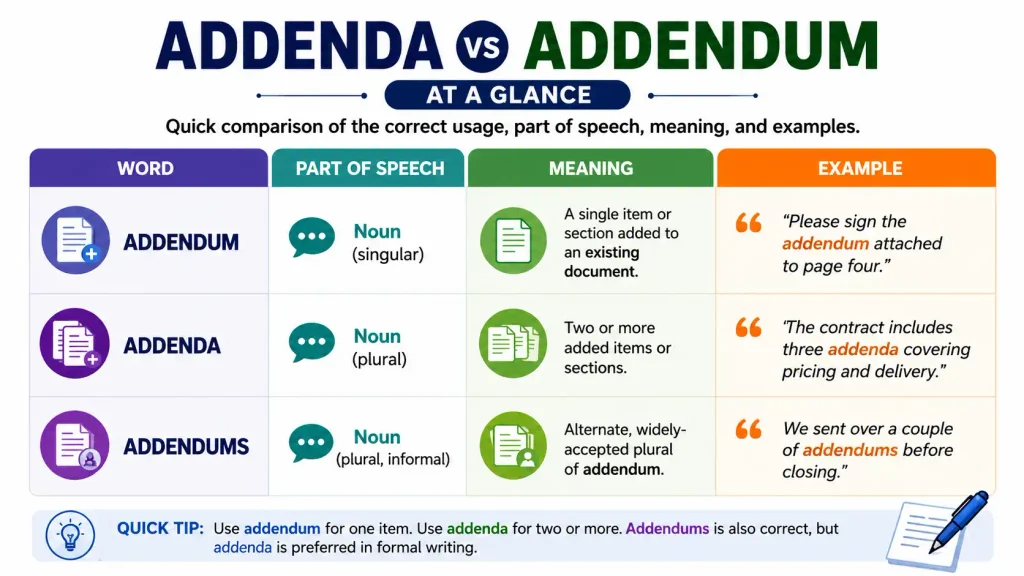
Before getting into definitions and examples, the core distinction looks like this:
| Word | Part of Speech | Meaning | Example |
| Addendum | Noun (singular) | A single item or section added to an existing document | “Please sign the addendum attached to page four.” |
| Addenda | Noun (plural) | Two or more added items or sections | “The contract includes three addenda covering pricing and delivery.” |
| Addendums | Noun (plural, informal) | Alternate, widely-accepted plural of addendum | “We sent over a couple of addendums before closing.” |
This table captures the heart of the addenda vs addendum question, but the nuances are worth walking through: when each form actually shows up in real writing, and why people keep tripping over it in the first place.
What Does “Addendum” Mean?
An addendum is a single supplementary item attached to something that already exists: a contract, a book, a report, an email thread. It adds new information without rewriting what came before it. The word entered English in the mid 1600s, borrowed almost unchanged from Latin, where it literally meant “a thing to be added.”
In real writing, it tends to look like this:
- “I’m attaching an addendum to the lease that covers the new pet policy; nothing else changes.”
- In a work email: “Quick addendum to my last message: the deadline moved to Friday, not Thursday.”
- In academic publishing: “The author included an addendum acknowledging a data source that was omitted from the original submission.”
- In real estate: “The seller’s addendum extends the closing date by two weeks.”
You’ll see addendum most often in contracts (a single clause added before signing), academic or published work (a short note correcting or expanding on something already printed), and everyday professional correspondence, where people use it almost like a formal version of “one more thing.”
What Does “Addenda” Mean?
Addenda is simply the plural of addendum, used the moment you’re referring to two or more of them. This is where a lot of people stumble, because English speakers are trained to add an “s” for plurals, and this word doesn’t follow that rule.
Real world examples:
- “The vendor agreement now has four addenda attached, one for each region we operate in.”
- In a construction bid: “Contractors should review all addenda issued before the bid deadline; ignoring even one can disqualify your submission.”
- In a thesis defense: “My advisor asked me to include addenda summarizing the datasets I collected after the initial draft.”
- In a business memo: “Legal sent over the addenda this morning; please confirm you’ve reviewed each one before the call.”
You’ll typically find addenda in more complex, high stakes documents: multi part contracts, construction bids, dense academic reports, where a single change wouldn’t cut it. One subtlety that trips up even experienced writers: because addenda refers to multiple items, it pairs with a plural verb.
“The addenda is attached” is incorrect; it should be “the addenda are attached.” I’ve seen this mistake in polished legal drafts from people who clearly know the addenda vs addendum distinction cold but still stumble on the verb agreement.
Key Differences Between Addenda and Addendum
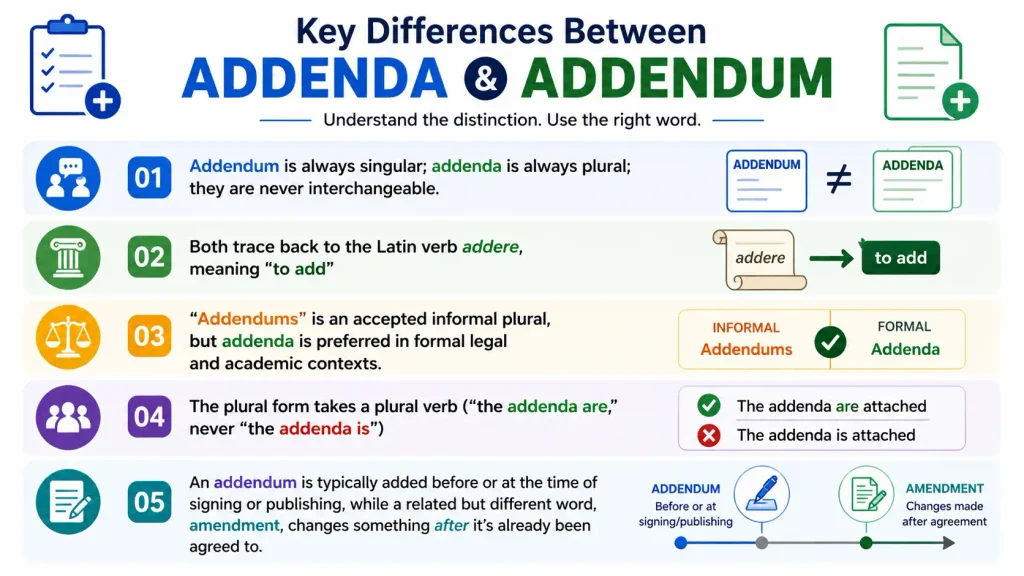
- Addendum is always singular; addenda is always plural; they are never interchangeable.
- Both trace back to the Latin verb addere, meaning “to add”
- “Addendums” is an accepted informal plural, but addenda is preferred in formal legal and academic contexts.
- The plural form takes a plural verb (“the addenda are,” never “the addenda is”)
- An addendum is typically added before or at the time of signing or publishing, while a related but different word, amendment, changes something after it’s already been agreed to
Addendum vs Amendment (The Real Confusion)
This is also where the addenda vs addendum conversation usually needs to widen a bit, because in practice, people confuse this pair with several neighboring terms, too.
| Term | What It Does | When It’s Used |
| Addendum / Addenda | Adds new information or terms | Before or at signing/publishing |
| Amendment | Changes or replaces existing terms | After signing |
| Corrigendum | Corrects an error in a published document | After publishing |
| Appendix / Exhibit | Supplies supporting or reference material | Alongside the original document |
A simple way to keep these straight: an addendum adds, an amendment changes, a corrigendum corrects, and an appendix supports. If you remember the timing (addenda arrive before the ink is dry; amendments arrive after), you’ll rarely mix these up again.
Where This Word Comes From (And Why the Plural Is Weird)
Addendum’s odd plural isn’t an English quirk; it’s inherited directly from Latin grammar. Words that end in um in Latin often become a in the plural, and English absorbed a whole family of these terms wholesale rather than anglicizing them:
- datum → data
- criterion → criteria
- phenomenon → phenomena
- memorandum → memoranda
- stratum → strata
Addendum simply joined that club. That inherited Latin plural is really the whole grammar story behind the addenda vs addendum question, not an arbitrary spelling rule. Common synonyms include supplement, attachment, and annex, though none of them carry addendum’s distinct singular/plural pattern.
Interestingly, some learners guess that addendum is a playful blend of “add,” “end,” and “um,” as if someone reached the end of a document and thought, “um, one more thing.” It’s a charming guess, and not entirely wrong in spirit (the word does mean “a thing to be added”), but the actual root is the Latin gerundive of addere, not an invented compound.
How to Pronounce Addenda vs Addendum
- Addendum: uh-DEN-dum
- Addenda: uh-DEN-duh
The difference is subtle: just the final syllable changes, which is part of why the two get blurred together in speech, even among people who know exactly which one they mean.
How to Remember the Difference
Here’s a memory trick that sticks: addendum has an “M,” just like “mono,” which means one. So addendum equals one thing added. Addenda, by contrast, ends the same way as words like several, extra, or data, all signals of “more than one.” Once that “M equals mono” link clicks, the addenda vs addendum distinction becomes almost automatic.
Common Mistakes to Avoid
| ❌ Wrong | ✅ Correct |
| “Please sign this addenda.” | “Please sign this addendum.” |
| “We have two addendum to review.” | “We have two addenda to review.” |
| “The addenda is attached.” | “The addenda are attached.” |
| “I need an addendae for this contract.” | “I need an addendum for this contract.” |
| “Addenda” and “agenda” mean the same thing. | Addenda is unrelated to agenda; don’t confuse the two. |
Quick Quiz: Addenda or Addendum?
Test what you’ve learned:
- “The contract has three ___ covering pricing and delivery.” (addendum/addenda)
- “Please sign the ___ before the closing meeting.” (addendum/addenda)
- “The ___ are all numbered sequentially.” (addendum/addenda)
- True or False: “Addendums” is always grammatically incorrect.
- Which word is singular, addendum or addenda?
(Answers: 1. addenda, 2. addendum, 3. addenda, 4. False, 5. addendum)
Frequently Asked Questions
What is the plural of addendum?
This is the classic addenda vs addendum question. The plural of addendum is addenda, following the Latin pattern of changing um to a. “Addendums” is also accepted in informal writing, but addenda is preferred in formal contexts.
Is “addendums” a real word?
Yes. While addenda is the traditional Latin plural, addendums has become common enough in everyday business and legal writing that most dictionaries and style guides now recognize it as a valid alternative.
Is addenda singular or plural?
Addenda is the plural form of addendum and always refers to two or more items. It pairs with a plural verb, as in “the addenda are attached.”
What is the difference between addendum and appendix?
An addendum adds new binding information to an existing document, while an appendix provides supplementary reference material that supports, rather than changes, the main text.
How do you use addendum in a sentence?
Use it when referring to a single added item, such as: “The landlord attached an addendum outlining the updated parking rules.”
What is the Latin origin of the word addendum?
Addendum comes from the Latin verb addere, meaning “to add.” It entered English in the mid 17th century largely unchanged, which explains its irregular Latin style plural.
Final Thought
At the end of the day, the addenda vs addendum confusion isn’t really about memorizing a spelling rule. It’s about understanding one simple idea: addendum means one added thing, addenda means more than one. Everything else in this article the Latin origin, the pronunciation, the memory trick, the comparison with amendment and appendix exists to support that one core fact.
Once you internalize that addendum carries the “M” of “mono” (one), and addenda belongs to the same family as data, criteria, and phenomena (all plural, all borrowed from Latin), you’ll stop needing to pause and second-guess yourself.
You’ll also start noticing this same um/a pattern in other words you already use, which makes the rule easier to remember precisely because it isn’t an isolated exception. It’s part of a small, recognizable group of English words that quietly kept their original Latin grammar.
To read more; Affectively vs Effectively: What’s the Difference? 2026