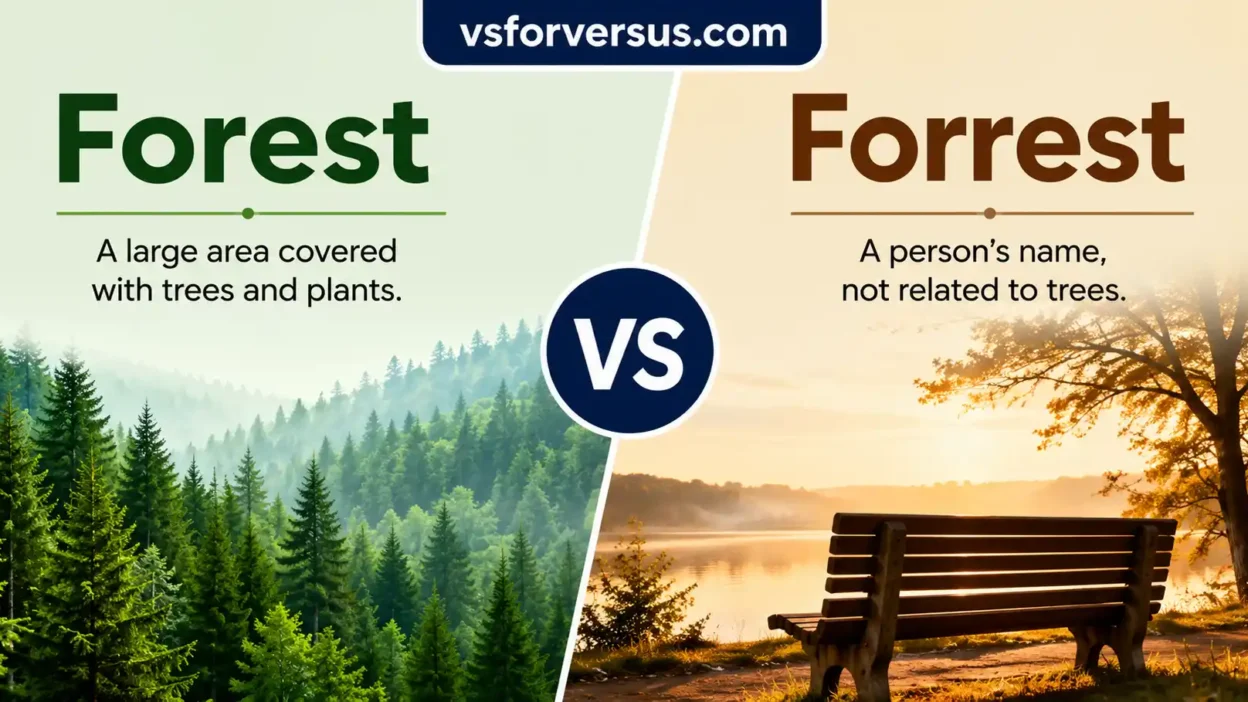
If you are confused about Forest vs Forrest, you are not alone because these two words look almost identical but have very different uses. Forest is a common noun that means a large area covered with trees and other vegetation. It is the correct word when you are talking about woodland or a natural area filled with trees.
Forrest, on the other hand, is not the standard spelling of the word for a wooded area. It is mainly used as a proper name, such as a person’s first or last name. Therefore, the key difference between Forest vs Forrest is their usage: forest describes a place, while Forrest is generally used as a name.
Quick Answer:
Forest vs Forrest comes down to one simple rule: Forest (one “r”) is the correct spelling for the noun meaning a large area covered with trees and vegetation. Forrest (two r’s) is a proper noun, a first or last name, as in Forrest Gump, the film character.
When writing about trees, nature, or wooded land, always choose forest. When referring to a person’s name, Forrest is the traditional spelling, though Forest also appears as an accepted name variant. That’s the entire forest vs forrest distinction in one paragraph.
Forest vs Forrest at a Glance
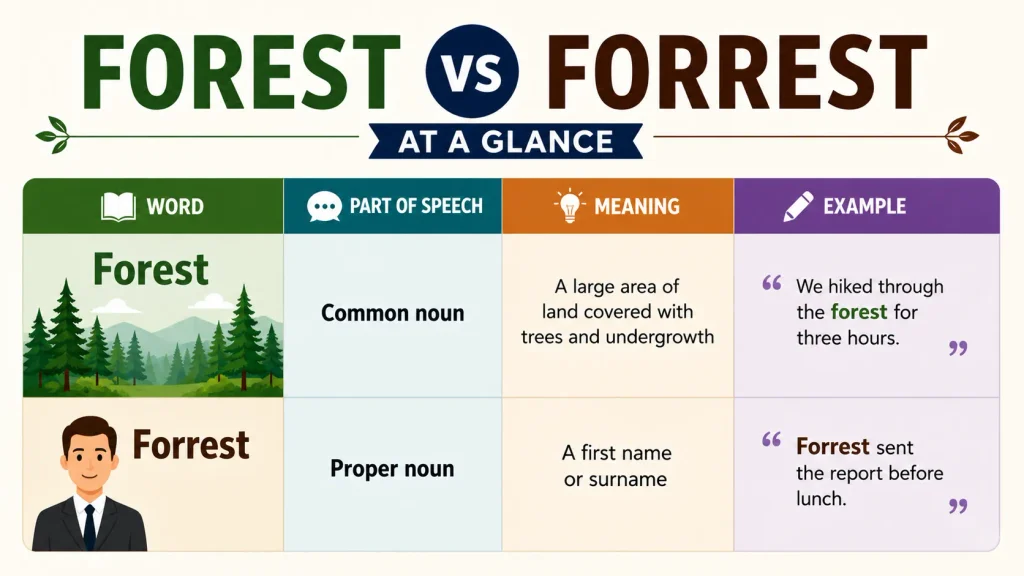
| Word | Part of Speech | Meaning | Example |
| Forest | Common noun | A large area of land covered with trees and undergrowth | “We hiked through the forest for three hours.” |
| Forrest | Proper noun | A first name or surname | “Forrest sent the report before lunch.” |
This table captures the entire forest vs forrest debate at a glance: one word describes a place, the other identifies a person. Everything else in this guide just fills in the details.
What Does “Forest” Mean?
Forest is a common noun referring to a dense, extensive area of trees, undergrowth, and wildlife. It comes from the Latin foris, meaning “outside,” by way of Old French, originally describing land outside cultivated settlements before it settled into its modern meaning.
You’ll see it everywhere, from casual conversation to formal environmental reports:
- “The kids got lost in the forest behind the campsite for a solid ten minutes, which felt like ten years.”
- “Deforestation in the Amazon rainforest has accelerated faster than most models predicted.”
- “Our marketing deck used the phrase ‘a forest of competitors’ to describe the crowded market.”
- “The national forest closes to visitors during peak wildfire season.”
Notice that last metaphorical use, “a forest of skyscrapers” or “a forest of paperwork”, where the word stretches beyond literal trees to describe density or overwhelming quantity. That flexibility is part of why “forest” shows up so often in professional and academic writing, not just nature essays.
If you’re searching for alternatives, common forest synonyms include woods, woodland, grove, and timberland, though each carries a slightly different shade of meaning. “Woods” tends to suggest a smaller, sparser area than a forest, while “woodland” leans more descriptive than dramatic. Knowing these substitutes is a useful trick if you’re ever unsure how to spell “forest” mid sentence and want a safe workaround.
Common contexts where “forest” appears: environmental journalism, travel writing, school essays, business jargon (metaphorical use), casual texts about hiking or camping.
What Does “Forrest” Mean?
Forrest, with two r’s, is a proper noun. It functions almost exclusively as a first name or surname, and its origin likely traces back to an occupational surname: someone who worked as a forest keeper or lived near wooded land eventually took “Forrest” as a family name.
Real world usage looks like this:
- “Forrest Gump remains one of the most quoted films of the 1990s.”
- “Please loop in Forrest before finalizing the client proposal.”
- “My grandfather, Forrest, taught me how to fish when I was seven.”
- “Nathan Bedford Forrest is a controversial figure in American Civil War history.”
Common contexts where “Forrest” appears: personal introductions, professional emails and bios, pop culture references, and, as we’ll get into, baby naming decisions.
Forest or Forrest, Naming Your Child? Here’s the Real Difference
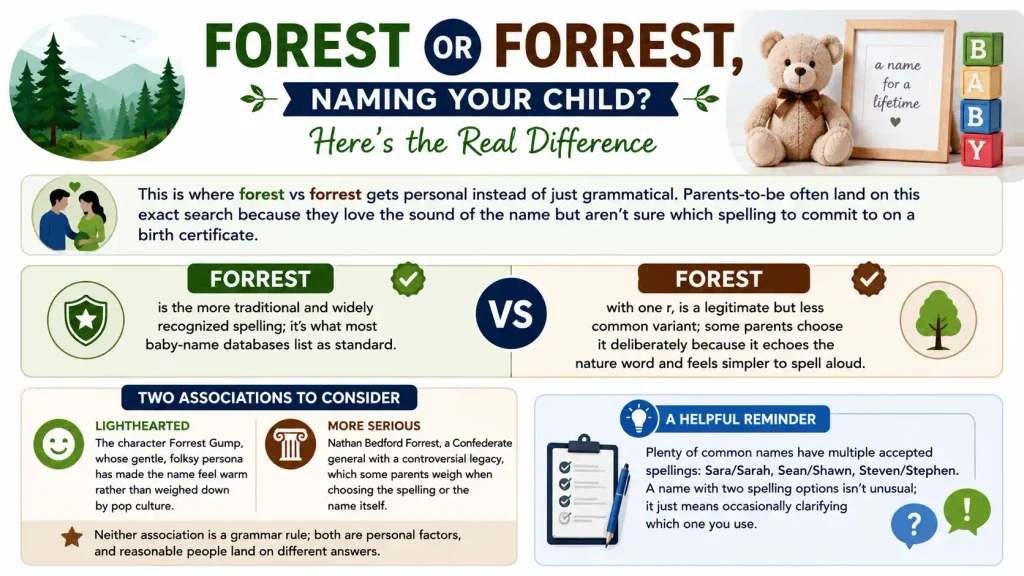
This is where forest vs forrest gets personal instead of just grammatical. Parents to be often land on this exact search because they love the sound of the name but aren’t sure which spelling to commit to on a birth certificate.
Both spellings are valid names. Forrest is the more traditional and widely recognized spelling; it’s what most baby name databases list as standard. Forest, with one r, is a legitimate but less common variant; some parents choose it deliberately because it echoes the nature word and feels simpler to spell aloud.
Two associations tend to come up in these conversations. One is lighthearted: the character Forrest Gump, whose gentle, folksy persona has made the name feel warm rather than weighed down by pop culture. The other is more serious: Nathan Bedford Forrest, a Confederate general with a controversial legacy, which some parents weigh when choosing the spelling or the name itself.
Neither association is a grammar rule; both are personal factors, and reasonable people land on different answers.
If it helps, remember that plenty of common names have multiple accepted spellings: Sara/Sarah, Sean/Shawn, Steven/Stephen. A name with two spelling options isn’t unusual; it just means occasionally clarifying which one you use.
Key Differences Between Forest and Forrest
- Spelling: Forest has one “r.” Forrest has two.
- Part of speech: Forest is a common noun. Forrest is a proper noun.
- Capitalization: Forest is only capitalized as part of a specific name, like “Sherwood Forest.” Forrest is always capitalized, since it’s a name.
- Meaning: Forest refers to trees and wooded land. Forrest refers to a person.
- Plural form: More than one forest is “forests”, never “forrests,” since Forrest doesn’t pluralize as a name.
- Pronunciation: Identical. Both words sound the same when spoken aloud, which is precisely why the spelling trips people up so often, and why autocorrect rarely catches the error.
Memory Trick: How to Remember Forest vs Forrest
Here’s the trick I give students who keep second guessing themselves: Forest has one “r” for one row of trees. Forrest has two r’s because it takes two names, first and last, to make a person.
If that doesn’t stick, try anchoring it to the movie: picture Tom Hanks on the park bench. You’re picturing a person, not a place, and a person gets the double letter. Once you associate “two r’s” with “somebody’s name,” the confusion tends to resolve itself permanently.
Common Mistakes With Forest and Forrest
Even experienced writers slip up on forest vs forrest occasionally, usually while typing quickly or trusting spell check too much. In practice, the errors look like this:
| ❌ Incorrect | ✅ Correct |
| We got lost in the forrest during our hike. | We got lost in the forest during our hike. |
| The Amazon forrest loses thousands of acres yearly. | The Amazon forest loses thousands of acres yearly. |
| I’m heading to the National Forrest this weekend. | I’m heading to the National Forest this weekend. |
| Forest Gump is quoted in half our team meetings. | Forrest Gump is quoted in half our team meetings. |
| There are two forrests near my hometown. | There are two forests near my hometown. |
The reason these slip through isn’t carelessness; it’s that “Forrest” is a genuine dictionary recognized word, so most spell checkers won’t flag it as an error. That’s exactly what happened to Sarah’s thesis: six instances of “forrest,” and not one red squiggly line.
It’s a mistake common enough among ESL writers and native speakers alike that it deserves its own mental flag whenever trees or nature come up in your writing.
Quick Quiz: Forest or Forrest?
Test yourself before moving on:
- We spent the weekend hiking through the ______.
- ______ Gump ran across the entire country, twice.
- The plural of “forest” is: (a) forrests (b) forests.
- My coworker’s name is spelled ______, with two r’s.
- True or False: “Forest” and “Forrest” are pronounced differently.
Answers: 1. forest, 2. Forrest, 3. b, 4. Forrest, 5. False
FAQs About Forest vs Forrest
Is it spelled “forest” or “forrest”?
“Forest,” with one r, is correct for the word describing a large wooded area. “Forrest,” with two r’s, is correct only when referring to a person’s name.
Why does Forrest Gump have two r’s in his name?
Forrest Gump, the film character, simply uses the traditional name spelling, “Forrest”, which is unrelated to the spelling rule for the nature word “forest.”
Is “Forrest” ever used as a common noun?
No. In standard English, “Forrest” never describes trees, land, or nature; that meaning always belongs to “forest.”
What’s the plural of forest, forests or forrests?
Always “forests.” Since “Forrest” functions as a proper noun rather than a describable quantity, it has no plural form in this context.
Should I spell my child’s name, Forest or Forrest?
Either is valid. “Forrest” is the more traditional and common spelling for the name, while “Forest” is a legitimate, if less frequent, alternative.
Are forest and forrest pronounced differently?
No, they’re pronounced identically. The entire forest vs forrest distinction lives in the spelling and the meaning behind it, not in how the word sounds out loud.
The Bottom Line: Forest vs Forrest
The forest vs forrest question stops being confusing the moment you separate the two by function: one names a place, the other names a person. Trust forest for anything involving trees, nature, or wooded land, and save Forrest for people.
Whenever you’re stuck mid-sentence deciding between forest and forrest, run it through a grammar checker, but don’t rely on it entirely. As Sarah’s thesis proved, “Forrest” is a word spell check is often happy to leave alone. Master this one rule, and you’ll never lose a point over forest vs forrest again.
To read more: “Fibre vs Fiber: Simple Guide to Correct Spelling”2026