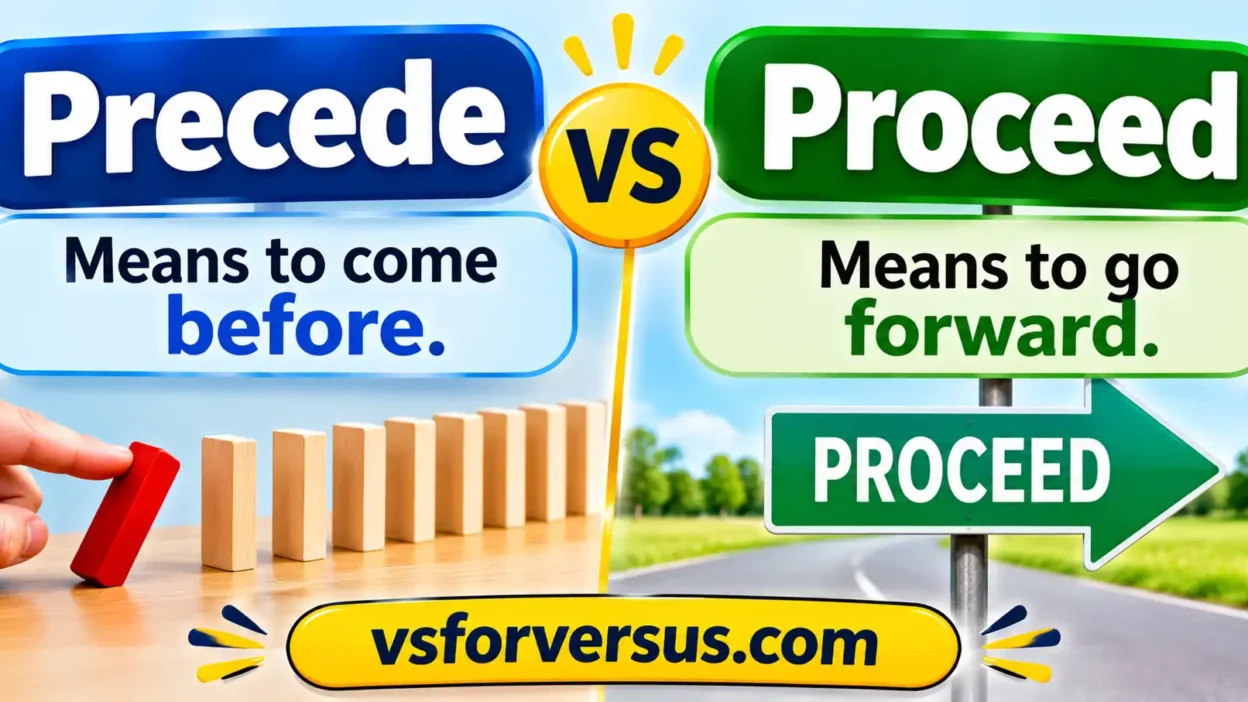
Precede vs Proceed is a pair of lookalike verbs that even confident writers swap by accident, since they differ by only a couple of letters and a slight shift in sound. Both involve movement or order, yet they point in different directions.
Precede means to come before something in time, order, or position, as in “the introduction precedes the main chapters.” Proceed, on the other hand, means to move forward or continue with an action, as in “please proceed to the exit.” Because spellcheckers accept both, the mistake often slips into emails, reports, and legal documents unnoticed.
In this guide, you’ll learn the correct usage of each word, the related noun forms, common mistakes to avoid, and clear examples that make the right choice easy every time.
Quick Answer:
Precede means to come before something in time, order, or rank, while proceed means to go forward or continue. To tell precede vs proceed apart, use the prefixes: “pre ” means before, and “pro ” means forward. For example, a short toast precedes dinner, and then the guests proceed to the dining room.
Precede vs Proceed at a Glance
The short version lives in the table below. Bookmark it for the next time you hesitate over an email.

| Word | Part of Speech | Meaning | Example |
| precede | verb (usually transitive) | to come before in time, order, or rank | A short speech will precede the dinner. |
| proceed | verb (usually intransitive) | to go forward or continue | Please proceed to the gate. |
| proceeds | noun (plural) | money earned from a sale or event | The proceeds went to charity. |
| proceedings | noun (plural) | an event, or formal legal or official action | The proceedings began at nine. |
What Does “Precede” Mean?
To precede is to come before something else. Usually the “before” is about time: the thing that happens first precedes the thing that happens second. It can also be about position in a document or list and, more rarely, about rank, such as who walks in first at a formal ceremony.
In ordinary writing, precede sounds like this:
- The foreword precedes chapter one, so most people skip straight past it.
- A week of heavy rain preceded the flood, and nobody in the village was surprised.
- In our style guide, the author’s name precedes the date in every citation.
- Her reputation preceded her, and by the time she walked into the interview, the panel had read three glowing references.
Where you will see it: timelines, cause and effect explanations, and references to earlier text (“the preceding paragraph”).
Grammar note: precede takes an object. Write “A precedes B,” or flip it into the passive: “B is preceded by A.” For example, “The keynote was preceded by a brief video.” The adjective form is preceding, as in “the preceding section.”
What Does “Proceed” Mean?
To proceed is to go forward or carry on, often after a pause, a decision, or a green light. Think of it as the word for “go ahead.”
- Once legal signs off, we’ll proceed with the launch.
- Please proceed to gate 14; boarding starts in ten minutes.
- I’d proceed with caution on that one, because the numbers don’t quite add up.
- After a short break, the meeting proceeded as if nothing had happened.
Where you will see it: instructions, signs, workplace emails, and any message that permits you to continue.
Grammar note: proceed is usually intransitive, meaning it has no direct object. It is typically followed by with plus a noun (“proceed with the plan”) or to plus a noun or verb (“proceed to the next step,” “proceed to explain”).
Key Differences Between Precede vs Proceed
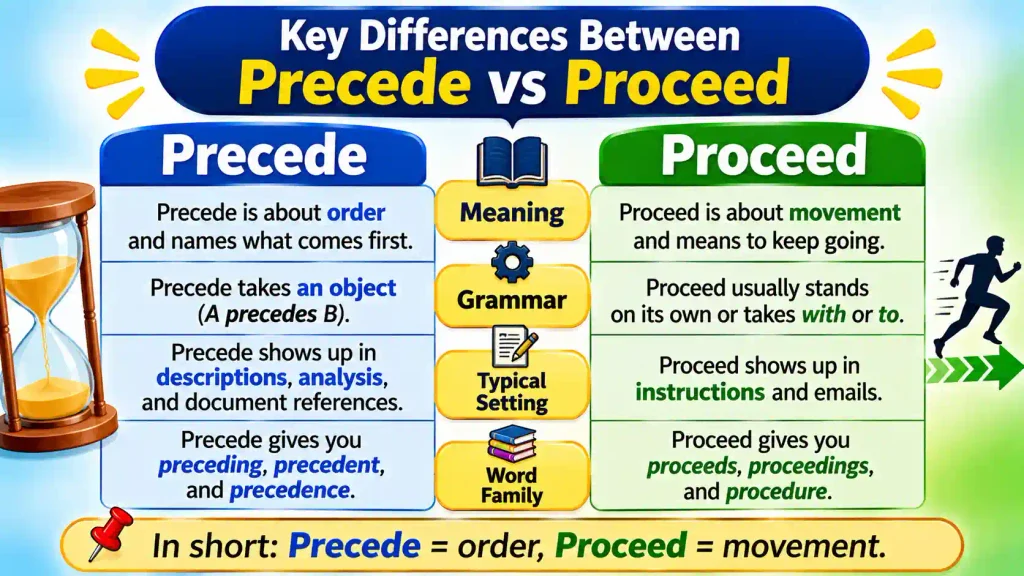
At the core of precede vs proceed is a split between order and movement, and it holds even when you flip the pair into proceed vs precede.
- Meaning: precede is about order and names what comes first. Proceed is about movement and means to keep going.
- Grammar: precede takes an object (A precedes B). Proceed usually stands on its own or takes with or to.
- Typical setting: proceed shows up in instructions and emails. Precede shows up in descriptions, analysis, and document references.
- Word family: precede gives you preceding, precedent, and precedence. Proceed gives you proceeds, proceedings, and procedure.
Verb Forms and Tenses
Both are regular verbs, so the forms are predictable.
| Base form | Third person | Past tense | ing form |
| precede | precedes | preceded | preceding |
| proceed | proceeds | proceeded | proceeding |
Two details are worth knowing. First, preceding is also a common adjective (“the preceding paragraph”). Second, proceeds is both a verb form (“she proceeds to the stage”) and a plural noun meaning money raised (“the proceeds went to charity”). Context tells you which one you are reading.
Using Both Words in One Sentence
Putting both words side by side is the fastest way to see precede vs proceed in action. Each one does a separate job:
- The welcome speech will precede the awards, and then we’ll proceed to the buffet.
- Once the introduction that precedes the data table is approved, you can proceed with the analysis.
In each sentence, the first verb names what comes first, and the second names the action that moves things along. Tell those two jobs apart, and you already understand the whole pair.
Common Phrases You Will Actually See
Words tend to travel in familiar company, and these collocations are worth recognizing on sight.
With precede: the preceding paragraph, the events that preceded the war, a reputation that precedes you, a toast that precedes the meal.
With proceed: proceed with caution, proceed to checkout, proceed with the plan, proceed as planned, proceed to the next step.
Words With a Similar Meaning
Sometimes a synonym is cleaner than either verb.
Near synonyms for precede: come before, go ahead of, come first, lead. Use lead with care: it fits people or things physically going in front (“police cars led the procession”), not order in time.
Near synonyms for proceed: continue, go ahead, carry on, move on, advance.
Opposites: the opposite of precede is follow, since something that follows comes after. The opposite of proceed is closer to stop, pause, or halt.
Where the Mix Up Costs You Most
The error is small, but the setting decides how much it matters.
Workplace email. Instructions are the classic trouble spot. People write them in a hurry, the “go ahead” instinct reaches for the wrong word, and the message goes out before anyone rereads it. Look twice at any sentence that grants permission to continue.
Academic and research writing. Papers describe sequence constantly: which event came first, which step followed. A line such as “Chronic stress may precede the onset of depression” is a claim about order, and the wrong verb either changes the claim or breaks the sentence.
Legal and financial writing. Here the whole word family is in play: court proceedings, the proceeds of a sale, an earlier precedent. Each word has its own job, and in a formal document the wrong one looks careless just when you want to look precise. If you edit in a formal register, give this pair a second look before anything is signed.
How to Remember the Difference?
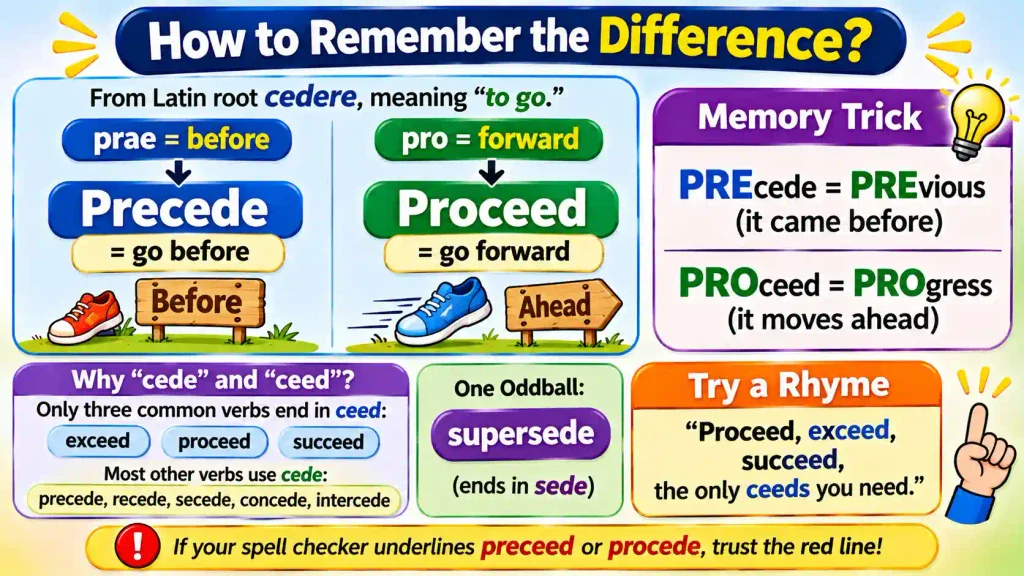
Both words are built on the same Latin root, cedere, which meant “to go.” The prefix sets the direction: prae meant before, and pro meant forward. So precede is literally “go before,” and proceed is “go forward.” Etymonline traces precede to the Latin praecedere, “to go before,” which matches that breakdown.
That gives you a memory trick short enough to run through your head mid email:
- PREcede = PREvious (it came before)
- PROceed = PROgress (it moves ahead)
This is the real answer behind precede vs proceed, and it works when you have two seconds to decide.
Why ” cede” in one and ” ceed” in the other?
The prefixes explain the meanings, but not the spellings. That part is a rule to memorize. Only three common English verbs end in ceed: exceed, proceed, and succeed. Nearly every other verb with that ending sound uses cede: precede, recede, secede, concede, intercede.
There is one more oddball: supersede, the only English word that ends in sede. With a pattern this lumpy, repetition beats logic.
Try a rhyme: “Proceed, exceed, succeed, the only ceeds you need.” If your spell checker underlines preceed or procede, trust the red line.
Common Mistakes (Wrong vs Correct)
| Context | ✗ Wrong | ✓ Correct |
| Business email | Once the contract is signed, please precede with onboarding. | Once the contract is signed, please proceed with onboarding. |
| Academic essay | The treaty preceded the war by only two years. | The treaty preceded the war by only two years. |
| Formal / fundraising message | All proceeds from the gala will go to the scholarship fund. | All proceeds from the gala will go to the scholarship fund. |
| Social media | The calm that preceded the storm was honestly eerie. | The calm that preceded the storm was honestly eerie. |
| Spelling errors | preceed, procede | precede, proceed |
| Report (pichle pages ka reference) | See the proceeding paragraph for details. | See the preceding paragraph for details. |
That last pair is where even experienced writers slip. Proceeding is a real word, so spell check waves it through, and a tired eye reads it as fine. Nothing flags the mistake, so it survives. When a sentence points backward at earlier material, stop and ask whether the word should mean “came before.”

Quick Quiz: Precede or Proceed?
Test yourself before you scroll on. Fill in each blank with precedes, proceed, proceeds, or preceding. One word is used twice.
- A short warm up act ______ the headliner at most concerts.
- You may ______ to the next room once the light turns green.
- The ______ from the bake sale went to the animal shelter.
- Please reread the ______ paragraph before you reply.
- Lightning usually ______ thunder.
Answers
- precedes: the warm up comes before the headliner.
- proceed: the light permits to go forward.
- proceeds: a plural noun meaning money raised.
- preceding: the adjective for the paragraph that came before.
- precedes: lightning arrives first, then thunder.
Related Words Worth Knowing
Several nearby words cause their own confusion, so it helps to know where each belongs.
- Precedent is a noun for an earlier case or example that guides a later decision. Its close cousin precedence means priority.
- Proceeds is a plural noun for money raised. Mind the stress shift: the verb proceed is said pro SEED, but the noun proceeds is said PRO seeds.
- Procedure comes from the same family as proceed and means an established way of doing something.
Frequently Asked Questions
What is the difference between precede and proceed? Precede means to come before something in time, order, or rank. Proceed means to go forward or continue. A simple way to hold precede vs proceed in your head is order versus movement: precede names what comes first, and proceed keeps things moving.
How do you remember precede vs proceed? Use the prefixes. PRE means before, so precede means to come before. PRO means forward, so proceed means to go forward. A shortcut: PREcede is PREvious, and PROceed is PROgress.
Does precede mean before or after? Precede means before. To precede something is to come ahead of it in time, order, or position. The opposite is follow: “A precedes B” and “B follows A” describe the same order.
Is it “proceed” or “procede”? It is proceed, spelled with a double e: ceed. The same goes for exceed and succeed. The word precede, by contrast, uses cede. Spellings such as procede and preceed are errors.
Why are precede and proceed spelled differently? Both come from the Latin cedere, meaning “to go,” but English settled on different endings. Proceed, exceed, and succeed use ceed, while precede and most similar verbs use cede. The prefixes explain the meanings, not the spellings.
Can precede and proceed be used interchangeably? No. They have different meanings and different grammar. Precede means to come before and takes an object. Proceed means to continue and usually does not take an object. Swapping them either changes your meaning or leaves the sentence confusing.
What is the noun form of proceed? The noun is proceeds, meaning money raised from a sale or event, and it is always plural. A related noun, proceedings, covers official or legal events, and a single legal action is a proceeding.
What does “proceed with” mean? “Proceed with” means to continue with something or go ahead with it. “Let’s proceed with the plan” means “let’s carry on with the plan.”
Final Thoughts
Precede vs Proceed: in grammar confusions fade once you stop memorizing and start asking one question. Here, the question is whether the sentence is about order or movement. If one thing simply comes first, reach for precede. If someone or something is moving ahead, reach for proceed.
Keep three habits close: read the prefix, trust the ceed spelling rule, and slow down whenever a sentence points back at earlier material. Do that, and the precede vs proceed choice stops being a coin flip. The next time you write a “please proceed” email, you will know the word is right.
To read more: Onsite vs On-Site: Which Is Ultimate Correct?2026

Elena covers lifestyle and consumer comparisons — everything from mattresses to meal kits — drawing on a background in market research. She’s known for digging past marketing copy to find the one detail that actually decides a purchase, and for admitting when two options are basically a coin flip.