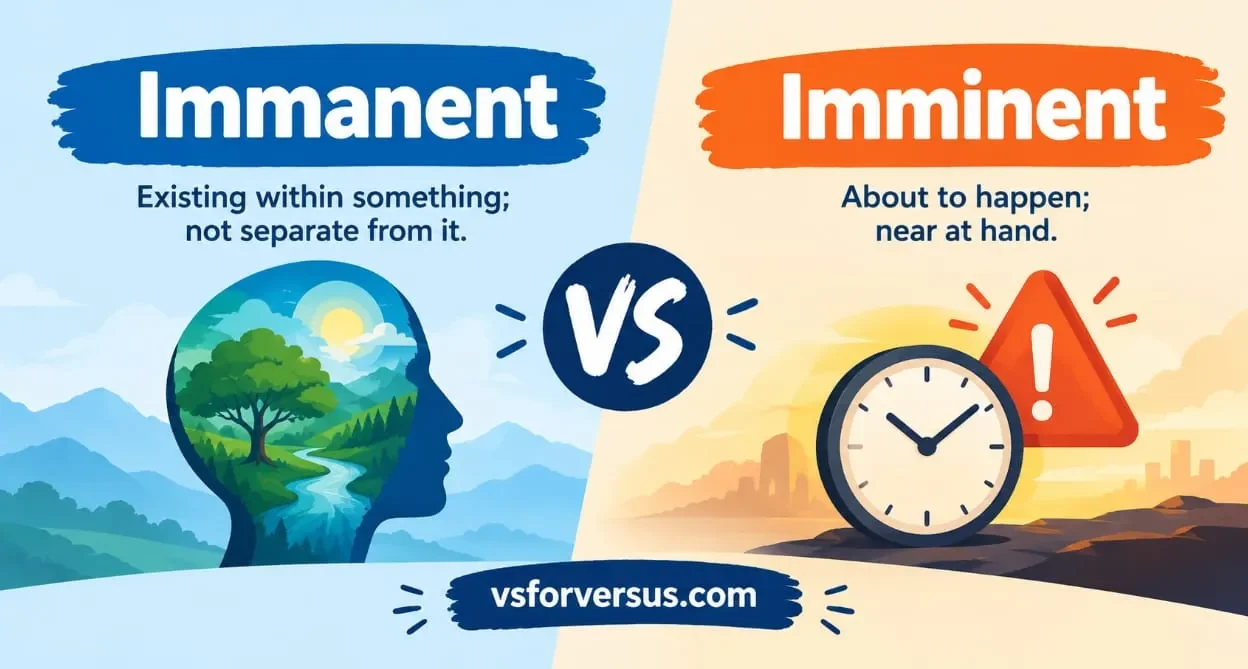
Language is full of word pairs that look deceptively similar yet diverge sharply in meaning, and “immanent” vs “imminent” is a classic case. “Immanent” is a philosophical and theological term describing something that exists within or is inherent to a system, nature, or being, for instance, the belief that the divine is immanent throughout the universe rather than existing outside it.
“Imminent,” by contrast, is purely about time: it describes something about to happen, often used to signal an approaching danger, event, or decision. Despite their similar spelling, confusing these two can completely change the meaning of a sentence, making careful usage essential for clear and accurate academic or formal writing.
Quick Answer
Imminent means about to happen very soon; the word is about timing. Immanent means existing within or inherent in something; the word is about presence, not time. A storm that’s about to hit is imminent. A trait built into someone’s character, by contrast, is immanent.
The two words are pronounced almost identically in standard English, which is the real reason the immanent vs imminent confusion is so common.
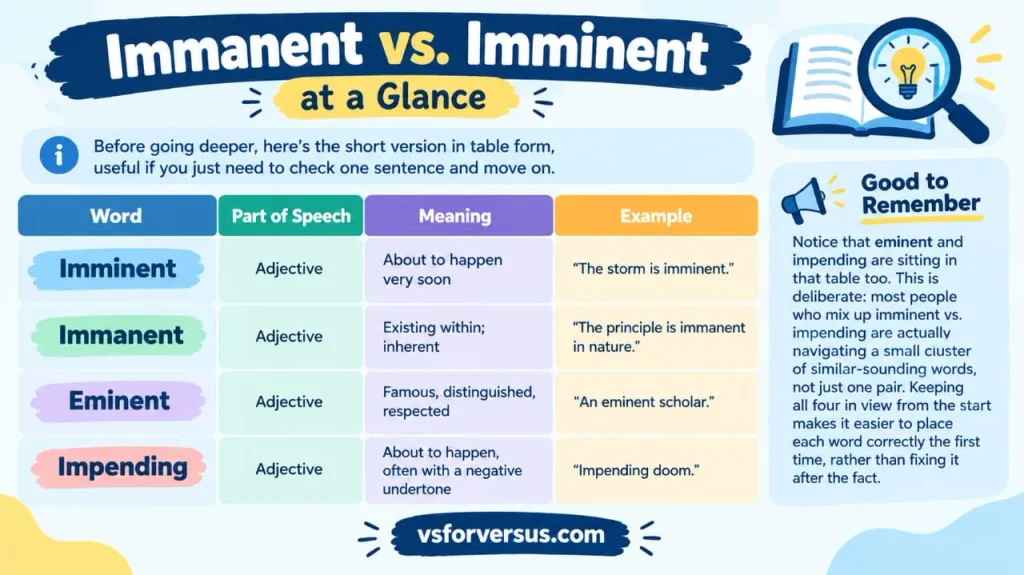
Immanent vs Imminent at a Glance
Before going deeper, here’s the short version in table form, useful if you just need to check one sentence and move on.
| Word | Part of Speech | Meaning | Example |
| Imminent | Adjective | About to happen very soon | “The storm is imminent.” |
| Immanent | Adjective | Existing within; inherent | “The principle is immanent in nature.” |
| Eminent | Adjective | Famous, distinguished, respected | “An eminent scholar.” |
| Impending | Adjective | About to happen, often with a negative undertone | “Impending doom.” |
Notice that eminent and impending are sitting in that table too. This is deliberate: most people who mix up imminent vs impending are actually navigating a small cluster of similar sounding words, not just one pair. Keeping all four in view from the start makes it easier to place each word correctly the first time, rather than fixing it after the fact.
What Does “Imminent” Mean?
Imminent describes something that hasn’t happened yet but is expected very soon. Its etymology traces back to the Latin verb imminere, meaning “to overhang” or “to project”; picture something hanging just above you, about to drop. The image still shapes how the word feels today: close, pressing, almost here.
Imminent shows up constantly in ordinary writing, and it isn’t limited to bad news. A few realistic examples:
- “Forecasters warned residents that flash flooding was imminent along the river.”
- “The board expects to announce the merger within days; it’s imminent at this point.”
- “Legal counsel flagged an imminent compliance deadline that nobody had put on the calendar.”
- “With her due date imminent, she’d already packed the hospital bag twice.”
You’ll see imminent most often in news reporting, business updates, legal and safety language, and everyday deadline talk. It’s a word people actually use in speech and casual writing, not just formal prose; you don’t need a philosophy degree to reach for it correctly.
What Does “Immanent” Mean?
Immanent means existing within something as a natural, built in part of it; inherent, indwelling, present throughout. Its Latin root, immanere, means “to remain within” or “to dwell in,” which is the opposite direction of imminent’s “hanging over.” Where imminent looks forward in time, immanent looks inward, toward presence.
Philosophy, theology, and academic or literary criticism are where immanent shows up most:
- “The professor argued that a sense of justice is immanent in human nature, not something we learn from scratch.”
- “In that theological tradition, the divine is described as immanent in creation rather than separate from it.”
- “The critic suggested that the novel’s tension is immanent in its structure, not just its plot.”
- “Some economists treat instability as immanent in unregulated markets.”
Immanent is a real, useful word, but it’s rare in everyday conversation. If you’re writing for a general audience, a plainer word often serves you better. “Trust is immanent in healthy teams” is grammatically fine, but “Trust is inherent in healthy teams” reads more naturally to most readers and won’t send anyone reaching for a dictionary mid sentence.
Key Differences Between Imminent vs Immanent
Strip away the philosophy class examples, and the immanent vs imminent divide comes down to a handful of practical checks:
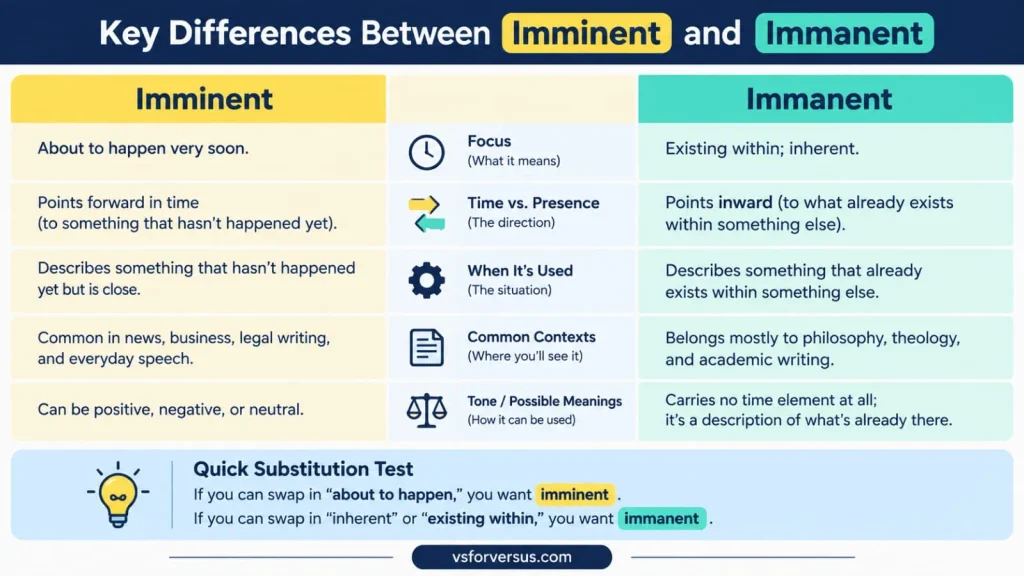
- Imminent is about time. Immanent is about presence. One points forward, the other points inward.
- Imminent describes something that hasn’t happened yet but is close. Immanent describes something that already exists within something else.
- Imminent is common in news, business, legal writing, and everyday speech. Immanent belongs mostly to philosophy, theology, and academic writing.
- Imminent can be positive, negative, or neutral. Immanent carries no time element at all; it’s a description of what’s already there.
- Quick substitution test: if you can swap in “about to happen,” you want imminent. If you can swap in “inherent” or “existing within,” you want immanent.
The Wider Confusion Cluster: Eminent and Impending
If you’ve only ever worried about immanent vs imminent, it’s worth widening the lens slightly, because these two rarely travel alone in people’s minds.
Eminent has nothing to do with time or presence; it means famous, distinguished, or highly regarded, as in “an eminent physicist” or “an eminent judge.” It sounds close enough to the other two that it regularly joins the confusion.
If that pair trips you up on its own, our eminent vs imminent guide breaks it down separately. The word also turns up in the legal phrase “eminent domain,” describing a government’s power to claim private property.
Impending overlaps closely with imminent; both mean “about to happen”, but impending almost always carries a heavier, more ominous tone. “An impending storm” and “an imminent storm” both work, but “impending doom” sounds natural in a way “imminent doom” doesn’t quite match.
If your sentence involves dread, disaster, or looming trouble, impending often fits the mood better than the more neutral imminent.
A fast reset for all four:
- eminent = famous
- imminent = soon (neutral)
- impending = soon (ominous)
- immanent = within
Memory Tricks to Remember Imminent vs Immanent
A couple of simple mnemonic anchors go a long way here:
Imminent → immediate. Both start with “immi,” and both point toward something close in time. If a decision, deadline, or storm feels immediate, it’s imminent.
Immanent → “man” is IN it. Literally, the letters m-a-n sit inside i-m-m-a-n-e-n-t. Since humankind is said to have certain immanent (inherent) traits, the buried “man” doubles as a reminder that this word is about something built in, not something arriving.
If you prefer a visual picture: imagine imminent as an arrow flying toward a clock, and immanent as a small circle nested inside a larger one. One approaches from outside; the other already lives inside.
Why Even Careful Writers Mix This Up
Here’s something worth saying plainly: this isn’t a beginner’s mistake. Professional editors, published authors on “immanent” vs “imminent”, and lifelong native speakers slip on immanent vs imminent more often than you’d expect, and there’s a real reason why.
Start with pronunciation: the two words “immanent” vs “imminent” the sound is almost identical in standard English, so spellcheck won’t catch the swap; both are valid words. This is a classic case of near homophones doing the damage, not a grammar failure. Then there’s frequency. Immanent is genuinely rare.
Most readers go years without encountering it outside a philosophy class or a theology text, so when it’s time to write it, the far more familiar “imminent” is what the brain reaches for automatically. And as the cluster above shows, you’re not really choosing between two words; you’re navigating four similar sounding ones at once.
Given all that, the mix up says less about someone’s grammar skills and more about how English handles near homophones. A sharp copyeditor under deadline pressure can still let one slip through, because the eye sees the familiar word first. It isn’t a character flaw. It’s just how pattern recognition works when two spellings sound the same.
Common Mistakes With Imminent vs Immanent
| ❌ Wrong | ✅ Correct |
| The deadline is immanent. | The deadline is imminent. |
| A major announcement is immanent. | A major announcement is imminent. |
| Justice is imminent in the legal system. | Justice is immanent in the legal system. |
| The hurricane is immanent. | The hurricane is imminent. |
| Compassion is imminent in her work. | Compassion is immanent in her work. |
The pattern is consistent: if the sentence is about something approaching, you want imminent. If it’s about a quality already present inside something, you want immanent. Reading the sentence aloud and asking “is this about when or where it already lives?” solves nearly every case. For more pairs like this, browse our commonly confused words hub.
Quick Quiz, Test Yourself
Try filling in each blank before checking the answer key. For more practice like this, try our grammar quizzes hub.
- The company announced that layoffs were ___. (imminent/immanent)
- The philosopher argued that freedom is ___ in human consciousness. (imminent/immanent)
- Forecasters said a storm was ___. (imminent/immanent)
- Some traditions describe the divine as ___ in the world. (imminent/immanent)
- Which word means “famous or distinguished”? (eminent/imminent/immanent)
Answers: 1. imminent, 2. immanent, 3. imminent, 4. immanent, 5. eminent
Frequently Asked Questions
Is immanent the same as imminent?
No. Imminent means about to happen very soon. Immanent means existing within or inherent in something. Anyone comparing immanent vs imminent should remember that one is about time and the other is about presence.
Is immanent a real word, or just a typo of imminent?
It’s a real, correctly spelled word. It’s simply far less common than imminent, which is why it often gets flagged mentally as a mistake when it isn’t one.
What’s the difference between imminent and eminent?
Imminent means about to happen soon. Eminent means famous, respected, or distinguished. The meanings share no overlap despite the similar sound.
Are imminent and immanent pronounced the same?
In standard American English, yes, they’re pronounced almost identically, which is the single biggest reason they get swapped in writing.
Is imminent always negative?
No. Imminent is neutral and can describe good, bad, or ordinary events: an imminent arrival, an imminent announcement, an imminent storm. Impending, by contrast, usually leans negative.
Can I just use a simpler word instead of immanent?
Often, yes. Words like inherent, intrinsic, or built in communicate the same idea and read more naturally for a general audience. Save immanent for contexts where its philosophical or theological weight actually matters to your argument.
Does spellcheck catch this mistake?
Usually not. Both imminent and immanent are correctly spelled words, so standard spellcheck tools won’t flag a swap. That’s exactly why understanding the meaning, not just the spelling, matters here.
What is the noun form of immanent?
The noun form is immanence, meaning the quality or state of existing within something. It’s most often used in philosophy and theology, as in “the immanence of the divine.”
What is the noun form of imminent?
The noun form is imminence, meaning the state of being about to happen. You’ll see it in phrases like “the imminence of the deadline” or “a sense of imminence in the room.”
Is “imminently” a correct word?
Yes. Imminently is the adverb form of imminent, used to describe how soon something will happen, for example, “the update is imminently expected.” Immanently exists too, as the adverb form of immanent, but it’s rare outside academic writing.
The Bottom Line
Separate time from presence, and immanent vs imminent stops being confusing. Imminent means something is about to happen; immanent means something already exists within something else.
Keep that one distinction in mind, run a sentence through the substitution test when you’re unsure, and you’ll get it right every time, even on deadline. Curious about other tricky pairs? Check out our breakdown of affect vs effect, one of the most searched confusions in English.
To read more: Heal vs Heel: The Essential Guide to Meaning, Usage 2026