
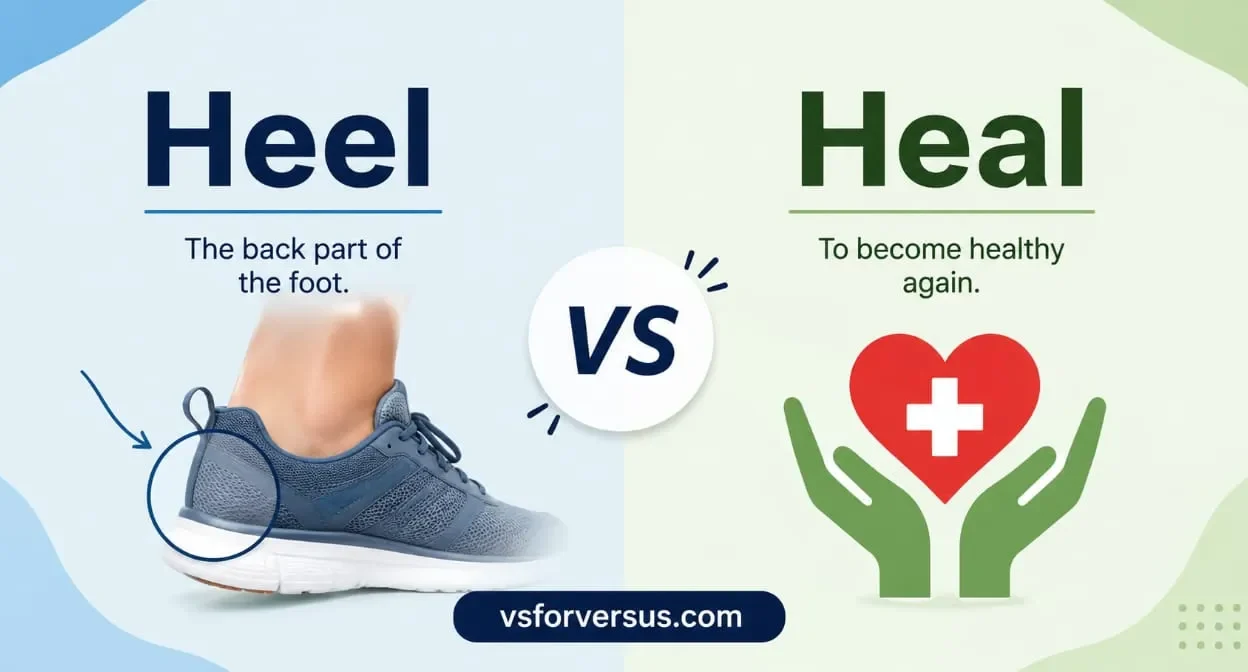
When writing Heel vs Heal, the two words can easily confuse because they have the same pronunciation but completely different meanings. Heel is mainly used for the back part of the foot or the raised part of a shoe, and it can also describe a person who behaves badly. Heal is a verb associated with recovery, meaning to become healthy again or to help an injury, illness, or emotional wound recover.
The easiest way to separate them is to connect heel with your foot and heal with getting better. Once you understand what each word represents, choosing the right spelling becomes much easier, especially when writing sentences where context alone may not immediately reveal the intended meaning.
Quick Answer
Heel vs heal are homophones; they sound the same but have completely different meanings and spellings. Heel is a noun referring to the back part of the foot or the bottom back part of a shoe. Heal is a verb meaning to recover, mend, or become healthy again. A simple test: if you can physically touch it, use heel; if it describes something getting better over time, use heal.
Heel vs Heal: Comparison Table
| Word | Part of Speech | Meaning | Example |
| Heel | Noun (also verb) | The back part of the foot or shoe; to follow closely or tilt | “She kicked off her heels the second she got home.” |
| Heal | Verb | To recover, repair, or become healthy again | “The sprain should heal within two weeks.” |
Heel does double duty; it’s mostly a noun, but it also shows up as a verb in a couple of specific situations (more on that below). Heal, by contrast, is always a verb. That asymmetry is one of the reasons the heel vs heal comparison trips people up: one word wears two hats, the other wears just one.
Heel: Definition, Examples, and Common Contexts
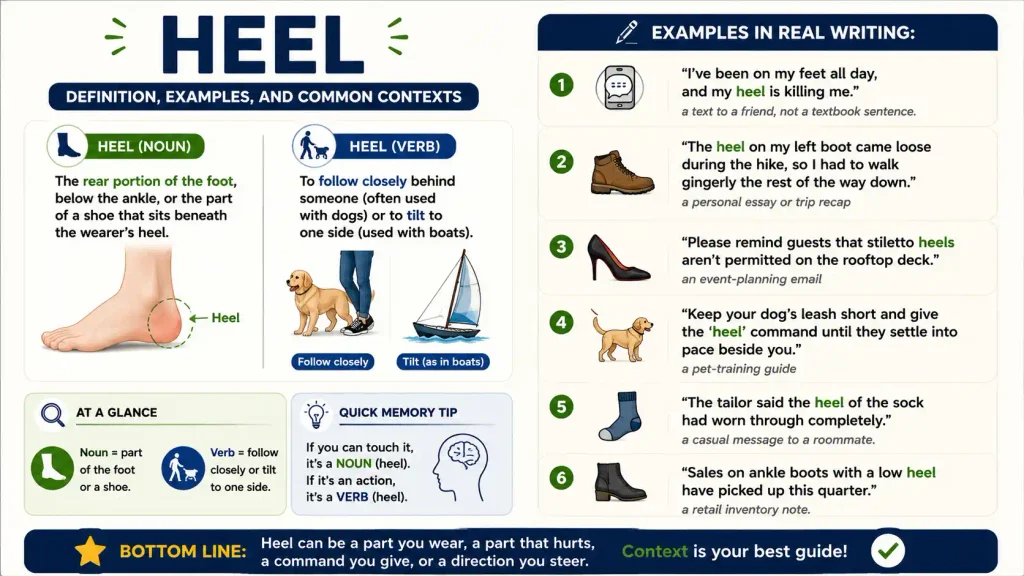
Heel (noun) refers to the rear portion of the foot, below the ankle, or the corresponding part of a shoe that sits beneath the wearer’s heel. As a verb, it means to follow closely behind someone (often used with dogs) or to tilt to one side (used with boats).
Examples in real writing:
- “I’ve been on my feet all day, and my heel is killing me.”, a text to a friend, not a textbook sentence.
- “The heel on my left boot came loose during the hike, so I had to walk gingerly the rest of the way down.”, a personal essay or trip recap
- “Please remind guests that stiletto heels aren’t permitted on the rooftop deck.”, an event planning email
- “Keep your dog’s leash short and give the ‘heel’ command until they settle into pace beside you.”, a pet training guide
- “The tailor said the heel of the sock had worn through completely.”, a casual message to a roommate.
- “Sales on ankle boots with a low heel have picked up this quarter.”, a retail inventory note.
Fashion and retail copy lean on this word constantly (shoe descriptions, sizing notes), and so does sports and fitness writing (foot injuries, form cues) and dog training material. Less commonly, sailors use it too; a boat is said to “heel” when it tilts under wind pressure. If your writing touches on footwear, athletics, or animal training, you’ll run into this word far more often than you’d expect.
Heal: Definition, Examples, and Common Contexts
Heal (verb) means to restore to health, to mend, or to become whole again, physically, emotionally, or even figuratively, as in repairing a relationship or a broken system.
Examples in real writing:
- “Give it another week to heal before you go back to running.”, advice from a physical therapist
- “It took a long time for the family to heal after the loss, but they got there together.”, a eulogy or personal reflection.
- “Our support team confirmed the connectivity issue should heal itself once the server reboot completes.”, an IT status update (yes, this metaphorical use is common in tech writing)
- “Writing in a journal every night genuinely helped me heal from a rough year.”, a social media caption.
- “The doctor said the fracture is healing faster than expected.”, a message updating family after a hospital visit.
- “Communities take time to heal after a natural disaster, and rebuilding is only part of it.”, a news article or op ed
This word dominates healthcare and medical writing, therapy and wellness content, and HR communication (healing team relationships after conflict). It’s also crept into tech writing, where systems are now routinely described as “healing” themselves after an error, a small but telling sign of how flexible this verb has become outside its original medical sense.
Key Differences Between Heel and Heal
The heel vs heal difference comes down to five scannable facts:
- Part of speech: Heel is primarily a noun, though it also works as a verb in dog training and sailing contexts; heal is always a verb, with no noun form of its own.
- What it describes: Heel names a physical object or position you could point to on a body or a shoe; heal describes a process unfolding over time, whether that’s days, weeks, or longer.
- The touch test: If you can point at it or touch it, it’s heel. If it’s getting better on its own or with care, it’s heal.
- Pronunciation: Identical for both; rhymes with “seal” and “peel.” Your ear won’t help you here, so you have to rely on context and spelling rules instead.
- Where each tends to appear: Heel shows up more in retail, fashion, and sports writing, plus dog training and sailing content. Heal shows up more in healthcare, HR, therapy, and emotional or reflective writing, and increasingly in tech copy about systems repairing themselves.
Memory Trick: How to Never Mix These Up Again?
Here’s the fastest way to lock in the heel vs heal distinction for good: memorize one sentence that uses both words correctly, side by side.
“My heel hurts, but it will heal soon.”
That single line does the heavy lifting. It shows heel as a physical noun (something that hurts) and heal as a verb describing recovery (something that happens over time), in the exact order most people actually need them.
If you want a spelling specific hook, try this: heal contains the letters that spell “ale,” as in something you’d sip while recovering, a stretch, sure, but memorable. Or simpler still: heel has two e’s, just like “feet,” which is what a heel belongs to. Pick whichever trick sticks, and you’ll stop pausing over this pair for good.
Common Mistakes with Heel vs Heal
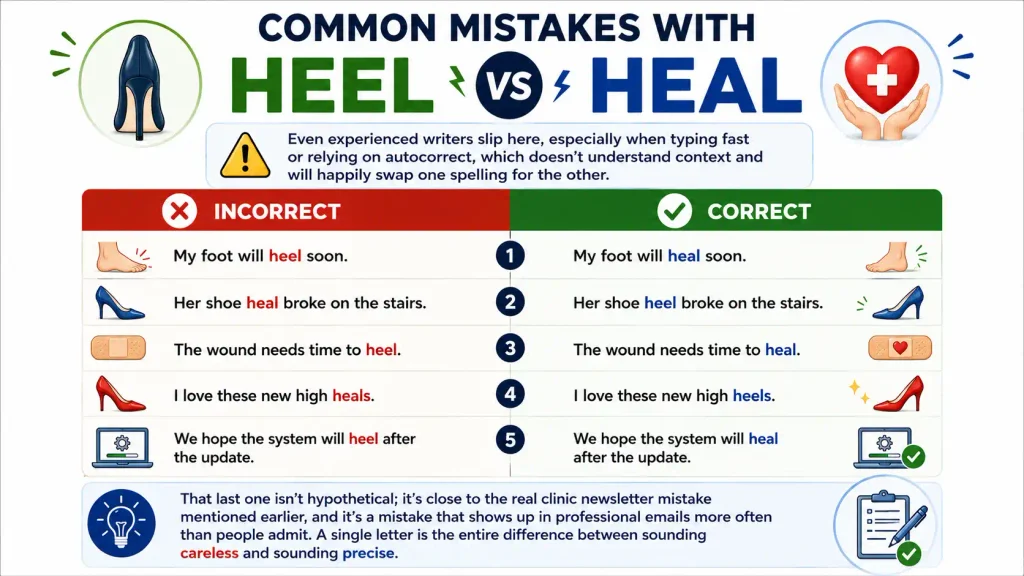
Even experienced writers slip here, especially when typing fast or relying on autocorrect, which doesn’t understand context and will happily swap one spelling for the other.
| ❌ Incorrect | ✅ Correct |
| My foot will heel soon. | My foot will heal soon. |
| Her shoe heal broke on the stairs. | Her shoe heel broke on the stairs. |
| The wound needs time to heel. | The wound needs time to heal. |
| I love these new high heals. | I love these new high heels. |
| We hope the system will heel after the update. | We hope the system will heal after the update. |
That last one isn’t hypothetical; it’s close to the real clinic newsletter mistake mentioned earlier, and it’s a mistake that shows up in professional emails more often than people admit. A single letter is the entire difference between sounding careless and sounding precise.
Heel vs Heal Beyond the Basics
The heel vs heal confusion doesn’t stop at simple sentences; it shows up in a few fixed expressions and adjacent word forms worth knowing:
- “Well heeled”, an idiom meaning wealthy or financially comfortable, spelled with heel, not heal.
- “Achilles’ heel”, a fixed phrase for a critical weakness, also spelled with heel, and unrelated to recovery of any kind.
- “Healing” (noun/gerund), the closest thing heal has to a noun form, used constantly in therapy, wellness, and medical writing (“the healing process,” “a healing journey”).
- “Reheal”, occasionally used informally in wound care or tech contexts to describe something mending again after reopening or recurring.
- “Heeled” (adjective) describes a shoe with a heel, as in “a heeled sandal,” distinct from “healed,” the past tense of heal.
Keeping these edge cases in mind rounds out the heel vs heal picture. Most of the confusion lives in ordinary sentences, but idioms and adjective forms are where even confident writers occasionally second guess themselves.
Quick Quiz: Test Yourself
- My cut will ______ within a week. (heal)
- She twisted her ______ while running downhill. (heel)
- The dog was finally trained to ______ beside its owner without a leash. (heel)
- Grief takes time to ______, and there’s no shortcut. (heal)
- Which word describes a part of a shoe? (heel)
If you got all five, the heel vs heal distinction has officially clicked.
Frequently Asked Questions
Is it “heal” or “heel” when talking about a wound?
It’s heal. A wound heals over time; heel is never used to describe recovery of any kind.
What is the past tense of heal?
Healed, as in “the cut healed within a week.” This is different from heeled, the past tense of the verb heel (to follow closely or to tilt), which is spelled the same way but means something entirely different.
Is heel ever used as a verb?
Yes, though less often than as a noun. It appears in dog training (“the dog heels beside her”) and sailing (“the boat began to heel in the wind”).
What does “well heeled” mean?
It’s an idiom meaning wealthy or financially comfortable. It has nothing to do with healing; the phrase traces back to old associations between fine footwear and financial status.
Do native English speakers actually mix up heel and heal, or is this just a learner problem?
Native speakers absolutely make this mistake too. This heel vs heal error is one of the most common homophone slips in professional writing, and it usually comes from typing quickly or trusting autocorrect too much, not from a lack of understanding. It’s a forgivable typo, but still worth catching before you hit send.
What’s the difference between “Achilles’ heel” and “healing”?
“Achilles’ heel” is spelled with heel and means a weakness or vulnerable point; it has no connection to healing, which describes recovery or repair.
Is there a noun form of heal?
Not directly, but “healing” functions as the closest equivalent, used as a noun or gerund in phrases like “the healing process” or “emotional healing.”
Final Thought
At the end of the day, heel vs heal comes down to one simple question: is it something you can touch, or something that gets better over time? A heel is physical, a body part, a shoe part, a command to a dog, a boat tilting in the wind. Heal is a process: recovery, repair, becoming whole again, whether that’s a body, a relationship, or even a piece of software.
Keep the anchor sentence close: “my heel hurts, but it will heal soon“, and the next time autocorrect tries to swap one for the other, you’ll catch it before it costs you two hundred confused phone calls.
To read more: “Incidences vs Incidents: Stop Making This Embarrassing Mistake in 2026”