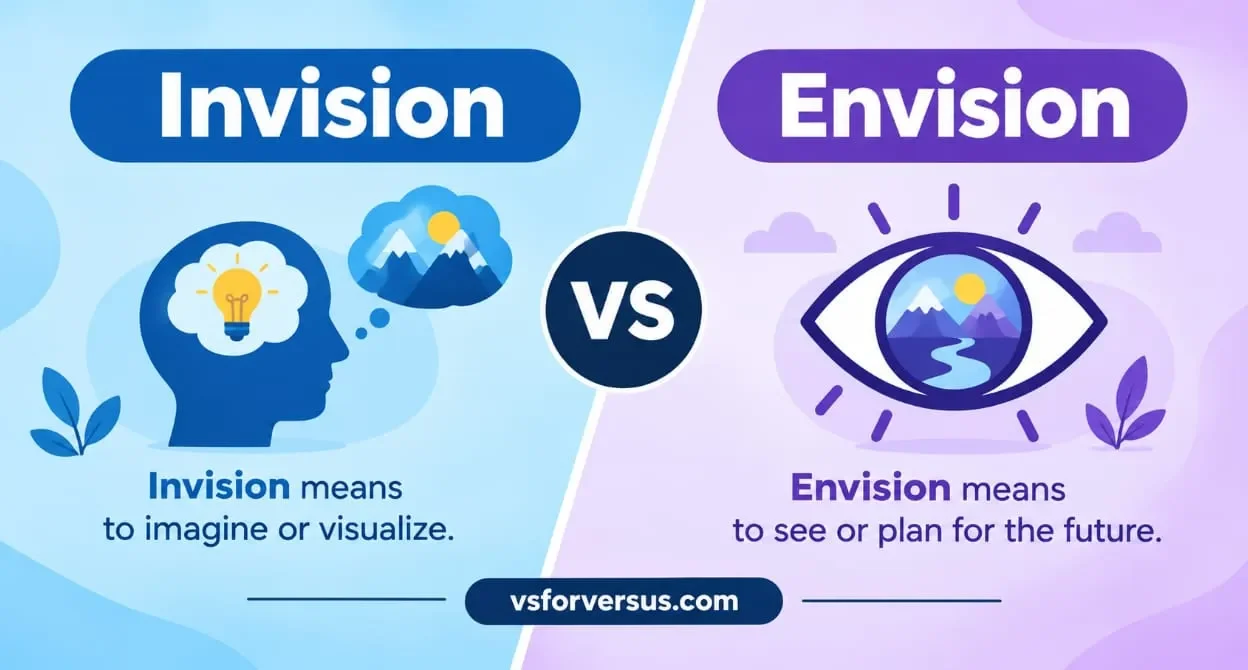
A surprisingly common mistake in English writing is confusing “envision” with the incorrect spelling “invision.” From both Invision vs Envision the correct word, “envision,” means to imagine or picture something in the mind, especially a future possibility, plan, or outcome; for example, a leader might envision a better future for their organization.
“Invision,” however, is not a recognized English word in standard usage; it is often simply a misspelling caused by confusing the prefix “in” with “en,” though it is also widely known as the name of a popular digital design and prototyping tool.
This mix up highlights how easily prefixes can be misapplied, especially when two forms sound almost identical, making spelling accuracy crucial in professional and academic writing.When people search for invision vs envision, they’re usually trying to figure out which spelling is grammatically correct.
Quick Answer
Envision is the only correct spelling in standard English. It’s a verb meaning to imagine or picture something in your mind, especially a future outcome or goal. Invision is not a real word; it’s either a misspelling of “envision” or a reference to InVision, the design software company. Whenever you’re writing a sentence, the correct choice is always “envision.”
Invision vs Envision at a Glance
Before digging into definitions, here’s the full picture in one table:
| Word | Part of Speech | Meaning | Example |
| Envision | Verb | To imagine or picture something, especially a future event or goal | “She envisions a career in public health.” |
| Invision | Not a standard word | Misspelling of “envision,” or a reference to the InVision brand | “She invisions a career…” → should be “envisions” |
| InVision | Proper noun | A digital design and prototyping software company | “We reviewed the mockups in InVision.” |
Laid out side by side like this, the invision vs envision question mostly answers itself, but the reasons behind the confusion are worth understanding, especially if you want the correct spelling to actually stick.
What Does “Envision” Mean?
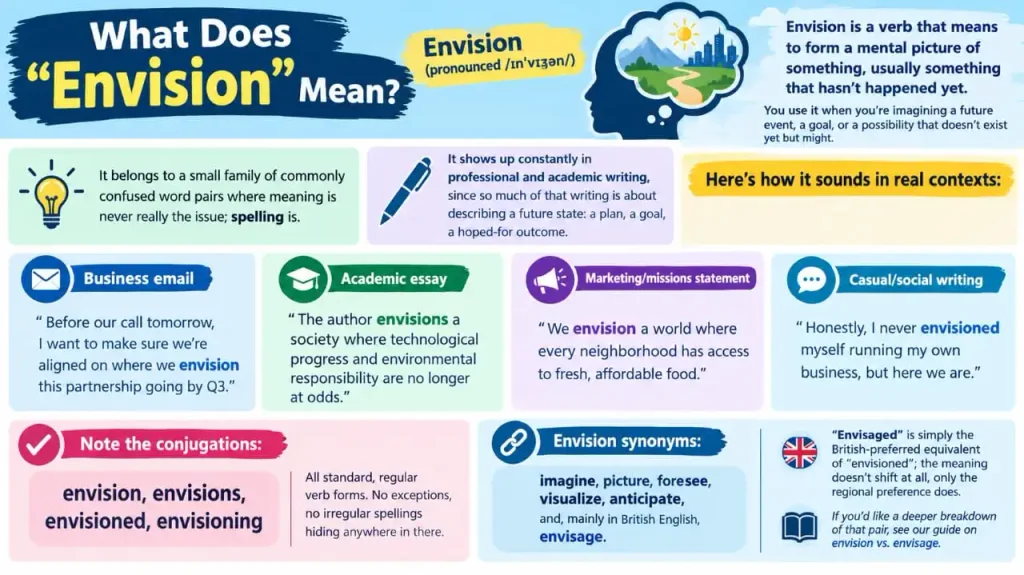
Envision (pronounced /ɪnˈvɪʒən/) is a verb that means to form a mental picture of something, usually something that hasn’t happened yet. You use it when you’re imagining a future event, a goal, or a possibility that doesn’t exist yet but might.
It belongs to a small family of commonly confused word pairs where meaning is never really the issue; spelling is.The word invision vs envision comes from the prefix “en” combined with “vision,” meaning to form a mental picture of something.
It shows up constantly in professional and academic writing, since so much of that writing is about describing a future state: a plan, a goal, a hoped for outcome. Here’s how it sounds in real contexts:
- Business email: “Before our call tomorrow, I want to make sure we’re aligned on where we envision this partnership going by Q3.”
- Academic essay: “The author envisions a society where technological progress and environmental responsibility are no longer at odds.”
- Marketing/mission statement: “We envision a world where every neighborhood has access to fresh, affordable food.”
- Casual/social writing: “Honestly, I never envisioned myself running my own business, but here we are.”
Note the conjugations: envision, envisions, envisioned, envisioning, all standard, regular verb forms. No exceptions, no irregular spellings hiding anywhere in there.
Envision synonyms: imagine, picture, foresee, visualize, anticipate, and, mainly in British English, envisage. “Envisaged” is simply the British preferred equivalent of “envisioned”; the meaning doesn’t shift at all, only the regional preference does. If you’d like a deeper breakdown of that pair, see our guide on envision vs envisage.
What Does “Invision” Mean? (Spoiler: Nothing, Unless You Mean the Brand)
Here’s what some other explanations get wrong: “invision” isn’t a variant spelling, an outdated form, or a word with its own separate meaning. It simply doesn’t exist in Merriam Webster, Oxford, or Cambridge. If you see it used as a verb anywhere, it’s an error.
There’s exactly one legitimate exception: InVision, capitalized, the name of a well known digital product design and prototyping platform (also referred to as the InVision app in design circles). As a proper noun, it follows normal brand name capitalization rules: never lowercase, never a verb.
It’s this single brand exception, more than anything else, that keeps the incorrect spelling alive for people who work in tech and design, since they see the name daily.
- ❌ “The designer will invision the new layout.”
- ✅ “The designer will use InVision to prototype the new layout.”
- ✅ “We shared the wireframes in InVision for client feedback.”
Outside of that one brand reference, “invision” has no legitimate place in a sentence.
Key Differences Between Envision vs Invision
- Envision is a real, dictionary recognized verb. Invision is not a word at all.
- Envision uses the prefix en, meaning “to bring into” or “to cause to be.” Invision mistakenly borrows the in prefix from unrelated words.
- Envision is standard in both American and British English (British writers often use “envisage” as a close synonym, but “envision” is understood and accepted everywhere).
- Invision correctly appears only inside the proper noun InVision, never as a lowercase verb.
- There’s no regional or historical version where “invision” was ever the accepted spelling for this word.
Why People Get This Wrong (Even Experienced Writers)
This is the part most explanations skip: the confusion isn’t really about carelessness. It’s phonetic. The first syllable of “envision” is unstressed, so it comes out sounding closer to “ihn” than “ehn,” and your ear naturally reaches for the far more common in prefix.
Whether you’re a student or a professional, knowing the difference between invision vs envision ensures your writing stays polished and error free.
That instinct isn’t random. English is full of in words that mean roughly the opposite of what “envision” describes: invisible (can’t be seen), inspire, involve, invade. Your brain has seen “in” attached to hundreds of words and rarely seen “en” used the same way, so it defaults to the familiar pattern.
This is exactly the kind of trap that fuels most word confusion pairs in English; the wrong option simply sounds more familiar than the right one.Writers who confuse invision vs envision often end up with spelling errors in essays, resumes, and business emails.
Add the software brand InVision into the mix (which plenty of design and marketing professionals see and type daily), and the incorrect spelling gets visually reinforced, even for careful writers. That’s why the invision vs envision mistake turns up in professional writing at every level, not just from beginners.
If you were taught this spelling once and it stuck, you’re not alone, and it’s an easy habit to break once you understand the pattern behind it.
Memory Trick: How to Never Mix These Up Again?
The simplest fix: “en” + “vision” = bringing a vision into your mind.
Envision belongs to the same prefix family as enable, enact, and endanger, all “make it happen” words. If you can remember that envision is about actively creating a mental picture, the en prefix makes logical sense.
Backup trick, if that doesn’t stick: “invision” starts exactly like invisible, and a spelling that should be invisible from your writing is exactly what “invision” is.
Common Mistakes to Avoid
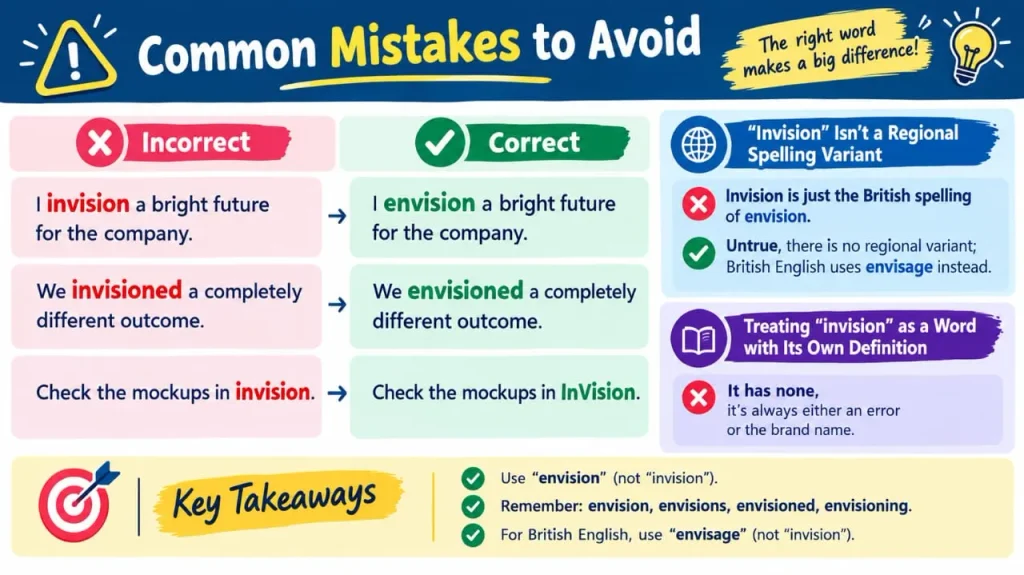
| ❌ Incorrect | ✅ Correct |
| “I invision a bright future for the company.” | “I envision a bright future for the company.” |
| “We invisioned a completely different outcome.” | “We envisioned a completely different outcome.” |
| “Check the mockups in invision.” | “Check the mockups in InVision.” |
| “Invision is just the British spelling of envision.” | Untrue, there is no regional variant; British English uses “envisage” instead |
| Treating “invision” as a word with its own definition | It has none, it’s always either an error or the brand name |
Quick Quiz: Test Yourself
- Fill in the blank: “The architect ___ a glass tower overlooking the harbor.” (envision / invision)
- True or False: “Invision” is an accepted British spelling of “envision.”
- Which is correct: (a) “We shared the files in Invision” or (b) “We shared the files in InVision”?
- Fill in the blank: “She could ___ herself walking across the graduation stage.” (envision / invision)
- True or False: “Invision” has its own dictionary definition, separate from “envision.”
Answers: 1. envisioned 2. False 3. b 4. envision 5. False
Frequently Asked Questions
Is “invision” a real word?
No. “Invision” doesn’t appear in any major English dictionary. It’s either a misspelling of “envision” or a reference to the InVision software brand.
Was I taught the wrong spelling growing up?
It’s possible, and it’s more common than you’d think. Some writers learn “invision” as correct simply because it matches how the word sounds, or because it mirrors familiar words like “invisible.” It’s an understandable mix up, not a sign of poor spelling overall.
What’s the difference between envision and envisage?
They mean essentially the same thing. “Envision” is more common in American English, while “envisage” is the preferred term in British English.
Is InVision only a company name?
Yes. Capitalized as “InVision,” it refers exclusively to the UX design and prototyping software. It should never be used as a lowercase verb in a sentence.
What is the past tense of envision?
“Envisioned”, for example: “The founders envisioned a very different company than the one they ended up building.”
Can I use “envision” in formal or academic writing?
Absolutely. “Envision” is fully standard in formal, professional, and academic contexts; there’s no register where it reads as too casual or too informal.
The Bottom Line
Once you understand the prefix logic behind it, the invision vs envision question stops being a guessing game. Envision is the verb; InVision is the brand; invision, lowercase and used as a word, is always a mistake.
The next time you’re drafting an email, an essay, or a slide deck and your fingers start typing “invision,” pause for half a second and remember: you’re not describing something invisible. You’re bringing a vision into being. That’s “envision,” every time. For more pairs like this one, browse our full commonly confused words library.
To read more: “Inter vs Intra: What’s the Shocking Difference? | Full Guide (2026)”