
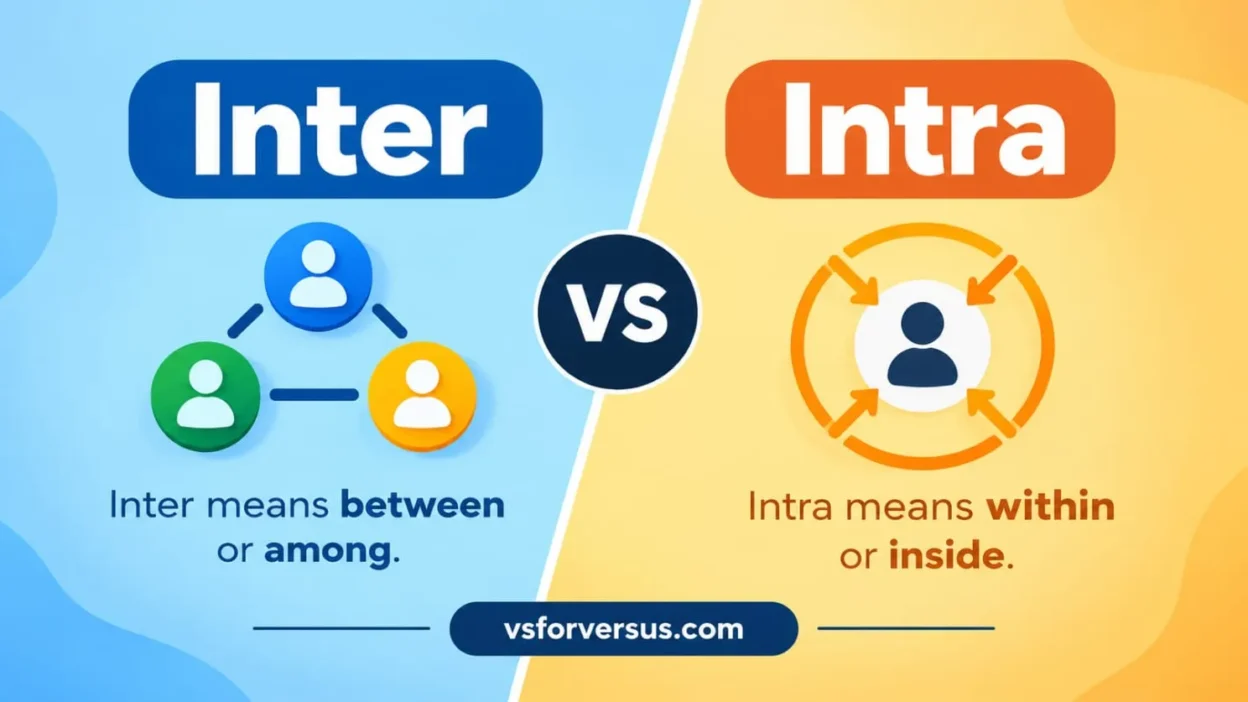
Among the most commonly misused prefixes in English are “inter” vs “intra,” which, despite their similar spelling, indicate opposite spatial relationships. The prefix “inter” means between or among different groups, entities, or systems; for example, “international” refers to relations between nations, and “interpersonal” describes interactions between individuals.
In contrast, “intra” means within a single group, entity, or system, as seen in “intramural,” referring to activities within one institution, or “intranet,” a network confined within an organization. This distinction is particularly important in academic, medical, and technical writing, where mixing up the two prefixes can lead to significant misunderstandings about scope, boundaries, and the actual relationship being described.
Quick Answer
“Inter” is a prefix meaning between or among two or more separate things, while “intra” is a prefix meaning within a single thing. An interstate highway runs between states, connecting them; an intrastate highway stays within the borders of one state.
A simple way to remember the difference: intra ends in the letter “a,” like the word contained; inter has an “e,” like the word open. Understanding inter vs intra starts with one question: does it happen between things, or within one?
What Do “Inter” vs “Intra” Mean? A Quick Comparison
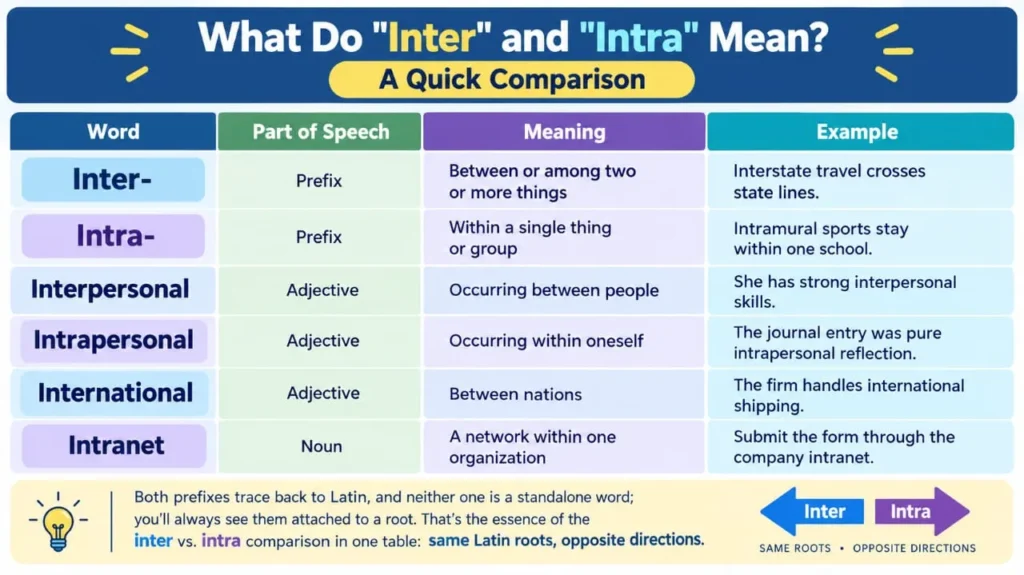
| Word | Part of Speech | Meaning | Example |
| Inter- | Prefix | Between or among two or more things | Interstate travel crosses state lines |
| Intra- | Prefix | Within a single thing or group | Intramural sports stay within one school |
| Interpersonal | Adjective | Occurring between people | She has strong interpersonal skills |
| Intrapersonal | Adjective | Occurring within oneself | The journal entry was pure intrapersonal reflection |
| International | Adjective | Between nations | The firm handles international shipping |
| Intranet | Noun | A network within one organization | Submit the form through the company intranet |
Both prefixes trace back to Latin, and neither one is a standalone word; you’ll always see them attached to a root. That’s the essence of the inter vs intra comparison in one table: same Latin roots, opposite directions.
What Does “Inter” Mean?
Inter comes from the Latin word for “among” or “between,” and it shows up whenever something involves two or more separate people, places, or groups. Think of it as a bridge; it connects distinct things rather than describing something selfcontained.
A few examples you’ve probably used yourself:
- “We’re launching an interdepartmental task force to fix the onboarding process.” (between departments)
- “Their interpersonal dynamic on the panel was surprisingly tense.” (between people)
- “The professor assigned an interdisciplinary project combining biology and economics.” (between academic fields)
- “Are we still doing the interoffice gift exchange this year?” (between offices)
You’ll see inter most often in academic writing (interdisciplinary research), workplace communication (interdepartmental memos, interoffice messages), and sports or competitive contexts (intercollegiate tournaments, international leagues).
Anytime the sentence implies “crossing over” from one group into another, inter is almost certainly the right prefix. Once you can spot that pattern, half of the inter vs. intra puzzle is solved.
What Does “Intra” Mean?
Intra also comes from Latin, and it means “within”, specifically, within one contained group, place, or system. Nothing crosses a boundary here; everything stays put inside it.
Natural examples of intra in everyday writing:
- “Can you post that in the intranet channel instead of emailing everyone?” (within the company network)
- “She led our intramural volleyball team to the championship last spring.” (within one school or institution)
- “The report focuses on intracellular signaling pathways.” (within a single cell)
- “There’s been some intradepartmental tension since the reorg.” (within one department)
Intra dominates in three real world contexts: internal company systems (intranet, intraoffice memos), single institution sports and academics (intramural leagues, intrastate competitions), and science or medicine (intracellular, intravenous, intracranial). The other half of the inter vs intra puzzle lives right here, in words that stay contained.
Related: Intranet vs Internet: Are They the Same Thing?
Key Differences Between Inter and Intra
Here’s the inter vs intra breakdown distilled to its essentials:
- Inter = between or among two or more separate things
- Intra = within a single, self contained thing
- Inter crosses a boundary; intra stays inside one.
- Neither prefix is a word by itself; both always attach to a root.
- Hyphens usually aren’t needed, except before proper nouns (inter American) or to avoid an awkward double letter (intra arterial)
- Intra’s true opposite is actually extra (meaning “outside”), not inter; the two aren’t a strict antonym pair, even though they’re often treated that way.
That last point matters more than it seems. People frequently assume inter and intra sit on opposite ends of a single spectrum, but linguistically, intra and extra are the real opposites. Inter occupies its own lane: it’s not about inside versus outside, but about shared space between multiple things.
Memory Trick: How to Keep Them Straight?

The trick that tends to stick the first time you’re sorting these out is simple:
Intra ends in the letter “a,” just like the word contained. Something intra stays contained within one place.
Inter has the letter “e,” just like the word open. Something inter is open, crossing between multiple things.
One example makes this click instantly: think about the internet versus a company intranet. The internet is open to the entire world; anyone, anywhere, can connect. An intranet is contained within one organization; you need to be an employee to get in. Once that image sticks, the rest of the inter/intra word family tends to fall into place on its own.
Why Even Careful Writers Get This Wrong: The “Internal” Exception
It’s a fair question, and one worth answering directly instead of brushing past: if intra means “within,” shouldn’t the word for “on the inside” be intranal instead of internal?
It’s a smart catch, and even experienced writers pause on this one. The answer is that internal doesn’t come from intra at all; it comes from a different Latin word, internus, which developed its “inside” meaning through a separate path entirely.
It’s not that the inter/intra rule has a loophole; it’s that internal was never playing by that rule in the first place. English is full of these quiet exceptions, where two words that look related actually have completely different word histories.
If internal has ever thrown you off mid sentence, you’re not alone; it’s one of the most commonly asked questions about inter vs intra logic.
Common Mistakes with Inter vs Intra
These are the inter vs intra mistakes that show up most often in real writing:
| ❌ Incorrect | ✅ Correct |
| “We’re organizing an intermural fundraiser.” | “We’re organizing an intramural fundraiser.” (within one school) |
| “This is an intrastate trade deal with Canada.” | “This is an international trade deal with Canada.” (between countries) |
| “Intra- and inter- are basically opposites.” | “Intra-‘s real opposite is extra-; inter- means something different entirely.” |
| “It should be ‘intranal’ since intra- means within.” | “It’s ‘internal’, a separate word history, not an exception to memorize as a rule-breaker.” |
| “I’ll post the update on the internet so only staff can see it.” | “I’ll post the update on the intranet so only staff can see it.” (internet is public; intranet is internal) |
Small as they look, these mix ups show up constantly in emails, reports, and essays, and readers notice, even if they can’t always explain why a sentence feels slightly off.
Quick Quiz: Test Yourself
Ready to test your inter vs intra knowledge?
- Which prefix describes a soccer tournament between two different colleges?
- Fill in the blank: “Please submit expense reports through the company net.”
- True or false: Intra and inter are direct opposites of each other.
- Which prefix fits: “cellular communication,” referring to activity within a single cell?
- Why isn’t “internal” spelled “intranal,” even though intra means “within”?
(Answers: 1. Inter (intercollegiate). 2. Intra (intranet). 3. False, intra’s real opposite is extra. 4. Intra (intracellular). 5. Because “internal” comes from the Latin internus, a separate word origin, not from intra.)
Frequently Asked Questions
What does “inter” mean as a prefix?
“Inter” means between or among two or more separate people, places, or things, as in interstate or international.
What does “intra” mean as a prefix?
“Intra” means within a single, contained group or place, as in intramural or intranet.
Is intra the opposite of inter?
Not exactly. While they’re often discussed together, intra’s true linguistic opposite is extra (meaning “outside”). Inter vs intra describe different relationships rather than sitting on the same spectrum.
Why is it called “international” and not “intranational”?
Because the word describes something happening between nations, not within a single one, which is precisely what inter signals.
Do inter vs intra need a hyphen?
Usually not. Most style guides skip the hyphen except before a proper noun (inter American) or to prevent an awkward double vowel (intra arterial).
Why isn’t “internal” spelled “intranal”?
Because internal descends from the Latin internus, a separate word root, not from intra. It’s a well known exception, not a mistake in the rule itself.
Final Thought
Getting inter vs intra right comes down to one question: does this cross between separate things, or does it stay contained within one? Once you can answer that, the correct prefix follows naturally. Remember the anchor: intra = “a” for contained, inter = “e” for open, and keep in mind the one exception, internal, which quietly breaks its own rule. Master those two ideas, and mix up free emails follow.
To read more: Heel vs Heal: The Complete Guide to Never Confusing Them Again 2026