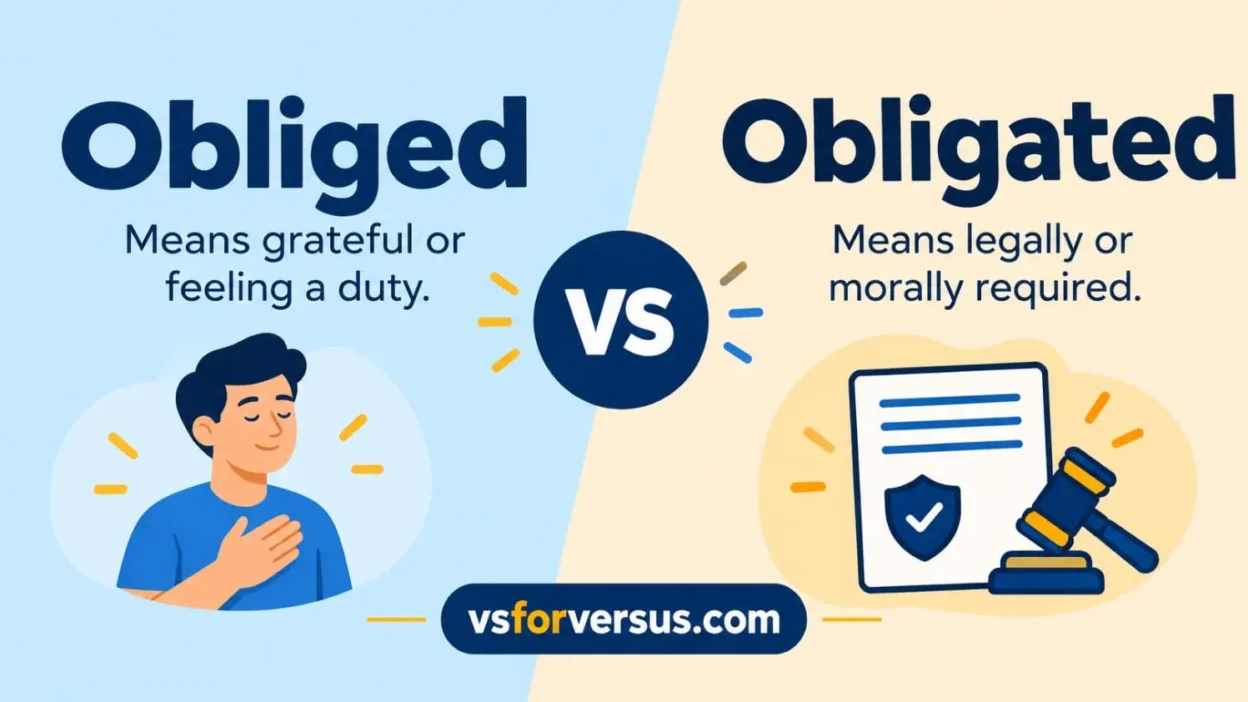
Obliged vs Obligated may look similar, but they carry a slight difference in use and meaning. Obliged means to feel grateful or thankful for something, as in “I’m obliged for your help,” expressing gratitude for someone’s kindness. This word is mostly used in a personal and emotional sense, when a favor or act of kindness makes you feel thankful.
On the other hand, Obligated means being bound to do something under a legal, professional, or moral duty, whether you genuinely want to or not. For example, “I’m obligated to sign the contract” implies a sense of compulsion or requirement rather than personal willingness. So while obliged leans toward gratitude, obligated leans toward duty and necessity.
Quick Answer
Obliged means feeling grateful or morally compelled to do something as a favor; think “much obliged” or a debt of gratitude owed to someone. Obligated means being legally, contractually, or formally required to do something, regardless of how you feel about it. Both words are correct in modern English, but obliged leans British and everyday, while obligated leans American, legal, and formal.
Obliged vs Obligated at a Glance
Here’s the fast comparison before we get into detail:
| Word | Part of Speech | Meaning | Example |
| Obliged | Adjective / past participle of “oblige” | Feeling grateful, indebted, or morally (not legally) compelled to act | “I’d be obliged if you could reply by Friday.” |
| Obligated | Adjective / past participle of “obligate” | Legally, contractually, or formally bound to act | “Tenants are obligated to pay rent by the first of the month.” |
Both verbs, oblige and obligate, arrived in English from Latin, and neither is a modern invention or an “incorrect” backformation, despite what you might read in an online grammar debate. Over the centuries, they’ve drifted into different lanes of usage: one softer, one more formal.
What Does “Obliged” Mean?
Oblige is the older of the two verbs, and “obliged” is its past participle used as an adjective. At its core, it describes feeling indebted for a favor, or feeling a personal, moral pull to do something, not a legal one.
You’ll see it in sentences like:
- “I’d be obliged if you could send over the final invoice before the end of day.”
- “She felt obliged to thank her old professor after he wrote her a reference letter.”
- “Much obliged for covering my shift last week; I owe you one.”
- “He obliged her request for feedback, even though he was slammed with deadlines.”
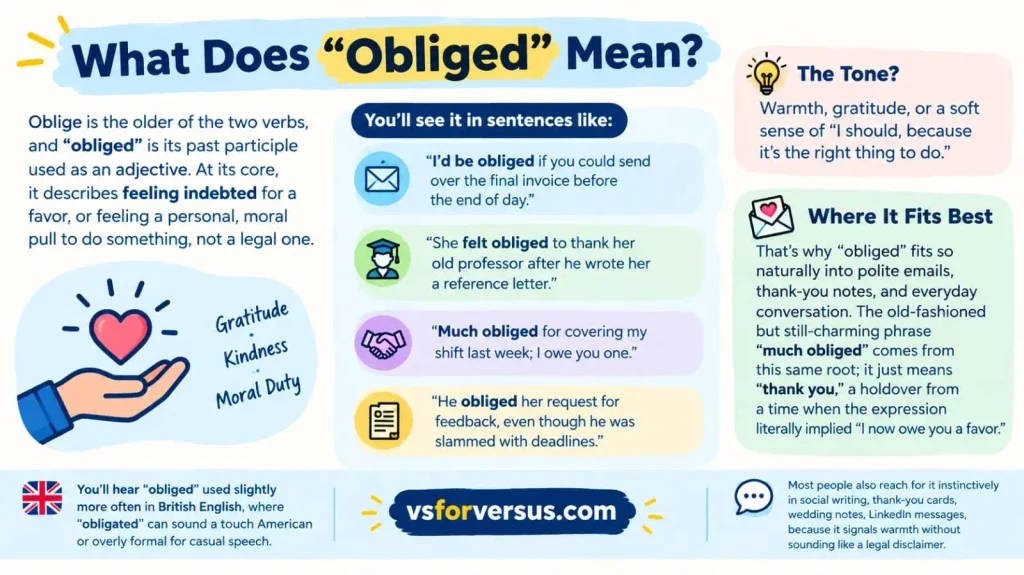
Notice the tone in each of these: warmth, gratitude, or a soft sense of “I should, because it’s the right thing to do.” This is why “obliged” fits so naturally into polite emails, thank you notes, and everyday conversation.
The old fashioned but still charming phrase “much obliged” comes from this same root; it just means “thank you,” a holdover from a time when the expression literally implied “I now owe you a favor.”
You’ll hear “obliged” used slightly more often in British English, where “obligated” can sound a touch American or overly formal for casual speech. Most people also reach for it instinctively in social writing, thank you cards, wedding notes, LinkedIn messages, because it signals warmth without sounding like a legal disclaimer.
What Does “Obligated” Mean?
Obligated comes from the verb obligate, and it carries a firmer, more formal sense of compulsion, usually legal, contractual, or procedural. When you’re obligated to do something, your personal feelings about it are beside the point; a law, contract, policy, or professional duty has decided for you.
Real world examples:
- “Under the new data privacy law, companies are obligated to report a breach within 72 hours.”
- “As a mandatory reporter, the school counselor is obligated to flag any signs of abuse.”
- “You are not obligated to accept the settlement offer; you can negotiate.”
- “All new hires are obligated to complete compliance training within their first thirty days.”
This is the word you’ll reach for in contracts, HR policies, terms of service, academic integrity statements, and any writing where a rule, not a feeling, is doing the compelling. American English leans on it more heavily, especially in legal and business writing, which is part of why the obliged vs obligated question comes up so often in professional writing forums and editing communities.
Academic writing leans on it too. A student might write, “Researchers are obligated to disclose any conflicts of interest in their published work”; here the requirement comes from a journal’s editorial policy, not personal ethics alone, even though the two frequently overlap.
Key Differences Between Obliged vs Obligated
Once you see obliged vs obligated side by side, the pattern is much easier to keep straight:
- Source of compulsion: obliged points to moral or social pressure; obligated points to legal or formal requirement.
- Emotional tone: obliged tends to sound warmer, even grateful; obligated tends to sound neutral or duty driven.
- Regional preference: obliged is the default in British English; obligated shows up more in American legal and business writing.
- Fixed phrases: only “obliged” works in set expressions like “much obliged”; you’ll never see “much obligated” in standard English.
- Interchangeability: in casual, everyday sentences, the two are often interchangeable without much meaning loss, but in a contract, policy, or legal document, swapping them can shift what’s actually being promised or required.
Memory Trick to Remember the Difference
If you only remember one trick, make it this one: obligated has a legal date attached; picture a contract with a signature line and a deadline. ObIIged has an “I” in it, like something you’d personally choose to do out of gratitude or goodwill.
Say it out loud a couple of times, and it sticks fast: date equals duty, “I” equals personal choice. The next time you’re stuck mid sentence deciding between obliged vs obligated, that tiny mental image, a signed date versus a personal “I”, is usually enough to settle it.
Common Mistakes with Obliged vs Obligated
Even confident, experienced writers slip here; it’s one of those pairs that feels obvious right up until you’re staring at a blank line in an email. A few of the most common mix ups.
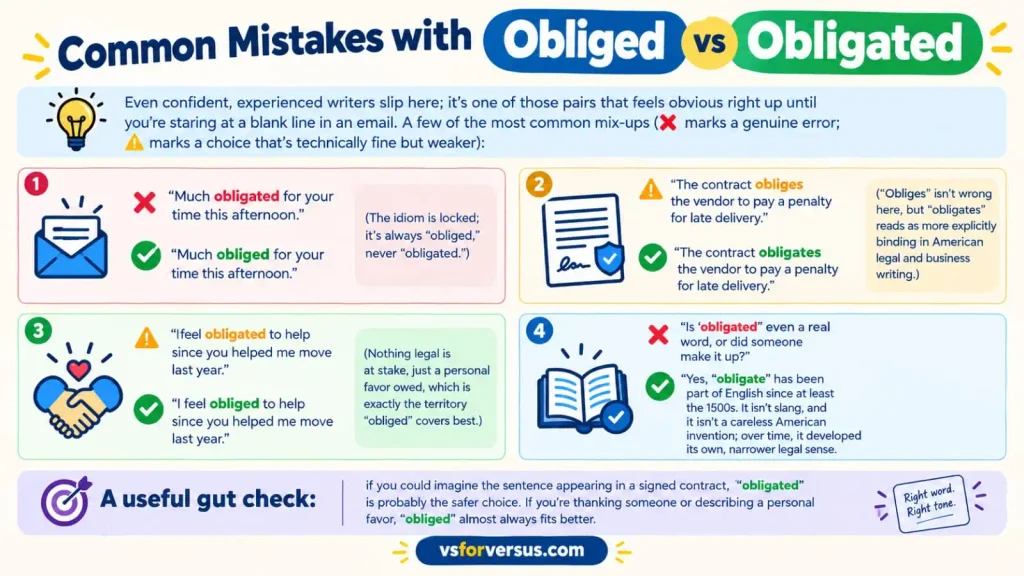
- ❌ “Much obligated for your time this afternoon.” ✅ “Much obliged for your time this afternoon.” (The idiom is locked; it’s always “obliged,” never “obligated.”)
- ⚠️ “The contract obliges the vendor to pay a penalty for late delivery.” ✅ “The contract obligates the vendor to pay a penalty for late delivery.” (“Obliges” isn’t wrong here, but “obligates” reads as more explicitly binding in American legal and business writing.)
- ⚠️ “I feel obligated to help since you helped me move last year.” ✅ “I feel obliged to help since you helped me move last year.” (Nothing legal is at stake, just a personal favor owed, which is exactly the territory “obliged” covers best.)
- ❌ “Is ‘obligated’ even a real word, or did someone make it up?” ✅ Yes, “obligate” has been part of English since at least the 1500s. It isn’t slang, and it isn’t a careless American invention; over time, it developed its own, narrower legal sense.
A useful gut check: if you could imagine the sentence appearing in a signed contract, “obligated” is probably the safer choice. If you’re thanking someone or describing a personal favor, “obliged” almost always fits better.
Quick Quiz: Obliged or Obligated?
Test yourself before you check the answers below.
- “Employees are ___ to sign the confidentiality agreement before their start date.”
- “I’m ___ if you could pass along that file when you get a chance.”
- “Under the lease terms, the landlord is ___ to fix the heater within 48 hours.”
- “She felt ___ to write a thank-you note after the interview.”
- “___, thank you for going out of your way to help.”
Answers: 1. obligated 2. obliged 3. obligated 4. obliged 5. Much obliged
Frequently Asked Questions
Is “obligated” a real word, or is it incorrect? Yes, it’s a real, standard English word. “Obligate” has been used in English since the 1500s and comes from Latin, just like “oblige.” It isn’t a modern error or an informal shortcut; over time, it developed a more specifically legal and formal meaning.
Is “obliged” or “obligated” more common in British English? “Obliged” is generally the preferred choice in British English, both in speech and writing. “Obligated” is used in the UK too, particularly in legal contexts, but it’s far more common in American English overall.
Can I use “obliged” and “obligated” interchangeably? The obliged vs obligated distinction only really matters when precision counts. In casual, everyday sentences, often yes, the meaning difference is subtle enough that most readers won’t notice.
In legal, contractual, or highly formal writing, though, it’s worth choosing deliberately: “obligated” more clearly signals a binding requirement.
Why do we say “much obliged” and not “much obligated”? “Much obliged” is a fixed idiom that predates the more common use of “obligated.” It originally meant something close to “I’m now in your debt,” and the phrase has stayed frozen in that exact form ever since; “much obligated” just never caught on.
Which word should I use in a legal or business contract? “Obligated” is generally the safer choice in contracts, policies, and compliance documents, since it more clearly conveys a binding, enforceable duty rather than a moral or social one.
Does saying “obligated” instead of “obliged” sound cold or rude? Not rude, but it can sound more formal or distant, especially in a personal message. If you’re thanking someone or describing a favor, “obliged” typically reads as warmer and more natural.
Final Thoughts
At the end of the day, obliged vs obligated comes down to one simple test: is the pull coming from gratitude and personal choice, or from law, contract, and formal duty? Reach for obliged when you’re describing a favor, a courtesy, or a genuine moment of thanks.
Reach for obligated when a rule, a signature, or a policy is doing the requiring, not your feelings. Keep that one distinction in mind, and you’ll never have to second-guess this pair again in an email, an essay, or a contract.
To read more: “Migrate vs Immigrate: The Shocking Difference? | Guide 2026”

Marcus is a former product manager turned comparison writer who spent eight years testing tools and gadgets before quitting to write full-time. He specializes in breaking down tech and software matchups into plain-English verdicts, with a soft spot for buying guides nobody else wants to write.