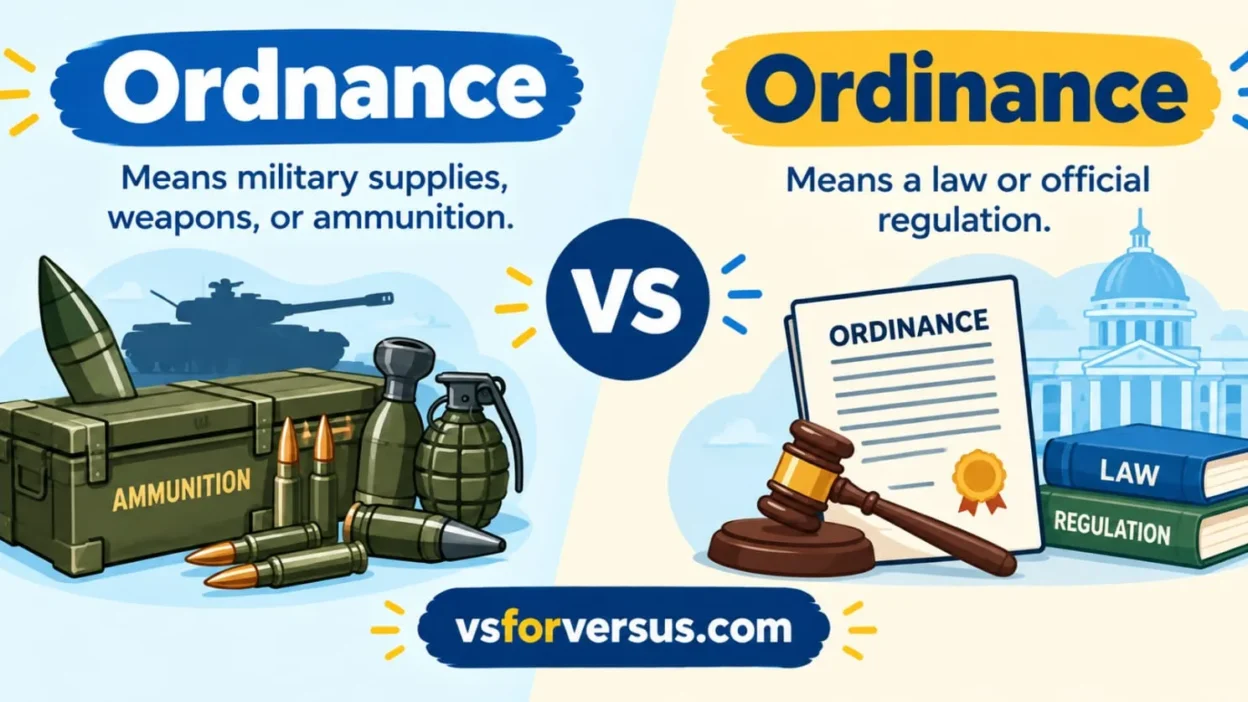
Ordnance vs Ordinance may look similar in spelling, but their meanings are completely different, making it essential to understand them correctly when writing. Ordnance relates to the military and refers to weapons, artillery, ammunition, or war equipment. On the other hand, Ordinance is a legal term that refers to a rule or regulation made by a government, council, or municipal authority, such as a traffic ordinance or a building ordinance.
The only difference between the spellings of these two words lies in a single letter, “n” versus “in,” ,” yet this small change completely alters their meaning. For this reason, using them correctly in exams, essays, or official writing carries significant importance.
Quick Answer
Ordnance vs ordinance confuses many writers because the two words differ by just a single letter. Ordinance means a law or rule passed by a local government, such as a city or town; for example, a noise ordinance or a zoning ordinance.
Ordnance means military weapons, ammunition, and equipment, for example, unexploded ordnance found at a former battlefield. Although the two words share the same origin, their modern meanings are completely unrelated, so you can never substitute one for the other.
Ordnance vs Ordinance at a Glance
Before breaking down the table, it helps to know that ordinance vs ordnance are homophones, or near homophones, depending on how carefully you pronounce the middle syllable. That sound similarity is a big part of why the two get swapped so often in speech to text writing and quick emails.
| Word | Part of Speech | Meaning | Example |
| Ordinance | Noun | A law or official rule, typically enacted by a municipal or local authority | The city council passed a new noise ordinance last week. |
| Ordnance | Noun (mass noun) | Military weapons, ammunition, and related equipment | Engineers spent the morning clearing unexploded ordnance from the old training site. |
There’s a pronunciation gap too: ordinance usually stretches to three syllables (or-di-nance), while ordnance compresses to two (ord-nance). That subtle vocal shortcut is part of why so many people default to the shorter, more familiar sounding word even when they mean the legal term.
What Does “Ordinance” Mean?
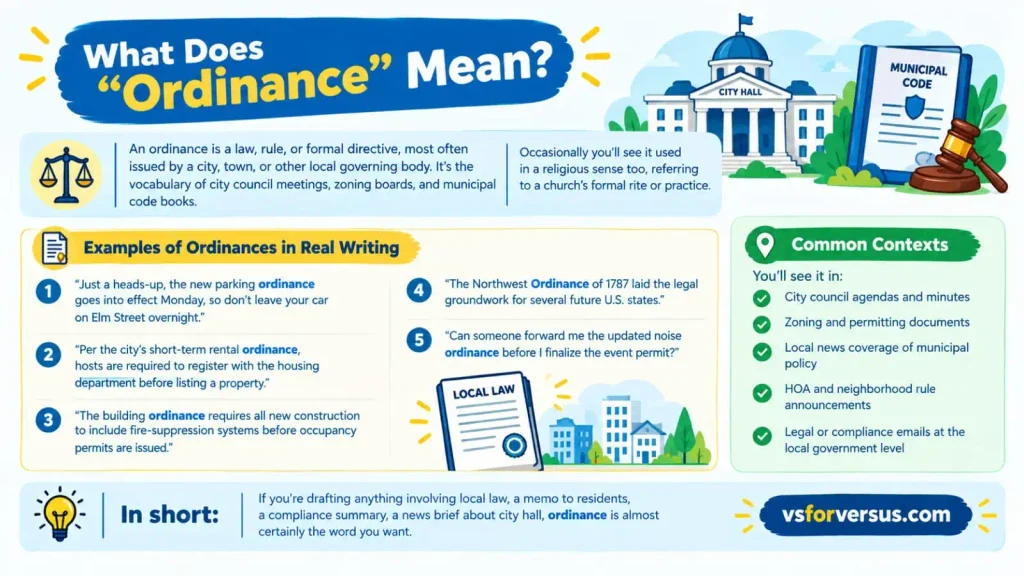
Let’s start with the civic half of the ordnance vs ordinance pair: ordinance. An ordinance is a law, rule, or formal directive, most often one issued by a city, town, or other local governing body. It’s the vocabulary of city council meetings, zoning boards, and municipal code books. Occasionally you’ll see it used in a religious sense too, referring to a church’s formal rite or practice.
Examples of ordinances in real writing:
- “Just a heads up, the new parking ordinance goes into effect Monday, so don’t leave your car on Elm Street overnight.”
- “Per the city’s short term rental ordinance, hosts are required to register with the housing department before listing a property.”
- The building ordinance requires all new construction to include fire suppression systems before occupancy permits are issued.
- The Northwest Ordinance of 1787 laid the legal groundwork for several future U.S. states.
- “Can someone forward me the updated noise ordinance before I finalize the event permit?”
Common contexts where you’ll see it: city council agendas and minutes, zoning and permitting documents, local news coverage of municipal policy, HOA and neighborhood rule announcements, and legal or compliance emails at the local government level.
If you’re drafting anything involving local law, a memo to residents, a compliance summary, a news brief about city hall, ordinance is almost certainly the word you want.
What Does “Ordnance” Mean?
Now for the other half of the ordnance vs ordinance pair: ordnance. Ordnance refers to military supplies, primarily weapons, ammunition, artillery, and the equipment used to store or deploy them. It’s a mass noun, meaning it doesn’t typically take a plural form; you don’t say “ordnances,” you say “a supply of ordnance.”
Examples of ordnance in real writing:
- “The demining team confirmed there’s still unexploded ordnance buried near the old airstrip.”
- “Ordnance shipments were delayed again due to the supply chain backlog.”
- Historians say the fort’s ordnance collection includes several 19th century cannons.
- “The base’s Ordnance Corps handles storage and maintenance for all munitions on site.”
You’ll typically run into ordnance in settings like these: military and defense reporting, historical accounts of warfare, news coverage of unexploded bombs or landmines, defense industry contracts and procurement documents, and, notably, the name of the UK’s national mapping agency, Ordnance Survey, which got its name from its original 18th century military purpose.
That last one trips up even careful writers. If you’ve ever typed “Ordinance Survey map” while referencing British maps, you’ve made one of the most common versions of this exact mistake, and you’re in good company.
Key Differences Between Ordinance vs Ordnance
- Spelling: Ordinance contains an extra “i”; ordnance drops it.
- Meaning: Ordinance refers to a law or rule; ordnance refers to weapons and military equipment.
- Field of use: Ordinance belongs to civic, legal, and municipal writing; ordnance belongs to military, defense, and historical writing.
- Pronunciation: Ordinance is usually three syllables; ordnance is usually two.
- Closest synonyms: Ordinance is close to “law,” “statute,” or “regulation”; ordnance is close to “munitions,” “artillery,” or “armaments.”
- Word origin: Both trace back to the same Angl French root; they’re what linguists call a “doublet,” a pair of words that split from one source into two distinct meanings over time.
- Interchangeability: Never. Despite sharing an origin, the two are not substitutes for one another in modern English.
That last point about shared origin is worth sitting with for a second, because it explains why this pair is so persistently confusing; it’s not a coincidence that they look alike.
The Real Reason They’re So Easy to Confuse
Most people assume ordinance and ordnance are just random look alikes, the way “affect” and “effect” happen to sound similar. But there’s a deeper reason this ordnance vs ordinance confusion sticks around: the words used to be the same word.
Centuries ago, ordnance began as a clipped, shortened form of an older sense of ordinance, one that referred broadly to “preparation” or “military provisions.” Over time, the clipped spelling and the fuller spelling drifted apart, each one settling into its own separate meaning.
Linguists call this kind of pair a doublet: two words with a shared root that diverged in form and meaning, often because they entered common usage through slightly different paths. English has quite a few of these.
Fire and pyre are one classic example; hospital and hostel are another, both descending from the same Latin root for “guest” or “host” before splitting into unrelated modern meanings. Ordinance and ordnance sit comfortably in that same family, a clear case of how a single letter can carry centuries of linguistic drift.
Knowing this doesn’t just satisfy curiosity; it also explains why even careful, experienced writers still slip on this pair occasionally. When two words share a visual and historical fingerprint, your brain has to do a little extra work to keep them separated, especially when you’re typing quickly.
Memory Trick to Remember the Difference
Here’s a simple mnemonic, a quick memory trick, for locking in the difference: ordinance has an “i,” like “illegal.” Breaking an ordinance is an illegal act, so if the sentence is about rules, laws, or legality, reach for the version with the extra “i.”
If it helps to picture it visually: ord-I-nance = laws (the “I” stands in for “illegal” if broken). Ordnance, shorter, sharper, no extra letter, matches its subject: weapons and ammunition, built for speed and impact, not extra syllables.
A quick fallback rule if the mnemonic doesn’t stick: when in doubt, think about the setting. City hall, zoning, and neighborhood rules point to ordinance. Battlefields, bomb disposal, and defense contracts point to ordnance. Get comfortable with this one mnemonic, and most ordnance vs ordinance mistakes disappear for good.
Common Mistakes with Ordinance vs Ordnance
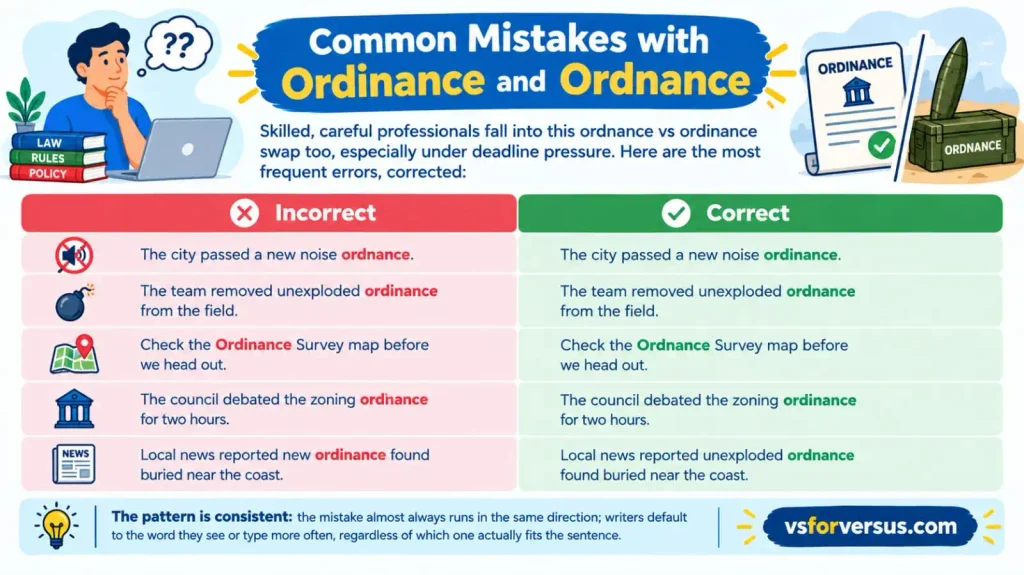
Skilled, careful professionals fall into this ordnance vs ordinance swap too, especially under deadline pressure. Here are the most frequent errors, corrected:
| ❌ Incorrect | ✅ Correct |
| The city passed a new noise ordnance. | The city passed a new noise ordinance. |
| The team removed unexploded ordinance from the field. | The team removed unexploded ordnance from the field. |
| Check the Ordinance Survey map before we head out. | Check the Ordnance Survey map before we head out. |
| The council debated the zoning ordnance for two hours. | The council debated the zoning ordinance for two hours. |
| Local news reported new ordinance found buried near the coast. | Local news reported unexploded ordnance found buried near the coast. |
The pattern is consistent: the mistake almost always runs in the same direction; writers default to the word they see or type more often, regardless of which one actually fits the sentence.
Quick Quiz: Ordinance vs Ordnance?
Test yourself before you move on:
- The military stockpiled heavy _____ before the operation. (ordnance)
- The town’s new _____ bans outdoor smoking in public parks. (ordinance)
- Bomb disposal squads are trained to safely handle unexploded _____. (ordnance)
- Is it “Ordinance Survey” or “Ordnance Survey” map? (Ordnance Survey)
- Which version has the extra “i”: the one about laws, or the one about weapons? (the one about laws, ordinance)
If you got four or five right, you’ve officially mastered the ordnance vs ordinance distinction.
Frequently Asked Questions
What is the difference between ordnance and ordinance?
Ordinance means a law or official rule, usually passed by a city or local government. Ordnance means military weapons, ammunition, or equipment. They sound alike but refer to entirely different things.
Is ordnance a real word?
Yes. Ordnance is a standard English noun used in military, defense, and historical writing to describe weapons and munitions.
What is unexploded ordnance?
Unexploded ordnance refers to bombs, shells, or other munitions that failed to detonate and remain hazardous, often found at former conflict sites or training grounds.
Why are ordnance and ordinance spelled so similarly?
Because they share the same historical root. Ordnance began as a clipped form of an older sense of ordinance, and the two spellings gradually settled into separate meanings, a pattern linguists call a doublet.
Is it “Ordnance Survey” or “Ordinance Survey”?
It’s Ordnance Survey, the United Kingdom’s national mapping agency, named for its original 18th century military mapping purpose.
Is “ordinance” used in British English?
Not often. British English typically uses “bylaw” instead of “ordinance” for local regulations, though “ordinance” still appears in historical records and some formal legal contexts across the UK.
How do I remember which spelling to use?
Remember that ordinance has an extra “i,” like “illegal,” since breaking an ordinance is an illegal act. If the sentence involves laws or local government, use ordinance; if it involves weapons or the military, use ordnance.
Final Thought
The difference between ordinance vs ordnance comes down to one letter, one syllable, and two completely separate worlds: city law versus military hardware. Once the mnemonic clicks (“ordinance” has an “i,” like “illegal”), the mix up becomes far easier to avoid, even under deadline pressure.
Ordnance vs Ordinance these two words are part of a much bigger family of commonly confused words in English, so if this pair felt tricky, pairs like materiel vs material or affect vs effect are worth exploring next; they follow many of the same patterns of sound alike spelling and historical drift.
To read more: “Obtain vs Attain: What’s the Alarming Difference? 2026”

Marcus is a former product manager turned comparison writer who spent eight years testing tools and gadgets before quitting to write full-time. He specializes in breaking down tech and software matchups into plain-English verdicts, with a soft spot for buying guides nobody else wants to write.