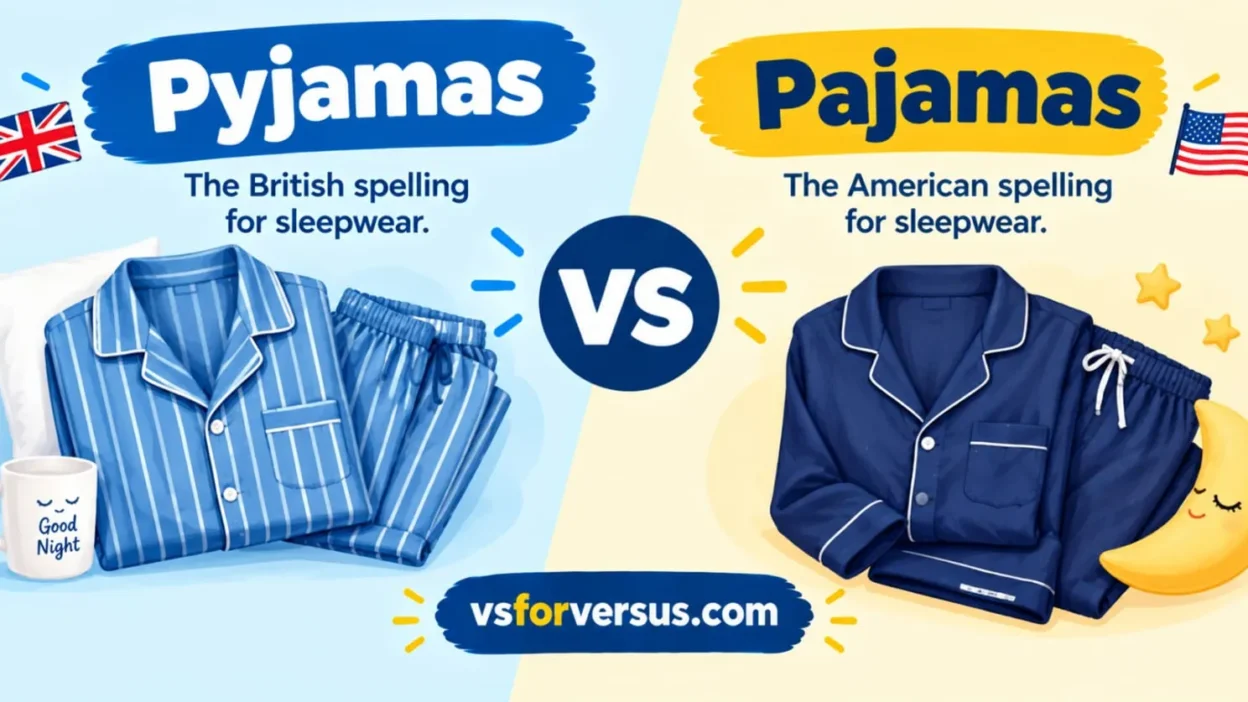
Pyjamas vs Pajamas have exactly the same meaning, referring to the comfortable clothing worn for sleeping at night, with the only difference being spelling, which varies according to geography. Pyjamas is the spelling prevalent in British English and is mostly written this way in the UK, India, Pakistan, and other Commonwealth countries.
On the other hand, Pajamas is the American English spelling, commonly used in the United States and Canada. The word is actually derived from the Hindi/Urdu word “paajama,” meaning “leg garment,” which is why its roots are connected to South Asia. Words like these are called “spelling variants,” where the pronunciation stays the same but the way of writing changes according to the English of different countries.
Quick Answer
Pyjamas vs pajamas comes down to regional spelling, not meaning; they’re the same word. “Pajamas” is the standard spelling in American English, while “pyjamas” is used in British English and most Commonwealth countries, including the UK, Australia, India, and New Zealand. Both spellings are pronounced identically and refer to comfortable clothing worn for sleeping.
Pyjamas vs Pajamas at a Glance
Here’s the entire pyjamas vs pajamas comparison in one table:
| Word | Part of Speech | Meaning | Example |
| Pajamas | Plural noun (American English) | Loose, comfortable clothing worn for sleeping | “She packed her favorite pajamas for the sleepover.” |
| Pyjamas | Plural noun (British English) | Same as pajamas, sleepwear | “He wore his striped pyjamas to bed every night.” |
| Pajama / Pyjama | Adjective / singular form | Used before a noun, as in “pajama party” | “The office held a pajama day to boost morale.” |
Notice that both words are plural nouns in their standard form; you wouldn’t say “a pajama” any more than you’d say “a scissor.” The singular form only appears as an adjective, as shown above in “pajama party.”
Regional Usage: Who Says What
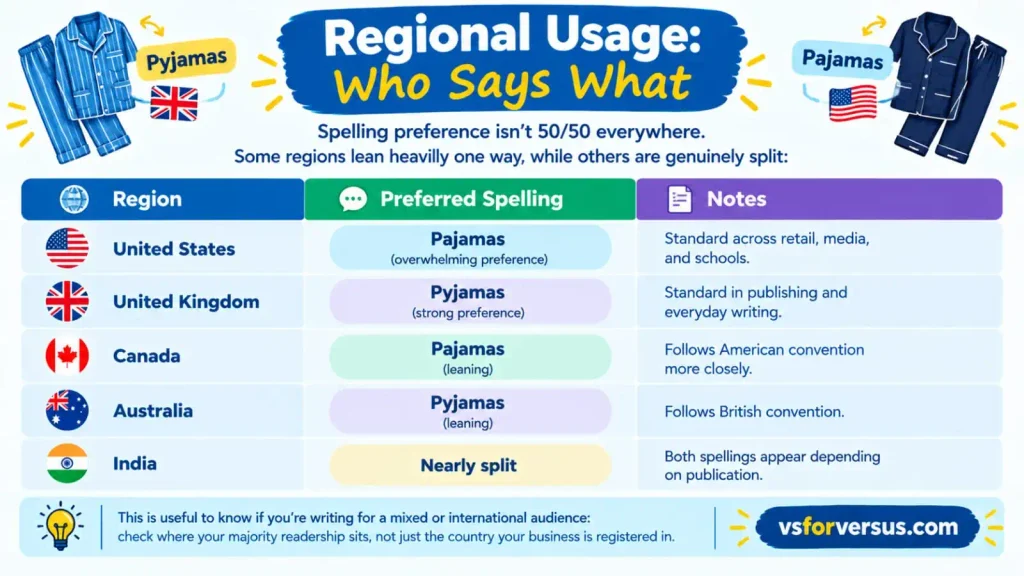
Spelling preference isn’t 50/50 everywhere. Some regions lean heavily one way, while others are genuinely split:
| Region | Preferred Spelling | Notes |
| United States | Pajamas (overwhelming preference) | Standard across retail, media, and schools |
| United Kingdom | Pyjamas (strong preference) | Standard in publishing and everyday writing |
| Canada | Pajamas (leaning) | Follows American convention more closely |
| Australia | Pyjamas (leaning) | Follows British convention |
| India | Nearly split | Both spellings appear depending on publication |
This is useful to know if you’re writing for a mixed or international audience: check where your majority readership sits, not just the country your business is registered in.
“Pajamas”, American English Spelling
Pajamas is the spelling you’ll see in the United States, Canada, and the Philippines. It’s a plural noun referring to any loose, comfortable clothing worn to bed, whether that’s a matching flannel set, an oversized T-shirt, or a onesie your toddler refuses to take off. This mirrors other simplified American spellings; see our guide on color vs colour for a similar US/UK pattern.
You’ll see it in writing like this:
- “Can we do the Zoom call at 10 instead? I’m still in my pajamas, and my coffee hasn’t kicked in yet.”
- The listing read: Women’s Cotton Pajamas, Soft, Breathable, Machine Washable.
- My professor once admitted she graded half our midterms in her pajamas because the heating in her office broke.
- “Pajama Day is this Friday; kids can wear their comfiest PJs to school.”
You’ll find “pajamas” dominating American retail listings, school newsletters, casual emails, and everyday conversation. If your audience is U.S. based, this is the spelling to default to, consistently.
“Pyjamas”, British English Spelling
Pyjamas is the preferred spelling across the UK, Australia, New Zealand, South Africa, and much of India. It carries the identical meaning and pronunciation as its American counterpart; the only change is that extra “y.” For more on how British spelling holds onto older forms, see our breakdown of British spelling conventions.
Some natural examples:
- A British parenting forum post read: “My daughter refuses to wear anything but her unicorn pyjamas, even in summer.”
- John Boyne’s novel The Boy in the Striped Pyjamas uses the British spelling throughout, since both the author and original publisher are UK based.
- “Pop your pyjamas on, we’re reading one more story, then it’s lights out.”
- A UK school sent a note home asking parents to stop dropping children off in their pyjamas during the winter term.
If you’re writing for a British, Australian, or Commonwealth audience, a UK based client’s blog, an Australian retailer, or an Indian English publication, “pyjamas” is the spelling readers expect to see.
Where the Word Comes From
The etymology behind pyjamas vs pajamas traces back further than either spelling. The word originates from the Persian pāy jāma, literally meaning “leg garment”: pāy for leg, jāma for clothing. This term was adopted into Hindi and Urdu, referring to loose trousers tied at the waist, long before it entered English.
British colonists in India during the 17th and 18th centuries picked up the word and the garment style and brought both back to England. Dictionaries still reflect this regional split today: Merriam Webster lists “pajamas” as its primary American entry, while the Oxford English Dictionary favors “pyjamas.” Neither is treated as an error, just a documented regional variant.
Why Your Eyes and Ears Disagree on This Word
Here’s something almost nobody talks about: if you grew up reading mostly American English, the word “pyjamas” can genuinely trip up your inner voice. Your eyes want to read that first syllable as “pee,” the way you’d pronounce “pylon” or “python.” For a split second, you might silently mispronounce it as “pee jamas” before your brain catches up and corrects itself.
The reassuring part: both spellings are pronounced the same way, “puh JAH muhz.” The “y” in “pyjamas” is purely visual; it doesn’t change a single sound. Even experienced writers and confident readers get that flicker of hesitation the first few times they encounter the British spelling in print. It’s not a sign you’re bad at English. It’s just a spelling convention doing something unfamiliar to your eyes.
Key Differences Between Pajamas vs Pyjamas
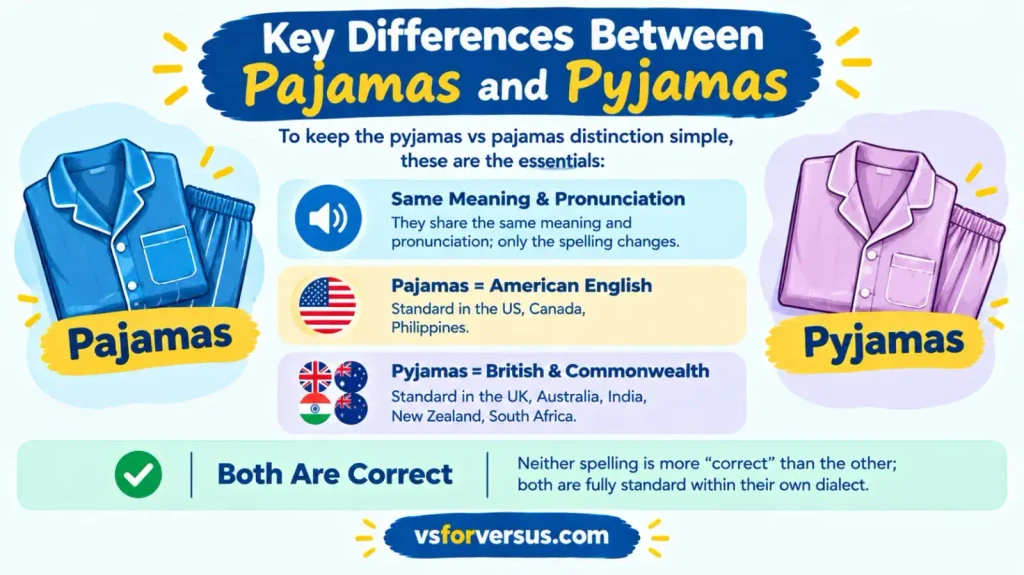
To keep the pyjamas vs pajamas distinction simple, these are the essentials:
- They share the same meaning and pronunciation; only the spelling changes.
- Pajamas is standard in American English (US, Canada, Philippines).
- Pyjamas is standard in British and Commonwealth English (UK, Australia, India, New Zealand, South Africa).
- Neither spelling is more “correct” than the other; both are fully standard within their own dialect.
Quick decision checklist:
- Where is your reader? Identify whether your audience is primarily American or British/Commonwealth.
- Match the spelling. Use “pajamas” for US readers, “pyjamas” for UK/Commonwealth readers.
- Stay consistent. Apply that choice across the entire document, page, or site; never mix the two.
Memory Trick to Remember the Difference
If you only remember one thing from this article, make it this: pAjamas has an extra A, just like America.
That’s it. American English adds the A; British English keeps the Y. Picture it as a tiny flag: 🇺🇸 pAjamas, 🇬🇧 pYjamas, and you’ll never second guess yourself again. This same “A for America” logic shows up in a handful of other US/UK spelling splits, so once it clicks here, it tends to stick for good.
Common Mistakes to Avoid
Even careful writers slip up on pyjamas vs pajamas in a few predictable ways:
- ❌ “I found the cutest pyjama online.” → ✅ “I found the cutest pajamas online.” It’s a plural noun, never a singular item.
- ❌ Using “pajamas” in the opening paragraph of an article and “pyjamas” by the closing one. → ✅ Pick one spelling and use it consistently from headline to footer.
- ❌ Assuming “pyjamas” is old-fashioned or on its way out. → ✅ Recognize it as simply regional, not outdated.
- ❌ “I bought new pajama’s for the trip.” → ✅ “I bought new pajamas for the trip.” No apostrophe is needed; it’s a plain plural, not a possessive.
Quick Quiz, Test Yourself
Try these before checking the answers below:
- Which spelling would a British newspaper most likely use, “pajamas” or “pyjamas”?
- Fill in the blank: “In the United States, most retailers write ___.” (pajamas/pyjamas)
- True or False: “Pyjamas” is pronounced differently from “pajamas.”
- Which spelling would you expect on an Australian clothing website?
- What’s the correct way to use “pajama” as a single word, noun or adjective?
Answers: 1. Pyjamas, 2. Pajamas, 3. False; they’re pronounced identically. 4. Pyjamas, 5. Adjective only (e.g., “pajama party”), never as a standalone singular noun.
Frequently Asked Questions
Is it pyjamas or pajamas in the UK?
Pyjamas. British English consistently uses the “y” spelling in fashion, literature, and everyday writing.
Is it pyjamas or pajamas in the US?
Pajamas. American English overwhelmingly favors the “a” spelling across retail, media, and casual writing.
Do pyjamas and pajamas mean the same thing?
Yes, completely. There’s no difference in the garment, style, or usage, only in regional spelling.
Which spelling is correct in the pyjamas vs pajamas debate?
Both are correct. The choice depends entirely on which English dialect your audience uses, not on grammatical accuracy.
Why do British people spell it “pyjamas”?
The British spelling stayed closer to the word’s original path through Persian, Hindi, and Urdu, while American English later simplified it.
Can I use pyjamas and pajamas interchangeably in my writing?
They mean the same thing, but you shouldn’t mix them within a single piece of writing. Pick one spelling based on your audience and keep it consistent throughout.
The Bottom Line
At the end of the day, pyjamas vs pajamas isn’t a grammar rule you need to agonize over. It’s a regional preference, the same as color/colour or theater/theatre. Use “pajamas” for American readers, “pyjamas” for British and Commonwealth ones, and let consistency do the rest of the work. Once you’ve got the “extra A, like America” trick locked in, you won’t have to think twice again.
To read more: “Pre vs Post: The Best Real Difference Explained 2026”

Marcus is a former product manager turned comparison writer who spent eight years testing tools and gadgets before quitting to write full-time. He specializes in breaking down tech and software matchups into plain-English verdicts, with a soft spot for buying guides nobody else wants to write.