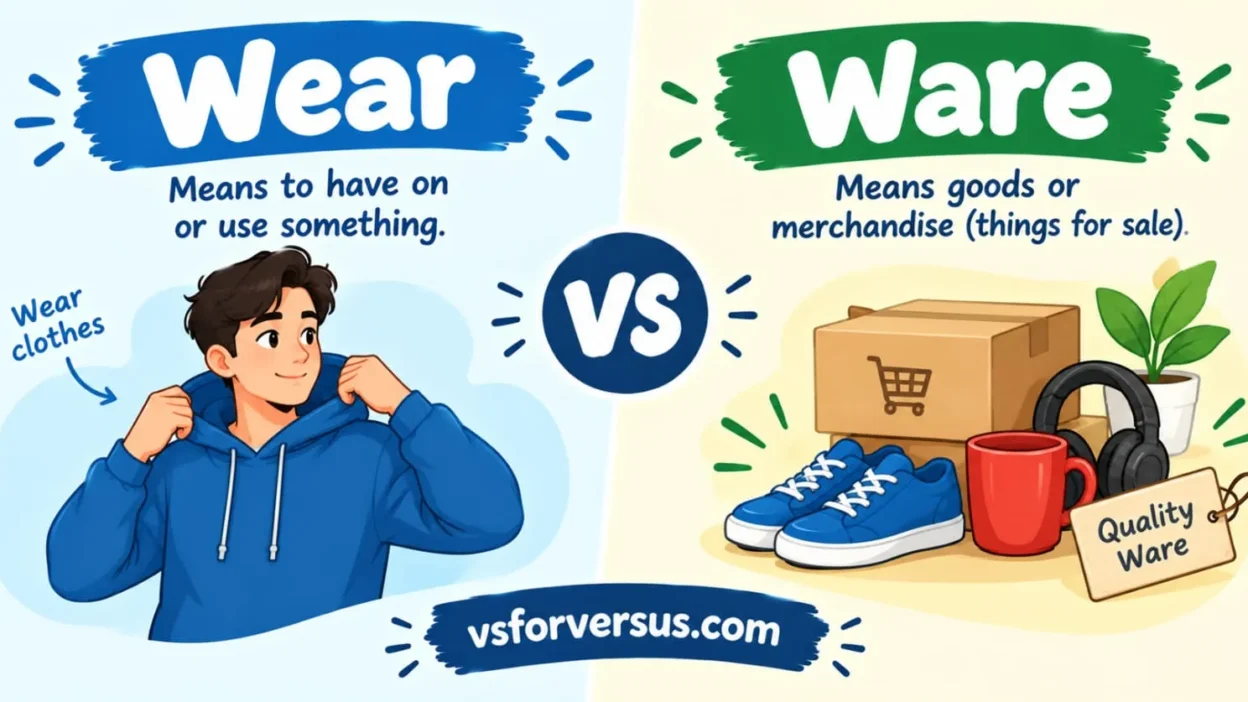
Wear vs Ware in english is full of word pairs that sound identical but point in completely different directions, and this one catches people off guard more often than you’d expect. Despite being pronounced exactly the same, these words come from different origins and serve entirely separate functions in a sentence.
Wear is primarily a verb, meaning to have clothing or accessories on your body, as in “she decided to wear her favorite jacket,” though it can also mean to gradually damage something through use, as in “the tires started to wear thin.” Ware, on the other hand, functions mainly as a noun or suffix, referring to manufactured goods or products, such as “glassware” or “software,” and is rarely used on its own in modern English outside of compound words.
Because they’re homophones, this mix up often slips past spellcheckers entirely. In this article, we’ll break down the origins of both words, their correct usage, and clear examples to help you tell them apart for good.
Quick Answer:
Wear vs ware comes down to meaning. Wear is a verb meaning to have clothing or accessories on your body, or to wear something down through use (“I wear glasses”). Ware is a noun for goods that are sold. It usually appears as the plural wares or inside compounds like software (“She sold her wares at the market”). The two words sound identical, so meaning decides the spelling.
Wear vs Ware at a Glance
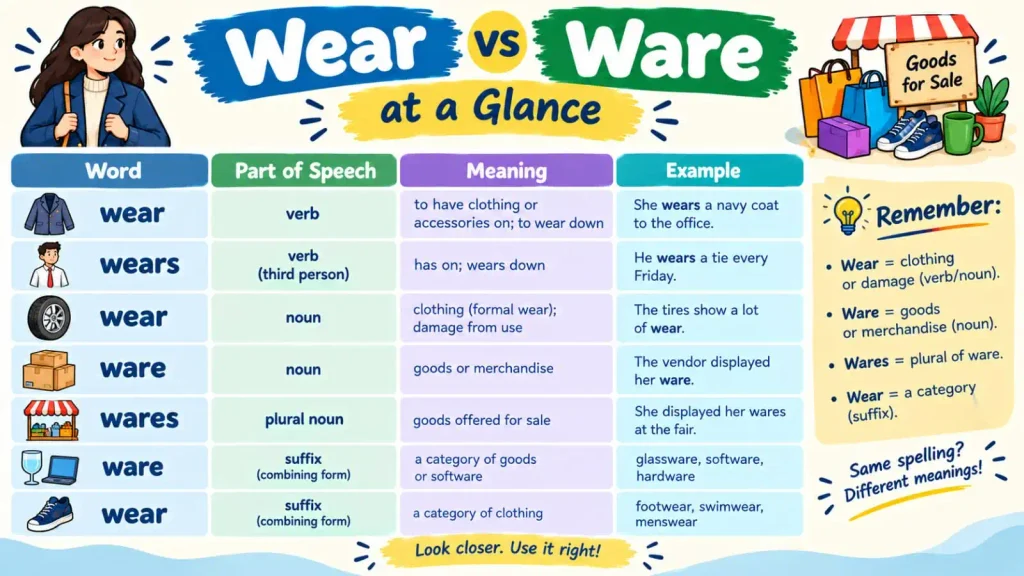
| Word | Part of Speech | Meaning | Example |
| wear | verb | to have clothing or accessories on; to wear down | She wears a navy coat to the office. |
| wears | verb (third person) | has on; wears down | He wears a tie every Friday. |
| wear | noun | clothing (formal wear); damage from use | The tires show a lot of wear. |
| ware | noun | goods or merchandise | The vendor displayed her ware. |
| wares | plural noun | goods offered for sale | She displayed her wares at the fair. |
| ware | suffix (combining form) | a category of goods or software | glassware, software, hardware |
| wear | suffix (combining form) | a category of clothing | footwear, swimwear, menswear |
What Does “Wear” Mean?
Wear is the busier of the two words. As a verb, it covers two ideas: having something on your body, and gradually damaging something through use. It is also an irregular verb, so the forms are wear, wore, worn, wearing, and wears. You might say, “I wore my blue blazer yesterday,” or “She has worn those boots for years.”
Everyday writing offers plenty of examples:
- “What should I wear to the interview on Thursday?”
- “Please wear closed toe shoes on the warehouse floor.”
- “Stop and go traffic will wear down your brake pads faster than highway driving.”
- “The sofa shows a lot of wear around the armrests.”
You will meet wear in dress codes, outfit captions, packing lists, and maintenance notes. As a noun, it also appears in formal wear and in the idiom wear and tear, which means the ordinary damage that comes from regular use.
What Does “Ware” Mean?
Ware is a noun meaning goods or merchandise. On its own, you will mostly see the plural, wares, as in “selling your wares,” which gives the word a market stall feel. The singular lives mainly inside compounds and in words for pottery, such as earthenware.
Some examples in context:
- “The potter laid out her wares on a folding table by the entrance.”
- “We stock glassware, cookware, and a small range of homeware.”
- “The software update is rolling out to everyone on Monday.”
- “Please move the stoneware to the top shelf before the delivery arrives.”
Ware turns up in retail listings, product catalogs, antiques, and IT documentation. A little word history helps, too. Wear comes from Old English werian, while ware comes from waru. The two are unrelated despite sounding alike. Even beware and aware belong to a different family, built on an old adjective meaning watchful, so they have nothing to do with merchandise.
The inflected forms add one more wrinkle. “Wears” with an s is the third person verb (“He wears a tie every Friday”), while “wares” is the plural noun for goods (“Check out her wares”). Because the extra s makes both look like plurals, writers sometimes treat them as interchangeable. Only wares ever means merchandise. If you catch yourself typing “her wears,” swap in “her goods.” If that works, you want wares.
Key Differences Between Wear vs Ware
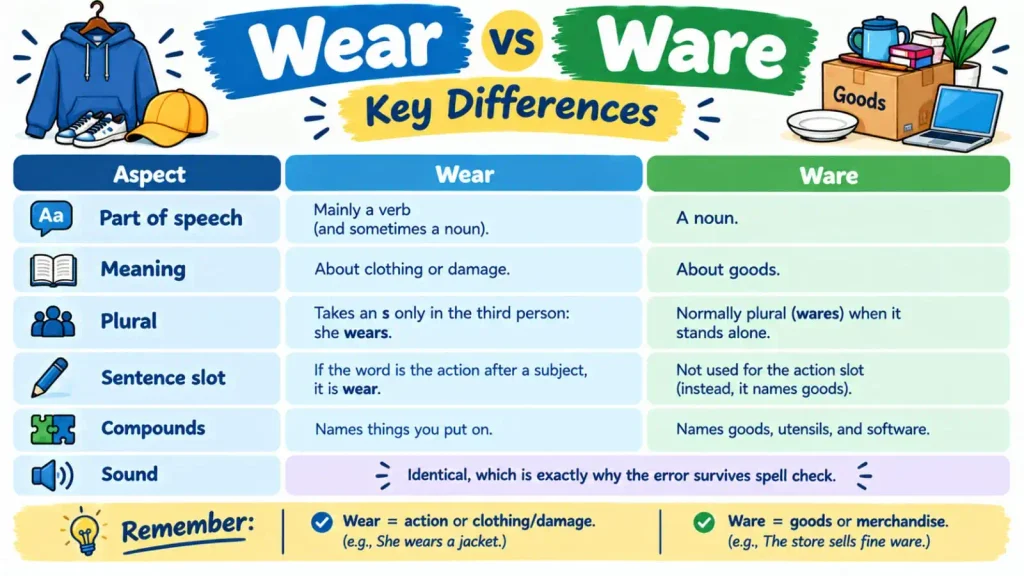
Here is the wear vs ware comparison in scannable form:
- Part of speech: Wear is mainly a verb (and sometimes a noun). Ware is a noun.
- Meaning: Wear is about clothing or damage. Ware is about goods.
- Plural: Ware is normally plural (wares) when it stands alone. As a verb, wear takes an s only in the third person: she wears.
- Sentence slot: If the word is the action after a subject, it is wear.
- Compounds: wear names things you put on. ware names goods, utensils, and software.
- Sound: Identical, which is exactly why the error survives spell check.
How to Choose Between wear vs ware in Compound Words?
Most real world slips happen inside compound words, not on their own. Ask one question: can you put it on your body? If yes, the ending is wear. If it is goods, tableware, tools, or software, the ending is ware.
| Compound | Ending | Why |
| swimwear, sportswear, outerwear, workwear | wear | you put them on |
| footwear, eyewear | wear | worn items |
| kitchenware, cookware, glassware, silverware | ware | goods and utensils |
| software, hardware, malware, firmware | ware | tech products |
Experienced writers slip here too, because a wrong ending still looks plausible. A copy editor skimming a catalog at the end of a long day can read “glasswear” and see nothing odd, since the brain fills in the expected word.
Some pairs exist in both spellings, and the meaning changes with the ending. Homeware means household goods like candles and storage baskets, while homewear is a fashion term for loungewear. Likewise, “vintage wear” describes old clothing, and “vintage ware” describes old pottery or other goods.
The tech world explains why ware feels so common. The suffix began with software and hardware, then spread to malware, firmware, and freeware. In every case, the ending names a product category, never clothing. That gives you a handy clue for any new ware coinage: it almost certainly refers to something built or sold, not something worn.
So when you write a product title, ask what the customer will do with the item. Will they wear it, or use and sell it?
Common Mistakes with Wear vs Ware
The table below lists six errors that show up constantly in emails, listings, and social posts, along with the fix for each.
| # | Incorrect | Correct | Why |
|---|---|---|---|
| 1 | ❌ “I ware a hat to work.” | ✅ “I wear a hat to work.” | A verb is needed. |
| 2 | ❌ “The store sells kitchenwear.” | ✅ “The store sells kitchenware.” | Utensils and goods take ware. |
| 3 | ❌ “These boots will ware out fast.” | ✅ “These boots will wear out fast.” | “Wear out” is a verb phrase. |
| 4 | ❌ “She sells her wears at the fair.” | ✅ “She sells her wares at the fair.” | Goods for sale are wares. |
| 5 | ❌ “Download the free softwear today.” | ✅ “Download the free software today.” | Software is a tech product, so it takes ware. |
| 6 | ❌ “The new hire forgot what to ware.” | ✅ “The new hire forgot what to wear.” | This is a question about clothing. |
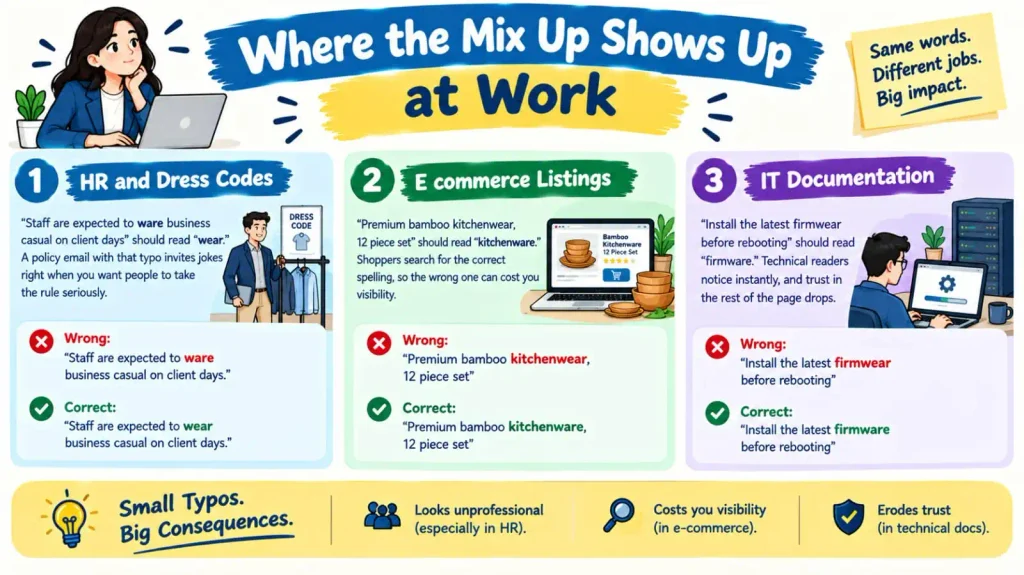
Where the Mix Up Shows Up at Work
The same slip looks different depending on the job. Three realistic cases:
- HR and dress codes: “Staff are expected to ware business casual on client days” should read “wear.” A policy email with that typo invites jokes right when you want people to take the rule seriously.
- E commerce listings: “Premium bamboo kitchenwear, 12 piece set” should read “kitchenware.” Shoppers search for the correct spelling, so the wrong one can cost you visibility.
- IT documentation: “Install the latest firmwear before rebooting” should read “firmware.” Technical readers notice instantly, and trust in the rest of the page drops.
Wear vs Ware vs Where
A third homophone often joins the party. Where is an adverb for place: “Where is the market?” It sounds the same as wear and ware, but it asks about location, so it never fits a sentence about clothing or goods. Writing “Where a coat today” when you mean “Wear a coat today” swaps in the wrong homophone. For the full breakdown of that pair, see our guide to wear vs where.
Quick Quiz: Wear or Ware?
Try these, then check the answers below.
- What are you going to ___ to the interview?
- The vendor laid out her ___ on the table.
- Is it kitchenware or kitchenwear?
- These tires show a lot of ___.
- Is it swimware or swimwear?
Answers: 1. wear. 2. wares. 3. kitchenware (goods). 4. wear (damage noun). 5. swimwear (clothing).
FAQs About Wear and Ware
What is the difference between wear vs ware?
Wear is a verb meaning to have something on or to wear it down, and it is also a noun for clothing or damage. Ware is a noun for goods or merchandise. They sound identical, so the meaning decides the spelling. In short, wear vs ware is a question of clothes versus goods.
Is it “what to wear” or “what to ware”?
“What to wear” is correct. The question is about clothing, and clothing needs the verb wear. Ware names goods for sale, so it never fits that sentence.
Is “ware” a real word?
Yes, ware is a real word. It is a noun meaning goods or articles made of a certain material. It is usually plural (wares) or part of a compound like software or silverware. It is rarer on its own, which is why many people assume it is a typo.
Is it footwear or footware?
Footwear is the correct spelling. You put footwear on your feet, so it takes wear. Use ware for goods and utensils, such as glassware, and for tech terms like hardware.
Is “wear” a noun or a verb?
Wear is both a verb and a noun. As a verb, it means to have something on (wear a coat). As a noun, it means clothing (formal wear) or damage from use (wear and tear).
How do you remember wear vs ware?
Think: ware is for the store, wear is for the body. If you put it on, use wear. If it is goods you buy or sell, use ware.
What does “wares” mean?
Wares are goods or products offered for sale, especially by a vendor or craftsperson. The word often appears in phrases like “selling your wares” or “displaying her wares at the fair,” and it always refers to merchandise, never clothing.
What is the past tense of wear?
The simple past is “wore” (she wore a green scarf), and the past participle is “worn” (she has worn it all winter). Wear is an irregular verb, so neither form adds ed. Ware is a noun, so it has no tense.
The Bottom Line
Both words are real, both sound the same, and your spell checker will let either one through. Meaning is the only filter you have. Ask whether you are putting something on (wear) or selling something (ware), and the answer follows. Once that habit sticks, wear vs ware stops being a problem.
To read more: Waist vs Waste: What’s the Difference? 2026

Marcus is a former product manager turned comparison writer who spent eight years testing tools and gadgets before quitting to write full-time. He specializes in breaking down tech and software matchups into plain-English verdicts, with a soft spot for buying guides nobody else wants to write.