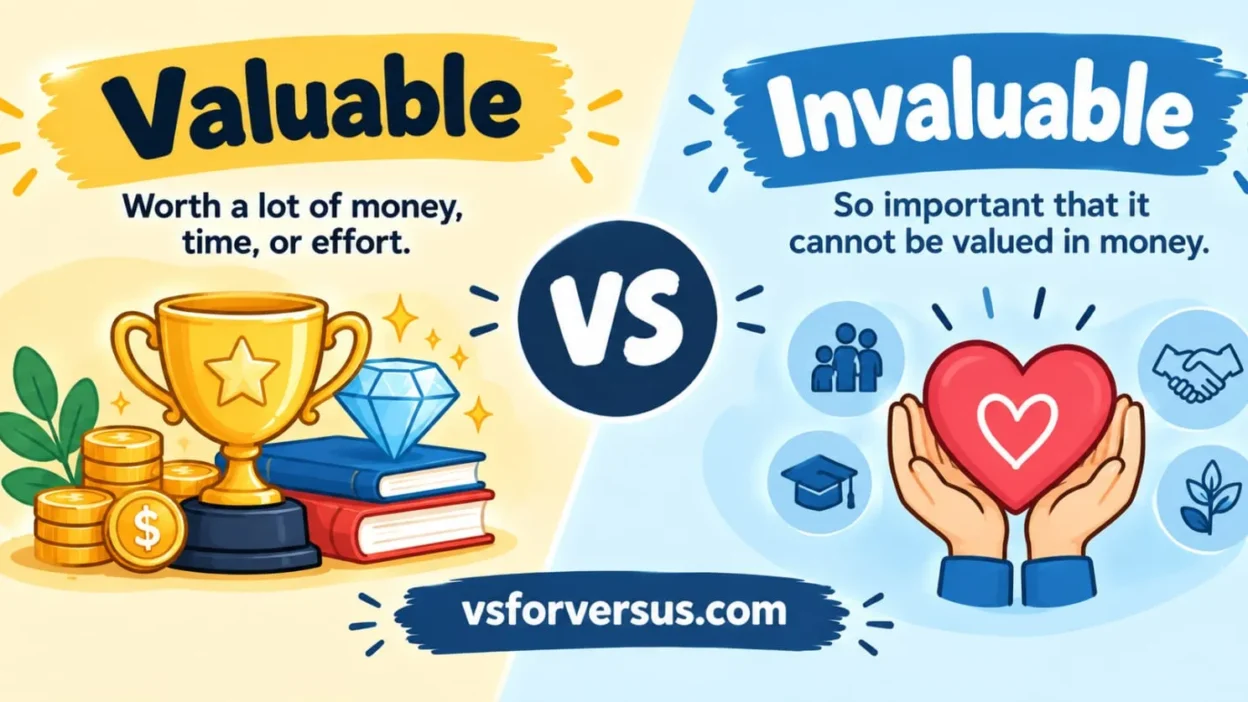
Valuable vs Invaluable on the surface, adding the prefix “in,” usually creates an opposite meaning, which is exactly why this word pair confuses so many writers. Logic suggests “invaluable” should mean “not valuable,” but the actual meaning flips that assumption completely.
Valuable describes something that has significant worth, whether financial, practical, or sentimental, such as a valuable piece of jewelry or valuable advice. Invaluable, however, doesn’t mean worthless; it means something is so precious or important that its value can’t even be measured, making it more valuable than “valuable” itself, as in “her experience was invaluable to the project’s success.”
This unexpected twist makes “invaluable” one of the trickiest prefix,based words in English. In this article, we’ll explore the origins of both terms, clarify their correct usage, and share clear examples to help you use them accurately every time.
Quick Answer
Valuable means worth a lot, whether in money, usefulness, or importance. Invaluable means so valuable that its worth cannot be measured, which makes it a stronger word, not the opposite. The difference between valuable and invaluable is degree: write valuable when a price is imaginable, and invaluable when no price would be enough.
Picture Daniela, three months into her first job as a project coordinator. The product launch goes well, and her director sends a short note: “Your work on this was invaluable.” Daniela reads it twice. The prefix in, usually means “not.” Does that mean her work counted for nothing? She spends the evening drafting a careful, slightly defensive reply asking whether there were “concerns about the launch.” The next morning her director, puzzled, has to explain that the note was the highest praise she gives.
Valuable vs Invaluable at a Glance
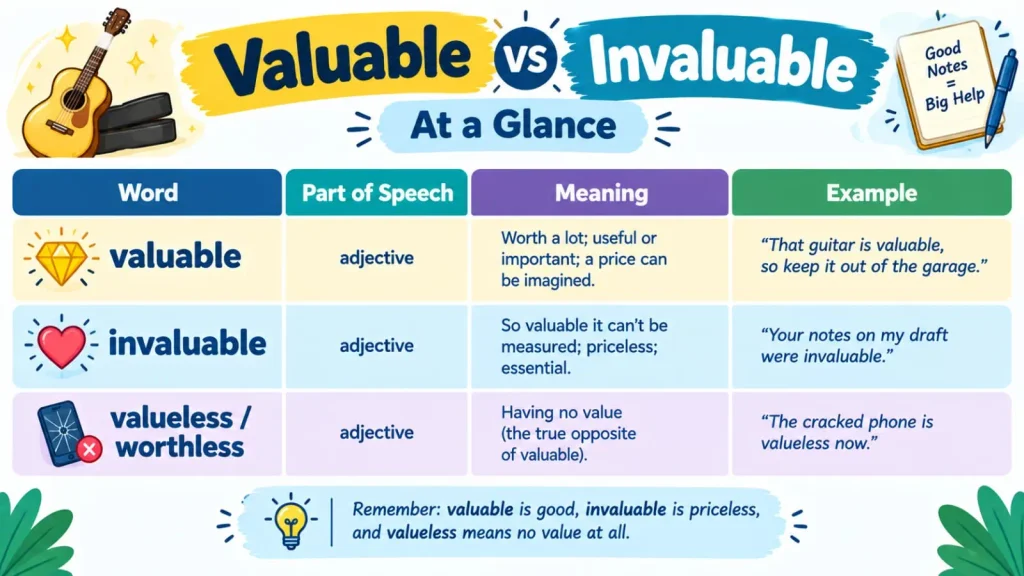
| Word | Part of Speech | Meaning | Example |
| valuable | adjective | Worth a lot; useful or important; a price can be imagined | “That guitar is valuable, so keep it out of the garage.” |
| invaluable | adjective | So valuable it can’t be measured; priceless; essential | “Your notes on my draft were invaluable.” |
| valueless / worthless | adjective | Having no value (the true opposite of valuable) | “The cracked phone is valueless now.” |
What Does “Valuable” Mean?
Something valuable has worth. That worth might be money, usefulness, or qualities people admire. With a valuable thing, you can usually imagine a price, a ranking, or a comparison.
In real writing, the word sounds like this:
- “I had my grandmother’s ring appraised, and it’s worth far more than we thought. It’s a valuable piece.”
- “Thanks for running the workshop. The tips on pricing were really valuable.”
- “Learning basic Excel is a valuable skill for almost any office job.”
- “Ruth has been a valuable friend through this whole move.”
You will meet the word most often in appraisals, shopping, and insurance; in job ads and résumés (“valuable experience”); and in everyday feedback (“valuable insights,” “valuable information”). It is gradable, so “very valuable,” “more valuable,” and “most valuable player” all work.
What Does “Invaluable” Mean?
Invaluable means beyond calculable worth: so precious, essential, or irreplaceable that no figure could capture it. Its meaning sits close to priceless, and its synonyms include inestimable and incalculable. Indispensable is a near neighbor, though it stresses “can’t do without,” while invaluable stresses “can’t be priced.”
- “Our neighbor’s help after the flood was invaluable. We’d have been lost without her.”
- “The archive’s letters are invaluable to anyone researching the town’s history.”
- “Honestly, your comments on my draft were invaluable. Thank you.”
- “A good mentor is invaluable in your first year as a manager.”
Thank,you messages, recommendation letters, research sources, and family keepsakes are where it appears most. Typical collocations are “invaluable asset,” “invaluable resource,” and “invaluable experience.” As for prepositions, “invaluable to” usually names a person (“invaluable to our team”), while “invaluable in” or “invaluable for” names a purpose (“invaluable in negotiations”).
Why Does Invaluable Look Like the Opposite?
The word uses the prefix in,, which usually means “not,” but here it means “not able to be valued.” The worth is too high to measure, so the word means priceless, not worthless.
The logic is easier to see with the word’s parts. Valuable is value plus ,able: able to be valued. Add in,, and you get “not able to be valued,” because no number is big enough.
The prefix trips people up because in, does several jobs in English. Negative: incurable (not curable), informal (not formal)
- Intensifier: inflame
- Locator: inland, indoors
One popular forum explanation claims in, simply means “very” here. It doesn’t. The prefix means “not,” and the result just happens to sound stronger.
You may also read that the two words are interchangeable. In casual speech, they overlap, but a careful writer keeps them apart, because invaluable is the stronger choice.
Key Differences Between Valuable vs Invaluable
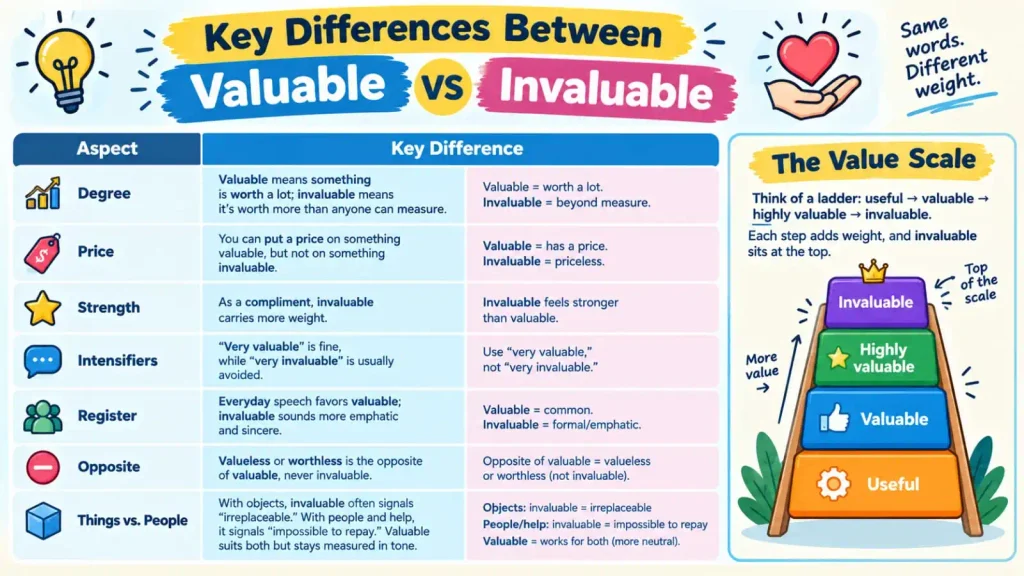
- Degree: valuable means something is worth a lot; invaluable means it’s worth more than anyone can measure.
- Price: you can put a price on something valuable, but not on something invaluable.
- Strength: as a compliment, invaluable carries more weight.
- Intensifiers: “very valuable” is fine, while “very invaluable” is usually avoided.
- Register: everyday speech favors valuable; invaluable sounds more emphatic and sincere.
- Opposite: valueless or worthless is the opposite of valuable, never invaluable.
- Things vs. people: with objects, invaluable often signals “irreplaceable” (“invaluable manuscripts”); with people and help, it signals “impossible to repay” (“invaluable support”). Valuable suits both but stays measured in tone.
The Value Scale
Think of a ladder: useful → valuable → highly valuable → invaluable. Each step adds weight, and invaluable sits at the top. (Graphic slot: a simple four,step ladder with alt text describing the scale.)
Which One Should You Use?
Ask yourself whether a price or ranking is imaginable. If it is, write valuable. If any number would undersell the thing, write invaluable. Because invaluable is a strong word, save it for real impact; used on every ordinary favor, it starts to read as filler.
Try it on a real situation. A colleague spends an hour teaching you the reporting system, and “That was a valuable session” is accurate and warm. Then she stays late for two weeks and rescues your quarter,end report. Now “Your help has been invaluable” is the better fit.
Valuable, Invaluable, Valueless, Priceless: Which Is Which?
Four words often sit near each other, so this table shows how they line up.
| Word | Direction | Best used for |
| valuable | Worth a lot | Things, skills, and advice with a clear worth |
| invaluable | Worth more than can be measured | Help, support, or sources no one could replace |
| priceless | Beyond any price | Keepsakes and moments that money can’t buy |
| valueless / worthless | No worth at all | Things that have lost their use or price |
There is one extra wrinkle. In informal English, priceless can also mean “hilarious” (“his face was priceless”), a sense invaluable never takes. That makes invaluable the safer choice in professional writing.
How to Remember the Difference?
Try this one,line memory trick for valuable vs invaluable: valuable has a price tag; invaluable is priceless.
If the prefix still feels backwards, tell yourself: “It sounds negative, but it’s the top of the scale.” The in, is not taking value away. It is saying that no value can hold the thing.
Common Mistakes Between Valuable vs Invaluable
Most errors with valuable vs invaluable fall into a few patterns:
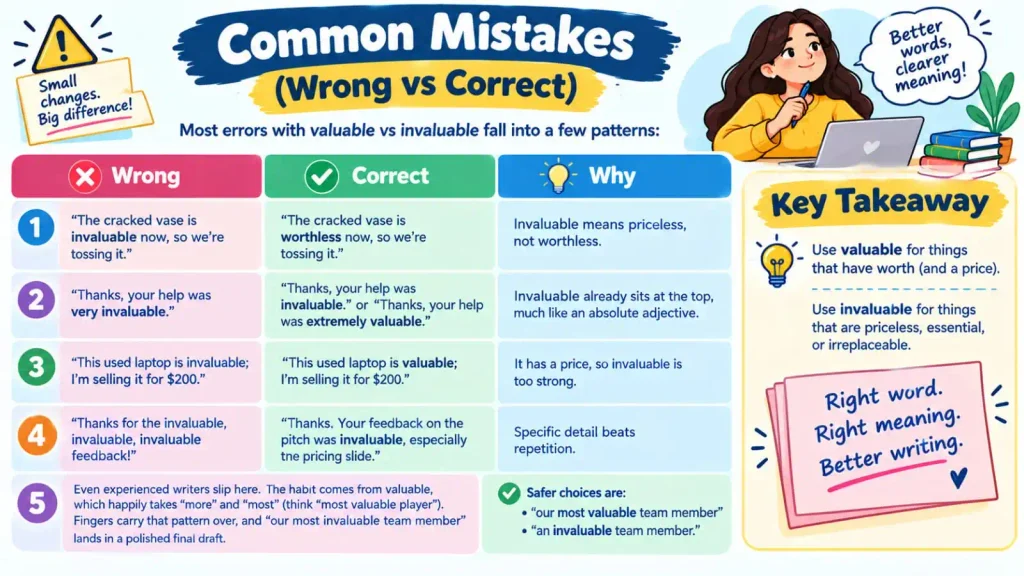
| Wrong | Correct | Why |
| “The cracked vase is invaluable now, so we’re tossing it.” | “The cracked vase is worthless now, so we’re tossing it.” | Invaluable means priceless, not worthless. |
| “Thanks, your help was very invaluable.” | “Thanks, your help was invaluable.” or “Thanks, your help was extremely valuable.” | Invaluable already sits at the top, much like an absolute adjective. |
| “This used laptop is invaluable; I’m selling it for $200.” | “This used laptop is valuable; I’m selling it for $200.” | It has a price, so invaluable is too strong. |
| “Thanks for the invaluable, invaluable, invaluable feedback!” | “Thanks. Your feedback on the pitch was invaluable, especially the pricing slide.” | Specific detail beats repetition. |
Even experienced writers slip here. The habit comes from valuable, which happily takes “more” and “most” (think “most valuable player”). Fingers carry that pattern over, and “our most invaluable team member” lands in a polished final draft. Safer choices are “our most valuable team member” or “an invaluable team member.”
Valuable vs Invaluable in Real Writing
Emails and messages. “Your feedback on the deck was invaluable” fits a thank,you to someone who spent real time helping. “That was a valuable conversation” suits a routine, useful call.
Résumés and cover letters. “Gained valuable experience in customer support” is safe and believable. “An invaluable asset to the team” is a bold claim, so back it with proof: “an invaluable asset who cut onboarding time by a third.”
Academic writing. “The survey produced valuable data on commuting habits.” “Parish records are invaluable primary sources for this period.” Reserve invaluable for material a field genuinely can’t replace.
Recommendation letters. Use invaluable once, for the strongest point, and let specifics carry the rest.
Before you hit send, read the sentence aloud. If invaluable feels like a bigger word than the situation, drop to valuable and add a specific detail. If valuable feels too polite for what someone actually did for you, step up to invaluable and say why.
Quick Quiz: Valuable or Invaluable?
Test yourself with this quick valuable vs invaluable check. Pick the best answer, then read the answers below.
- “The used laptop is ___, but it still sells for about $200.”
- “Without the volunteers, this project would have failed. Their help was ___.”
- True or false: invaluable means “worthless.”
- Which word is the true opposite of valuable: invaluable or valueless?
- Which sounds wrong: “very valuable,” “extremely valuable,” or “very invaluable”?
Answers:
- Valuable. It has a price, so invaluable is too strong.
- Invaluable. The help was essential and can’t be measured.
- False. It means priceless.
- Valueless. The prefix in invaluable does not make it the opposite.
- “Very invaluable.” Invaluable is already at the top of the scale.
Frequently Asked Questions
Is invaluable the opposite of valuable? No. Invaluable means priceless, not the opposite of valuable. The true opposite of valuable is valueless or worthless.
Does invaluable mean not valuable? Not in modern usage. Invaluable technically means “not able to be valued,” which now means too precious to measure.
What’s the simplest way to explain valuable vs invaluable? Valuable means worth a lot. Invaluable means worth so much that no price could capture it. One has a price tag; the other is priceless.
Can you say “very invaluable”? “Very invaluable” is usually avoided because invaluable is already extreme. Use invaluable alone, or say “extremely valuable.”
Is invaluable a compliment in an email? Yes, invaluable is a strong compliment in an email. It signals that the help was essential, so save it for contributions that truly earned it.
Is it “invaluable to” or “invaluable for”? “Invaluable to” is common for people (“invaluable to our team”), while “invaluable in” or “invaluable for” fits purposes (“invaluable in negotiations”).
Final Thoughts
Valuable vs Invaluable words that look like opposites but behave like allies are the ones that teach us to read closely. Invaluable is a perfect example: the prefix suggests loss, yet the meaning points to the greatest gain. Once you know that, the word stops being a puzzle and becomes a tool.
Use valuable for the many things that deserve honest credit, and keep invaluable for the few that deserve more than any price could say. Choose carefully, add a specific detail, and your praise will always land the way you meant it. Ready for more? Try the next quiz in our commonly confused words series.
To read more: Vain vs Vein: What’s the Shocking Difference? 2026

Marcus is a former product manager turned comparison writer who spent eight years testing tools and gadgets before quitting to write full-time. He specializes in breaking down tech and software matchups into plain-English verdicts, with a soft spot for buying guides nobody else wants to write.