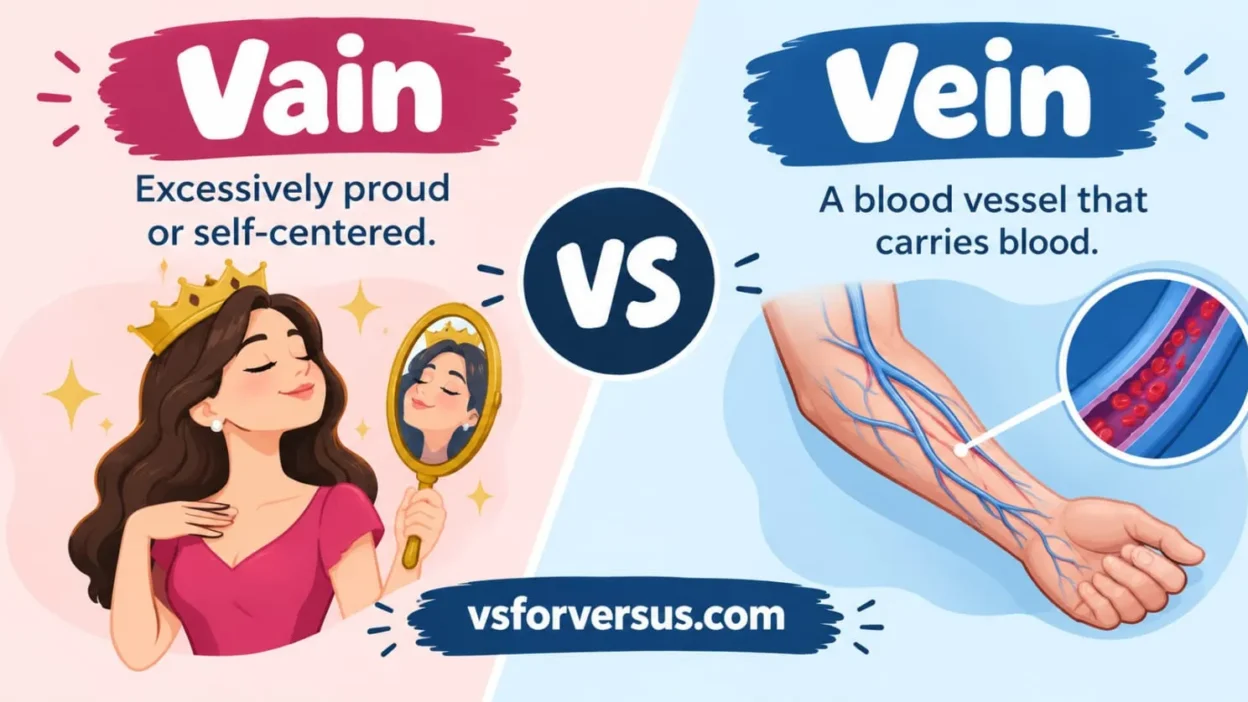
Vain vs Vein Spelling mix ups often happen with words that sound exactly alike but carry completely unrelated meanings, and this pair is a textbook example of that trap. Despite identical pronunciation, one word belongs to human anatomy while the other describes a personality trait.
Vein refers to a blood vessel that carries blood back to the heart, commonly used in medical and biological contexts, as in “the doctor checked her vein before drawing blood.” Vain, on the other hand, describes someone excessively concerned with their own appearance or achievements, often carrying a negative connotation, as in “he was too vain to admit his mistake.”
Because these words are homophones, spellcheckers rarely catch the error, making careful proofreading essential. In this article, we’ll explore the origins of both words, clarify their correct usage, and share clear examples to help you avoid this common mistake for good.
Quick Answer
Vain vs vein are homophones that sound identical but mean completely different things. Vain is an adjective describing someone excessively proud of their looks or achievements, or describing a hopeless effort, as in “a vain attempt.” Vein is a noun referring to a blood vessel that carries blood to the heart, or figuratively to a style or manner, as in “in the same vein.” When comparing vain vs. vein, the rule is simple: if it’s describing a person or a failed effort, use vain; if it’s a physical or figurative channel, use vein.
Vain vs Vein at a Glance
Here’s the full picture in one table, before we get into definitions. Bookmark it if you only need a quick reference here.
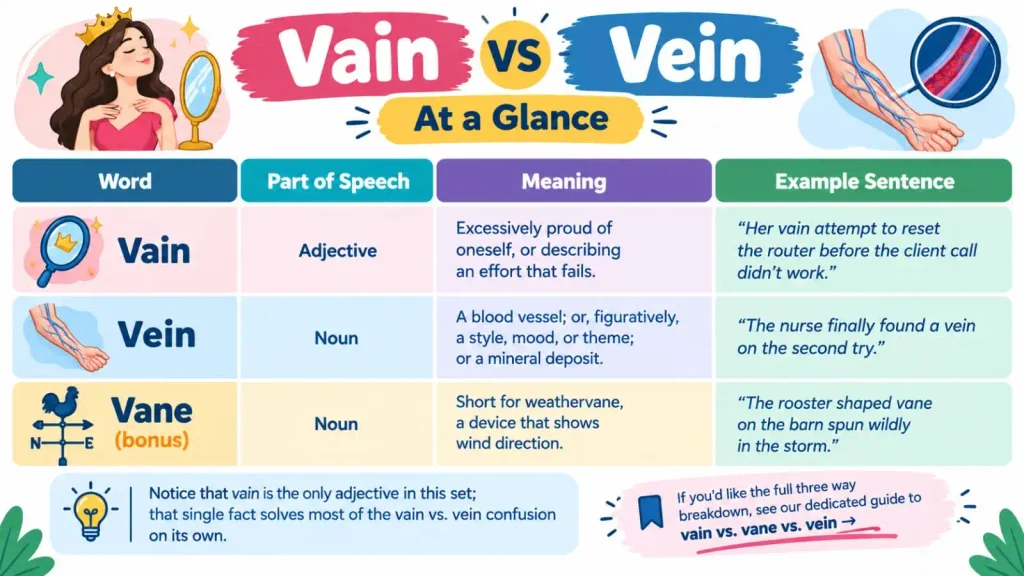
| Word | Part of Speech | Meaning | Example Sentence |
| Vain | Adjective | Excessively proud of oneself, or describing an effort that fails | “Her vain attempt to reset the router before the client call didn’t work.” |
| Vein | Noun | A blood vessel; or, figuratively, a style, mood, or theme; or a mineral deposit | “The nurse finally found a vein on the second try.” |
| Vane (bonus) | Noun | Short for weathervane, a device that shows wind direction | “The rooster shaped vane on the barn spun wildly in the storm.” |
Notice that vain is the only adjective in this set; that single fact solves most of the vain vs vein confusion on its own. If you’d like the full three way breakdown, see our dedicated guide to vain vs vane vs. vein →.
What Does “Vain” Mean?
Vain is an adjective with two related but distinct senses. One describes a person with an inflated sense of their own looks, talent, or importance. The other describes an action, effort, or hope that produces no result, something futile.
Here’s what that looks like in real writing:
- “He’s gotten so vain since the promotion; he mentions his new title in every meeting.”
- “I made a vain attempt to fix the leak myself before calling a plumber.”
- “Our pitch was, in the end, in vain; the client went with a competitor despite three rounds of edits.”
- “She checked her reflection in the elevator mirror one more time; her friends teased her for being vain about it.”
- “The professor’s essay comment read: ‘Avoid vainglorious language; let the research speak for itself.'”
- “He vainly insisted the numbers would turn around, even after the third quarter of losses.”
Those last two examples introduce related word forms worth knowing. Vainglorious is a slightly old fashioned, more intense cousin of vain; it means excessively proud or boastful, often in a way that invites mockery. Vainly is simply the adverb form, describing an action done in a vain, futile way (“he vainly tried” means he tried, but failed).
Vain shows up most in personality descriptions, social media captions, workplace gossip, character studies in essays, and in the fixed phrase in vain, which is common in professional writing whenever a project falls apart despite real effort: status updates, postmortems, and hard conversations about a deal that didn’t close. That idiom trips people up specifically because it sounds like it should have an “e.” We’ll get to why it doesn’t a little further down.
What Does “Vein” Mean?
Vein is a noun, and it carries three main meanings depending on context.
The most literal is anatomical: a vein is a blood vessel that carries blood back toward the heart; worth noting, this is different from an artery, which carries oxygen rich blood away from the heart. If you’re ever unsure which term applies in medical writing, our guide on vein vs artery → breaks down that distinction in detail.
A second, figurative sense describes a particular style, tone, or theme, something running through a piece of writing, art, or conversation. Less common is a geological sense, where a vein is a streak of mineral or ore running through rock.
Examples across those contexts:
- “The phlebotomist tapped my arm twice before finding a good vein.”
- “Her new album continues in the same vein as her earlier acoustic work, quiet, stripped back, personal.”
- “Geologists confirmed the site sits on a rich vein of copper.”
- In an email to the team: “In that same vein, let’s also test a shorter subject line next.”
- “The countertop had a beautiful veined pattern running through the marble.”
- “In his cover letter, he described his writing style as ‘in the vein of’ the outlet’s most popular columnist.”
That second to last example points to veined, the adjective form of vein, used to describe something marked with vein like lines, whether that’s marble, a leaf, or even skin. It’s a small but useful addition to your vocabulary once you’ve got the core vein vs vein distinction down.
Vein appears most in medical or health writing, in literary and music criticism (“in the vein of,” “in a similar vein”), and, less obviously, in everyday business writing, where “in that vein” or “along those lines” connects one idea to a related one. That last context is exactly where the vain vs vein mix up happens most in professional settings, because the phrase is common but its spelling isn’t intuitive.
Key Differences Between Vain vs Vein
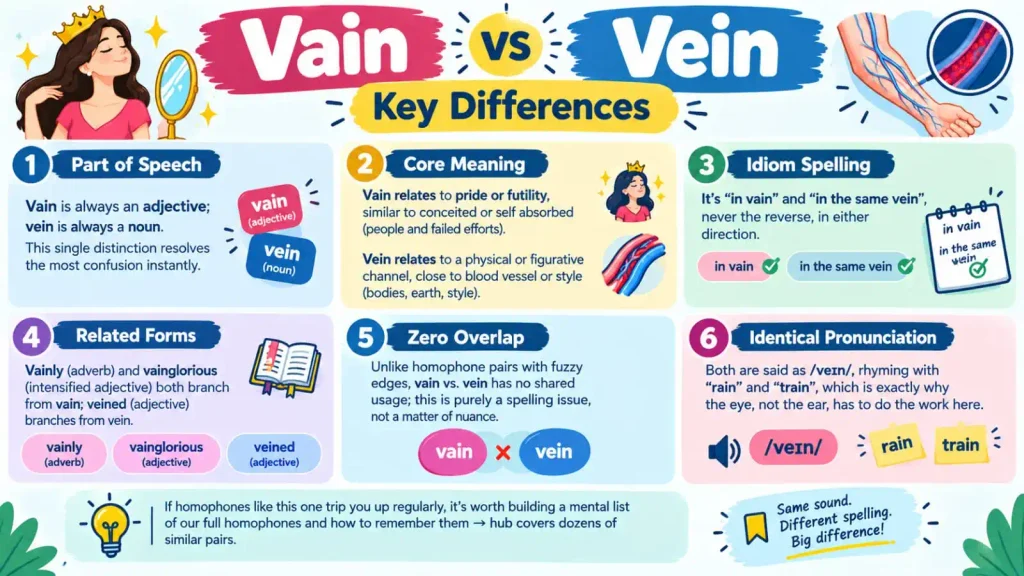
- Part of speech: vain is always an adjective; vein is always a noun. This single distinction resolves most confusion instantly.
- Core meaning: vain relates to pride or futility, similar to conceited or self absorbed (people and failed efforts); vein relates to a physical or figurative channel, close to blood vessel or style (bodies, earth, style)
- Idiom spelling: it’s “in vain” and “in the same vein”, never the reverse, in either direction
- Related forms: vainly (adverb) and vainglorious (intensified adjective) both branch from vain; veined (adjective) branches from vein
- Zero overlap: unlike homophone pairs with fuzzy edges, vain vs. vein has no shared usage; this is purely a spelling issue, not a matter of nuance.
- Identical pronunciation: both are said as /veɪn/, rhyming with “rain” and “train”, which is exactly why the eye, not the ear, has to do the work here
If homophones like this one trip you up regularly, it’s worth building a mental list of our full homophones and how to remember them → hub covers dozens of similar pairs.
Memory Trick: How to Never Mix Up Vain vs Vein Again?
Try this: vain has an “I” in it, just like the “I” someone vain can’t stop talking about. Picture that person checking a mirror and muttering “I, I, I”; that’s your adjective, spelled with the letter that matches the ego.
For vein, picture the physical: a vein is inside your body, part of your vessel system; both words start the same way, which makes the connection easy to hold onto.
For the idiom specifically, the one that catches plenty of confident writers off guard, think of vein as a pathway. A blood vessel is literally a pathway for blood; a mineral vein is a pathway of ore through rock. So when something continues “in the same vein,” it’s following the same pathway of thought or style as something before it. There’s no pathway involved in being vain, so the idiom can never take that spelling, no matter how natural it feels in the moment.
This same “picture it” approach works well for other tricky word pairs too; pairing a spelling to a mental image beats memorizing a rule you’ll forget under deadline pressure.
Common Mistakes with Vain vs Vein
Even experienced writers slip on this; it’s one of the most common corrections editors make in first drafts, precisely because these words don’t get flagged as typos.
| ❌ Wrong | ✅ Correct | Why It Happens |
| “He kept talking in that same vain about the merger.” | “He kept talking in that same vein about the merger.” | The idiom sounds identical either way, and “vain” simply looks more familiar to most writers. |
| “She died in vein trying to warn them.” | “She died in vain trying to warn them.” | Writers associate “vein” with intensity or drama (as in “bulging veins”), which subconsciously feels dramatic enough to fit. |
| “The doctor couldn’t find a good vain in his arm.” | “The doctor couldn’t find a good vein in his arm.” | Fast typing and autocorrect rarely catch this, since both spellings are real words. |
| “Don’t be so vein about your test scores.” | “Don’t be so vain about your test scores.” | This one is a pure homophone slip, no logical reason, just an unlucky guess. |
| “In that vain, let’s also revisit the budget.” | “In that vein, let’s also revisit the budget.” | Common in meeting notes and follow up emails, where speed matters more than spellcheck. |
That last row, “in that vain” slipping into meeting notes and follow up emails, is the single most common real world mistake with this pair, largely because the idiom sounds so natural that people never stop to question the spelling.
Quick Quiz: Test Yourself on Vain vs Vein
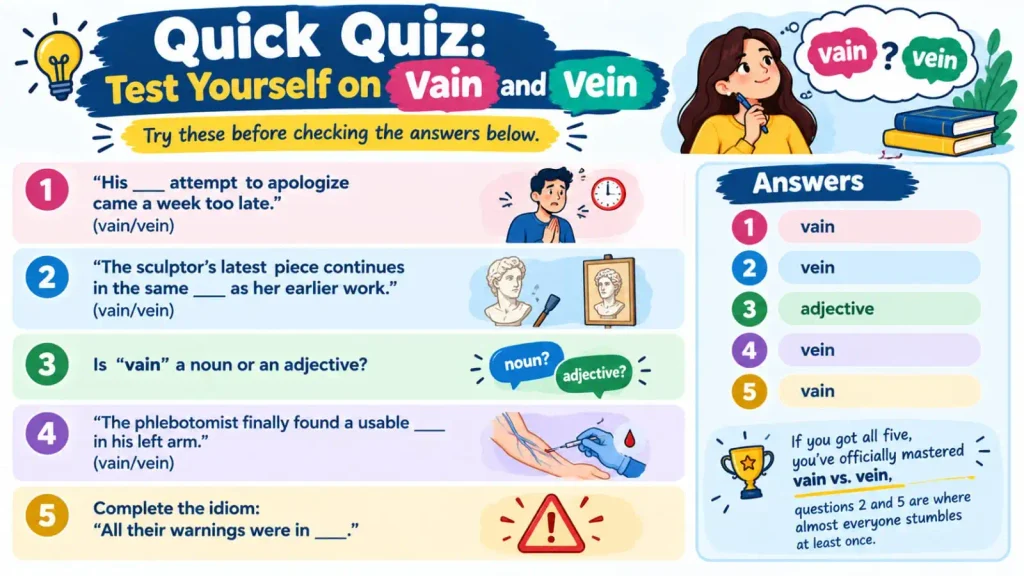
Try these before checking the answers below.
- “His ___ attempt to apologize came a week too late.” (vain/vein)
- “The sculptor’s latest piece continues in the same ___ as her earlier work.” (vain/vein)
- Is “vain” a noun or an adjective?
- “The phlebotomist finally found a usable ___ in his left arm.” (vain/vein)
- Complete the idiom: “All their warnings were in ___.”
Answers: 1. vain 2. vein 3. adjective 4. vein 5. vain
If you got all five, you’ve officially mastered vain vs. vein, questions 2 and 5 are where almost everyone stumbles at least once.
Frequently Asked Questions
What does “in vain” mean?
“In vain” means without success; an effort, hope, or attempt that produced no result. “They searched in vain for the missing file” means the search failed.
Is it “all in vain” or “all in vein”?
It’s “all in vain.” Since vain is the adjective meaning futile or unsuccessful, and the phrase describes an effort that failed, the correct spelling never includes an “e”; vein has one, vain doesn’t.
What is the difference between vain vs vein?
The core difference between vain vs vein comes down to part of speech and meaning: vain is an adjective describing pride or futility, while vein is a noun describing a blood vessel, a stylistic theme, or a mineral deposit.
Is vain a noun or an adjective?
Vain is always an adjective. It never functions as a noun, which is a useful shortcut: if the word in your sentence needs a noun, a thing, not a description, it can’t be “vain.”
Why are vain and vein pronounced the same?
Both words are pronounced /veɪn/, rhyming with “rain.” They’re true homophones, words with identical pronunciation but different spellings and meanings, which is why spellcheck tools often miss the error; the word is spelled correctly, just for the wrong meaning.
What’s the difference between vein and vane?
Vane is a separate noun, short for weathervane, a device that shows wind direction. Like vein, it’s always a noun and never an adjective; unlike vain, which describes pride or a failed effort, vane has nothing to do with people, style, or blood vessels at all.
Final Thoughts
The vain vs vein mix up isn’t a sign of careless writing; it’s a side effect of two words that sound completely identical but carry completely different jobs in a sentence.
Once you anchor vain to the adjective describing pride or futility, and vein to the noun describing a physical or figurative channel, the confusion mostly disappears. Keep the “I for ego” trick in your back pocket, watch for the idiom trap in meeting notes and emails, and you’ll spell this pair correctly every time.
To read more: Unlawful vs Illegal: What’s the Difference?2026

Marcus is a former product manager turned comparison writer who spent eight years testing tools and gadgets before quitting to write full-time. He specializes in breaking down tech and software matchups into plain-English verdicts, with a soft spot for buying guides nobody else wants to write.