
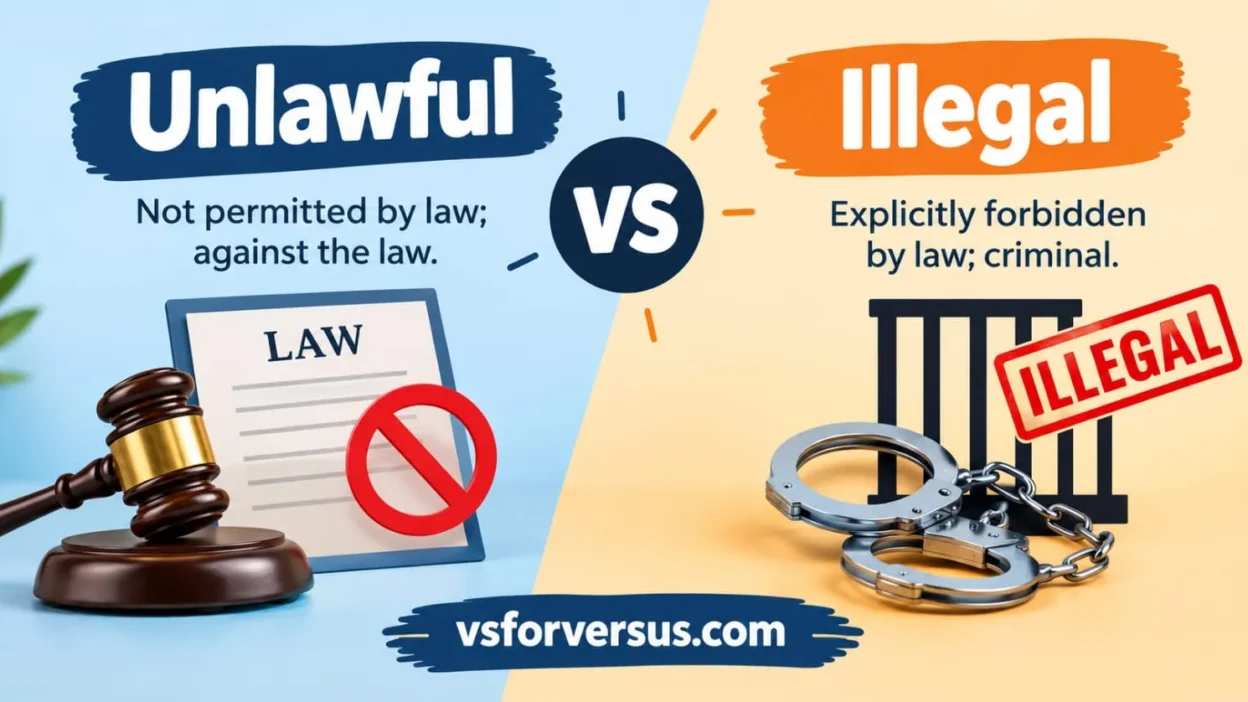
Unlawful vs Illegal these two words are often used as perfect synonyms in everyday conversation, yet in legal writing, a subtle but meaningful distinction separates them. Both describe actions that violate the law, but they can imply different scopes and severities.
Illegal typically refers to actions that are strictly prohibited by law and often carry criminal penalties, such as theft, fraud, or drug trafficking. Unlawful, on the other hand, is a broader term, covering any action that isn’t legally sanctioned or authorized, which may not necessarily be a crime but still falls outside legal boundaries, such as a breach of contract or a civil violation.
This distinction matters significantly in legal, academic, and professional writing, where precision changes meaning. In this article, we’ll explore both terms in detail, covering their origins, correct usage, and real world examples to help you use them accurately.
Quick Answer
Illegal describes an act that breaks a specific law or statute, usually with criminal consequences, like theft or drug possession. Unlawful is broader: it means an act isn’t authorized by law, even without a named statute forbidding it, and often applies to civil matters like wrongful termination or improper evictions. In casual writing, the two words are interchangeable, but unlawful is the more formal choice in legal, academic, and workplace writing.
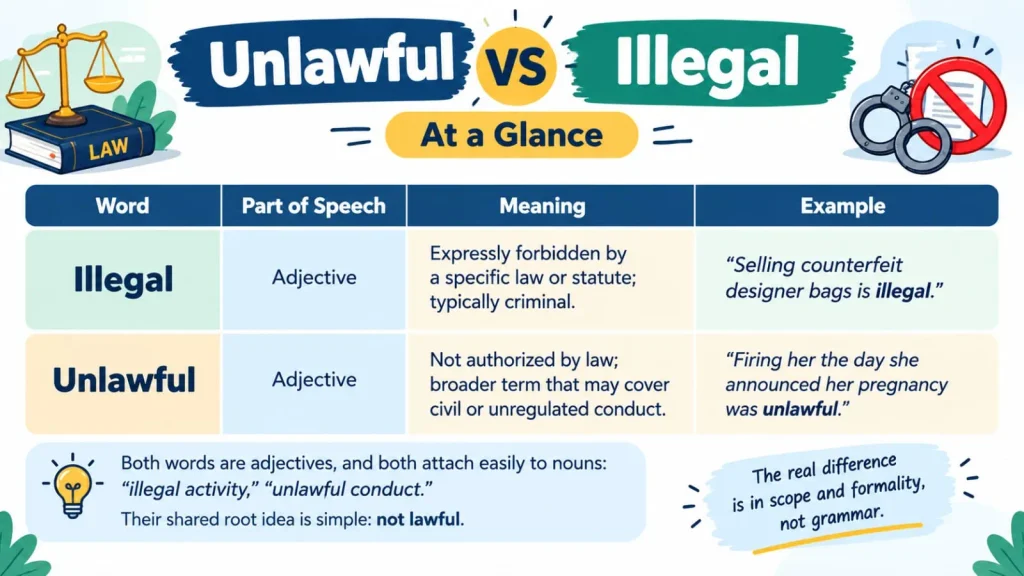
Unlawful vs Illegal at a Glance
Before breaking down each word individually, here’s the short version in table form, useful for a quick reference or a printable cheat sheet if you’re studying legal or business English.
| Word | Part of Speech | Meaning | Example |
| Illegal | Adjective | Expressly forbidden by a specific law or statute; typically criminal | “Selling counterfeit designer bags is illegal.” |
| Unlawful | Adjective | Not authorized by law; broader term that may cover civil or unregulated conduct | “Firing her the day she announced her pregnancy was unlawful.” |
Both words are adjectives, and both attach easily to nouns: “illegal activity,” “unlawful conduct.” Their shared root idea is simple: not lawful. The real difference is in scope and formality, not grammar.
What Does “Illegal” Mean?
Illegal is the word most people reach for by default, and for good reason: it’s the plain English term for “against the law.” Something is illegal when a specific statute, code, or regulation explicitly forbids it, and breaking that rule usually comes with a defined penalty.
Examples in natural context:
- “It’s illegal to drive without a valid license in most states, so don’t risk it before your test.”
- “We found out too late that downloading the course materials and reselling them was illegal.”
- “The factory was fined six figures for illegal dumping of chemical waste into the river.”
- “Honestly, half of what people post about ‘side hustles’ online skirts illegal territory without realizing it.”
Common contexts: criminal law, government regulations, news reporting, workplace compliance training, and everyday conversation. If you’re writing a general email, a social post, or a casual essay and you’re unsure which word fits, illegal is almost always the safer default, one of the few places the unlawful vs illegal debate resolves itself easily.
What Does “Unlawful” Mean?
Unlawful covers more ground. It means an act isn’t authorized or sanctioned by law, but unlike illegal, it doesn’t require a specific statute spelling out the prohibition. That’s why unlawful shows up so often in civil, employment, and administrative contexts, where the wrong is real but not necessarily criminal.
Examples in natural context:
- “The court ruled the layoff was unlawful termination, since it violated her contract’s notice clause.”
- “After the lease ended, he refused to leave; that’s technically unlawful detainer, not trespassing, until the eviction is finalized.”
- “Witnesses described the shooting as an unlawful killing, though no charges had been filed yet.”
- “The gathering was broken up and declared an unlawful assembly under the city’s permit rules.”
Common contexts: court rulings, HR and employment policy documents, legal correspondence, academic writing about law or ethics, and formal journalism covering disputes that haven’t reached criminal court. If you’re writing something that needs to sound precise and professional, unlawful often signals that precision better than illegal does.
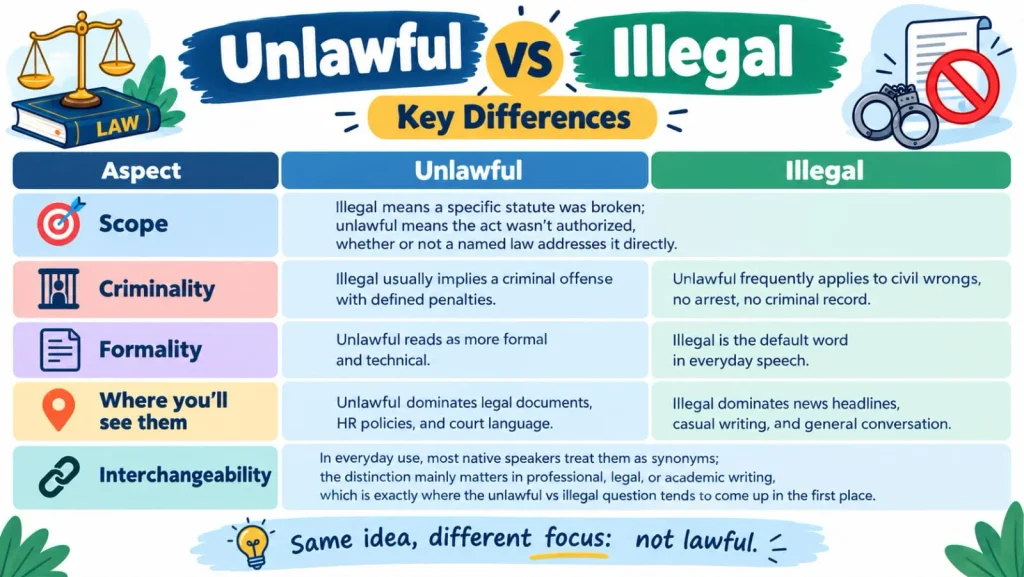
Key Differences Between Unlawful vs Illegal
- Scope: Illegal means a specific statute was broken; unlawful means the act wasn’t authorized, whether or not a named law addresses it directly
- Criminality: Illegal usually implies a criminal offense with defined penalties; unlawful frequently applies to civil wrongs, no arrest, no criminal record
- Formality: Unlawful reads as more formal and technical; illegal is the default word in everyday speech
- Where you’ll see them: unlawful dominates legal documents, HR policies, and court language; illegal dominates news headlines, casual writing, and general conversation
- Interchangeability: In everyday use, most native speakers treat them as synonyms; the distinction mainly matters in professional, legal, or academic writing, which is exactly where the unlawful vs illegal question tends to come up in the first place
Memory Trick: How to Remember the Difference?
Here’s a simple way to lock this in: Illegal = a specific law says no. Unlawful = unauthorized, even if no single rule spells it out.
Think of it visually: illegal is a locked door with a sign on it listing exactly what you can’t do. Unlawful is a door with no sign at all, but you still don’t have permission to walk through it.
Quick synonym check, if that helps it stick: in casual use, illegal is close enough to illicit and unlawful that people swap them freely. Reach for unlawful specifically when you need precision, civil disputes, HR language, legal drafting.
If you want the linguistic backstory, it’s genuinely interesting: both prefixes mean “not,” but they come from different roots. Un is the native English negation, while il is actually a shape shifted version of the Latin prefix in , which becomes il before words starting with “l” (illegal, illicit, illegitimate) and im before “p” or “b” (impossible, imbalance). English inherited two different toolkits for saying “not,” and legal vocabulary ended up using both.
Common Mistakes with Unlawful vs Illegal
Even experienced writers slip here; this isn’t just an ESL issue, and unlawful vs illegal mix ups show up in professional writing more often than you’d expect.
| ❌ Incorrect | ✅ Correct | Why |
| “The leaked emails were an unlawful crime.” | “The leaked emails were an illegal act.” | “Unlawful” paired with “crime” is redundant, use “illegal” when you mean criminal |
| “He was illegally evicted without proper notice.” | “He was unlawfully evicted without proper notice.” | Eviction disputes are civil matters, so “unlawful” is the accurate legal term |
| “Illegal parking is worse than an unlawful killing, illegal always means more serious.” | “Don’t assume unlawful is automatically the softer word, an unlawful killing is far more serious than illegal parking.” | Severity depends on the act, not the word choice |
| “That’s not illegal, so it must be totally fine.” | “That’s not illegal, but it could still be unlawful, check the contract first.” | Not every problematic act is covered by a named statute |
Quick Quiz: Test Yourself
This quick unlawful vs illegal quiz checks whether the distinction has actually stuck.
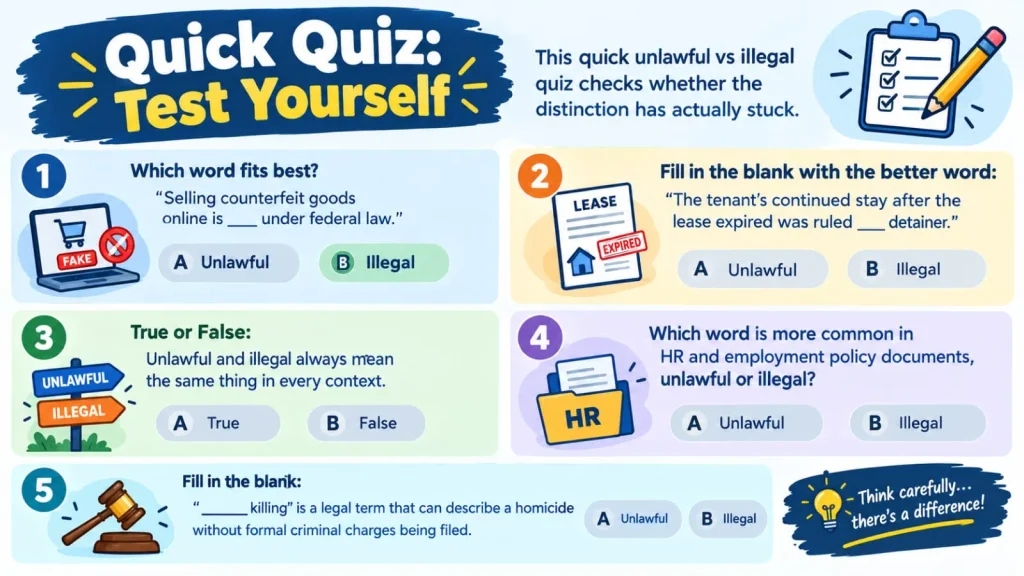
- Which word fits best? “Selling counterfeit goods online is ___ under federal law.” (illegal)
- Fill in the blank with the better word: “The tenant’s continued stay after the lease expired was ruled ___ detainer.” (unlawful)
- True or False: Unlawful and illegal always mean the same thing in every context.
- Which word is more common in HR and employment policy documents, unlawful or illegal?
- Fill in the blank: “___ killing” is a legal term that can describe a homicide without formal criminal charges being filed.
Frequently Asked Questions
Is unlawful the same as illegal?
Mostly, yes. In everyday conversation, they’re interchangeable, and most people won’t notice or care which one you use. The technical difference only matters in professional and legal writing: illegal means a specific statute was violated, while unlawful is broader and can cover civil or unauthorized conduct that isn’t formally criminal.
Which is worse, unlawful or illegal?
Neither word automatically signals more severity; that’s a common misconception. “Unlawful killing” is extremely serious, while “illegally parked” is minor. The unlawful vs illegal comparison isn’t a severity scale; the act itself determines how serious the situation is, not the label attached to it.
Can something be unlawful but not illegal?
Yes, and this is where the unlawful vs illegal distinction actually earns its keep. Civil wrongs, like an unlawful eviction or unlawful termination, violate legal standards without being criminal offenses. They’re unlawful in the sense of “not authorized,” but they don’t carry the criminal weight that “illegal” implies.
Is unlawful more formal than illegal?
Generally, it is. Unlawful shows up far more often in court rulings, legal contracts, HR policy documents, and academic writing, while illegal remains the default in everyday speech, casual writing, and news headlines.
Why do lawyers say “unlawful” instead of “illegal”?
Because “unlawful” covers a wider range of violations, including civil and administrative wrongs, without automatically implying a criminal charge. That precision matters in legal drafting, where accuracy about criminality has real consequences.
What’s an example of unlawful vs illegal in practice?
Selling drugs is illegal; it breaks a specific criminal statute. Evicting a tenant without following the correct legal process is unlawful; it violates the law without necessarily being a crime. Keeping both examples in mind is often the fastest way to internalize the unlawful vs illegal difference for good.
Final Thoughts
At the end of the day, unlawful vs illegal isn’t a rule you need to obsess over in casual writing; in everyday conversation, the two words really are close enough to swap.
What matters is knowing when the distinction counts: reach for illegal when a specific law or statute was broken, and reach for unlawful when you’re describing something unauthorized but not necessarily criminal, a wrongful termination, an improper eviction, a civil dispute. Get that one habit right, and you’ll sound noticeably more precise in emails, essays, and professional writing without having to memorize a single legal textbook.
To read more: Suit vs Suite: What’s the Shocking Difference? 2026

Marcus is a former product manager turned comparison writer who spent eight years testing tools and gadgets before quitting to write full-time. He specializes in breaking down tech and software matchups into plain-English verdicts, with a soft spot for buying guides nobody else wants to write.