
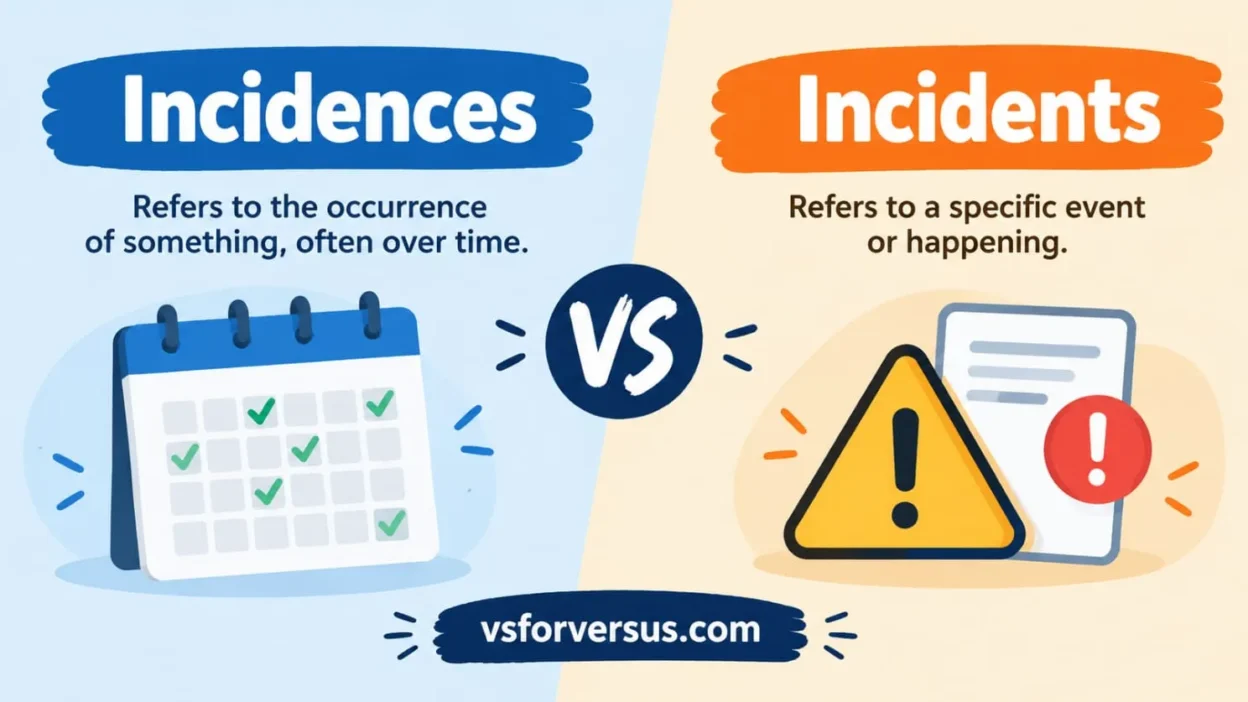
In everyday English, “incidences” vs “incidents” are often confused, yet they carry distinct meanings and serve different grammatical purposes. The word “incident” refers to a specific event or occurrence, often unexpected or noteworthy, such as an accident, a disturbance, or a minor happening. Its plural form is “incidents.”
On the other hand, “incidence” is a more abstract, often statistical term that refers to the rate, frequency, or extent of occurrence of something, especially in scientific, medical, or academic contexts, for example, the incidence of disease in a population. Understanding this difference is essential for clear, precise writing, especially in formal or technical communication.
Quick Answer
Incidents is the correct plural to use when you’re talking about separate events, accidents, security breaches, workplace disputes, anything that happened. Incidences is the rare plural of incidence, a word that describes the rate or frequency at which something occurs, most often in medical, statistical, or research contexts, and it’s rarely the word you want when describing multiple events.
If you’re recounting what happened, use incidents. If you’re describing how often something happens, reach for incidence, and think twice before pluralizing it at all.
Incidences vs Incidents at a Glance
Before going further, here’s the side by side breakdown that makes the “incidences” vs “incidents”distinction click for most people. This table also works well as a quick visual reference if you’re building a style guide for a team or classroom.
| Word | Part of Speech | Meaning | Example |
| Incident | Noun (countable, plural: incidents) | A specific, individual event, often unplanned, notable, or disruptive | “There were three incidents reported at the warehouse this month.” |
| Incidence | Noun (typically uncountable, plural incidences is rare) | The rate or frequency at which something occurs within a population or period | “The incidence of flu cases rises every winter.” |
What Does “Incident” Mean?
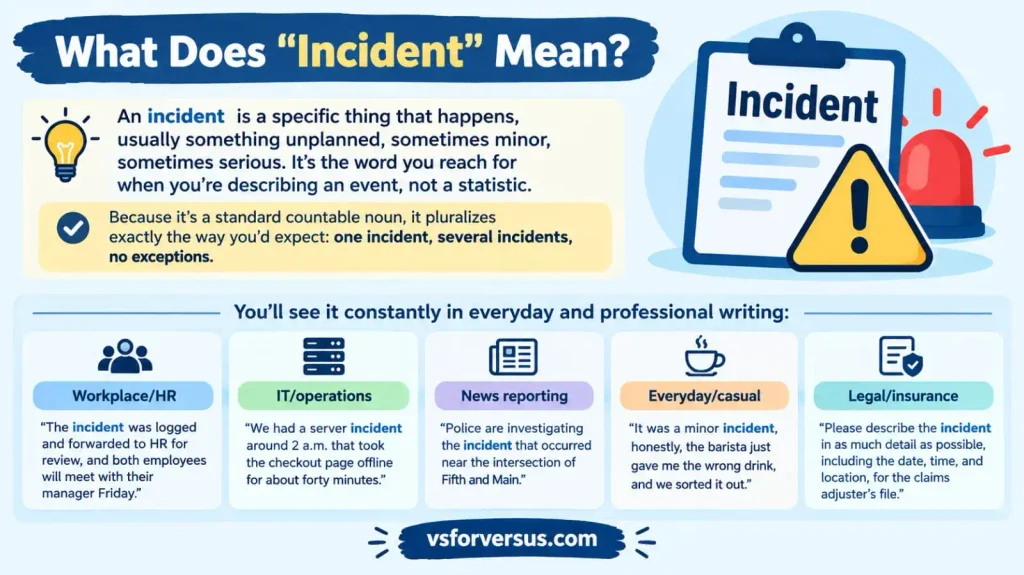
An incident is a specific thing that happens, usually something unplanned, sometimes minor, sometimes serious. It’s the word you reach for when you’re describing an event, not a statistic. Because it’s a standard countable noun, it pluralizes exactly the way you’d expect: one incident, several incidents, no exceptions.
You’ll see it constantly in everyday and professional writing:
- Workplace/HR: “The incident was logged and forwarded to HR for review, and both employees will meet with their manager Friday.”
- IT/operations: “We had a server incident around 2 a.m. that took the checkout page offline for about forty minutes.”
- News reporting: “Police are investigating the incident that occurred near the intersection of Fifth and Main.”
- Everyday/casual: “It was a minor incident, honestly, the barista just gave me the wrong drink, and we sorted it out.”
- Legal/insurance: “Please describe the incident in as much detail as possible, including the date, time, and location, for the claims adjuster’s file.”
You’ll find incident anywhere something specific occurred and needs to be recorded or discussed: incident reports at work, incident response plans in cybersecurity, incident logs in customer support, incident coverage in journalism, and incident descriptions on insurance claim forms.
What Does “Incidence” Mean?
Incidence is a different animal entirely. It doesn’t describe a single event; it describes how often something happens across a group, population, or time period. Statistics, rates, and frequency are its natural territory, which is why it shows up so heavily in medical, statistical, and academic writing.
- Medical/epidemiological: “Researchers tracked the incidence of the disease over five years to see whether the new screening program was working.”
- Statistical/social: “There’s been a noticeable increase in the incidence of remote work burnout since 2023.”
- Academic/research: “The study measured incidence rates across different age groups to identify who was most at risk.”
- Insurance/actuarial: “Underwriters calculate the incidence of claims within a given demographic to help set premium pricing.”
- Rare plural (used with caution): “Analysts compared incidences of reported fraud across three regions.” This use exists technically, but many editors would flag it and suggest “rates of fraud” instead; even a defensible plural often reads more naturally when rephrased.
You’ll most often encounter incidence in public health reporting, scientific papers, insurance risk assessments, and social science research, anywhere someone is measuring frequency rather than describing a single event.
It helps to picture the two words operating at different altitudes. Incident sits at ground level, describing one thing that happened at a specific place and time. Incidence sits above the data, describing a pattern across many of those ground level events. A hospital’s daily log is full of incidents: a fall in Ward 3, a medication error on the night shift, a visitor dispute at the front desk.
The hospital’s annual report, by contrast, talks about incidence, the rate of falls per thousand patient days, the rate of medication errors per shift, figures drawn from tallying up all those individual incidents over time. Neither word is more “correct” than the other; they’re simply answering different questions.
What Style Guides Say About Incidences vs Incidents
If you’re writing for publication, the major style guides largely agree, even if none of them devote much space to the topic. The AP Stylebook doesn’t carry a dedicated entry for “incidence” versus “incident,” but AP trained editors consistently apply the same rule newsrooms use for any near homophone pair: match the word to the meaning, not the sound.
Medical and scientific style guides, including those used by major public health journals, are more explicit; they treat “incidence” as a term of art tied to rate calculations (cases per population per time period) and generally discourage pluralizing it outside of very specific comparative contexts, such as comparing incidence figures across multiple studies or regions.
In practice, this means most professional editors will flag “incidences” on sight and ask the writer whether “incidents,” “cases,” or “rates” was actually intended. When you’re deciding between incidences vs incidents for a formal document, defaulting to “incidents” for events and “incidence” (singular) for rates will keep you aligned with virtually every major style guide’s implicit preference.
Key Differences Between Incidences and Incidents
Once you’ve read the definitions above, the incidences vs incidents choice usually stops being a guessing game and starts being a quick gut check: am I naming something that happened, or measuring how often it happens?
Most writers already know the answer instinctively once the question is framed that way; the confusion tends to happen only when someone is reaching for a word that sounds more formal or technical than what the sentence actually calls for. Here’s the quick reference version, stripped down to what actually matters when you’re deciding between them:
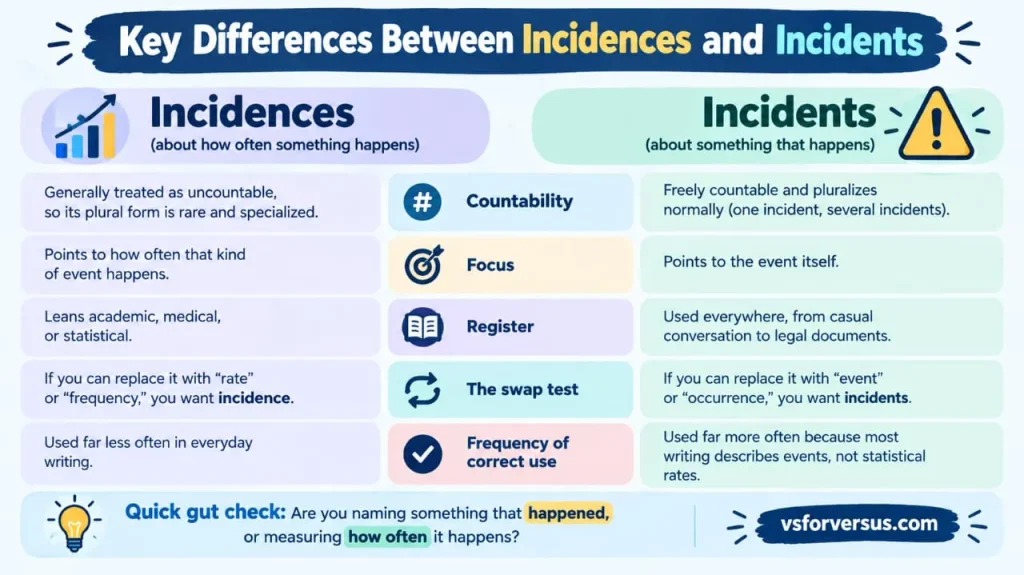
- Countability: Incident is freely countable and pluralizes normally. Incidence is generally treated as uncountable, so its plural form is rare and specialized.
- Focus: Incident points to the event itself. Incidence points to how often that kind of event happens.
- Register: Incidence leans academic, medical, or statistical. Incident is used everywhere, from casual conversation to legal documents.
- The swap test: If you can replace the word with “rate” or “frequency” and the sentence still makes sense, you want incidence. If you can replace it with “event” or “occurrence,” you want incidents.
- Frequency of correct use: Most writing describes events, not statistical rates, so incidents gets used correctly far more often than incidence does.
Memory Trick: How to Never Mix Them Up Again?
The fastest way to lock this in is a small sound based trick: inciden CE rhymes with frequen CE (both describe a rate), while inciden T describes an event (both describe a single thing that happened). If you’re ever stuck mid sentence, ask yourself whether you’re counting things on your fingers or measuring a rate; fingers mean incidents, rate means incidence.
Common Mistakes
Even experienced writers slip here, particularly under deadline pressure.“incidences” vs “incidents” is a phrase like “multiple incidences” tends to surface precisely when a writer wants to sound formal but reaches for the wrong tool to do it, and that instinct is how the error ends up in a broadcast script or an official statement in the first place. Here are the errors that show up most often, corrected:
| ❌ Wrong | ✅ Correct |
| “There were several incidences of theft last month.” | “There were several incidents of theft last month.” |
| “We had an incidence last week where a customer complained about shipping delays.” | “We had an incident last week where a customer complained about shipping delays.” |
| “The incidents of the disease increased sharply this winter.” | “The incidence of the disease increased sharply this winter.” |
| “Please list all incidences involving the vehicle over the past twelve months.” | “Please list all incidents involving the vehicle over the past twelve months.” |
| “The report cited a growing incident of workplace injuries in the sector.” | “The report cited a growing incidence of workplace injuries in the sector.” |
A third word often gets tangled into this incidences vs incidents confusion: instance. An instance is a specific example used to illustrate a point, “In this instance, the delay was caused by weather”, and it sounds close enough to incidents that writers sometimes reach for incidence by mistake when they actually mean instance.
If you’re unsure among all three, ask what you’re really describing: a single case (instance), a specific event (incident), or a rate (incidence).
Quick Quiz: Test Yourself
- “The hospital reported a rising ___ (incidence/incidents) of flu cases this winter.”
- “Security logged two ___ (incidence/incidents) overnight near the loading dock.”
- True or False: “Incidence” is commonly pluralized in everyday writing.
- Fill in the blank: “The ___ occurred at approximately 3 p.m. near the main entrance.”
- Fix this sentence: “There have been several incidences of vandalism in the parking garage this month.”
(Answers: 1. incidence, 2. incidents, 3. False, 4. incident, 5. “several incidents of vandalism”)
Frequently Asked Questions
Is it “incidences” or “incidents” of a disease? When describing individual cases, use “incidents” or, more precisely, “cases.” When describing the rate at which a disease occurs across a population, use the singular “incidence”; the plural “incidences” is rarely correct here.
What is the plural of incident? The plural of “incident” is simply “incidents”, a standard, regular countable noun with no exceptions.
Can incidence be plural? Technically yes, but it’s uncommon and often stylistically awkward. Most style guides and editors prefer rephrasing with “rates of occurrence” rather than using “incidences” as a plural.
What does incidences mean? “Incidences” is the plural form of “incidence,” referring to multiple rates or frequencies of occurrence, typically across different groups, regions, or time periods, not multiple individual events.
Is “incidences” even a word? Yes, it’s a real word, but it’s rarely the correct choice. In the vast majority of cases where someone reaches for “incidences,” “incidents” is the word they actually need. That single substitution resolves most incidences vs incidents errors on its own.
What’s the difference between incident and accident? An “incident” is a broader term for any notable event, which may or may not involve harm or fault. An “accident” specifically implies something unintended, often with damage or injury involved. Every accident is technically an incident, but not every incident is an accident.
Conclusion
The incidences vs incidents mix up almost always comes down to one thing: are you describing something that happened, or how often it happens? Incidents is the word for events, countable, everyday, and correct nearly every time you’re tempted to reach for its rarer cousin. Incidence belongs to rates and frequencies, mostly in medical, statistical, and research writing, and its plural, incidences, should be used sparingly, if at all.
When in doubt, run the swap test: “event” points to incidents, “rate” points to incidence. Keep that distinction straight, and this is one confused word pair you’ll never get wrong again.
To read more: “Immanent vs Imminent: The Ultimate Guide to the Confusing Difference (2026)”