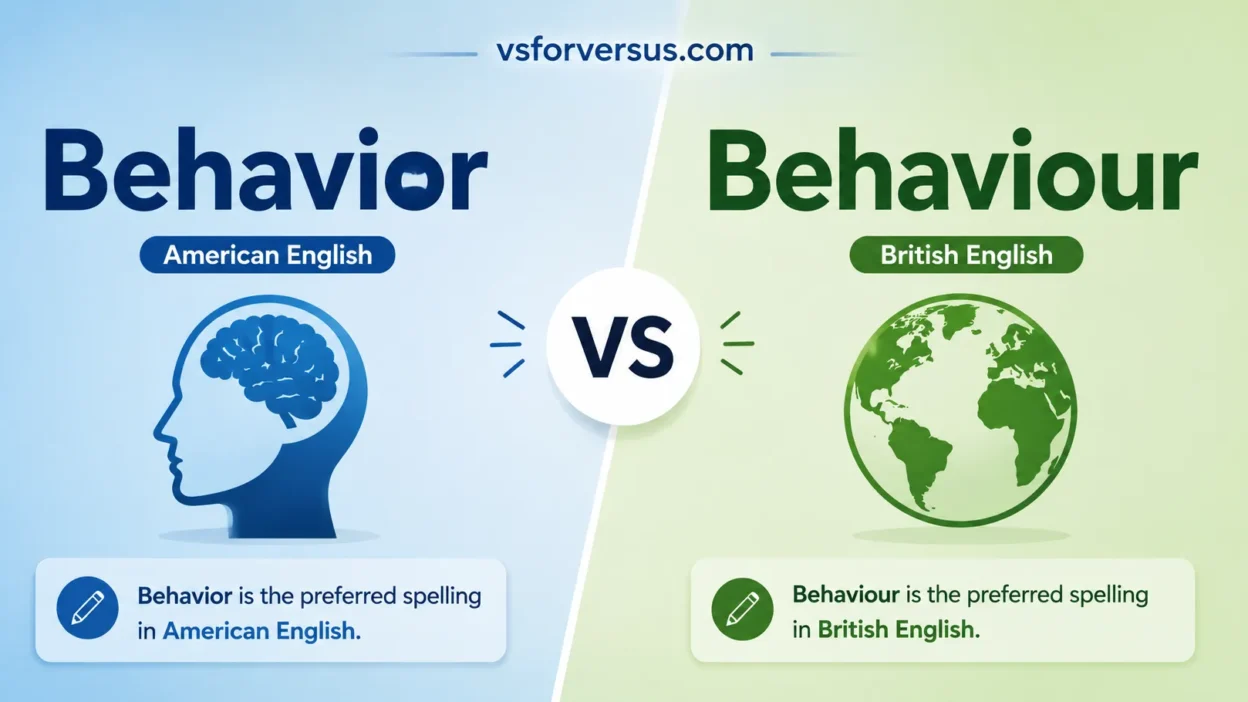
Choosing between “behavior” and “behaviour” can be confusing, especially when you write for an international audience. At first glance, the two words look different, but they carry the same meaning: the way a person, animal, group, or organization acts or responds.
The real difference lies in the variety of English you’re using. In American English, behavior is the standard spelling. In British English, behaviour is preferred. You’ll see the same pattern in word pairs like color/colour, favor/favour, and honor/honour.
Neither spelling is inherently more correct; the goal is simply to match the form to your audience, publication, or style guide. When choosing between Behavior vs behaviour, use the spelling that fits your intended variety of English and remain consistent throughout your writing.
Quick Answer
Behavior vs behaviour are two spellings of the same noun with an identical meaning. Behavior is standard in American English, while behaviour is standard in British English and is also used across Canada, Australia, and most Commonwealth countries.The difference between Behavior vs behaviour mainly depends on the variety of English being used.
Neither version is “wrong”; the right pick depends on who you’re writing for, and staying consistent throughout a piece matters more than which spelling you land on.
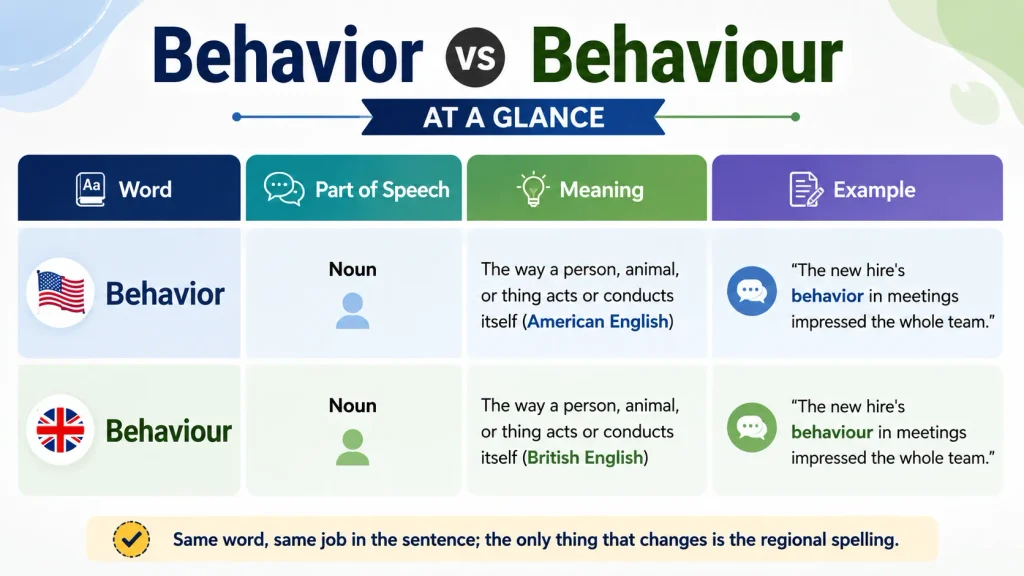
Behavior vs Behaviour at a Glance
| Word | Part of Speech | Meaning | Example |
| Behavior | Noun | The way a person, animal, or thing acts or conducts itself (American English) | “The new hire’s behavior in meetings impressed the whole team.” |
| Behaviour | Noun | The way a person, animal, or thing acts or conducts itself (British English) | “The new hire’s behaviour in meetings impressed the whole team.” |
Same word, same job in the sentence; the only thing that changes is the regional spelling.Writers should choose between Behavior vs behaviour according to their target audience.
What Does “Behavior” Mean?
Behavior is a noun describing observable actions, the way someone or something acts, reacts, or conducts itself. It’s the standard spelling throughout the United States, appearing in news articles, psychology journals, and everyday workplace writing. It follows the same American pattern as color vs colour and favor vs favour, both of which drop the British “u.”
Some everyday examples:
- “HR flagged his behavior during the meeting as unprofessional.” (workplace)
- “The professor’s research focuses on consumer behavior during economic downturns.” (academic)
- “Can we talk about your dog’s behavior around guests?” (everyday conversation)
- “This kind of behavior won’t be tolerated on our platform,” the moderator posted. (social media)
Behavior is the expected spelling in American publications, US based business writing, and anything following APA or AP style, both of which default to American conventions.
What Does “Behaviour” Mean?
Behaviour has the same definition; it’s simply spelled with the “u” that British English kept. It’s the standard form across the UK and is also expected in Canada, Australia, New Zealand, and most Commonwealth countries. It follows the same pattern as honor vs honour and labor vs labour, both of which retain the “u” in British usage.
A few natural examples:
- “The teacher praised her behaviour throughout the term.” (education, UK)
- “Workplace behaviour policies were updated after the review.” (business, UK/AU)
- “His behaviour at the dinner party was the talk of the group chat.” (casual/social)
- “Antisocial behaviour orders were once common in UK local news.” (journalism)
British publications, Oxford-style writing, and academic papers submitted to UK, Australian, or Canadian institutions consistently use behaviour.
Is There a Real Difference Between Behavior and Behaviour?
No, there’s no difference in meaning, tone, or concept between the two words, which is worth stating plainly since it trips people up more than expected. Some writers assume the spelling hints at a subtle cultural or conceptual distinction, as though British “behaviour” means something slightly different from American “behavior.”
It doesn’t. Even experienced editors sometimes pause here, wondering whether a UK client expects a different nuance rather than just a different letter. They don’t; it’s purely cosmetic.
Why Do Two Spellings Exist in the First Place?
The short answer: one dictionary editor with strong opinions. The word entered English centuries ago with the “our” ending, following French and Latin spelling patterns that were standard across the English speaking world at the time. In the early 1800s, American lexicographer Noah Webster set out to simplify American spelling, partly to make written English easier to learn, and partly to give the young United States its own linguistic identity separate from Britain.
Webster dropped the silent “u” from dozens of words, including color, honor, labor, and behavior, and those simplified forms became the American standard. Britain and the rest of the Commonwealth simply kept the older spelling.
This is often called the “or vs our” spelling rule, and it’s a matter of orthography, standardized spelling convention, not grammar or meaning. Neither version is more “correct” historically; they’re two branches of the same word that grew apart after Webster’s reforms took hold.
Behavioral vs Behavioural: Does the Rule Carry Over?
Yes, and this is where people often slip even after mastering the base word. The same regional split applies to every related form:
- Behavioral (US) / Behavioural (UK), the adjective
- Behaviorally (US) / Behaviourally (UK), the adverb
- Behaviors (US) / Behaviours (UK), the plural
For example: “The clinic specializes in behavioral therapy” (American) versus “The clinic specialises in behavioural therapy” (British). Notice that the neighboring spelling shifts too; regional consistency applies to the whole sentence, not just one word in isolation. Keep the “u” in behaviour, and keep it in behavioural and behaviourally as well; the entire word family travels together.
Key Differences Between Behavior and Behaviour
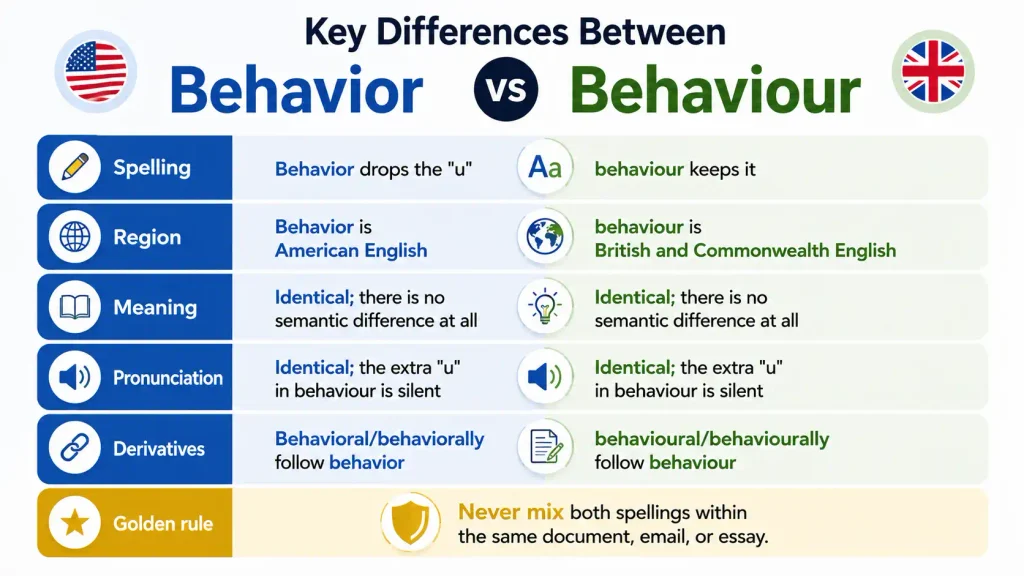
- Spelling: Behavior drops the “u”; behaviour keeps it
- Region: Behavior is American English; behaviour is British and Commonwealth English
- Meaning: Identical; there is no semantic difference at all
- Pronunciation: Identical; the extra “u” in behaviour is silent
- Derivatives: Behavioral/behaviorally follow behavior; behavioural/behaviourally follow behaviour
- Golden rule: Never mix both spellings within the same document, email, or essay
Memory Trick to Remember the Difference
The simplest way to lock this in: behaviour has an extra “u,” just like the u in United Kingdom. Hold onto that one connection and you’ll never second guess it again.
For the derivative forms, think of it as a package deal rather than a word by word decision; once you pick a region, every related form follows automatically.
Which One Should You Use?
Match your spelling to your audience whenever you know their region. Writing for American readers or a US company? Use behavior. Writing for a UK publication, an Australian university, or a London based client? Use behaviour.n American English, Behavior vs behaviour may appear different because of regional spelling conventions. The same logic applies to related pairs like organisation vs organization, where the regional convention, not personal preference, decides the spelling.
But what if you’re writing for a global blog, or you’re a student unsure which convention your international program expects? In that case, default to American spelling (behavior). Once you understand Behavior vs behaviour, this common English spelling confusion becomes much easier to avoid.It’s the convention most international style guides, SEO content platforms, and global tech companies lean toward, largely because of the sheer volume of American audience content online. That said, if your organization already has a house style, follow it over any general default.
A UK based reader won’t think less of you for using behavior in a clearly American-context article, and an American reader is unlikely to flag behaviour in a piece by a UK based author, but consistency within a single piece of writing is what signals professionalism either way.Students and bloggers often search for Behavior vs behaviour when they are unsure about the correct spelling.
Quick style guide reference:
- APA, AP, Chicago Manual of Style: behavior
- Oxford Style Guide, most UK publishers: behaviour
Common Mistakes With Behavior vs Behaviour
Even confident writers slip on this occasionally, usually not from ignorance, but from juggling multiple documents or clients in the same week. Here are the most frequent errors. Unlike a genuine meaning mix up such as affect vs effect, these are pure spelling-consistency slips rather than confusion over what the word means.
| ❌ Incorrect | ✅ Correct |
| “His behavior was noted, and the school monitors student behaviour closely.” | “His behavior was noted, and the school monitors student behavior closely.” |
| Assuming “behaviour” is a typo or misspelling | Recognizing it as the correct British spelling, not an error |
| Using “behavioral” in an otherwise British-spelled document | Matching derivatives to your chosen region: behavioural with behaviour |
| Letting autocorrect silently switch your spelling mid-document | Setting your word processor’s language and region before you start writing |
That last one catches more people than you’d think. Tools like Word and Grammarly will quietly change behaviour back to Behavior without asking, since American English is the out of the box default for most new documents. Before submitting anything important, check your region settings; it takes ten seconds and prevents an entire document of inconsistent Behavior vs behaviour spelling.
Quick Quiz, Test Yourself
- Which spelling is standard in American English, behavior or behaviour?
- Which spelling would you expect to see in a British academic journal?
- True or false: “Behavioural” is a misspelling of “behavioral.”
- Fill in the blank: A US psychology journal would publish research on “____ analysis” (behavior/behaviour).
(Answers: 1. behavior, 2. behaviour, 3. False; it’s the correct British spelling, 4. behavior)
Frequently Asked Questions
Is it behavior or behaviour in Canada? Canadian English generally follows British conventions for this word, so behaviour is the more common and expected spelling, though behavior does appear, especially in American influenced or informal writing.
Is it behavior or behaviour in Australia? Australian English follows the British standard, so behaviour is correct. You’ll see it consistently in Australian schools, government documents, and media.
Does “behavioral” change to “behavioural” too? Every derivative form follows the same regional rule: behavioral and behaviorally pair with behavior, while behavioural and behaviourally pair with behaviour.
Is one spelling more “correct” than the other? Neither is more correct. This isn’t a grammar error or a right versus wrong situation; it’s purely a regional spelling convention, and both forms are fully standard in their respective English varieties.
Which spelling should I use for an international audience? When you don’t know your audience’s region, behavior is the safer default, since it aligns with the most common style guides used in global and digital content.
Will Grammarly or Microsoft Word mark one spelling as wrong? It depends on your language settings. A document set to English (US) may flag behaviour, while one set to English (UK) may flag behavior. Setting the correct regional language avoids this entirely.
Is the behavior vs behaviour distinction the same for words like color and honor? Yes, the same American versus British split appears in color/colour, honor/honour, labor/labour, and favor/favour; all of them drop or keep the “u” depending on the regional variety of English you’re writing in.
The Bottom Line
At the end of the“behavior“ and “behaviour” , this isn’t really a right versus wrong debate; it’s about knowing your audience and staying consistent once you’ve chosen. Whether you’re drafting a client email, finishing a university essay, or writing a blog post for readers on both sides of the Atlantic, pick your spelling, apply it to every related word, and move on with confidence.
To read more: Momma vs Mama: 7 Common Mistakes & Easy Ways to Understand Their Meaning