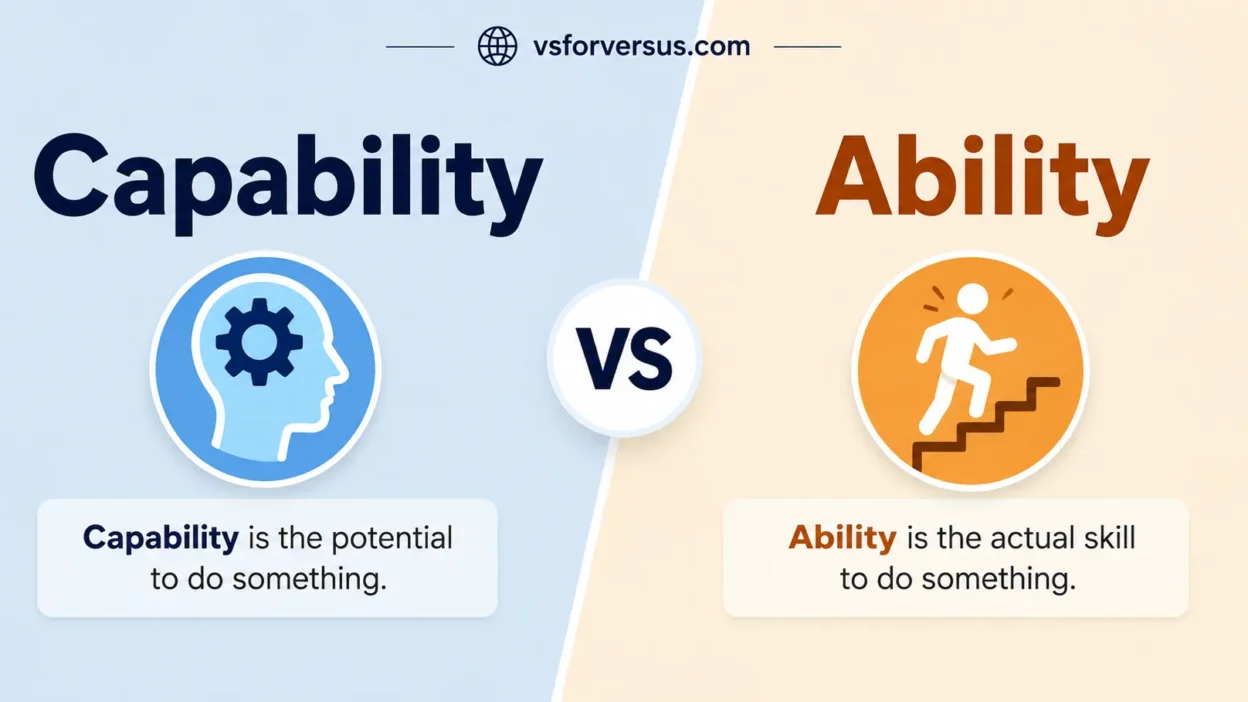
These are the real stakes behind capability vs ability. An ability is a skill a person has and can perform right now, often something innate, like verbal communication. It belongs to one individual and grows stronger with practice. A capability is broader: it combines skills, knowledge, tools, and behaviors that let a team or organization deliver results, job specific or company-wide.
Understanding capability vs ability comes down to timing and scale. Ability describes what someone can do today, measured in degrees like good or excellent. Capability describes potential that depends on resources, systems, and future conditions all coming together. A skilled employee has ability; a well equipped department has capability. Knowing which word fits keeps resumes and reviews precise instead of vague.
Quick Answer
In the capability vs ability comparison, ability means a skill or capacity a person or thing already has and is currently using; it’s about the present, and it’s often innate rather than trained.
Capability means the broader potential to do something, usually combining skills, knowledge, tools, and processes on a larger scale; it’s about what’s possible, whether for a person, a team, or a whole organization.
For example: “She can speak French” describes a current, personal skill, while “The company can expand internationally” describes a broader, future facing potential.
Ability vs Capability at a Glance
Before digging into the nuance, here’s the fastest way to see the capability vs ability distinction side by side:
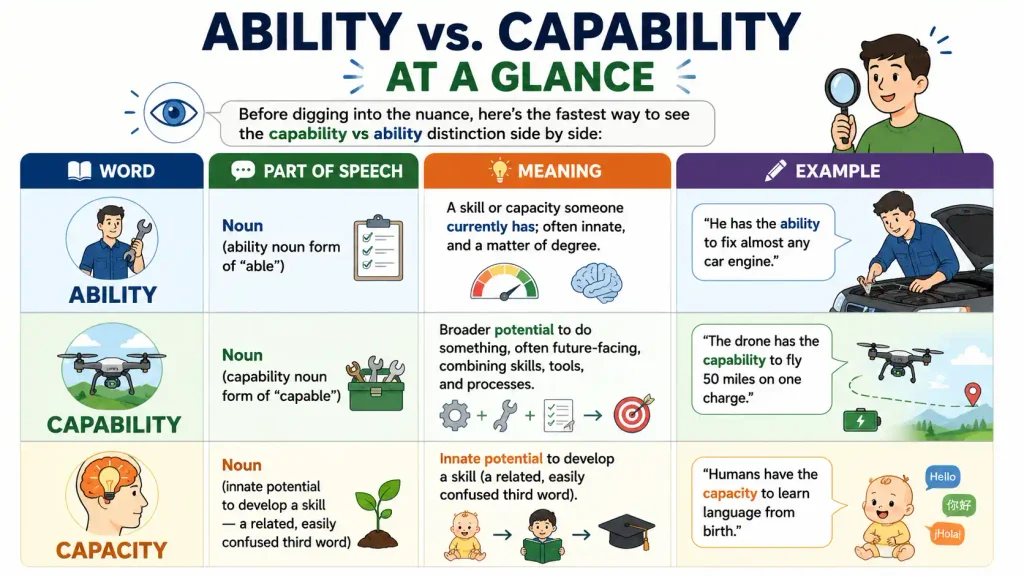
| Word | Part of Speech | Meaning | Example |
| Ability | Noun (ability noun form of “able”) | A skill or capacity someone currently has; often innate, and a matter of degree | “He has the ability to fix almost any car engine.” |
| Capability | Noun (capability noun form of “capable”) | Broader potential to do something, often future-facing, combining skills, tools, and processes | “The drone has the capability to fly 50 miles on one charge.” |
| Capacity | Noun | Innate potential to develop a skill (a related, easily confused third word) | “Humans have the capacity to learn language from birth.” |
Notice that capacity sneaks into this comparison too; it’s the quiet third cousin in this family of words, and worth knowing so you don’t swap it in by accident.
What Does “Ability” Mean?
Ability comes from the adjective “able.” If you’re able to do something, you can do it, plain and simple. It describes a skill, talent, or aptitude that’s already in use, and unlike a trained skill, an ability is often treated as something closer to innate, a natural aptitude for verbal communication, for instance, rather than something painstakingly learned.
It can still grow or shrink over time as a matter of degree. One person’s ability can be stronger or weaker than another’s; it’s not a light switch, it’s a dial.
Here’s how it shows up in real, everyday writing:
- “I can speak both Russian and English, which came in handy during the client call.”
- “Her writing ability improved so much over the semester that her professor asked if she’d tutor other students.”
- “Honestly, I can’t run five miles right now; I’m still recovering from the flu.”
- “Please list your key abilities in the summary section of your resume, not just your job titles.”
You’ll see ability constantly in resumes (“strong communication abilities”), performance reviews (“demonstrates ability to manage competing deadlines”), and casual conversation (“I just can’t deal with that today”). It’s the word for what someone can already do, right now, without needing a system or a team behind them.
What Does “Capability” Mean?
Capability comes from “capable,” and it leans toward potential rather than a single demonstrated skill in the moment. Something has capability if it’s positioned to perform a function, now or in the future, often depending on circumstances, resources, or scale.
This is where the capability vs ability distinction gets practically useful: capability tends to describe a broader potential for action, one that usually combines several ingredients, skills, knowledge, tools, and behaviors, rather than one person’s individual talent alone.
Real world examples:
- “Our team’s technical capabilities have grown a lot since we hired two backend engineers last quarter.”
- “This software has offline capability, so you can keep working even without Wi-Fi.”
- “The report questioned the region’s capability to handle another major flood.”
- “I’m honestly not sure I can finish this proposal by Friday, given everything else on my plate.”
In practice, capability shows up constantly in business writing, product specs, and technical documentation: “cloud capability,” “AI capability,” “manufacturing capability.” Some companies even publish formal capability statement examples to summarize what their teams and systems can deliver to a client or partner, which is a good sign of how organization-level this word tends to be.
You’ll also see it stand in for a nearby but distinct idea: a core competency vs capability discussion, for instance, usually treats “core competency” as the specific strength an organization is best known for, while “capability” is the wider set of resources that supports it. Capability scales up naturally to teams, systems, and organizations in a way ability rarely does.
“Ability To” vs “Capability To”
One of the most common places the capability vs ability confusion shows up in real writing is right before the word “to.” Both “ability to [verb]” and “capability to [verb]” are grammatically correct, so spellcheck won’t catch a mismatch, but they’re not interchangeable in meaning.
Use “ability to” when you’re describing something a specific person or thing can already do: “She can calm down an angry customer in seconds.” Use “capability to” when you’re describing a broader, often conditional potential, especially for organizations, systems, or products: “The platform can process a million transactions a day.”
A simple test: if you could swap in “can” and it still sounds natural, “ability to” is usually the better fit; if “has the capacity to handle it, given the right resources” sounds more accurate, reach for “capability to” instead.
Key Differences Between Ability and Capability
The distinction becomes clearest when you break it down into a few concrete factors that separate the capability vs ability pair:
- Timing: Ability describes what’s true right now, a skill you can demonstrate today. Capability describes what’s possible, often contingent on future conditions, like “the capability to scale production once new equipment arrives.”
- Scale: Ability usually belongs to one person, describing their individual talent. Capability often describes a team, system, or organization; for example, a company’s capability to serve international customers depends on far more than any single employee’s ability.
- Measurement: Ability is qualitative, a matter of degree, like “pretty good” or “excellent” at a task. Capability tends to be more binary: either the capacity, tools, and processes exist to do something, or they don’t.
- Register: Capability shows up more often in formal, corporate, or technical writing, while ability works comfortably in both formal and casual contexts, from a job application to a text message.
- Collocation: As covered above, both “ability to” and “capability to” are grammatically valid, but capability pairs more naturally with plural or business flavored nouns, as in “capabilities in data analysis” or “leadership capabilities.”
Memory Trick: How to Remember the Difference
If you need a fast mental shortcut for capability vs ability, try this: capability and potential both contain the letter P; think of capability as your capped potential, something waiting to be unlocked rather than something you’re already doing.
For ability, picture the word active: ability is what’s active, in use, happening right now. Ability = active. Capability = potential.
There’s a reassuring truth here, too: even experienced writers slip on this pair. It’s common to see published articles use “capability” when a simple, demonstrated skill would have been the more precise choice; the words are close enough in meaning that even careful editors let one slide into the other’s territory. If it trips up professionals, it’s not a sign you’re bad at English; it’s a sign the words are genuinely close cousins.
Common Mistakes with Ability and Capability
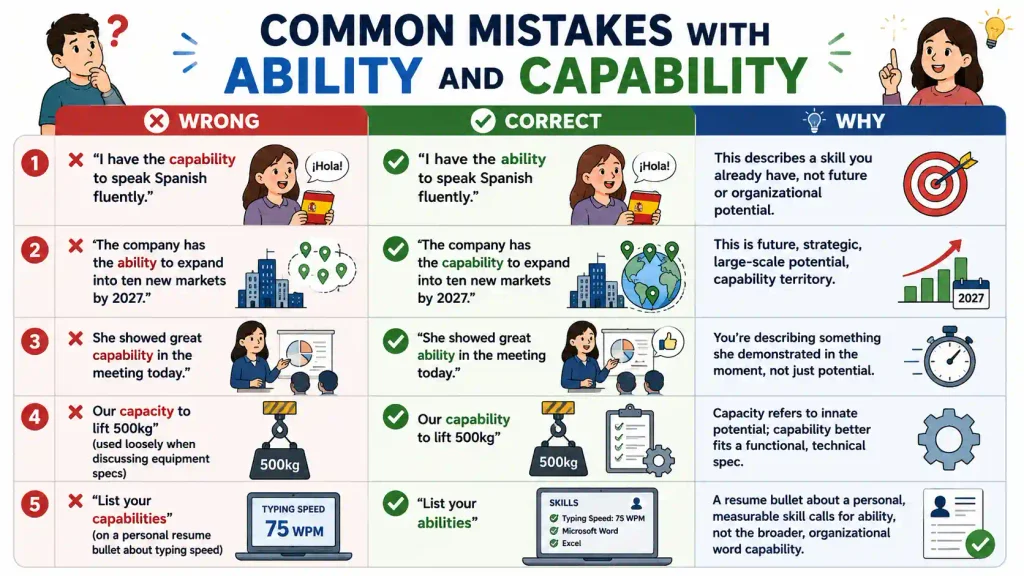
| ❌ Wrong | ✅ Correct | Why |
| “I have the capability to speak Spanish fluently.” | “I have the ability to speak Spanish fluently.” | This describes a skill you already have, not future or organizational potential. |
| “The company has the ability to expand into ten new markets by 2027.” | “The company has the capability to expand into ten new markets by 2027.” | This is future, strategic, large-scale potential, capability territory. |
| “She showed great capability in the meeting today.” | “She showed great ability in the meeting today.” | You’re describing something she demonstrated in the moment, not just potential. |
| “Our capacity to lift 500kg” (used loosely when discussing equipment specs) | “Our capability to lift 500kg” | Capacity refers to innate potential; capability better fits a functional, technical spec. |
| “List your capabilities” (on a personal resume bullet about typing speed) | “List your abilities” | A resume bullet about a personal, measurable skill calls for ability, not the broader, organizational word capability. |
Getting this pair right in these situations isn’t about being pedantic; it’s about making sure your sentence says what actually happened, rather than what might happen someday.
Quick Quiz: Test Yourself
Fill in the blank with ability or capability:
- “She has the ______ to solve complex math problems in her head.” (ability)
- “The new engine has the ______ to reach 300 mph under test conditions.” (capability)
- “Our team’s ______ in project management really impressed the client.” (capabilities)
- “He doesn’t have the ______ to lift that couch alone, it’s way too heavy.” (ability)
- “This phone has 5G ______, even in areas with weaker signal.” (capability)
If you got most of these right, you’ve already internalized the core capability vs ability rule: present, personal skill versus broader, future-facing potential.
Frequently Asked Questions
Is capability the same as ability?
Not quite. Ability describes a current, often innate, demonstrated skill, while capability describes a broader potential, usually combining skills, knowledge, tools, and processes on a larger scale.
Which is correct: “ability to” or “capability to”?
Both are grammatically correct. Choose “ability to” for a present, personal skill, and “capability to” when describing potential, especially in business or technical contexts.
Is capability a formal word?
It leans formal and shows up often in business, technical, and strategic writing, but it’s not exclusively formal; it appears in casual speech too, just less frequently than ability.
What’s the difference between capacity, capability, and ability?
Capacity is an innate potential to develop a skill, capability is a functional or strategic potential to act, and ability is a skill you’re already using.
Can I use ability and capability interchangeably?
In casual conversation, people often do without confusion. In professional or precise writing, though, swapping them changes the nuance, so it’s worth choosing deliberately.
Why do businesses use “capability” instead of “ability”?
Because capability implies scalable, strategic potential, something a whole team or system can do, rather than one person’s individual skill.
Final Thoughts
Understanding capability vs ability ultimately comes down to one question: are you describing what’s happening now, or what’s possible later, for one person or for a whole system? Ability is personal, present, and often innate.
Capability is broader, more conditional, and usually built from several parts working together. Keep that lens handy next time you’re drafting a resume line, a performance review, or a business proposal, and you’ll rarely reach for the wrong word again.
To read more: Calves vs Calfs: The Definitive Guide to the Correct Spelling (2026)