
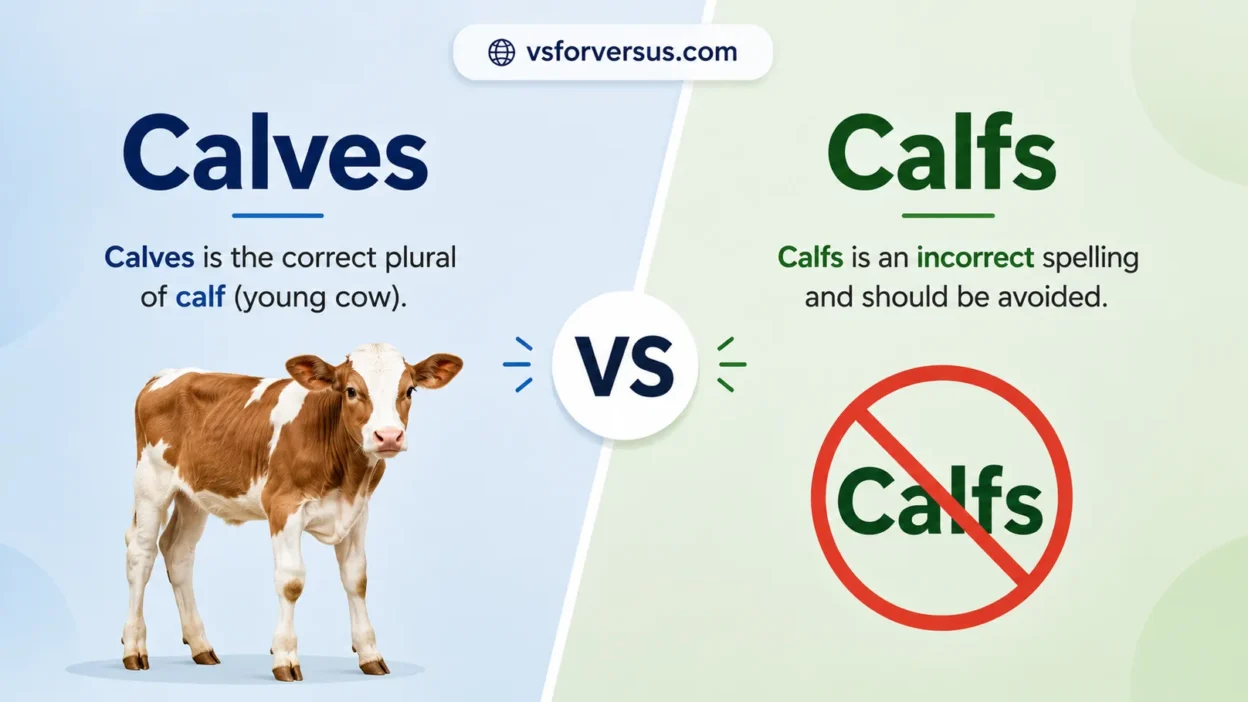
Calves is the correct plural noun for “calf”; it means more than one baby cow (or baby elephant, whale, or elk), and it also refers to the muscles on the back of your lower legs. This is the word you should always use in every context.
Calfs, on the other hand, is simply a misspelling of “calves.” It’s not a recognized standard English word, though a couple of dictionaries note it as a rare, outdated variant tied to cattle hides, not something you’d ever use in normal writing.
So why does the calves vs calfs mix up happen so often? Most English words pluralize the easy way, just adding an “s,” like dog or table. These are regular plurals. But calf belongs to a smaller group of irregular plurals, alongside wolf and shelf, where the “f” swaps for “ve” before adding “s.” This guide breaks down exactly how and why.
Quick Answer
Calves is the correct plural of calf in every context, whether you mean baby cows, the muscles behind your lower legs, or baby elephants and whales. Calfs is not standard modern English and should be avoided, even though a couple of dictionaries note it as a rare, outdated variant referring to cattle hides.
Calves vs Calfs at a Glance
| Word | Part of Speech | Meaning | Example |
| Calf | Noun (singular) | A baby cow or other large mammal (elephant, whale, elk); also the muscle behind the lower leg | “The calf followed its mother across the field.” |
| Calves | Noun (plural) | More than one baby animal; the muscle group behind both legs | “My calves were sore after the hike.” |
| Calve | Verb | To give birth (of a cow); or for glacier ice to break away | “The cow is expected to calve any day now.” |
| Calfs | Not standard | Common misspelling of “calves” | (Avoid in standard writing) |
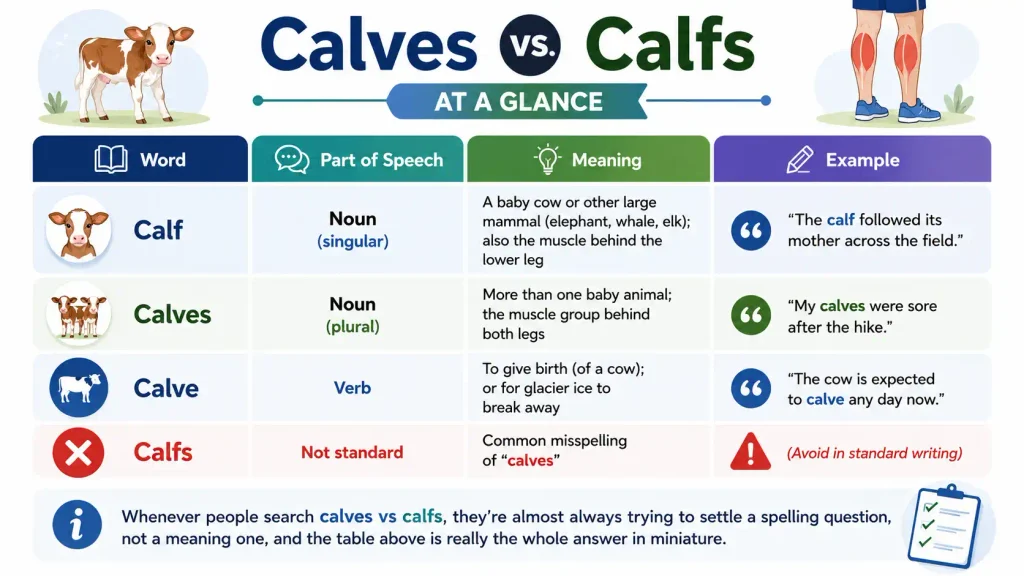
Whenever people search calves vs calfs, they’re almost always trying to settle a spelling question, not a meaning one, and the table above is really the whole answer in miniature.
What Does “Calf” Mean?
“Calf” is a singular noun with two everyday meanings, and English didn’t make it easy on us by using the same word for both. First, a calf is a young cow, though the term also covers the offspring of other large mammals; elephants, whales, elk, and moose all have calves. It’s a word you’ll meet early in any farming vocabulary, and it shows up just as often in nature documentaries and biology textbooks describing animal life cycles.
Second, “calf” refers to the muscular area behind your lower leg, between the knee and the ankle. This sense pops up constantly in fitness culture, physical therapy notes, and casual conversation about sore muscles after a workout. Context almost always makes clear which meaning is intended; nobody reading a gym blog thinks you’re talking about a baby cow, and nobody reading a farm report thinks you’ve pulled a muscle.
- The calf stayed close to its mother the whole afternoon.
- I tore a calf muscle halfway through my last 10K and had to stop running.
- A baby whale is also called a calf, which surprises a lot of people the first time they hear it.
- The recipe called for veal, which comes from a young calf.
Look for “calf” most often in farming and veterinary writing, fitness or physical therapy content, and the occasional biology lesson about marine mammals.
What Does “Calves” Mean?
“Calves” is simply the plural form, more than one baby animal, or both leg muscles together. This is the word most people are actually reaching for when they type calves vs calfs into a search bar, usually because they’ve typed “calfs” once, stared at it, and thought: that doesn’t look right. That instinct is correct, and it’s worth trusting.
You’ll notice “calves” behaves like plenty of other irregular English plurals; it doesn’t just add an “s”; it changes the ending entirely. That’s part of what makes it feel unfamiliar even to people who use it correctly without thinking twice.
- The herd of calves grazed near the barn all morning.
- Doing calf raises three times a week has truly made a difference in my calves.
- Elephant calves stay close to their mothers for years, sometimes into their teens.
- We sold three calves at the auction last weekend and kept the rest of the herd.
It turns up everywhere from gym and wellness blogs to agricultural reports to school essays about animal biology.
What About “Calve” and “Calfs”?
There’s a third word in this family that trips people up even when they’ve already sorted out calves vs calfs: “calve.” It’s a verb, not a noun, and it means to give birth (for a cow) or, in a completely different context, for a chunk of ice to break away from a glacier. “The cow is expected to calve within the week” and “Scientists watched the glacier calve into the sea” are both correct, even though the sentences have nothing to do with each other.
As for “calfs” itself, it’s not a word you should use in standard writing. A couple of dictionaries, including Merriam Webster, list it as a rare, largely obsolete variant tied specifically to cattle hides in leatherworking contexts, but that’s a historical footnote, not permission to use it in an email, essay, or blog post. Unless you’re specifically discussing 19th century leather trade terminology, there’s no practical reason to reach for it.
Think of “calfs” like an old dictionary entry that’s technically on record but functionally retired. Modern style guides, grammar checkers, and editors will all flag it as an error, and readers will interpret it the same way, regardless of the context you’re writing in.
Key Differences Between Calves and Calfs
- Calves is always correct; it’s the only real plural of “calf,” whether you mean the animal or the muscle.
- Calfs is not a recognized spelling in modern standard English.
- Both words are pronounced identically, since the “s” is silent in each, which is exactly why the mix up happens so often.
- This isn’t a knowledge gap about grammar; it’s a visual spelling slip in the calves vs calfs pair, because your ear genuinely can’t tell the two apart.
- It’s also not a US versus UK issue. Unlike some spelling differences between American and British English, “calves” is standard on both sides of the Atlantic.
- The confusion tends to cluster around three real world settings: fitness and health writing, farming or veterinary content, and everyday essays or emails, not because the rule changes, but because “calf” simply comes up a lot in those contexts.
Memory Trick to Never Mix Them Up Again

Here’s the fastest way to lock in calves vs calfs for good: pair “calf” with other familiar words that follow the same pattern. Leaf becomes leaves. Knife becomes knives. Wolf becomes wolves. Calf becomes calves. If you wouldn’t write “leafs” or “knifes” in a sentence, don’t write “calfs” either; your brain already knows this rule for other words, it just hasn’t connected the dots for this one yet.
One caveat worth flagging: not every f ending word follows this pattern. “Roof” becomes “roofs,” not “rooves.” “Chief” becomes “chiefs.” “Belief” becomes “beliefs.” So the rule is common, not universal; calf just happens to be one of the words that follows it.
And if you’ve ever wondered why the Toronto Maple Leafs spell their name that way instead of “Maple Leaves,” that’s a deliberate branding choice, not correct grammar. Team names, product names, and other proper nouns are allowed to bend spelling rules; your grocery list and your work email are not. It’s a useful example precisely because it shows the exception clearly: the rule still applies everywhere else, and the team name is memorable specifically because it breaks convention on purpose.
If mnemonics aren’t your thing, a simpler backup plan works just as well: keep a short mental list of the f to ves words you already spell correctly without thinking leaves, knives, wolves, shelves and mentally slot “calves” into that same group every time you write it.
Common Mistakes With Calves and Calfs
This trips up plenty of experienced writers too, usually when typing quickly or when autocorrect doesn’t catch it. See the difference side by side below:
| Incorrect | Correct |
| The calfs were grazing in the field. | The calves were grazing in the field. |
| I need to strengthen my calfs before ski season. | I need to strengthen my calves before ski season. |
| She’s had calfs muscle pain for a week. | She’s had calf muscle pain for a week. |
| The cow gave birth to twin calfs overnight. | The cow gave birth to twin calves overnight. |
The mistake shows up in more places than you’d expect, including professionally edited books and published articles, so if you’ve made it before, you’re in good company. The goal isn’t to feel embarrassed about it; it’s to catch it before it goes out the door next time, whether that’s a work email, a social media caption, or a school assignment.
A quick habit that helps: before you hit send or submit, do a search for “calfs” in your document. If it turns up anywhere outside a direct quote, it’s almost certainly meant to be “calves.” That one second check settles the calves vs calfs question for good, every single time.
Quick Quiz, Test Yourself
- Which is correct? “The farmer raised three this spring.” a) calfs b) calves c) calfes
- True or false: “Calfs” is standard British English spelling.
- What’s the correct plural when referring to the muscles behind both of your legs?
- Which sentence uses the right verb form? “The cow is about to any day now.” a) calve b) calves c) calf.
- Which of these does not follow the same f to ves pattern as calf? a) leaf b) roof c) knife d) wolf
(Answers: 1-b, 2-false, 3-calves, 4-a, 5-b)
Frequently Asked Questions
Here are quick answers to the most common calves vs calfs questions people search for.
What is the plural of calf? The plural of “calf” is always “calves,” whether you’re referring to baby animals or leg muscles.
Is calfs ever correct? Not in standard modern English. A few dictionaries list “calfs” as a rare, outdated variant related to cattle hides, but it’s not used in everyday or professional writing.
Is it calve or calf? “Calf” is the singular noun, a baby cow or the leg muscle. “Calve” is a verb meaning to give birth or, for glaciers, to break apart.
Is calfs a British or American spelling? Neither. “Calves” is the standard plural in both British and American English, so this isn’t a regional spelling difference at all.
Why do calf and calve sound the same but spell differently in the plural? Because the “s” is silent in both words, they sound identical when spoken aloud. The calves vs calfs confusion is a purely visual, spelling based issue rather than a pronunciation one.
Do all words ending in “f” change to “ves” in the plural? No. Many do, leaf to leaves, wolf to wolves, but others don’t, like roof to roofs and chief to chiefs. Calf reliably follows the ves pattern, so when in doubt about calves vs calfs, calves wins every time.
The Bottom Line
Every version of this word the baby animal, the leg muscle, even the glacier breaking apart shares the same plural: calves. “Calfs” isn’t a regional variant, an acceptable shortcut, or a modern simplification; it’s simply not standard English, no matter how often it slips through autocorrect or shows up in a hastily edited post.
The pattern that trips people up is the same one that governs leaf, knife, and wolf, so once it clicks for calf, it tends to stick for good.
Next time you catch yourself pausing over the spelling, you won’t need to guess. Run the quick search and check habit, lean on the f to ves family of words if your memory needs a nudge, and trust that calves is correct whether you’re writing about a farm, a workout, or anything in between.
To read more: Behavior vs Behaviour: The Essential Guide to Correct Spelling (2026)