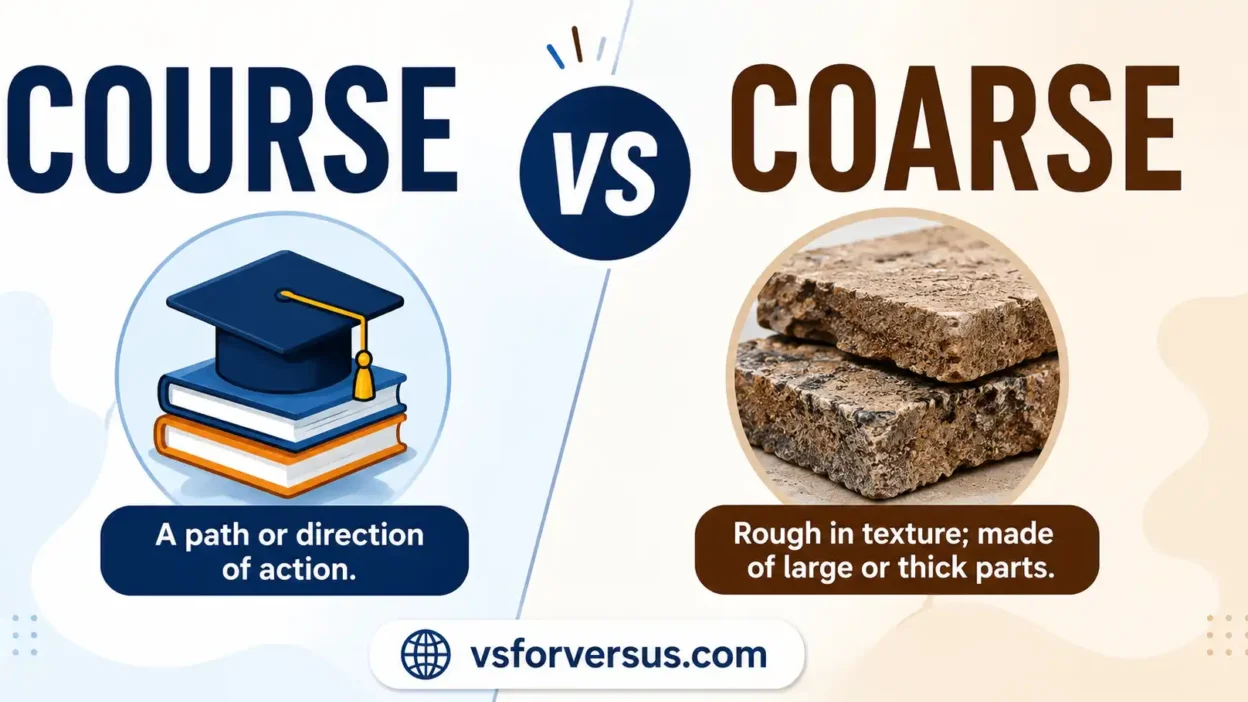
A single course vs coarse mix up can slip past spellcheck and straight into a cover letter, a client email, or a college essay. Course works as a noun and a verb: a route or direction, a program of instruction, a part of a meal, or, as a verb, to run, race, or move swiftly, the way adrenaline courses through veins mid sprint.
Coarse, by contrast, is only ever an adjective, describing something rough in texture or harsh, unrefined, and crude in manner. Both are correctly spelled words, so spellcheck never steps in, which is how “coarse of action” ends up in a document meant to look polished.
Quick Answer
Course vs coarse are homophones: they sound exactly alike but carry unrelated meanings. Course is a noun (occasionally a verb) meaning a path, a class, a direction, or part of a meal, as in “a golf course” or “a math course”, while coarse is an adjective meaning rough or unrefined in texture, quality, or manner, as in “coarse sandpaper” or “coarse language.” Because both spellings are valid words, spellcheck will never flag a course vs coarse swap; only a careful read will.
Course vs Coarse at a Glance
| Word | Part of Speech | Meaning | Example |
| Course | Noun (also verb) | A path, direction, class, or meal segment; to flow rapidly | “She’s taking an English course this semester.” |
| Coarse | Adjective | Rough in texture; crude or unrefined in manner | “The sweater felt coarse against her skin.” |
At a glance, the pattern holds every time: if the word is naming something, it’s almost certainly course; if it’s describing something, it’s almost certainly coarse. Keep that one filter running in your head, and the rest of this guide is just reinforcement.
What Does “Course” Mean?
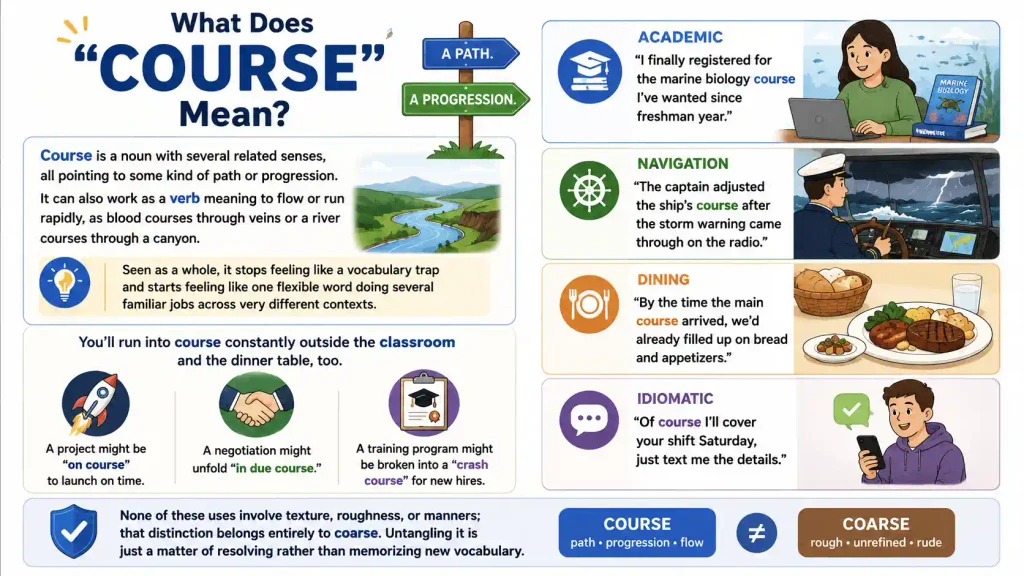
Course is a noun with several related senses, all pointing to some kind of path or progression. It can also work as a verb meaning to flow or run rapidly, as blood courses through veins or a river courses through a canyon. Seen as a whole, it stops feeling like a vocabulary trap and starts feeling like one flexible word doing several familiar jobs across very different contexts.
Academic: “I finally registered for the marine biology course I’ve wanted since freshman year.”
Navigation: “The captain adjusted the ship’s course after the storm warning came through on the radio.”
Dining: “By the time the main course arrived, we’d already filled up on bread and appetizers.”
Idiomatic: “Of course I’ll cover your shift Saturday, just text me the details.”
You’ll run into course constantly outside the classroom and the dinner table, too. A project might be “on course” to launch on time, a negotiation might unfold “in due course,” and a training program might be broken into a “crash course” for new hires. None of these uses involve texture, roughness, or manners; that distinction belongs entirely to coarse, and untangling it is really just a matter of resolving rather than memorizing new vocabulary.
What Does “Coarse” Mean?
Coarse is strictly an adjective. It never functions as a noun or a verb, no matter how the sentence around it is rearranged. It describes two related but distinct things: physical roughness in texture, or a lack of refinement in behavior, language, or overall quality.
Texture: “This sandpaper is too coarse for the final sanding pass; grab the finer grit instead.”
Behavior: “His coarse comments during the client dinner made everyone at the table visibly uncomfortable.”
Material: “The rug’s coarse burlap backing scratched at bare feet all winter.”
Food/cooking: “Finish the steak with a pinch of coarse sea salt right before it comes off the grill.”
Notice how naturally coarse shows up in everyday workplace and kitchen language: a Slack message might describe a joke as “a little coarse for the group chat,” and a recipe might specifically call for “coarse ground pepper” rather than fine. In every case, the word is doing descriptive work, never naming a thing, a place, or an action. If you can swap in “rough” or “crude” and the sentence still makes sense, you’re almost certainly looking at coarse.
Key Differences Between Course and Coarse
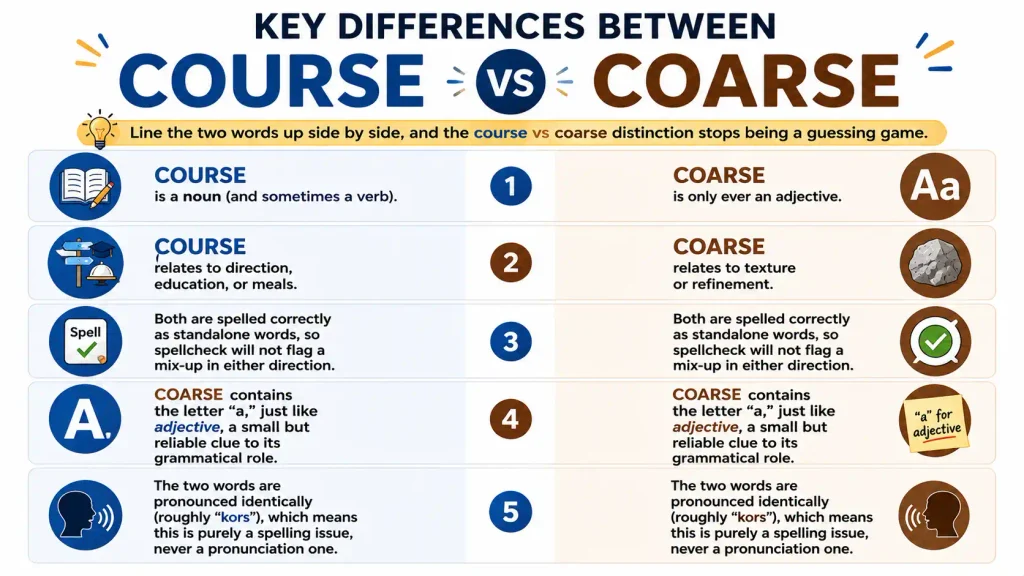
Line the two words up side by side, and the course vs coarse distinction stops being a guessing game:
- Course is a noun (and sometimes a verb); coarse is only ever an adjective.
- Course relates to direction, education, or meals; coarse relates to texture or refinement.
- Both are spelled correctly as standalone words, so spellcheck will not flag a mix up in either direction.
- Coarse contains the letter “a,” just like adjective, a small but reliable clue to its grammatical role.
- The two words are pronounced identically (roughly “kors”), which means this is purely a spelling issue, never a pronunciation one.
Even experienced writers slip here, especially when typing quickly under deadline pressure. The words feel interchangeable in the moment because your ear can’t tell them apart, and your fingers are moving faster than your proofreading brain can keep up.
Editors and copywriters who’ve been at this for years still occasionally catch themselves typing “coarse of action” in a rushed first draft. A deliberate review pass simply catches what instinct alone cannot. This is one of those word pairs, much like, where familiarity with the sound of a word actively works against the person typing it.
Why This Mix Up Happens So Often
Part of the reason the course vs coarse mix up trips up so many writers isn’t carelessness; it’s how the brain processes written language under time pressure. When you type quickly, your fingers are often reproducing the sound of a word rather than consiously selecting its spelling, and since “course” and “coarse” are pronounced identically, the wrong one can slip through without triggering any internal alarm.
Add to that the fact that both words are common enough to feel automatic, you’ve typed each of them hundreds of times, and you get a mistake that hides in plain sight, invisible to the very person who wrote it.
This is also why relying purely on spellcheck or autocorrect is risky for any word that has a legitimate homophone. Tools built to catch misspellings have nothing to flag here, because nothing is technically misspelled; the error lives entirely at the level of meaning, not spelling.
Grammar checking software has gotten better at flagging some of these swaps in context, but it’s far from foolproof, especially in short sentences where the surrounding words don’t give the algorithm much to work with. That’s precisely why human proofreading, or reading a document aloud before sending it, still catches mistakes that software routinely misses.
The stakes vary depending on where the mistake lands. A typo in a group chat gets a laugh and gets forgotten. The same typo in a client proposal, a scholarship essay, or a performance review reads as a lack of polish, and readers who notice tend to wonder what else might have been rushed. That gap between a harmless slip and a real credibility hit is why this particular word pair earns its own explainer instead of getting lumped in with every other typo under the sun.
Memory Trick: How to Never Mix Them Up Again
If the definitions ever blur together mid sentence, lean on one simple mnemonic:
Coarse has an A, just like Adjective and Abrasive.
- Describing something rough, crude, or abrasive? It needs the “a” → coarse.
- Talking about a class, a path, a direction, or a meal? No “a” needed → course.
Picture it as a two column rule: “A” pairs with Adjective and Abrasive on one side, and “No A” pairs with Noun and Navigate on the other. That single letter is the entire hinge the course vs coarse decision turns on, and once the association clicks, it tends to stay clicked for good.
Common Mistakes with Course and Coarse
These mix ups show up constantly in real writing, resumes, emails, group chats, even published articles, because both words sail through spellcheck without a flicker of concern.
| ❌ Incorrect | ✅ Correct |
| “I’m taking a coarse in accounting.” | “I’m taking a course in accounting.” |
| “The blanket felt very course.” | “The blanket felt very coarse.” |
| “Please advise on the best coarse of action.” | “Please advise on the best course of action.” |
| “The chef added course pepper to the dish.” | “The chef added coarse pepper to the dish.” |
| “Of coarse, I’ll send the report today.” | “Of course, I’ll send the report today.” |
This is exactly the kind of mix up that happens in real documents every day: a course vs coarse mistake sails through spellcheck untouched and lands directly in front of a reader who notices.
Mistakes like these are common examples of precisely because nothing here is technically misspelled, it’s also the kind of error that’s easy to miss on a glowing screen but jumps out immediately to a careful reader on the receiving end, so it’s worth a manual scan before anything goes out the door, alongside a check for elsewhere in the same document.
Quick Quiz: Test Yourself on Course vs Coarse
See how confidently you can apply the rule. Answers and explanations follow each question.
- The sandpaper was too _____ for delicate woodwork. (course/coarse)
- She signed up for a photography _____ at the community college. (course/coarse)
- His manners were _____ and off-putting at the dinner party. (course/coarse)
- The captain adjusted the ship’s _____ to avoid the reef. (course/coarse)
- _____ I’ll be there to help you move! (Of course/Of coarse)
Answer key:
- Coarse describes texture, so it needs the “a.”
- Course names a class or program, so no “a” is required.
- Coarse describes manner or behavior, so it’s the adjective form.
- Course refers to direction and navigation, a noun.
- Of course, this fixed idiom never takes an “a” in any context.
If you got all five, you’ve internalized the course vs coarse rule better than plenty of professional writers ever bother to.
Frequently Asked Questions
Are “course” and “coarse” homophones or homonyms? They’re technically homophones, words that sound identical but differ in spelling and meaning. “Homonym” is sometimes used loosely to mean the same thing, but strictly speaking, true homonyms share spelling too, which course and coarse do not.
Will spellcheck catch it if I use the wrong one? No. Both “course” and “coarse” are correctly spelled words, so spellcheck and autocorrect won’t flag a mix up between them; only careful proofreading, or reading your writing aloud, will catch it reliably.
Is “coarse” ever used as a noun? No. “Coarse” functions only as an adjective in modern English; it never shifts into a noun regardless of context.
Is “course” ever used as an adjective? No. “Course” functions as a noun or, less commonly, a verb, never as an adjective, which is one of the clearest anchors in the course vs coarse comparison whenever you’re second guessing a sentence.
How do you spell “of course”, with an “a” or without? Always without an “a”: “of course.” “Of coarse” is incorrect in every context, however informal the message.
What’s an easy way to remember the difference? Remember that “coarse” contains an “a,” just like “adjective”, since coarse is always an adjective describing something rough, crude, or unrefined.
Final Thought
The next time your fingers type one of these words on autopilot, pause for half a second and ask what the sentence actually needs: a thing (course) or a description (coarse). That one small habit resolves the course vs coarse question permanently, long before it ever reaches a reader, a boss, or a hiring manager scanning a cover letter for reasons to say no. Course and coarse are just one entry on a long list; the letter “a” is simply the easiest one to fix for good.
To read more: Capability vs Ability: The Ultimate Difference 2026