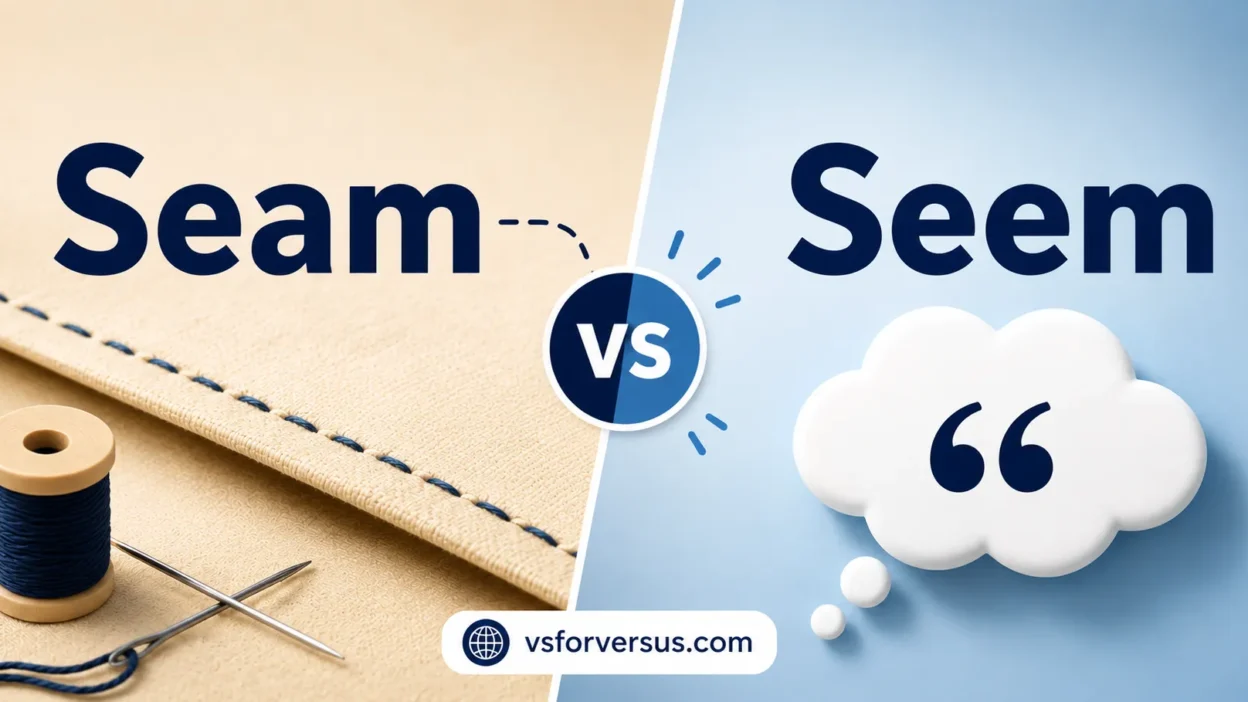
From my experience, mastering Seam vs Seem: What’s the Difference is something every writer should prioritise, because these two words sound identical yet serve completely different purposes in a sentence. A seam is a physical line where two pieces of fabric, leather, or material are joined together, most commonly seen in clothing, upholstery, and textiles. It represents something tangible you can actually see and touch.
Seem, however, works entirely differently; it conveys an impression or appearance, describing how something feels or comes across rather than a solid fact. Many writers assume one spelling covers both meanings, while others notice the confusion but never fully resolve it. I’ve learned that writing this pair correctly instantly improves clarity, strengthens professionalism, and reflects genuine attention to detail in your work.
Quick Answer
Seam vs seem are homophones; they sound exactly alike but have completely different meanings and functions. Seam is a noun that refers to the line where two pieces of fabric or material are joined (as in “the seam of the shirt”). Seem is a verb that means to appear or give an impression (as in “it seems late”). A fast way to decide: if the word “appear” fits the sentence, the correct choice is seem.
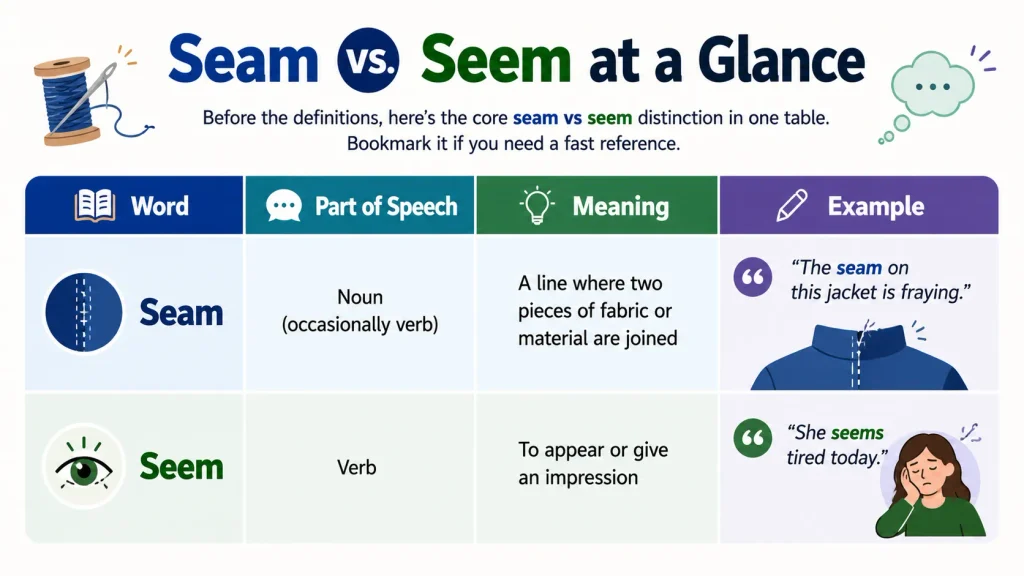
Seam vs Seem at a Glance
Before the definitions, here’s the core seam vs seem distinction in one table. Bookmark it if you need a fast reference.
| Word | Part of Speech | Meaning | Example |
| Seam | Noun (occasionally verb) | A line where two pieces of fabric or material are joined | “The seam on this jacket is fraying.” |
| Seem | Verb | To appear or give an impression | “She seems tired today.” |
One word describes something you can touch; the other describes something you perceive. Keep that split in mind, and most sentences sort themselves out.
What Does “Seam” Mean?
Seam is a noun. It refers to the line where two pieces of fabric, leather, or other material are joined, usually by stitching, but sometimes just by contact, as in construction or geology. Occasionally, it also works as a verb meaning to join something along that line, though this usage is rare outside sewing and manufacturing contexts.
A few examples of how it shows up in real writing:
- “The tailor let out the seam so the jacket would fit across the shoulders.”
- “There’s a bumpy seam where the new pavement meets the old parking lot.”
- “The quilt’s seams are hand stitched, which is why it took three weeks to finish.”
- “Miners followed the coal seam nearly half a mile underground.”
Seam tends to cluster in a handful of predictable contexts: clothing and tailoring, upholstery and quilting, construction and flooring, and geology or mining, where it describes a layer or vein running through rock. It also survives in figurative expressions, “bursting at the seams,” “seamless transition”, which stretch the sewing image into everyday language.
What Does “Seem” Mean?
Seem is a linking verb. It expresses how something appears, feels, or is perceived, not a fact stated outright, but an impression. Because of that, it’s one of the most common words for softening an opinion so it reads as an observation rather than a demand.
A few natural examples:
- “It seems like the client hasn’t reviewed the proposal yet.”
- “He seemed distracted during the whole meeting.”
- “This deadline seems tight, but I think we can hit it.”
- “You seem to have a good handle on the numbers; want to present them?”
The sentence patterns are worth learning by feel: seem + adjective (“seems tired”), seem + to infinitive (“seems to know”), and “it seems that/like” clauses. All three show up constantly in workplace communication, casual conversation, and academic writing, precisely because seem lets a writer state an impression without overcommitting to a claim.
Even experienced writers lean on seem so heavily that editors often flag it as a crutch word; a sentence like “It seems that the plan is working” is usually stronger as “The plan is working.” That’s a style note, not a seam vs seem error, but it’s worth knowing the word has both a spelling trap and an overuse trap.
“Seams” in Fiction and Figurative Writing
There’s a subtler side of the seam vs seem confusion that gets less attention than it should. Readers who know both words perfectly well sometimes still get stuck when seams shows up in a metaphorical sense inside a story or article. A line like “her composure was coming apart at the seams” can cause a pause, not because the spelling is unclear, but because the image doesn’t immediately click if you’re only thinking of seam as a sewing term.
That figurative use borrows directly from fabric: something that was holding together neatly starts to fail, stitch by stitch. “The plan started to show its seams” means the plan’s weaknesses were becoming visible. Once the sewing image behind the metaphor clicks, the figurative meaning stops being a mystery; it’s the literal meaning, extended.
Dictionary definitions alone don’t always resolve this kind of confusion. If a sentence uses “seams” in a way that no definition quite explains, try picturing stitching starting to unravel. That mental image solves more confusion than a dictionary entry does.
Key Differences Between Seam and Seem
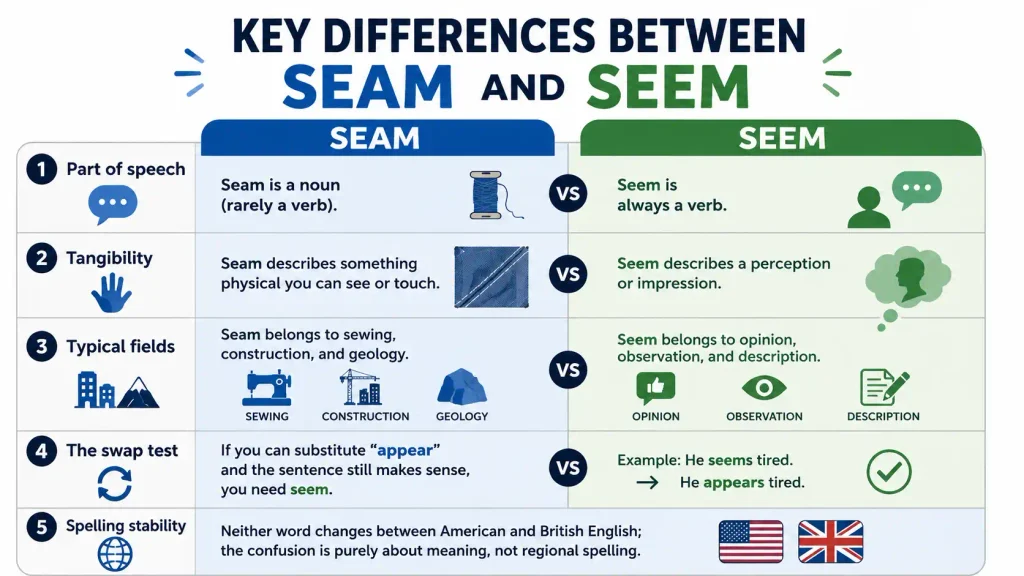
- Part of speech: Seam is a noun (rarely a verb); seem is always a verb.
- Tangibility: Seam describes something physical you can see or touch; seem describes a perception or impression.
- Typical fields: Seam belongs to sewing, construction, and geology; seem belongs to opinion, observation, and description.
- The swap test: If you can substitute “appear” and the sentence still makes sense, you need seem.
- Spelling stability: Neither word changes between American and British English; the confusion is purely about meaning, not regional spelling.
Memory Trick: How to Never Mix Them Up Again
The fastest fix for seam vs seem confusion is a single visual anchor: seem has two E’s, like a pair of eyes, and eyes are how you see how something appears. Seam, by contrast, has an A, which you can tie to “a stitch” or “a fabric line.”
For a physical image to lock it in, picture a needle and thread running along a seam. If the sentence is about something joined or stitched, it’s seam. If it’s about how something looks, feels, or comes across, it’s seem. One mnemonic, applied consistently, beats memorising a list of rules.
Common Mistakes with Seam and Seem
The single most common seam vs seem error is using seams where seems belongs, almost always because the writer typed fast and trusted their ear instead of the actual rule.
In everyday writing:
- ❌ “It seams like it’s going to rain all weekend.”
- ✅ “It seems like it’s going to rain all weekend.”
In business and professional emails:
- ❌ “It seams the invoice was sent to the wrong contact.”
- ✅ “It seems the invoice was sent to the wrong contact.”
In academic writing:
- ❌ “The data seams to support the original hypothesis.”
- ✅ “The data seems to support the original hypothesis.”
In legal and contract writing:
- ❌ “The clause seams to conflict with Section 4.2 of the agreement.”
- ✅ “The clause seems to conflict with Section 4.2 of the agreement.”
In social posts and quick messages:
- ❌ “This new update seams way faster tbh”
- ✅ “This new update seems way faster tbh”
Why Spellcheck Won’t Catch This
This is the frustrating part: spellcheck and autocorrect are nearly useless against this specific error, and that’s by design, not a flaw. Both seam and seem are correctly spelled, real English words. Spellcheck tools flag words that don’t exist in their dictionary; they have no built-in sense of grammar or meaning, so a sentence using the wrong but real word sails through untouched.
The only real fix is reading your sentence back and asking whether you mean a physical joint or an impression. Reading it aloud often makes the error jump out, since your ear catches the grammatical mismatch even when your eyes don’t.
Quick Practice: Seam or Seem?
Try filling in the blanks before checking the answers below.
- The tailor carefully repaired the torn ______ in the sleeve.
- It ______ like the meeting ran long again.
- Her calm exterior was starting to come apart at the ______.
- He ______ nervous just before walking into the interview.
- The exposed coal ______ ran deep beneath the old mine.
Answers: 1. seam · 2. seems · 3. seams · 4. seems · 5. seam
Frequently Asked Questions
What does “seam” mean in a sentence?
Seam refers to the line where two pieces of fabric, leather, or other material are joined, usually by stitching, as in “the seam of the dress needs mending.”
What does “seem” mean in a sentence?
Seem means to appear or give an impression, as in “he seems confident about the presentation.”
Is “seams to be” or “seems to be” correct?
“Seems to be” is correct when describing an impression or appearance, such as “she seems to be running late.” “Seams” only applies to physical stitching, so it would never precede “to be” in that construction.
Is “seam” a noun or a verb?
Seam is primarily a noun. It can occasionally function as a verb in sewing or manufacturing contexts, such as “to seam two panels together,” but that usage is uncommon in everyday writing.
Why are “seam” and “seem” pronounced the same?
They’re homophones, words that sound identical but differ in spelling and meaning. Both are pronounced /siːm/, which is exactly why the seam vs seem mix up is so persistent even among careful writers.
How can I remember the difference between seam and seem?
Use the two E’s mnemonic: seem has two E’s like eyes, and eyes let you see how something appears. Seam has an A, which you can link to “a stitch” or “a fabric line.” Applied consistently, this trick resolves the seam vs seem question almost instantly.
Related Confusable Words
The seam vs seem pair isn’t the only near rhyme that trips up writers. If this kind of mix up sounds familiar, check out our guides on seen vs scene, which shares the same /siːn/ sound family, or browse our full commonly confused words hub for more homophone breakdowns worth bookmarking.
Final Thought
At the end of the day, seam vs seem isn’t a hard rule to learn; it’s a habit to build. Once you’ve run into the mistake once (or watched it cost someone a job interview), the distinction tends to stick for good.
The next time your fingers type “it seams like” out of habit, pause for half a second: are you talking about fabric, or an impression? Get that one question right, and you’ll never lose a reader, or a hiring manager, over seam vs seem again.
To read more: Dice vs Die: The Ultimate Guide to the Real Difference in 2026