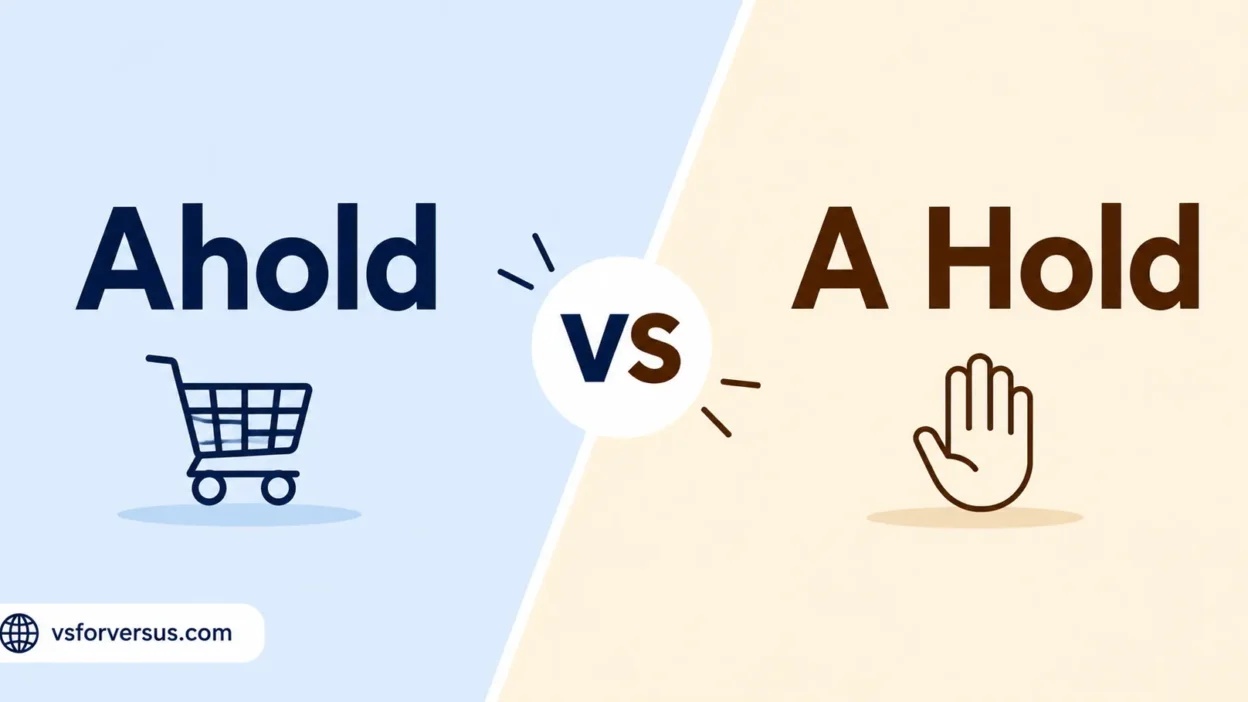
“Ahold” vs “a hold” are commonly confused, even though they serve different grammatical purposes. “A hold” refers to a grasp, restraint, or degree of control over something, as in “she has a hold on her emotions.” “Ahold,” on the other hand, is an informal adverb meaning to obtain, reach, or make contact with someone, as in “I need to get ahold of that report.”
Ahold vs a hold really comes down to formality: “a hold” works comfortably in professional and academic writing, while “ahold” stays casual and conversational, and is mostly used in American English. If you have ever paused mid-sentence unsure which one to type, this guide settles it for good.
Quick Answer
“Ahold” is a one-word, informal adverb used mainly in American English, as in “I finally got ahold of him.” “A hold” is two words: the article “a” plus the noun “hold,” meaning a grasp, reservation, or restraint, as in “The bank put a hold on my card.”
Both are grammatically valid in casual writing, but “a hold” or simply “hold” is the safer, more formal choice for professional and academic contexts. That’s the short version of the ahold vs a hold rule.
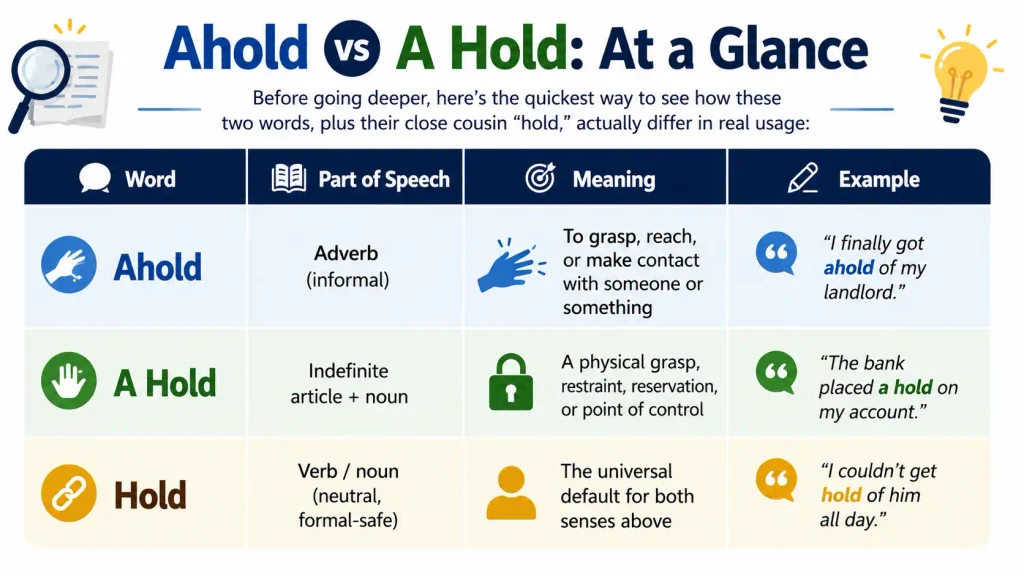
Ahold vs A Hold: At a Glance
Before going deeper, here’s the quickest way to see how these two words, plus their close cousin “hold,” actually differ in real usage:
| Word | Part of Speech | Meaning | Example |
| Ahold | Adverb (informal) | To grasp, reach, or make contact with someone or something | “I finally got ahold of my landlord.” |
| A Hold | Indefinite article + noun | A physical grasp, restraint, reservation, or point of control | “The bank placed a hold on my account.” |
| Hold | Verb / noun (neutral, formal-safe) | The universal default for both senses above | “I couldn’t get hold of him all day.” |
This table is really the heart of the ahold vs a hold debate: one is a compressed, spoken language shortcut, and the other is a standard noun phrase that behaves like any other “a + noun” combination in English. Once you see them side by side, the ahold vs a hold decision gets a lot less intimidating.
What Does “Ahold” Mean?
“Ahold” functions as an adverb. It modifies a verb, usually get, grab, or take, to express possession, contact, or a firm grip. It almost always shows up paired with the preposition “of,” forming the familiar phrase “ahold of.”
Here’s the important context for the ahold vs a hold split: “ahold” is a distinctly American colloquialism. It’s rarely seen in British English writing, and most style guides classify it as informal, meaning it belongs in conversation and casual writing rather than reports, essays, or client emails.
Examples in natural use:
- “Can you try to get ahold of Marcus before the meeting starts?”
- “I’ve been trying to grab ahold of the invoice all week, but nobody’s replying.”
- “She finally got ahold of herself after the interview went sideways.”
- “Text me if you get ahold of the landlord. I need that lease signed today.”
These sentences read naturally in texts, Slack messages, or spoken dialogue. That’s exactly where “ahold” belongs: it’s the language of everyday communication, not formal documentation. In many of these cases, you could just as easily write “get in touch with” or “reach” instead, which is a useful substitute whenever “ahold” feels too casual for the moment.
Linguistically, “ahold” traces back to “hold” itself, which produced a handful of regional variants over the centuries, including the older form “holt,” still heard in parts of the American South and the English Midlands. “Ahold” fused the article and noun into a single spoken unit as a compound word, similar to how “a lot” gets slurred into “alot” in casual speech, except “ahold” actually earned its place in the dictionary, while “alot” never did.
What Does “A Hold” Mean?
“A hold” is simply the indefinite article “a” attached to the noun “hold.” Unlike “ahold,” this is a completely standard construction, the same pattern you’d use with “a house” or “a plan.” “Hold,” as a noun, carries several related meanings: a physical grip, a restraint or blockage, a reservation, or even a financial term.
Examples in natural use:
- “The bank put a hold on my paycheck because of a routing error.”
- “I placed a hold on that library book. It’s finally my turn.”
- “The referee stopped the match because the wrestler used an illegal hold.”
- “Our supplier has a hold on new orders until the shipment issue clears up.”
- “She kept a hold on the rope even as her arms started to shake.”
Notice the difference in register here compared to the ahold examples above. These sentences slot easily into a business email, a customer service note, or a formal report, exactly where “ahold” would feel out of place. If you’re describing someone maintaining a grip on something, phrases like “take hold of” or “catch hold of” work as close, fully formal synonyms for “a hold” and “ahold” alike.
Is “Ahold” Even a Real Word?
Yes. This is worth stating plainly, because it’s the actual question behind most ahold vs a hold searches. “Ahold” appears in Merriam Webster and other major dictionaries, labeled as informal and chiefly American. It’s been in print since at least the mid 1800s. It isn’t a typo or internet slang, and it isn’t something to feel embarrassed about using casually.
What it isn’t, though, is formal. That distinction, real but informal, is exactly why so many people get tripped up by the ahold vs a hold question. A word can be completely legitimate and still be the wrong choice for a cover letter.
Key Differences Between Ahold and A Hold
Once you strip away the dictionary jargon, the ahold vs a hold question comes down to five practical distinctions:
- Spelling: “Ahold” is one word; “a hold” is two.
- Part of speech: “Ahold” is an adverb; “a hold” is an article plus a noun.
- Formality: “Ahold” is informal and conversational; “a hold” is neutral and safe for formal writing.
- Region: “Ahold” is largely American; “a hold” and “hold” are used everywhere English is spoken.
- Safest default: When you’re unsure, drop the article entirely and just use “hold.” It works in nearly every context.
Ahold or A Hold Which Should You Use?
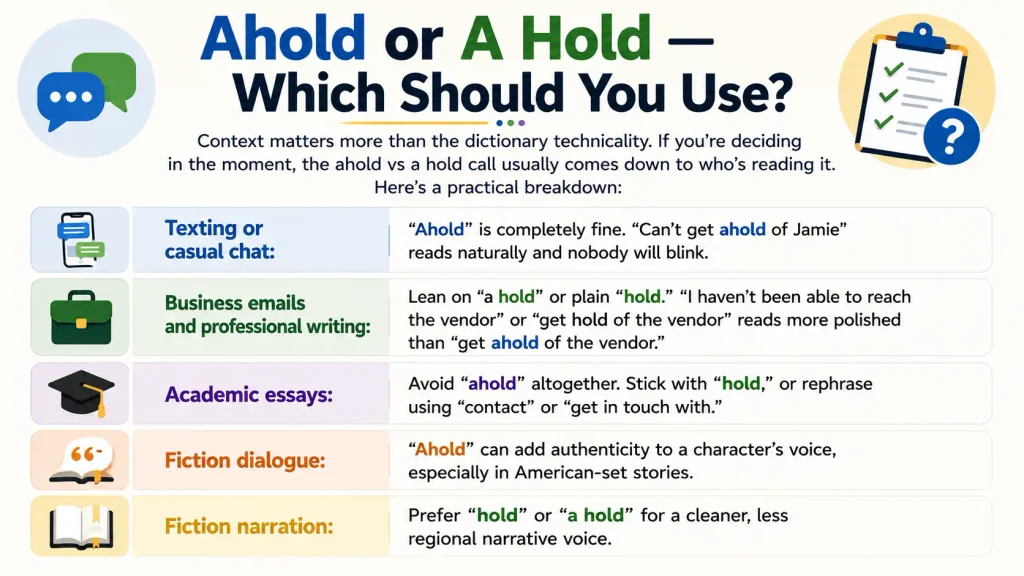
Context matters more than the dictionary technicality. If you’re deciding in the moment, the ahold vs a hold call usually comes down to who’s reading it. Here’s a practical breakdown:
- Texting or casual chat: “Ahold” is completely fine. “Can’t get ahold of Jamie” reads naturally and nobody will blink.
- Business emails and professional writing: Lean on “a hold” or plain “hold.” “I haven’t been able to reach the vendor” or “get hold of the vendor” reads more polished than “get ahold of the vendor.”
- Academic essays: Avoid “ahold” altogether. Stick with “hold,” or rephrase using “contact” or “get in touch with.”
- Fiction dialogue: “Ahold” can add authenticity to a character’s voice, especially in American set stories.
- Fiction narration: Prefer “hold” or “a hold” for a cleaner, less regional narrative voice.
Even experienced writers slip on this. Professional editors will tell you that “ahold” is one of the most common informalisms that sneaks past a first draft, because it sounds so natural out loud that the eye skips right over it.
Memory Trick to Remember the Difference
Here’s a simple test that settles the ahold vs a hold question almost instantly.
The Swap Test: Try replacing the word with “the” or “some.” If the sentence still makes sense, as in “The bank put the hold on my account,” you’re dealing with a noun phrase, so it’s two words: “a hold.” If the phrase only works glued directly onto “get” or “grab” with no article possible in its place, it’s the adverb “ahold.”
A second shortcut, if the swap test ever feels shaky: when in doubt, delete the article entirely and just write “hold.” It’s grammatically safe in nearly every sentence where either “ahold” or “a hold” would otherwise appear, and it sidesteps the ahold vs a hold decision altogether.
Common Mistakes with Ahold and A Hold
| ❌ Wrong | ✅ Correct |
| “I need to get a-hold of you.” | “I need to get ahold of you.” (no hyphen) |
| “She has ahold on her temper.” | “She has a hold on her temper.” (noun use needs the article) |
| “Put an hold on the order.” | “Put a hold on the order.” |
| “I’ll ahold the door for you.” | “I’ll hold the door for you.” (never use “ahold” as a plain verb) |
That last mistake is a good reminder: “ahold” only ever functions as an adverb paired with a verb like “get” or “grab.” It can never stand in for the verb “hold” itself.
Quick Quiz Test Yourself
- “I couldn’t ___ of him all weekend.” (get ahold / get a hold)
- “The bank placed ___ on my card.” (a hold/ahold)
- True or False: “Ahold” is standard, widely accepted usage in British English.
- “The climber found ___ on the narrow ledge.” (a hold/ahold)
- Which is the safest choice for a formal business email: ahold, a hold, or hold?
(Answers: 1. Either works informally; 2. a hold; 3. False; 4. a hold; 5. hold)
Frequently Asked Questions
Is “ahold” a real word?
Yes, “ahold” is listed in major dictionaries as an informal, chiefly American adverb, and it has been in use since at least the 1850s.
Is it “get ahold of” or “get a hold of”?
Both forms are used and understood, though neither is technically more correct than the other. The globally preferred and most formal option is actually “get hold of,” without any article at all.
Is “ahold” formal or informal?
“Ahold” is informal. Save it for conversation, texting, and casual writing, and avoid it in essays, reports, and professional emails.
Is “ahold” British or American English?
“Ahold” is primarily American. British English writers rarely use it, typically opting for “hold” or “a hold” instead.
Can I use “ahold” in an essay?
It’s best avoided. Academic writing calls for the more neutral “hold,” or a rephrase like “contact” or “get in touch with.”
What’s the real difference between “hold” and “ahold”?
“Hold” is the flexible, universally accepted verb and noun that works in any register. “Ahold” is a narrower, informal adverb reserved for casual contact related phrases like “get ahold of.”
Why does the ahold vs a hold mix-up happen so often, even to careful writers?
Both forms sound identical out loud, and both are genuinely correct in their own lane. Spoken English rarely pauses to insert the article, so the ear gets used to “ahold” as a single beat. It’s only when that sound has to be typed out that a writer has to consciously choose a spelling, and autopilot often picks the more casual, more frequently heard version.
Final Thoughts
The ahold vs a hold mix up isn’t a sign of sloppy writing. English has quietly let an informal shortcut compete with a standard grammatical construction, and both have stuck around. The fix isn’t memorizing a rigid rule; it’s reading the room. Texting a friend?
“Ahold” is fine. Emailing a client, like Priya learned the hard way? Reach for “a hold,” or better yet, just “hold.” Keep this ahold vs a hold breakdown handy the next time you’re not sure which one to type.
To read more; Seam vs Seem: The Ultimate Guide to the Clear Difference 2026