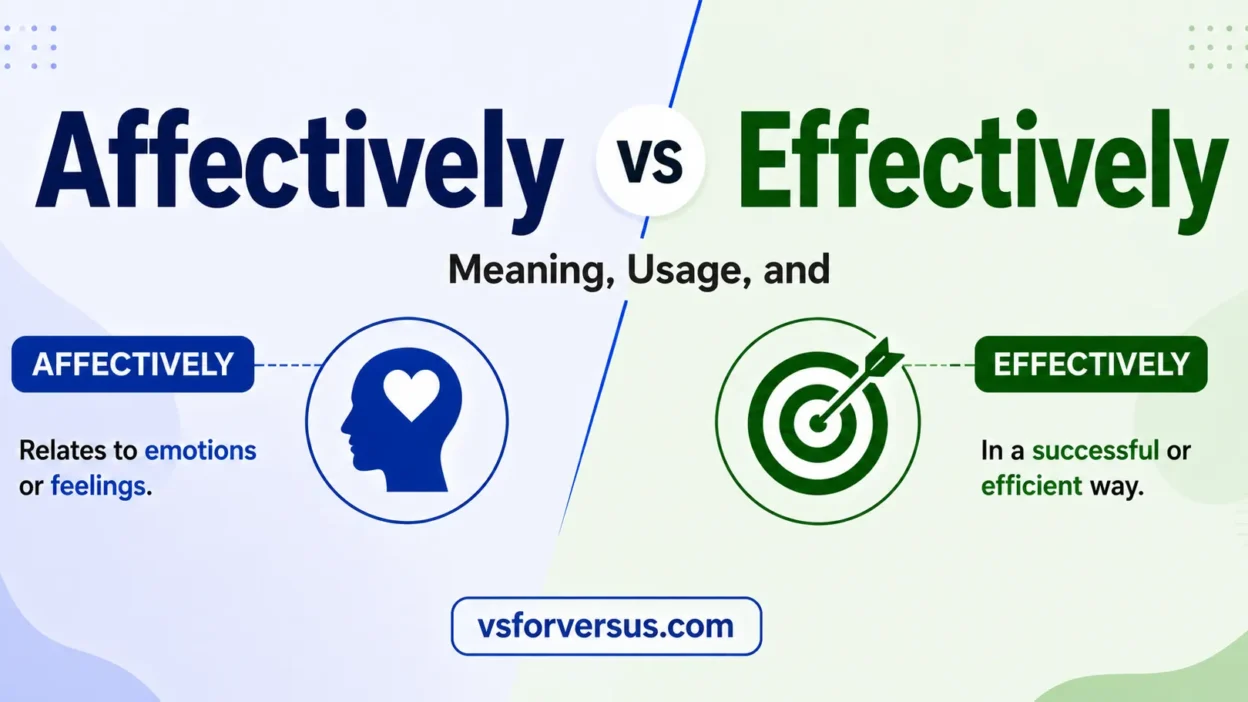
“Affectively” vs “effectively” is one of English’s most commonly confused adverb pairs. “Effectively” means something done in a way that produces an intended result. “Affectively” means something done in a way that expresses or is influenced by emotion. “Effectively” is used constantly in business, academic, and everyday writing, while “affectively” is used almost exclusively in psychology and clinical writing.
Both words come from “affect” and “effect,” though effectively and affectively function only as adverbs, describing how an action is performed. This mix-up happens more often than people realize even in professional writing, where a single misplaced word can change the entire tone of a sentence.
For instance, writing “I affectively communicated our vision to stakeholders” instead of “effectively” turns a confident statement into an unintentionally emotional one, which can cost a writer credibility, or even a job opportunity, in formal contexts.
Quick Answer
Affectively vs effectively comes down to one core distinction: one word is about results, the other is about emotion. Effectively means “in a way that produces the intended result” and is the word almost every writer actually needs, as in “she communicated effectively.”
Affectively means “in an emotional way” and belongs almost exclusively in psychology or clinical writing, as in “he responded affectively to the loss.” If your sentence has nothing to do with feelings or emotions, effectively is the correct choice.
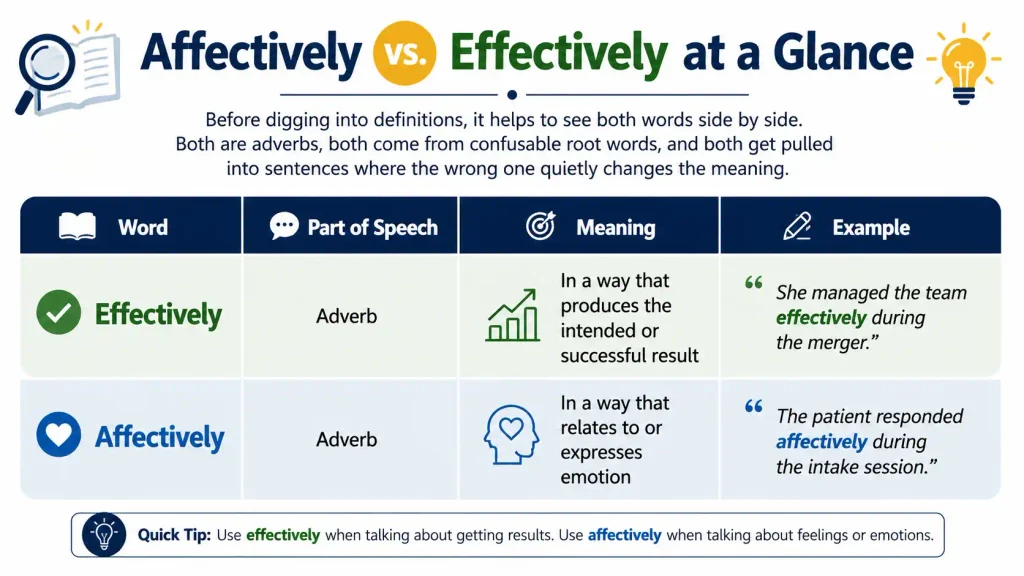
Affectively vs Effectively at a Glance
Before digging into definitions, it helps to see both words side by side. Affectively vs Effectively both are adverbs, both come from confusable root words, and both get pulled into sentences where the wrong one quietly changes the meaning.
| Word | Part of Speech | Meaning | Example |
| Effectively | Adverb | In a way that produces the intended or successful result | “She managed the team effectively during the merger.” |
| Affectively | Adverb | In a way that relates to or expresses emotion | “The patient responded affectively during the intake session.” |
What Does “Effectively” Mean?
Effectively is the adverb form of effective, which itself comes from the noun effect, meaning a result or outcome. When something happens effectively, it happens in a way that gets the job done, produces the desired outcome, or works as intended.
This is by far the more common of the two words, and it shows up constantly in professional writing, essays, and everyday conversation. A few natural examples:
- “Can you walk me through how you effectively cut onboarding time in half last quarter?”, a manager asking in a Slack message
- “The essay effectively argues that remote work reshaped office culture, but the conclusion feels rushed.”, a professor’s margin comment.
- “Honestly, cold brew wakes me up way more effectively than regular coffee ever did.”, a casual tweet.
- “We need to communicate the new refund policy effectively so customers don’t flood support with questions.”, an internal memo.
- “I finally found a study method that effectively helps the material stick before exams.”, a student’s group chat message.
Notice that none of these sentences involve emotion. They’re about outcomes, performance, and results, which is exactly the territory effectively owns. When you’re drafting a resume bullet point, a project update, or a persuasive essay, effectively is almost always the word you’re reaching for.
You’ll see effectively show up most often in:
- Workplace writing, performance reviews, status updates, and emails describing how a task or project was handled
- Academic and essay writing, arguments about how well a strategy, policy, or historical event achieved its goal
- Everyday conversation and social posts, casual claims about what works well, from productivity hacks to skincare routines
What Does “Affectively” Mean?
The adverb affectively comes from affective, which in turn comes from the noun affect, a term psychology uses for emotion or the outward expression of feeling. Affectively describes something done in an emotionally charged or emotion related way, and outside of clinical or academic writing, you’ll rarely see it at all.
Real examples where affectively actually belongs:
- “She spoke affectively rather than analytically about the accident, her voice breaking as she described it.”, a clinical progress note.
- “This study examines how adolescents process affectively charged images differently than neutral ones.”, a psychology journal abstract.
- “He reacted affectively rather than logically when confronted with the diagnosis.”, a case study write up.
- “Her performance moved the audience affectively, even if the technical execution was uneven.”, a rare general use example, more common in reviews of art or theater.
- “Participants who scored higher on the affectively worded survey items also reported greater anxiety overall.”, a line from a research methods section.
Outside of emotion related writing, you almost certainly don’t need this word at all. That’s part of what makes the affectively vs effectively confusion so persistent: one of these words is everywhere, and the other barely exists outside a niche context, so writers default to whichever one sounds more familiar in the moment.
You’ll mostly encounter affectively in:
- Clinical and therapy notes, describing how a patient expressed or displayed emotion during a session
- Psychology and neuroscience research, academic papers studying emotional processing, mood disorders, or affective responses
- Reviews of art, film, or performance, occasionally used to describe emotional impact, though this usage is far less common than the clinical one.
If you’re drawn to affectively adjacent topics, you might also enjoy our breakdown of [empathy vs sympathy], another emotion related pair that trips people up constantly.
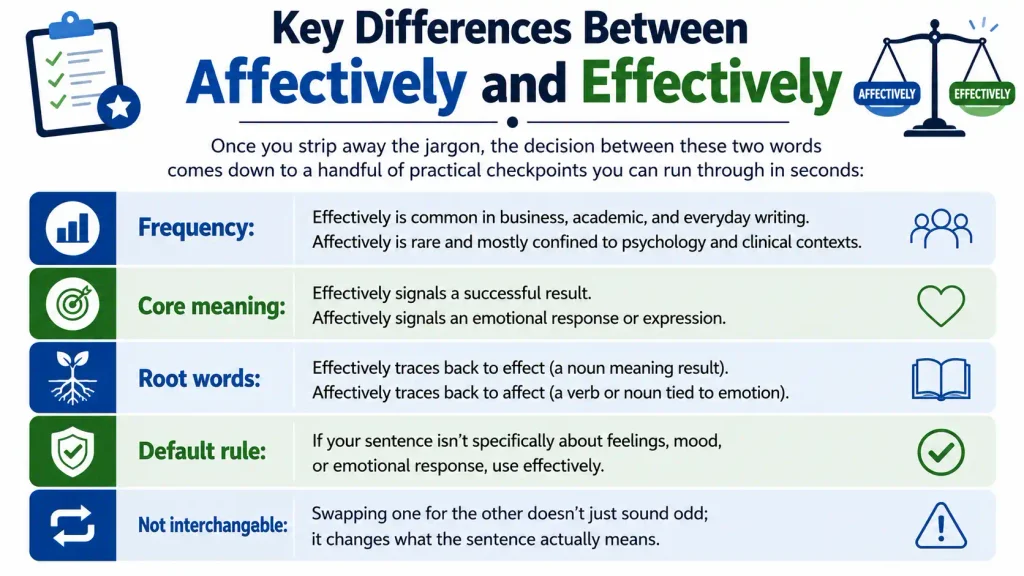
Key Differences Between Affectively and Effectively
Once you strip away the jargon, the decision between these two words comes down to a handful of practical checkpoints you can run through in seconds:
- Frequency: Effectively is common in business, academic, and everyday writing. Affectively is rare and mostly confined to psychology and clinical contexts.
- Core meaning: Effectively signals a successful result. Affectively signals an emotional response or expression.
- Root words: Effectively traces back to effect (a noun meaning result). Affectively traces back to affect (a verb or noun tied to emotion).
- Default rule: If your sentence isn’t specifically about feelings, mood, or emotional response, use effectively.
- Not interchangeable: Swapping one for the other doesn’t just sound odd; it changes what the sentence actually means.
Keep these five checkpoints nearby, and choosing between the two stops being a guessing game and starts being a quick, almost automatic decision.
Memory Trick: How to Never Mix Them Up Again?
Here’s the simplest way to lock this in: Effect = result. Affect = Attached to feelings.
Both cues share a first letter with their meaning: effect starts with E, just like “result,” and affect starts with A, just like “attached to feelings.” Picture the two words as two separate family trees:
- Emotion track: affect (verb) → affective (adjective) → affectively (adverb)
- Result track: effect (noun) → effective (adjective) → effectively (adverb)
If your sentence belongs on the emotion track, use affectively. If it belongs on the result track, which covers almost everything else, use effectively. Running this quick mental check before you hit send solves the affectively vs effectively dilemma faster than trying to memorize a dictionary definition.
Common Mistakes with Affectively and Effectively
Even confident, experienced writers slip here, usually because “affectively” sounds like it could mean “in an effective way,” when it means something entirely different. It’s a mistake worth watching for alongside other [commonly confused words] that quietly undercut otherwise polished writing.
| ❌ Wrong | ✅ Correct | Why |
| “She solved the customer’s complaint affectively.” | “She solved the customer’s complaint effectively.” | Solving a complaint is about the outcome, not emotion. |
| “The patient responded effectively during today’s session.” | “The patient responded affectively during today’s session.” | The sentence describes an emotional response, not a successful outcome. |
| “The new workflow worked affectively once we trained the team.” | “The new workflow worked effectively once we trained the team.” | “Worked” here refers to a successful result. |
| “The medication affectively treated her anxiety symptoms.” | “The medication effectively treated her anxiety symptoms.” | “Treated” implies a positive, measurable outcome. |
That third example is the one that causes the most trouble: “worked affectively” reads smoothly out loud, which is why it slides past a quick proofread so easily. Spellcheck won’t flag it either, since “affectively” is a real, correctly spelled word; the software has no way of knowing it’s wrong for the sentence.
This is a meaning error, not a spelling one, so only a careful re read, or a quick mental check against the memory trick above, will catch it.When in doubt, read the sentence back and ask whether you’re describing an emotion or a result.
If you can replace the word with “successfully” and the sentence still makes sense, you almost certainly want effectively. If you can replace it with “emotionally” instead, affectively is the one you need.
Quick Quiz, Test Yourself
- “The team ___ rolled out the new policy before Monday’s deadline.” → effectively
- “The child reacted ___ to the sad film, crying through the final scene.” → affectively
- “They ___ trained the new hires in under a week.” → effectively
- “Her thesis explores how trauma survivors respond ___ to reminders of the event.” → affectively
- “The ad campaign ___ boosted weekend sales, beating every previous quarter.” → effectively
If you got four or five right, you’ve already got a solid handle on the affectively vs effectively distinction. The first question is the one most people second guess, since it’s tempting to reach for the adjective “effective” instead of the adverb “effectively” when a sentence is describing an action.
Frequently Asked Questions
Is “affectively” a real, commonly used word? Yes, it’s a real word, but it’s rare outside psychology and clinical writing. You’ll find it in academic journals, therapy notes, and research on emotion, but in everyday, business, or general academic writing unrelated to emotions, you’ll rarely need it, and reaching for it there is usually a sign the writer meant “effectively” instead.
Can I use “affectively” and “effectively” interchangeably? No. They aren’t interchangeable. Effectively describes a successful outcome; affectively describes an emotional state or response. Swapping them changes the meaning of the sentence, not just the tone.
What is the difference between “affect” and “effect”? Affect is most often a verb meaning “to influence,” while effect is most often a noun meaning “a result.” This is the same root distinction that separates affectively vs effectively, just in verb and noun form instead of adverb form.
Which is correct in professional writing: “affectively” or “effectively”? Effectively is almost always correct in professional or business writing, since that context is about outcomes and performance rather than emotional expression.
What part of speech is “effectively”? As an adverb, effectively modifies verbs to describe how successfully or capably an action was performed. (For more on how adverbs work in general, see our guide to.
How do I know if I mean “affectively” or “effectively” in a sentence? Ask whether your sentence is about emotions, mood, or feelings; if so, use affectively. If it’s about results, performance, or success, which covers the vast majority of writing, use effectively.
When you’re still unsure, try a quick substitution test: swap in “successfully” or “emotionally” and see which one keeps the sentence’s original meaning intact. This one question resolves almost every affectively vs effectively judgment call, whether you’re writing a work email, a research paper, or a quick text to a friend.
Final Thoughts
At its core, affectively vs effectively is a simple habit, not a spelling rule: pause for half a second before you type either word, and ask what your sentence is actually about. Results and performance point to effectively. Emotions and feelings point to affectively.
That’s it, no dictionary required once the rule clicks. Sarah’s cover letter mistake cost her a callback, but it also made her double check every “affectively” she typed from then on. Catch the habit once, and it stops costing you anything later.
To read more: Ahold vs A Hold: The Complete Guide to the Correct Usage 2026