
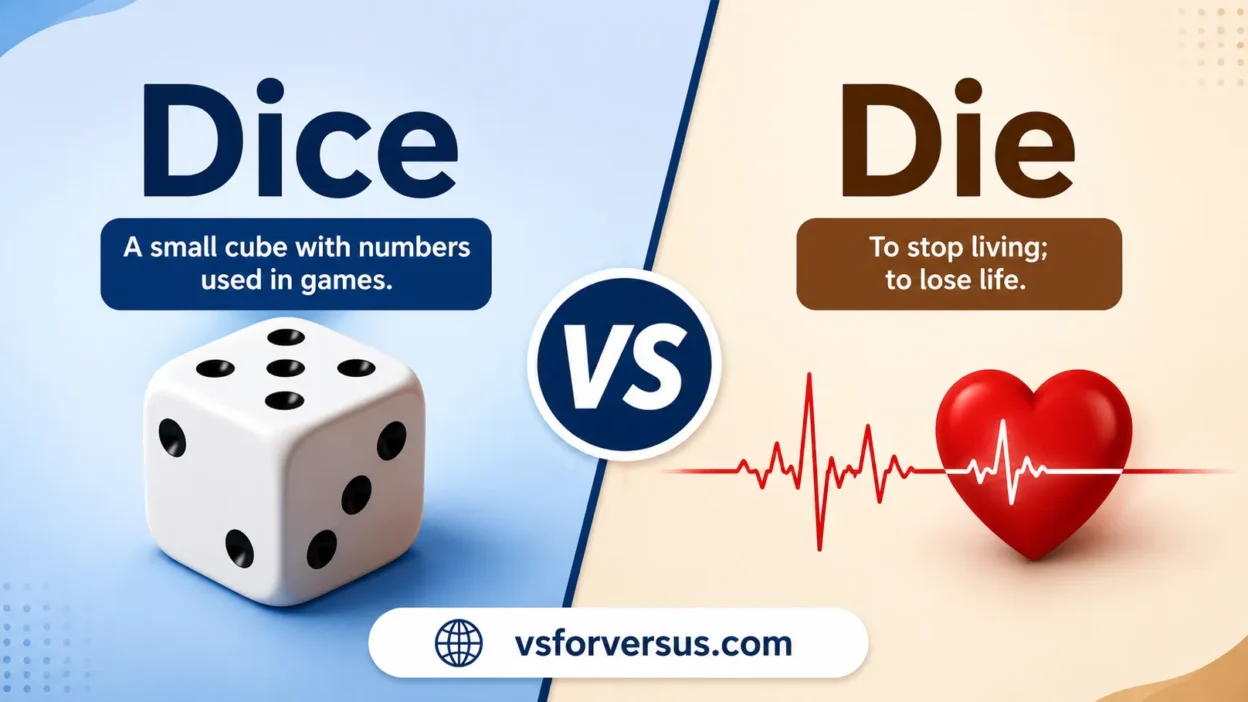
When it comes to board games, gambling, and tabletop play, a lot of people pause over dice vs die, unsure if the two words actually mean something different or if they’re just interchangeable.
The short answer is that die is the word for a single cube you roll, while dice is what you call two or more of them together. Knowing this small difference makes a real difference in how clearly you write and speak. In everyday conversation, plenty of people use “dice” for both one cube and many, but if you’re following traditional grammar rules, “die” is technically the correct singular form.
This guide breaks down dice vs die in plain, easy to follow language, covering what each word means, how they differ, and how to use them correctly with simple examples you can rely on.
Quick Answer
“Die” is the singular form and “dice” is the plural form; you roll one die, but you roll two or more dice. In casual speech, “dice” is now widely accepted as singular too (“roll a dice”), but formal, academic, and professional writing still expects “die” for one cube and “dice” for more than one. When people search “dice vs die,” this singular plural split is almost always the answer they’re looking for.
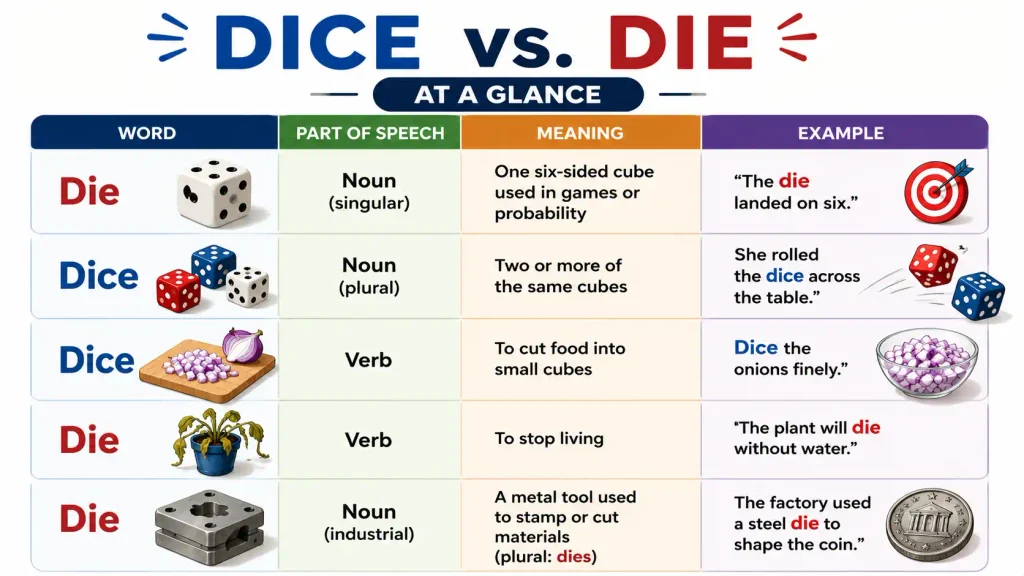
Dice vs Die at a Glance
| Word | Part of Speech | Meaning | Example |
| Die | Noun (singular) | One six-sided cube used in games or probability | “The die landed on six.” |
| Dice | Noun (plural) | Two or more of the same cubes | “She rolled the dice across the table.” |
| Dice | Verb | To cut food into small cubes | “Dice the onions finely.” |
| Die | Verb | To stop living | “The plant will die without water.” |
| Die | Noun (industrial) | A metal tool used to stamp or cut materials (plural: dies) | “The factory used a steel die to shape the coin.” |
What Does “Die” Mean?
“Die” is a singular noun referring to one small cube, usually marked with dots or numbers from one to six, used in games of chance and probability. It comes from the Old French dé, rooted in the Latin datum, “something given,” a nod to how a roll hands you an outcome you didn’t choose. English absorbed the word centuries ago, and the singular plural split has survived largely intact in formal writing ever since.
You’ll see “die” used correctly in contexts like these:
- “I opened the Yahtzee box and found only one die inside; someone must have lost the rest years ago.”
- “Statistically speaking, the probability of rolling a 6 on a single die is one in six.”
- “The factory technician replaced the worn die used to stamp the coin’s edge.” (an unrelated industrial meaning, see the table above)
- “Once the contract was signed, the die was cast; there was no walking it back now.”
Outside of gaming, “die” also shows up in manufacturing, referring to a metal tool used to shape or stamp materials; its plural there is “dies,” not “dice,” one of the more overlooked wrinkles in the broader dice vs die conversation.
In probability and math classes, “die” is the standard term for a single randomizing cube, since precision matters when calculating odds: “one die” gives you six possible outcomes, while “two dice” gives you thirty six.
What Does “Dice” Mean?
“Dice” is the plural of “die,” referring to two or more of the same cubes. In modern spoken English, it’s also commonly used as a singular, a shift that dictionaries like the now acknowledge, even while noting it remains informal.
Natural examples of “dice” in use:
- “Grab the dice, we need two for this next round of Monopoly.”
- “She shook the dice in her fist for a solid ten seconds before letting them fly, like it might change her luck.”
- “Can someone hand me a dice? I think I dropped mine under the table.” (informal singular, common in speech, generally avoided in formal writing)
- “Dice the onions and garlic before you start the sauce.” (a completely unrelated verb, meaning to cut food into small cubes)
This last example flags a separate trap: “dice” as a cooking verb has nothing to do with gaming cubes, even though it shares a spelling with them. A third look alike is worth a mention too: “dye,” meaning to change something’s color, a homophone that occasionally slips into the same sentence by accident, especially in fast typed texts. None of these three words are interchangeable, even though they sound related and, in one case, are spelled almost identically.
If English isn’t your first language, this pair deserves extra attention: textbooks teach regular plurals (add an “s”) long before irregular ones like die/dice or mouse/mice, so the exception can feel like it comes from nowhere. Memorizing “die” and “dice” as a matched pair tends to make it stick faster than memorizing a rule in the abstract.
Key Differences Between Dice and Die
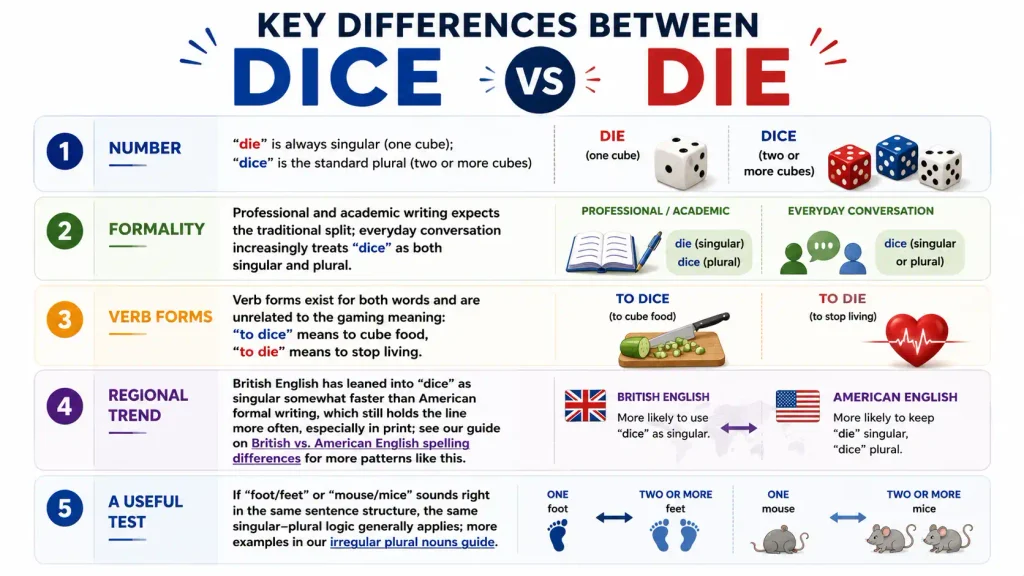
- Number: “die” is always singular (one cube); “dice” is the standard plural (two or more cubes)
- Formality: professional and academic writing expects the traditional split; everyday conversation increasingly treats “dice” as both singular and plural
- Verb forms exist for both words and are unrelated to the gaming meaning: “to dice” means to cube food, “to die” means to stop living.
- Regional trend: British English has leaned into “dice” as singular somewhat faster than American formal writing, which still holds the line more often, especially in print; see our guide on British vs American English spelling differences for more patterns like this
- A useful test: if “foot/feet” or “mouse/mice” sounds right in the same sentence structure, the same singular plural logic generally applies; more examples in our irregular plural nouns guide
Understanding these distinctions is basically the whole game. Once you’ve internalized dice vs die as fundamentally a number problem rather than a spelling problem, the rest of it tends to fall into place on its own.
How to Remember the Difference
Here’s a trick that tends to stick: the word “die” has one fewer letter than “dice,” and one is exactly what “die” means. Picture it as “i” for individual, singular, alone. The extra letters in “dice” mirror the extra cubes rolling around on the table.
If that doesn’t stick for you, anchor yourself to the idiom “the die is cast.” It’s always singular, always frozen in that historical form, and it’s one phrase that virtually nobody gets wrong, even people who mix up everything else. When in doubt, recalling that single fixed idiom is often enough to jog the right instinct back into place.
Common Mistakes With Dice and Die
Even experienced writers slip here; it’s a forgiving grammar error, since almost everyone will still understand you regardless of which form you choose. But a few patterns are worth catching before they end up in something more permanent than a text message.
| ❌ Incorrect | ✅ Correct | Where it tends to happen |
| “I rolled a dice and landed on six.” | “I rolled a die and landed on six.” | Casual writing, blog posts, game reviews |
| “Please have each player roll the dice.” (each player rolls one cube per turn) | “Please have each player roll the die.” | Rulebooks and game instructions |
| “Once we signed the lease, the dice was cast.” | “Once we signed the lease, the die was cast.” | Business emails, idiom misuse |
| “The professor asked us to find the probability of a dice landing on 4.” | “…probability of a die landing on 4.” | Academic and technical writing |
| “I need to dye the peppers for the stir-fry.” | “I need to dice the peppers for the stir-fry.” | Recipes, kitchen instructions, dice/dye mix-up |
Most of these slip ups aren’t about not knowing the rule at all; they’re about forgetting which register you’re writing in. “A dice” tossed into a group chat is fine, and nobody will notice. The same phrase sitting inside a probability textbook or a signed contract will raise an eyebrow. The practical takeaway from dice vs die is simpler than the grammar rule itself: match your word choice to who’s going to read it.
Quick Quiz: Dice or Die?
Test yourself before moving on. Fill in each blank with the correct form.
- Monopoly requires two ______ to play.
- The teacher searched the drawer but couldn’t find a single ______ for the demonstration.
- “The ______ is cast”, meaning a decision can no longer be undone.
- She ______d the carrots finely before adding them to the pot.
- In a formal lab report, “I rolled a ______” reads more polished than “I rolled a dice.”
Answers: 1. dice, 2. die, 3. die, 4. dice(d), 5. die
FAQs About Dice vs Die
Is it “roll a die” or “roll a dice”?
Formally, “roll a die” is correct for one cube, since “die” is the singular form. “Roll a dice” is extremely common in casual speech but is treated as informal in professional or academic writing, where precision still matters.
Is “dice” ever singular?
“Dice” can function as a singular noun in modern informal English; major dictionaries, including Oxford, now list it as acceptable for both singular and plural. The formal rule still favors “die” for one and “dice” for more than one.
What’s the plural of “die”?
When talking about gaming cubes, the plural of “die” is “dice.” Worth noting: the plural of the unrelated industrial “die”, the stamping tool, is “dies,” not “dice,” a distinction that often gets lost in casual conversation.
Why do people say “dice” instead of “die”?
Most games involve two or more dice at once, so people hear the plural far more often. Over time, the more familiar word became the default, even for one cube.
Is it wrong to say “a dice”?
Saying “a dice” isn’t wrong in casual speech; it’s widely used and easily understood almost everywhere. In formal writing, exams, or professional documents, “a die” remains the expected and safer form.
Can I just avoid the issue entirely?
Yes, if you’d rather sidestep the dice vs die decision altogether, neutral alternatives like “cube,” “game piece,” or simply specifying the number (“one d6”) work in most contexts without raising any grammar flags at all.
Does British English handle this differently than American English?
Both dialects follow the same core rule, but British English has shifted faster toward accepting “dice” as a singular in everyday use, while American formal writing tends to preserve the traditional split more strictly.
Conclusion
At the end of the day, dice vs die isn’t really a trap; it’s a rule that everyday English is in the middle of renegotiating. Die is the one cube word, dice is the many cube word, and that split still governs formal and professional writing even as casual speech drifts toward using “dice” for everything.
The safest approach isn’t memorizing a rigid law; it’s reading your room. Text a friend “pass the dice,” and nobody blinks. Write “a dice” into a rulebook or a client email, and you risk looking careless where precision counts.
Keep the “one die, I for individual” trick in your back pocket, and lean on “the die is cast” whenever your memory blanks. For more word pairs like this, see our guides on mouse vs mice, foot vs feet, and dye vs die.
To read more: Dying vs Dieing? 4 Essential Differences You Must Know 2026