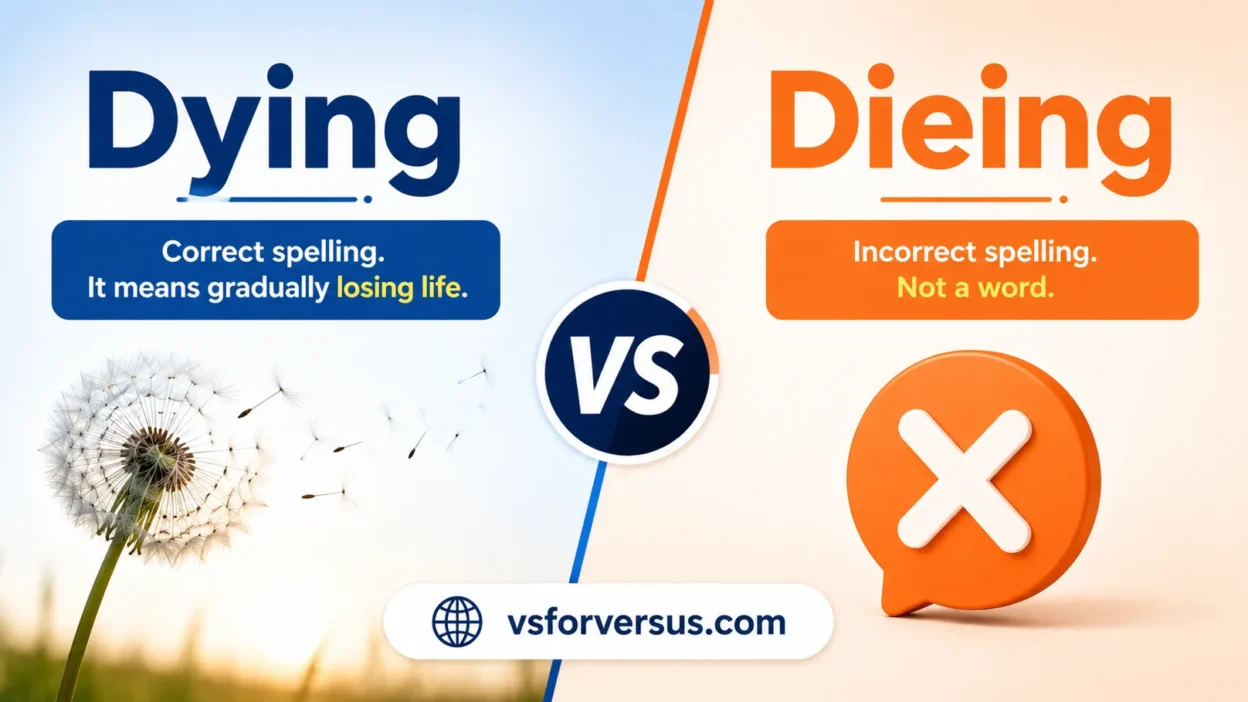
Have you ever wondered whether dying vs dieing is the correct spelling? The confusion between dying vs dieing is common because both words look almost identical, but their meanings and uses are quite different.
Dying is the standard and correct form of the verb “die,” and it is used when talking about death, loss of life, or something coming to an end. In contrast, dieing is not normally used when referring to death and is mainly found in specialized terms related to die, a tool used in manufacturing.
Knowing the difference between dying and dieing can help you avoid embarrassing spelling errors and communicate more clearly. In this guide, we’ll explore their meanings, differences, and practical examples.
Quick Answer
“Dying” is the correct spelling for the present participle of “die”; it’s the word you want when talking about death, something ending, or something no longer working. “Dieing” is not a standard English word and is almost always a spelling mistake.
English breaks its usual pattern here: instead of just adding “ing” to the root verb, it drops the “e” and swaps “ie” for “y,” turning die into dying. The confusion between these two spellings comes entirely from that unexpected shift, not from any difference in meaning.
Dying vs Dieing at a Glance
| Word | Part of Speech | Meaning | Example |
| Dying | Verb (present participle) / Adjective | To stop living, or to stop functioning or existing | “The garden is dying without regular watering.” |
| Dieing | Not a standard word (rare technical variant) | Rarely used in older technical writing for shaping metal with a tool called a die | ⚠️ Avoid, use “dying” in virtually every case |
| Dyeing | Verb (present participle) | To change something’s color using dye | “She’s dyeing the curtains a deeper blue.” |
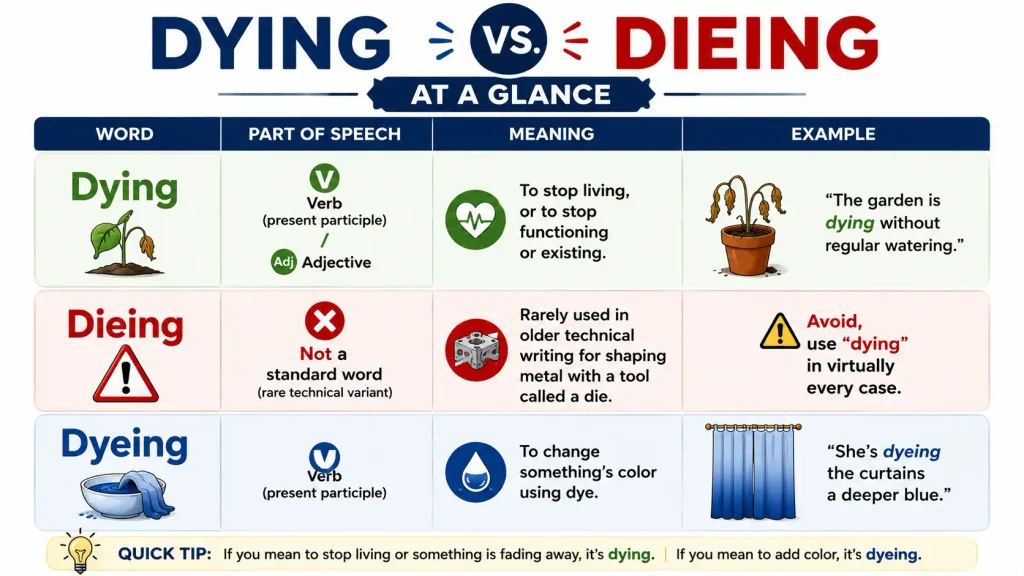
At a glance, this comparison looks like it should be simple, one letter, right? But that single letter is exactly where the trouble starts, so it’s worth slowing down and looking at each word on its own. (For a broader look at how English handles irregular spelling changes like this one, are a solid reference.)
What Does “Dying” Mean?
“Dying” is the present participle and gerund of the verb “die,” meaning to stop living or to cease functioning. It’s one of the most common words in English for describing an ending, whether that ending is literal or figurative.
You’ll see it in sentences like:
- “The doctor gently explained that her father was dying, and that hospice care could keep him comfortable.”
- “My laptop battery is dying faster every week; I think it’s time for a new one.”
- “We were dying of laughter by the end of his toast at the wedding.”
- “It was her dying wish to have her ashes scattered near the lake where she grew up.”
Notice how “dying” shifts across registers: a literal medical situation, a fading device, an exaggerated reaction to something funny, and a formal adjective describing someone’s final moments. That flexibility is part of why the word shows up so often, and part of why getting the spelling wrong is so noticeable.
You’ll encounter it constantly in health and medical writing, in casual texting (“I’m dying 😂”), in literature, and in everyday small talk about plants, phones, and Wi-Fi connections.
What Does “Dieing” Mean? (And Why It’s Rarely Correct)
This is where most of the confusion in the dying vs dieing debate actually lives. “Dieing” technically exists, but only in a narrow, largely outdated technical sense related to manufacturing. In machining, a “die” is a tool used to cut or stamp metal into a specific shape, and some older texts use “dieing” to describe that process.
In practice, though, even that usage has mostly been replaced by clearer terms like “die cutting” or “die casting.” Unless you work in metalworking and are writing for other machinists, you can treat “dieing” as functionally nonexistent.
In the wild, that mistake tends to show up like this:
- ❌ “My tomato plants are dieing in this heat.” (should be dying)
- ⚠️ “The technician spent the afternoon dieing sheet metal for the prototype.” (rare, technical, most style guides now prefer die cutting)
- ❌ “Honestly, this whole trend feels like it’s dieing out.” (should be dying)
So why does this happen so often, even to careful writers? Because “dieing” is the logical spelling. Most English verbs simply add “ing” to the root: talk becomes talking, walk becomes walking, so die + ing = dieing feels correct by pattern. English just doesn’t follow that pattern here, and that mismatch between logic and rule is the entire reason so many people search dying vs dieing in the first place.
Dying vs Dyeing (The Other Common Mix Up)
There’s a second layer to this confusion: “dyeing.” It’s a true homophone of “dying”, pronounced the same way, but it means something completely unrelated: coloring something using dye.
- “I’m dyeing my hair before the wedding this weekend.”
- “We spent the afternoon dyeing old t-shirts for the tie dye station at the fair.”
Compare that to death or ending:
- “The flowers are dying because nobody remembered to water them.”
Same sound, different letter, completely different meaning. It’s a smaller trap, but still worth knowing about; autocorrect won’t always catch it, since both are real words.
Key Differences to Remember
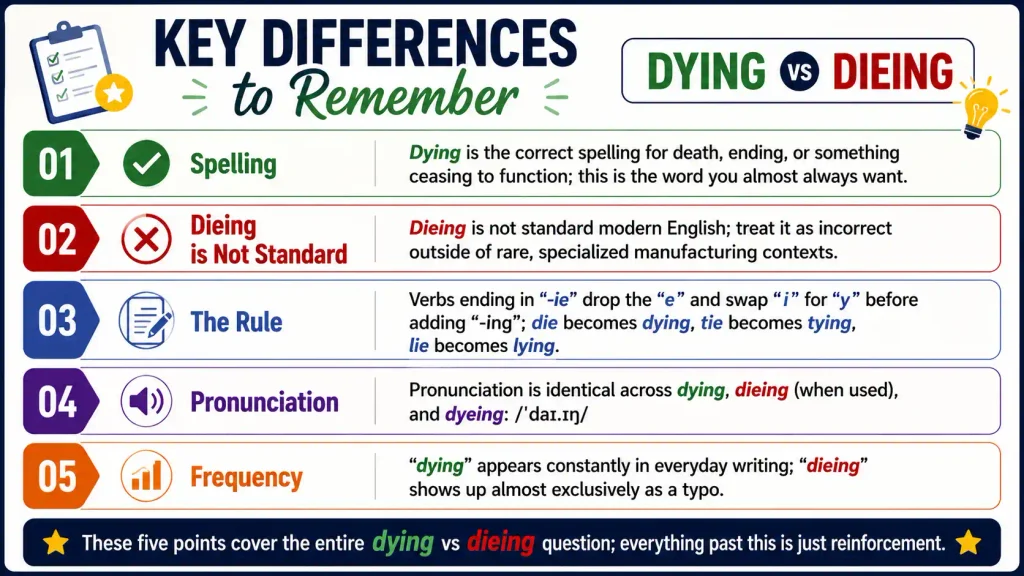
- Dying is the correct spelling for death, ending, or something ceasing to function; this is the word you almost always want
- Dieing is not standard modern English; treat it as incorrect outside of rare, specialized manufacturing contexts.
- The rule: verbs ending in “ie” drop the “e” and swap “i” for “y” before adding “ing”; die becomes dying, tie becomes tying, lie becomes lying.
- Pronunciation is identical across dying, dieing (when used), and dyeing: /ˈdaɪ.ɪŋ/
- Frequency: “dying” appears constantly in everyday writing; “dieing” shows up almost exclusively as a typo
These five points cover the entire dying vs dieing question; everything past this is just reinforcement.
Memory Trick: How to Never Misspell “Dying” Again?
The easiest way to lock this in: drop the IE, add a Y.
Die becomes dying the same way a small family of other verbs behaves:
| Root Verb | Correct -ing Form |
| tie | tying |
| lie | lying |
| vie | vying |
| die | dying |
If you can remember tying and lying, you already know how to spell dying; it follows the same pattern. Next time this comparison trips you up mid-sentence, run through that short list in your head; the pattern usually clicks within a second or two.
For the dyeing mix up, try this: dyeing has an “e,” just like material and clothes, the two things you’re most likely dyeing in the first place.
Common Mistakes People Make
In texts and social media:
- ❌ “lol I’m dieing rn”
- ✅ “lol I’m dying rn”
In student essays:
- ❌ “The protagonist is slowly dieing throughout the final act of the play.”
- ✅ “The protagonist is slowly dying throughout the final act of the play.”
In workplace emails:
- ❌ “Just a heads up, our open rate on the newsletter is dieing, we should revisit the subject lines.”
- ✅ “Just a heads up, our open rate on the newsletter is dying; we should revisit the subject lines.”
If you’re not sure whether a mistake like this counts as a spelling issue, a grammar issue, or something deeper, it’s purely spelling. The grammar (present participle, verb form) is identical either way; only the letters are wrong. That distinction matters because it means there’s no rule to memorize beyond the one swap: ie becomes y.
Test What You Know
- The flowers are (dying / dieing) because I forgot to water them.
- My grandmother shared her (dying / dieing) wish before she passed.
- He was (dying / dieing) to try the new restaurant downtown.
- True or False: “Dieing” is an acceptable modern spelling in everyday writing.
- Which sentence is correct?
- a) “My phone is dieing, I need a charger.”
- b) “My phone is dying; I need a charger.”
Answers: 1. dying 2. dying 3. dying 4. False; it’s a rare technical term at best, incorrect otherwise. 5. (b)
Frequently Asked Questions
Is “dieing” a real word?
In a very narrow, mostly outdated technical sense tied to metalworking, yes, but as a substitute for “dying,” it’s simply incorrect.
Why is it spelled “dying” and not “dieing”?
English requires dropping the “e” and changing “i” to “y” when adding “-ing” to verbs ending in “-ie,” which is why die, tie, lie, and vie become dying, tying, lying, and vying.
What is the correct spelling of “die” plus “ing”?
The correct spelling is “dying.” Simply tacking “ing” onto “die” produces “dieing,” which is a common but incorrect spelling.
What’s the difference between dying and dyeing?
“Dying” relates to death or something ending, while “dyeing” means coloring something with dye. They sound identical but are spelled and used differently.
Is “dieing” a typo or an accepted spelling variant?
In nearly every modern context, it’s simply a typo. Spellcheckers and style guides consistently flag it as incorrect.
How do you spell “dying” when you mean laughing really hard?
The same way as always: “dying,” as in “I’m dying laughing at this text.”
Conclusion
In conclusion, understanding dying vs dieing is easier once you know how each word is used.Dying is the correct and commonly used spelling when referring to death, the process of losing life, or the end of something.
Dieing, on the other hand, is rarely used and usually relates to a specialized manufacturing process involving a die. Remembering this simple distinction can help you avoid common spelling mistakes and make your writing more accurate and professional.
Whenever you are talking about dying vs dieing coming to an end, dying is almost always the word you need. By keeping these meanings in mind, you can confidently choose the right spelling and never feel confused about dying vs dieing again.
To read more: https://vsforversus.com/course-vs-coarse/