
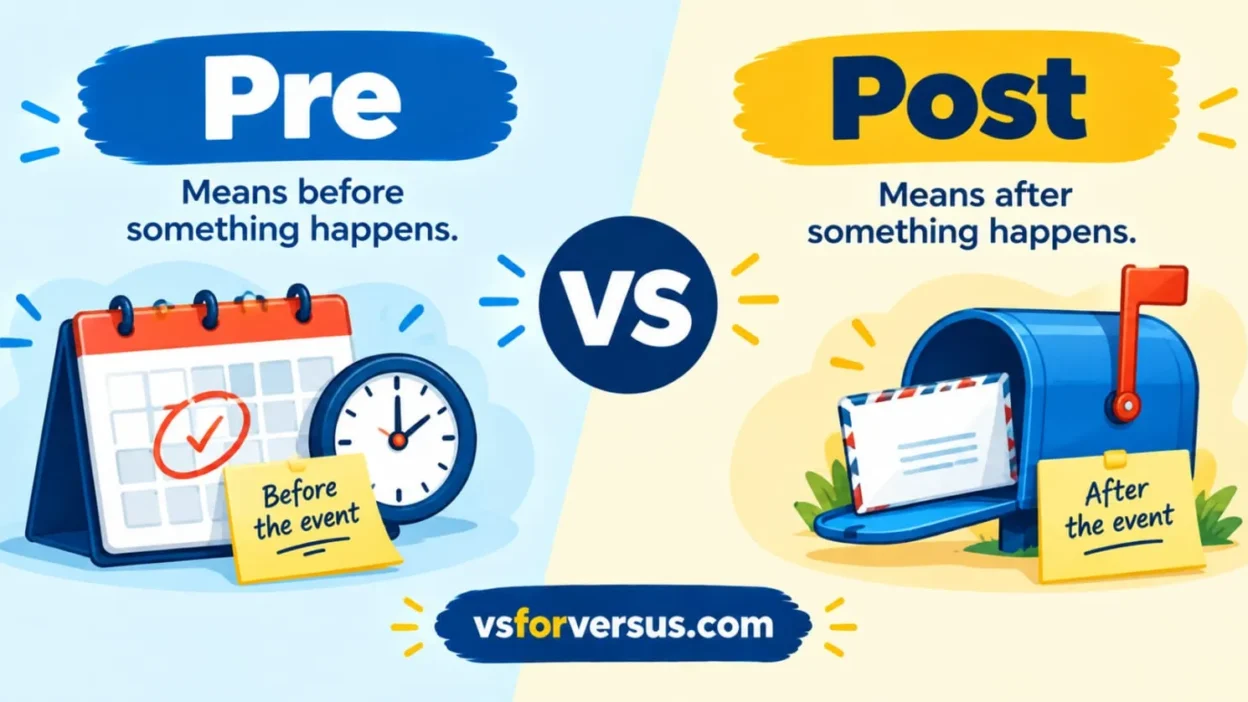
Pre vs Post are English prefixes that attach to the beginning of a word and change its meaning based on time. Pre means “before” or prior to something, as in “pre war,” referring to the era before a war, or “preview,” which means viewing something before its release.
In contrast, Post means “after” or following an event, as in “post war,” referring to the period after a war ends, or “postpone,” which means delaying a task to a later time. Both prefixes are very commonly used in English grammar, especially in history, medicine, and everyday conversation, which is why understanding their difference proves quite beneficial for both reading and writing.
Quick Answer
Pre means “before,” and post means “after.” They are opposite prefixes, not standalone words, and they attach directly to a root word to signal timing. The main source of confusion in a pre vs post comparison is spelling: newer or less common compounds usually keep the hyphen (pre launch, post pandemic), while long established words have dropped it entirely (prepay, postpone). When you’re unsure, check a dictionary. If the word isn’t listed as one solid word, hyphenate it.
Pre vs Post at a Glance
Before diving into the details, here’s a quick comparison table that sums up how these two prefixes function in English.
| Word | Part of Speech | Meaning | Example |
| Pre- | Prefix | Before / prior to | “We need the pre-surgery bloodwork by Friday.” |
| Post- | Prefix | After / following | “The post-surgery recovery took about six weeks.” |
| Pre | Rare standalone use | Existing before a reference point | Usually written hyphenated instead, e.g., “the pre-2020 numbers” |
| Post | Standalone verb/noun | To publish, or a written entry | “I’ll post the update to the team channel tonight.” |
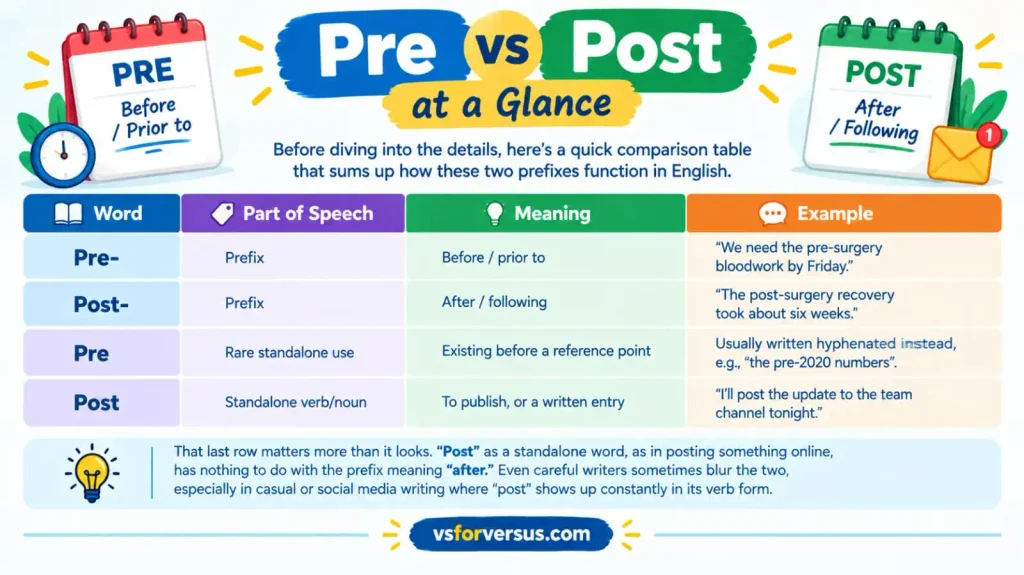
That last row matters more than it looks. “Post” as a standalone word, as in posting something online, has nothing to do with the prefix meaning “after.” Even careful writers sometimes blur the two, especially in casual or social media writing where “post” shows up constantly in its verb form.
What Does “Pre” Mean?
Pre comes from the Latin prae, meaning “before.” Attach it to a word, and you’re telling the reader that whatever follows happens earlier than, or in preparation for, some other event.
You’ll see it constantly in everyday and professional writing:
- “Can you send the pre approval paperwork before we close on the house?”
- “I always eat a banana as part of my pre workout routine.”
- “The clinic asked me to fill out a pre existing conditions form.”
- “Let’s do a quick pre meeting huddle so everyone’s aligned before the client joins.”
Common contexts where pre shows up most: finance and banking (pre approval, pre tax), healthcare (pre op, prenatal), education (pre test, pre reading), and everyday planning (pre order, pre book). If prefixes like this trip you up elsewhere, too, our guide to Prerequisite vs Perquisite covers another pre word pair that catches even confident writers off guard.
What Does “Post ” Mean?
Post also comes from Latin, simply post, meaning “after.” It marks whatever comes later, whether that’s a result, a follow up, or a new phase that begins once something else has wrapped up.
Real world examples, the way people actually write them:
- “The post op nurse said recovery would take a few days longer than expected.”
- “We’re still seeing the effects of a post pandemic hiring slowdown.”
- “Can someone put together a post mortem doc after Friday’s outage?”
- “She’s weighing a few post graduation job offers right now.”
Analysis and review work leans on post especially hard: post launch reports, post event surveys, post implementation audits, because it’s naturally the word we reach for when summarizing what happened after the fact. For a closer look at how “post” behaves differently as a standalone verb versus a prefix, see our breakdown in Affect vs Effect, which walks through a similar dual function word trap.
Key Differences Between Pre vs Post
- Timing: Pre marks the period before the anchor event; post marks the period after it.
- Function: Both are prefixes, not free standing words in formal English; neither should typically appear as a separate word with a space before the root.
- Hyphenation habits: Newer or less common compounds usually keep the hyphen; long established ones don’t.
- Field specific speed: Medical and scientific terms (postnatal, preoperative) tend to lose their hyphens faster than business or tech terms (pre implementation, post deployment).
- A separate trap: “Post” used alone as a verb (to publish) is unrelated to the prefix sense; don’t confuse the two when editing.
The Hyphenation Rule Nobody Explains Properly
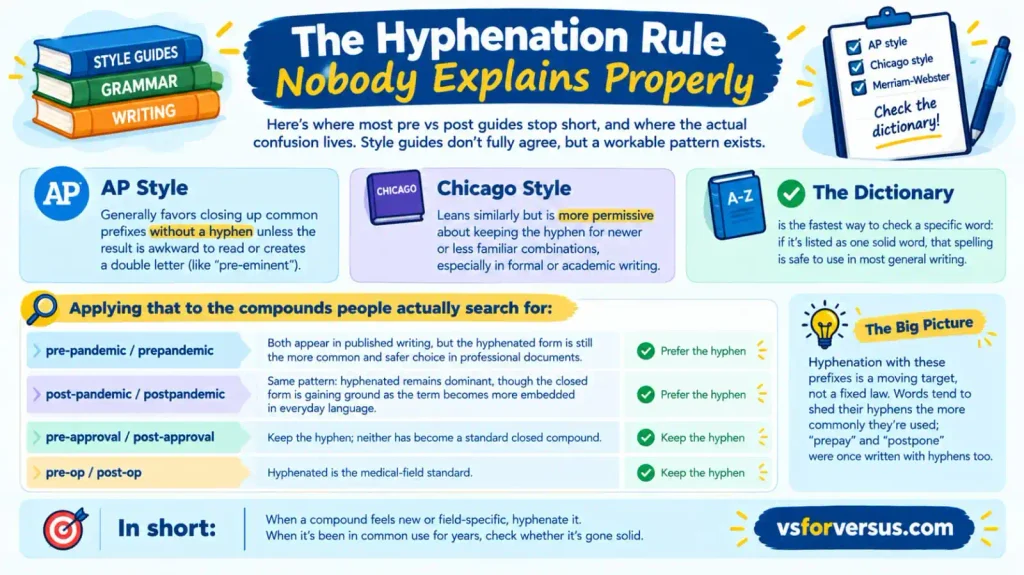
Here’s where most pre vs post guides stop short, and where the actual confusion lives. Style guides don’t fully agree, but a workable pattern exists.
The generally favors closing up common prefixes without a hyphen unless the result is awkward to read or creates a double letter (like “pre eminent”). The leans similarly but is more permissive about keeping the hyphen for newer or less familiar combinations, especially in formal or academic writing. s the fastest way to check a specific word: if it’s listed as one solid word, that spelling is safe to use in most general writing.
Applying that to the compounds people actually search for:
- pre pandemic / prepandemic, both appear in published writing, but the hyphenated form is still the more common and safer choice in professional documents.
- post pandemic / postpandemic, same pattern: hyphenated remains dominant, though the closed form is gaining ground as the term becomes more embedded in everyday language.
- pre approval, post approval, keep the hyphen; neither has become a standard closed compound.
- pre op, post op, hyphenated is the medical field standard.
Put simply, hyphenation with these prefixes is a moving target, not a fixed law. Words tend to shed their hyphens the more commonly they’re used; “prepay” and “postpone” were once written with hyphens too. When a compound feels new or field specific, hyphenate it. When it’s been in common use for years, check whether it’s gone solid.
Is It One Word, Two Words, or Hyphenated?
Since “pre” and “post” aren’t standalone words, they should never be written with a space before the root. Avoid “pre event” or “post approval” as two separate words; your real choice is between hyphenated (“pre event,” “post approval”) and closed (“preevent,” “postapproval,” both rare).
If you’re not sure which camp a word falls into, the hyphenated version is almost always the safer default in professional writing. Getting this right is really the crux of nearly every pre vs post question people search for.
Memory Trick to Remember Pre vs Post
Picture a simple timeline: PRE → [EVENT] → POST. Pre sits on the left because it comes before the point you care about; post sits on the right because it comes past that point. If it helps, remember that “post” contains the letters in “past”, a small nudge toward “after.”
Even experienced writers slip here under deadline pressure; it’s an easy prefix to type on autopilot, especially when editing a document that uses both words dozens of times, like a clinical report or a project timeline. If you’re proofreading fast, it’s worth doing one dedicated pass just for “pre” and “post,” since spell check won’t catch a wrong but real word.
Common Mistakes with Pre vs Post
A pre vs post mix up tends to creep into everyday writing in a few predictable spots:
| ❌ Incorrect | ✅ Correct | Why |
| “Post-approval is needed before we can proceed.” | “Pre-approval is needed before we can proceed.” | Post means after, which contradicts “before.” |
| “The pre pandemic economy” (two words, no hyphen) | “The pre-pandemic economy” | Pre isn’t a standalone word. |
| “We’ll cover that in the post-meeting notes, before the meeting starts.” | “We’ll cover that in the pre-meeting notes, before the meeting starts.” | Timing mismatch between the prefix and the rest of the sentence. |
| “I’ll pre it later today.” | “I’ll prepare it later today.” | Pre is a prefix, not a verb on its own. |
Quick Quiz: Pre or Post?
- The nurse reviewed the ___ operative checklist before wheeling him into surgery.
- Ticket sales spiked during the ___ launch teaser campaign, weeks before release.
- Is it “pre-pandemic” or “pandemic pre”?
- The team scheduled a ___ mortem meeting to figure out what went wrong after the outage.
- True or false: pre and post can be swapped without changing the meaning of a sentence.
(Answers: 1. pre; 2. pre; 3. pre pandemic is correct, “pandemic pre” is not a real construction; 4. post; 5. false; they’re opposites, not interchangeable.)
Frequently Asked Questions
Is it pre pandemic or prepandemic?
Both appear in published writing, but the hyphenated form, pre pandemic, is still the safer and more common choice, especially in professional or formal contexts.
Do you always hyphenate pre and post?
No. Long established words like “prepay” and “postpone” are written solid, while newer or field specific compounds like “pre launch” or “post implementation” usually keep the hyphen.
Is post op one word or two?
It’s hyphenated: post op. It should never be written as two separate words with a space.
Can pre and post be used interchangeably?
No. In any accurate pre vs post comparison, the two prefixes carry opposite meanings, so swapping them reverses the timing and changes the entire message.
Why do people confuse pre vs post if the meanings are opposite?
Because the confusion usually isn’t about meaning at all; it’s about spelling and hyphenation. Writers know which one they mean but hesitate over how to format it correctly.
What’s the difference between pre, post, and during?
Pre and post only mark two points, before and after, while “during” covers the time an event is actively happening. A product launch, for example, might have pre launch teasers, live support during the launch, and a post launch survey afterward.
Final Thought
At the end of the day, pre vs post isn’t really a meaning problem; it’s a formatting decision hiding behind two very simple words. Once you accept that pre always points before, and post always points after, the only real work left is choosing whether to hyphenate, close the word up, or check a dictionary when you’re not sure.
Keep the timeline trick in mind, lean on a style guide when your workplace has one, and don’t worry if a word’s spelling shifts over time; that’s just English settling into a new habit, not a rule you missed.
To read more: “Ordnance vs Ordinance: The Amazing Difference Explained 2026”

Marcus is a former product manager turned comparison writer who spent eight years testing tools and gadgets before quitting to write full-time. He specializes in breaking down tech and software matchups into plain-English verdicts, with a soft spot for buying guides nobody else wants to write.