
Aloud vs Allowed this homophone pair catches even careful writers off guard because the words sound completely identical, yet they belong to entirely different parts of speech with unrelated meanings.
Despite their identical pronunciation, mixing them up can completely change a sentence’s meaning. Aloud is an adverb, meaning spoken out loud or audibly, as in “she read the letter aloud so everyone could hear.” Allowed, on the other hand, is the past tense of the verb “allow,” meaning given permission, as in “pets are not allowed in the building.” Since spellcheckers treat both as valid words, this mistake often slips through unnoticed until a reader catches it.
In this article, we’ll break down the origins of both words, clarify their correct usage, and share clear examples to help you use each one with confidence.
Quick Answer:
Aloud is an adverb meaning “out loud” or “audibly,” as in read aloud. Allowed is the past tense and past participle of allow, meaning “permitted,” as in not allowed to. Both are pronounced /əˈlaʊd/, so the aloud vs allowed choice comes down to meaning: sound takes aloud, and permission takes allowed.
Quick test: If permitted fits the sentence, write allowed. If out loud fits, write aloud.
What Does “Aloud” Mean?
Aloud is an adverb meaning audibly: spoken in a voice other people can hear, rather than silently or under your breath. It usually follows a verb of speech or thought and tells you how the action happened.
- Our teacher read the opening chapter aloud while we followed along in our books.
- “Wait, that can’t be right,” Dana said aloud, then glanced around to see who had heard.
- I always think aloud when I’m debugging, because talking it through helps me catch my own mistakes.
- In Monday’s meeting, Marcus wondered aloud whether the launch date was realistic.
- She laughed aloud when she finally read the message.
You will meet aloud most often after verbs like read, say, think, wonder, speak, and laugh. “Read aloud” is a staple of classrooms and libraries, and “think aloud” simply means saying your thoughts out loud as you work through a problem.
Aloud, “out loud,” and “loudly”
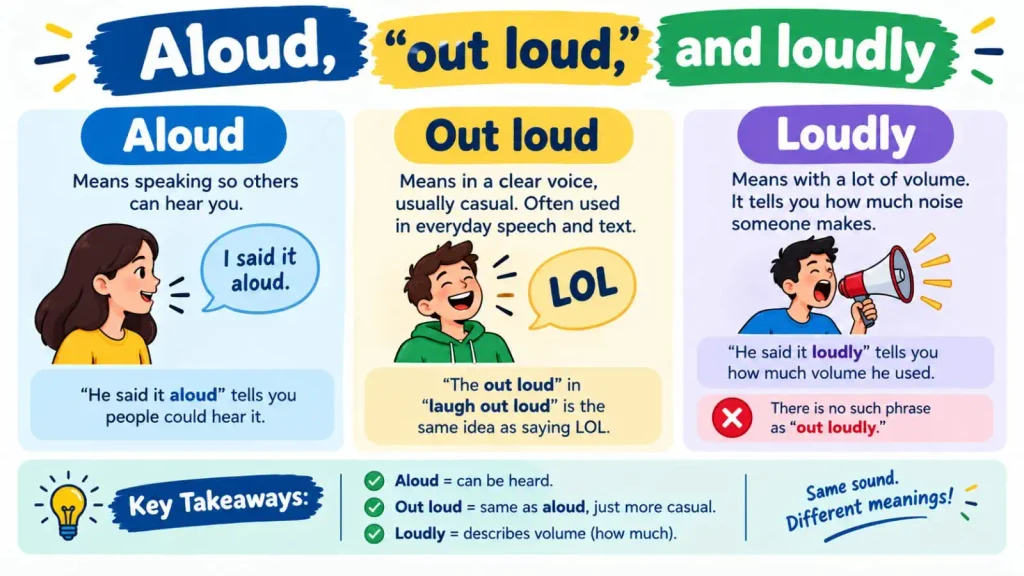
In most sentences, aloud and out loud mean the same thing, and out loud is simply a little more casual. It is the “out loud” in “laugh out loud,” the LOL of text messages. Loudly is a different word entirely. “He said it aloud” tells you people could hear it. “He said it loudly” tells you how much volume he used. And there is no such phrase as “out loudly.”
What Does “Allowed” Mean?
Allowed is the simple past tense and past participle of the verb allow, which means to give permission or to let something happen. In everyday writing, it appears in two ways: as a plain past tense verb (“she allowed it”) and after be in passive sentences, where it behaves almost like an adjective (“it is allowed”).
- Visitors aren’t allowed in the lab after 6 p.m., so please plan your samples accordingly.
- My manager allowed the team to leave early on Friday because the client call ran long.
- Small bags are allowed on board, but strollers must be checked at the gate.
- We were allowed to bring one reference sheet into the exam.
- Dogs are allowed on the patio until noon.
Look at the patterns around it: be allowed to plus a verb, not allowed to, and allowed in/on/for. These are the phrases of rules, signs, contracts, school policies, and airline notices. Wherever permission is being given or withheld, allowed is your word.
It also helps to know the rest of the family. The base verb is allow, and the other forms are allows and allowing: “The office allows pets on Fridays,” and “Allowing extra time helped everyone finish.” Aloud has no family like this. It never changes form, which is another quiet clue that it isn’t a verb.
Aloud vs Allowed at a Glance
| Word | Part of Speech | Meaning | Example | Substitution Test |
| aloud | Adverb | Out loud; audibly | She read the poem aloud to the class. | Does out loud fit? |
| allowed | Verb form (past tense and past participle of allow) | Permitted; given permission | Phones are not allowed in the exam hall. | Does permitted fit? |
How do you pronounce aloud and allowed? Each is said “uh LOWD,” rhyming with crowd, and written /əˈlaʊd/ in IPA. Because the sound can’t help you decide, the spelling has to carry the meaning.
Key Differences Between Aloud vs Allowed
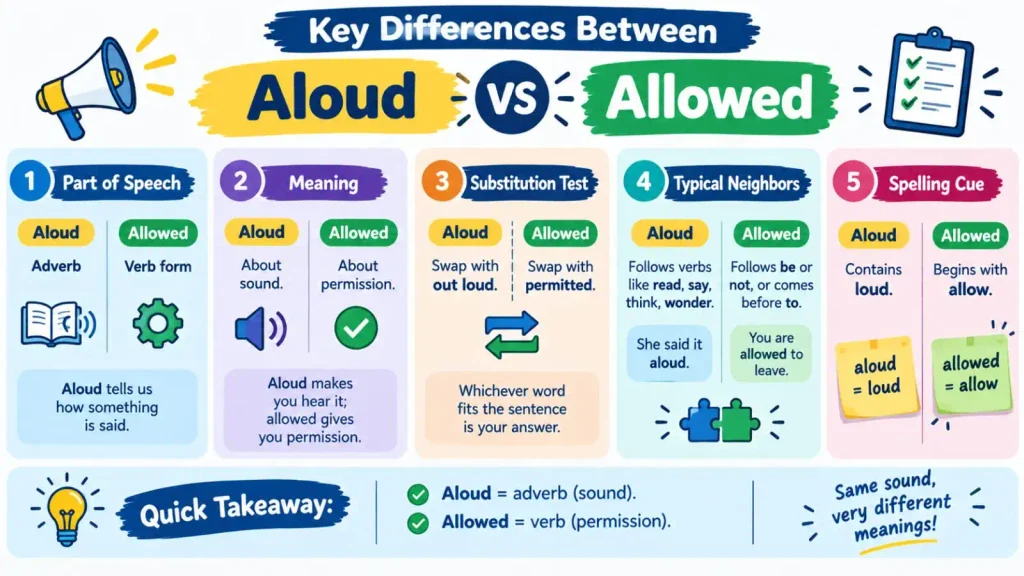
Here is the aloud vs allowed difference in five scannable points:
- Part of speech: aloud is an adverb; allowed is a verb form.
- Meaning: aloud is about sound; allowed is about permission.
- Substitution test: swap in out loud (aloud) or permitted (allowed). Whichever fits is your answer.
- Typical neighbors: aloud follows verbs like read, say, think, and wonder; allowed follows be or not, or comes before to.
- Spelling cue: aloud contains loud; allowed begins with allow.
How to Remember the Difference?
A good mnemonic is short enough to recall mid sentence. Try these two:
- Aloud has LOUD inside it. If the sentence is about sound, look for the loud.
- Allowed starts with ALLOW. If the sentence is about permission, look for the allow.
Then lock both in with one sentence you can repeat in your head: “You’re allowed to read aloud.” Each word does its own job, and the sentence works as a tiny cheat sheet.
There is a grammar clue too. Allowed ends in ed, the classic marker of the past tense. Aloud does not end that way, because it isn’t a verb at all.
Whenever aloud vs allowed trips you up mid draft, ask one question: is this sentence about sound or about permission? When you’re proofreading something longer, search the document for both words and check each in context. A tool that only checks spelling will pass both versions, so your own eyes are the safety net.
Common Mistakes (Wrong vs Correct)
| Context | ✗ Wrong | ✓ Correct |
| Workplace email | Personal devices are not aloud in the meeting room. | Personal devices are not allowed in the meeting room. |
| School rules | We weren’t aloud to talk during the exam. | We weren’t allowed to talk during the exam. |
| Essay or assignment | The class was asked to read the passage allowed. | The class was asked to read the passage aloud. |
| Social media caption | Laughing allowed at this video. | Laughing out loud at this video. |
| Fiction or dialogue | “I’m leaving,” she said allowed. | “I’m leaving,” she said aloud. |
| Phrase confusion | He read a loud. | He read aloud. |
Why do these slips happen? Writers who would never misspell definitely or separate can still stumble on aloud vs allowed, because the error doesn’t feel like a spelling mistake. It feels like the word you meant, since the sound in your head is identical.
Even experienced writers slip here. When you type quickly, your fingers follow the sound of the sentence rather than its meaning, and your brain approves the result because it sounds right when heard. That is why this error can survive several rounds of review: everyone hears the right word, and nobody sees the wrong spelling. If you catch yourself writing “not aloud,” pause and run the substitution test. It takes about two seconds.
Where This Mix Up Shows Up Most
Three situations account for most of these errors, and each has its own trap.
Workplace emails and chat. Policy reminders are the danger zone. Sentences like “laptops are not allowed in the lab” or “guests are allowed after 5 p.m.” get written fast, copied from older messages, and sent to many people at once. One wrong spelling then repeats every time the template is reused.
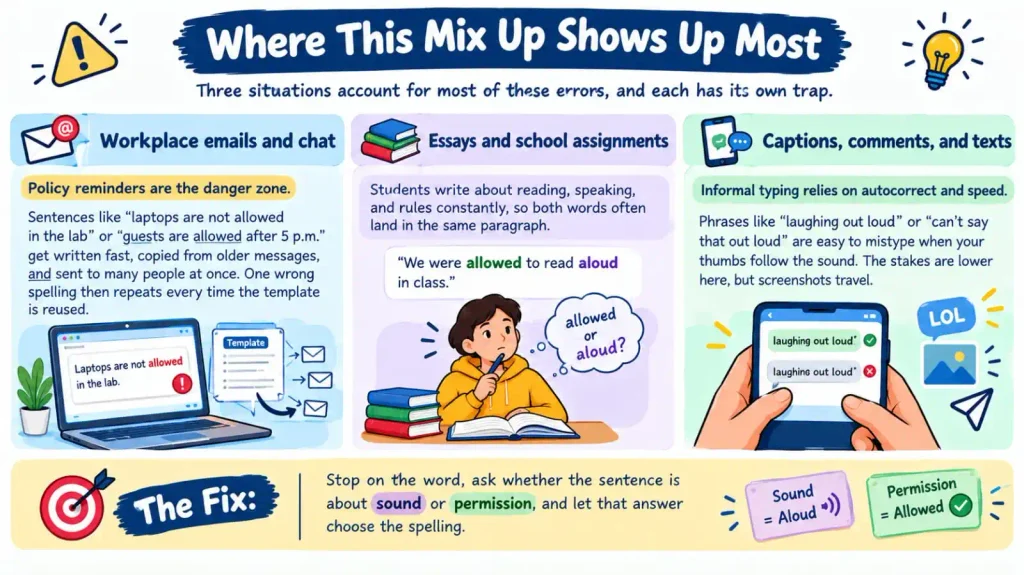
Essays and school assignments. Students write about reading, speaking, and rules constantly, so both words often land in the same paragraph. “We were allowed to read aloud in class” contains both, which makes it a favorite sentence for swapping them by accident.
Captions, comments, and texts. Informal typing relies on autocorrect and speed. Phrases like “laughing out loud” or “can’t say that out loud” are easy to mistype when your thumbs follow the sound. The stakes are lower here, but screenshots travel.
In every case, the fix is the same short habit: stop on the word, ask whether the sentence is about sound or permission, and let that answer choose the spelling.
Quick Quiz: Aloud or Allowed?
Fill in each blank, then check the answers below.
- Students are not ___ to use phones in class.
- She read the poem ___ to the group.
- He often thinks ___ when he’s stressed.
- Pets are not ___ in this building.
- Are we ___ to read ___ in the library?
Answers:
- allowed. It’s about permission, so permitted fits.
- aloud. She read it out loud.
- aloud. Thinking out loud is about sound.
- allowed. Another permission rule.
- allowed / aloud. The first blank is permission (permitted to), and the second is sound (out loud). Both words appear in one sentence.
Aloud vs Allowed FAQs
Are aloud and allowed homophones?
Yes, aloud and allowed are homophones. They share the pronunciation /əˈlaʊd/ but are spelled differently and mean completely different things. Words that sound the same but differ in spelling and meaning are called homophones.
Is it “read aloud” or “read allowed”?
The correct phrase is read aloud. It means to read out loud, so you need the adverb. “Read allowed” would only make sense if someone were granting permission to read, which is rarely what anyone means.
Is it “not allowed” or “not aloud”?
The correct phrase is not allowed. Anything about rules, permission, or what you may or may not do takes allowed. “Not aloud” is correct only in the unusual sense of “not out loud.”
What part of speech is aloud?
Aloud is an adverb. It describes how an action is done, as in “she said it aloud” or “he laughed aloud.”
Is “allowed” the past tense of allow?
Yes, allowed is both the simple past tense and the past participle of allow. It is also commonly used like an adjective after be, as in “pets are allowed.”
Is it “out loud” or “aloud”?
Aloud and out loud are both correct and usually interchangeable. Out loud is a touch more casual. Avoid “out loudly,” which isn’t standard English.
Why doesn’t spellcheck catch aloud vs allowed mistakes?
Spellcheck misses these mistakes because both are valid English words. A basic spellchecker only asks whether a word exists, not whether it fits the sentence. Tools that read context may flag the error, but you shouldn’t rely on them.
The Bottom Line
Once you have seen aloud vs allowed side by side, the choice is simple. If the sentence is about sound, write aloud and remember the loud inside it. If the sentence is about permission, write allowed and remember the allow at the front. Run the substitution test whenever you’re unsure (out loud for aloud, permitted for allowed), and read your final draft once more for sound alike slips. Your readers will never notice the right word, which is exactly the point.
To read more: Aloud vs Out Loud: What’s the Difference?
Aloud vs Out Loud unlike most confusing word pairs, this one isn’t really about right versus wrong, but about formality and context, which makes it uniquely tricky to navigate. Both phrases describe the act of speaking audibly, yet they aren’t always considered equally acceptable in every setting.
Aloud is the more formal, traditional adverb, commonly used in written and academic contexts, as in “please read the passage aloud.” Out loud, on the other hand, is the more casual, conversational phrase, frequently used in everyday speech and informal writing, as in “I couldn’t help but laugh out loud.”
While many style guides once insisted on “aloud” for formal writing, modern usage has blurred this line, with “out loud” appearing more frequently even in professional contexts. In this article, we’ll explore the subtle differences between these two expressions, their appropriate usage, and examples to help you choose confidently.
Quick Answer:
Aloud vs out loud is an easier call than most people expect. Both mean “in a voice others can hear,” and both are correct in standard English. Aloud runs slightly more formal and pairs naturally with “read” and “wonder.” Out loud sounds more conversational, and it’s the only form used in “laugh out loud” and “for crying out loud.” Pick whichever matches the tone of what you’re writing.
Priya spent three weeks polishing her cover letter. One line said she likes to “think out loud with teammates before committing to a plan.” A friend who considers herself the office grammar police read it and winced. “Too casual,” she said. “Professionals always use aloud.” Priya swapped the phrase, swapped it back, and at 11 p.m., no longer trusting her own ear, rewrote the whole sentence. The next morning an experienced recruiter glanced at both versions and shrugged. Either was fine. The only casualty was a night of sleep.
Scenes like this play out constantly. The two phrases look as if a strict rule should govern them, and the half remembered rules people reach for are usually wrong. Some were taught that “out loud” is sloppy; others swear “aloud” sounds stiff. Spellcheck says nothing either way, because both are legitimate words.
Aloud vs Out Loud at a Glance
Here’s the whole picture in one table. Both phrases are adverbs with the same job: they tell you that something was said, read, or worked through in an audible voice rather than silently.
| Word | Part of Speech | Meaning | Example |
| aloud | Adverb | In an audible voice; not silently | “She read the opening paragraph aloud.” |
| out loud | Adverb (two word phrase) | In an audible voice; not silently | “She read the opening paragraph out loud.” |
| allowed (look alike) | Verb or adjective | Permitted | “Phones aren’t allowed in the exam room.” |
| loudly (look alike) | Adverb | At high volume | “The crowd cheered loudly.” |
What Does “Aloud” Mean?
Aloud is an adverb meaning audibly, as opposed to silently. It’s the older of the two forms, which helps explain its slightly formal, even literary, feel.
It does not mean loudly. You can read a bedtime story aloud in a whisper, or mutter a doubt aloud in an empty office; a whisper still counts as audible, and volume has nothing to do with it. Grammatically, “aloud” normally follows the verb or its object: “She read the letter aloud,” rather than “She aloud read the letter.”
Examples in context:
- “Before we sign, could someone read the final clause aloud?”
- “Ms. Alvarez asked each student to read a paragraph aloud from the novel.”
- “In Monday’s meeting, Dev wondered aloud whether the deadline was realistic.”
- “Participants were asked to think aloud while completing each task in the app.”
Common contexts: classrooms, ceremonies and readings, academic and research writing (think aloud is even the name of a research method), and any writing that calls for a measured tone. Typical pairings include “read aloud,” “wonder aloud,” “think aloud,” and “say aloud.”
What Does “Out Loud” Mean?
Out loud is a two word adverbial phrase with the same core meaning: audibly, not silently. It arrived in English later than “aloud,” and for a long time usage guides dismissed it as colloquial. Merriam Webster’s current position is that the evidence says otherwise; today it’s the natural choice in conversation, texts, social posts, and fixed expressions.
Examples in context:
- “I can’t believe I said that out loud.” (muttered after an awkward comment in a meeting)
- “Her reply made me laugh out loud on the train.”
- “For crying out loud, who scheduled a 7 a.m. call?”
- “Sorry, I was just thinking out loud. Ignore that last idea.”
Common contexts: everyday speech, blog posts and social media, idioms, and moments of surprise, embarrassment, or sudden reaction. Mind the spelling: “out loud” is two words, and “outloud” is not standard.
Key Differences Between Aloud vs Out Loud
Here’s the aloud vs out loud comparison in scannable form:
- Meaning: essentially identical. Both mean audibly, not silently.
- Register: aloud leans formal, and out loud leans conversational; that difference is one of tone only.
- Idioms: out loud is the only form in “for crying out loud” and in the acronym LOL.
- Verb pairing: read and wonder lean toward aloud, while laugh and blurt lean toward out loud.
- Form: aloud is one word, and out loud is two.
- Age: aloud is older, though age doesn’t make it more correct.
Which Should You Use? By Verb and Situation
The aloud vs out loud choice usually comes down to two things: the verb and the room. The table below shows tendencies drawn from usage evidence, their habits, and picking the other phrase is rarely an error.
| Verb | Usual Choice | Note |
| read | aloud (out loud is also common) | “Read aloud” is the stock phrase in print; “read it out loud” is just as natural in speech |
| wonder | aloud | Slightly literary |
| think | either | “Think aloud” in research; “thinking out loud” in conversation |
| say | either | “Say it out loud” is the usual spoken form |
| laugh | out loud | “Laugh aloud” exists but is rarer |
| blurt | out loud | Rarely paired with aloud |
Four everyday situations show how this plays out:
- Classroom: “Please read the instructions aloud to your group.” Either phrase works, but aloud is the traditional classroom wording.
- Work email: “Before you hit send, read the draft out loud. You’ll catch awkward phrasing.” Email is flexible territory, so let tone decide.
- Academic paper: “Interviewees were encouraged to think aloud as they worked.” Aloud suits the measured register.
- Text message: “I literally said that out loud in the elevator.” Out loud sounds like a real person talking.
When you’re stuck, hear the sentence in your head as if you were telling it to a colleague. If it sounds natural with “out loud,” keep it. If you’re writing for a journal, a ceremony, or a formal report and the sentence feels loose, try “aloud.” Neither choice will cost you credibility, though matching the document’s tone makes the writing feel deliberate.
Is “Out Loud” Wrong in Formal Writing?
No, and the history explains the confusion. Older usage guides often treated “out loud” as an error for “aloud.” Merriam Webster now says usage evidence shows “out loud” is not a colloquialism, and that the two are essentially interchangeable, with “aloud” more likely in solemn writing.
Grammar Girl’s Mignon Fogarty lands in the same practical place: use whichever sounds more natural, and lean toward “aloud” for something like a reading in church or another formal occasion. She also notes that some phrases favor “out loud” even in published books: “I said that out loud” turns up more often than “I said that aloud.”
What should you do when a friend corrects you? Share, calmly, that dictionaries list the phrases as interchangeable. The same reply works if someone corrects you in the opposite direction and insists “aloud” is wrong.
You may also hear folk rules, such as the claim that “out loud” always implies volume. Dictionaries define both phrases by audibility, so that rule has no support. In the aloud vs out loud debate, tone and habit matter far more than any hidden rule.
Even experienced writers slip here. In a rushed draft, “Phones are not aloud in the exam room” (a slip for “allowed”) sails past spellcheck, because “aloud” is a real word. The two words are homophones, so the error comes from the ear, not from ignorance. A slow reread for meaning is what catches it, reading the sentence back in your head, word by word, rather than skimming for sound.
A Simple Way to Remember
Try this rule of thumb: aloud for assignments, out loud for outbursts. When someone deliberately reads a passage, recites a clause, or states a thought for an audience, “aloud” fits. When something spills out, such as a laugh, a blurt, or an embarrassing comment, “out loud” fits. Treat the trick as a guide to what sounds natural, not as a law to enforce.
A second trick covers the look alike: “allowed” means permission, and “aloud” means sound. If “permitted” fits in the sentence, you want “allowed.” When the aloud vs out loud choice still feels fuzzy, pick whichever sounds more like you.
Common Mistakes (Wrong vs Correct)
| Wrong | Correct | Why |
| “Students aren’t aloud to eat in class.” | “Students aren’t allowed to eat in class.” | Homophone mix up |
| “She aloud read the letter.” | “She read the letter aloud.” | Unnatural word order |
| “I said it outloud.” | “I said it out loud.” | Two words |
| “Never use out loud in formal writing.” | Both are standard; aloud simply sounds more solemn. | Outdated myth |
| “Out loud always means shouting.” | Out loud means audibly; the voice can be soft or strong. | Folk myth |
The last row deserves a second look. “Loudly” describes volume, while “aloud” and “out loud” describe whether sound happens at all. You can read aloud in a whisper and still be correct.
Quick Quiz
- “She read the poem ____.” Which is correct: aloud, out loud, or both?
- Answer: Both are correct.
- Complete the idiom: “For crying ____!”
- Answer: Out loud.
- Fix the error: “Phones aren’t aloud in this room.”
- Answer: Allowed.
- Which tends to suit a formal ceremony: “The oath was read aloud” or “The oath was read out loud”?
- Answer: Aloud, as a tendency.
- True or false: Out loud is incorrect in formal writing.
- Answer: False.
Frequently Asked Questions
Is it “aloud” or “out loud”?
Both are correct. They mean the same thing, so choose whichever fits your tone.
What is the difference between aloud vs out loud?
The aloud vs out loud difference is mostly register and habit. Aloud is slightly more formal; out loud is more conversational.
Is “out loud” grammatically correct?
Yes. Out loud is a standard adverbial phrase found in published books, news writing, and everyday speech.
Is “aloud” one word or two?
One word. Out loud is the two word form.
Does “aloud” mean “loudly”?
No. Aloud means audibly, even if the voice is quiet.
Why do we say “laugh out loud” vs not “laugh aloud”?
Out loud became the usual pairing with laugh, which is why the acronym is LOL. “Laugh aloud” does appear in published writing, so it isn’t wrong, only less common.
Final Thoughts
Priya’s cover letter was fine either way, and yours probably is too. When you weigh aloud vs out loud, ask two questions: which verb am I using, and who is reading? Reach for aloud in measured or formal writing and for out loud in conversation and idioms. Then read your next draft out loud before you send it to catch awkward phrasing; the choice between these two words will rarely be the thing that trips up your reader.
To read more: Waste vs Waist: Which Spelling Is Right?2026

Marcus is a former product manager turned comparison writer who spent eight years testing tools and gadgets before quitting to write full-time. He specializes in breaking down tech and software matchups into plain-English verdicts, with a soft spot for buying guides nobody else wants to write.


[…] To read more: https://vsforversus.com/aloud-vs-allowed/ […]