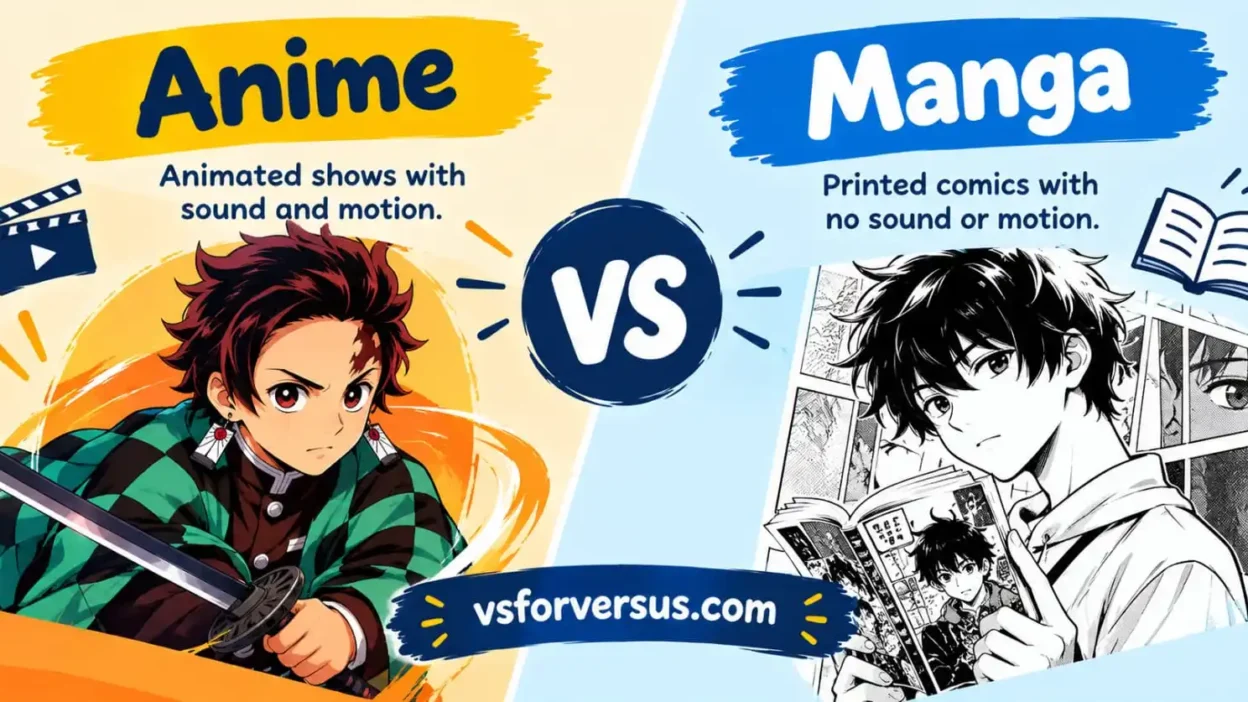
Casual fans often use anime and manga interchangeably, but they represent two distinct forms of Japanese storytelling with their own unique characteristics. While both share overlapping worlds, characters, and fan bases, the medium through which each tells its story sets them completely apart.
Anime refers to animated television shows, films, or web series originating from Japan, bringing characters to life through movement, voice acting, music, and visual animation. Manga, on the other hand, refers to Japanese comic books or graphic novels, told through illustrated panels, dialogue bubbles, and sequential art, meant to be read rather than watched.
Many popular anime series begin as manga and are later adapted into animation. In this article, we’ll explore the key differences between these two formats, their origins, and how they complement each other in Japanese pop culture.
Quick Answer:
Anime vs manga comes down to format. Anime is animation from Japan: television series and films that viewers watch. Manga is comics from Japan: chapters and volumes that readers read. Many anime are adapted from manga, and both words keep the same form in the plural: one anime, two anime; one manga, two manga.
Anime vs Manga at a Glance
| Word | Part of Speech | Meaning | Example |
| anime | Noun (same form in plural) | Animated TV series or films from Japan, or made in that style | “We stayed up late finishing an anime about time travel.” |
| manga | Noun (same form in plural) | Japanese comics or graphic novels, read in print or digitally | “She keeps every volume of the manga on one shelf.” |
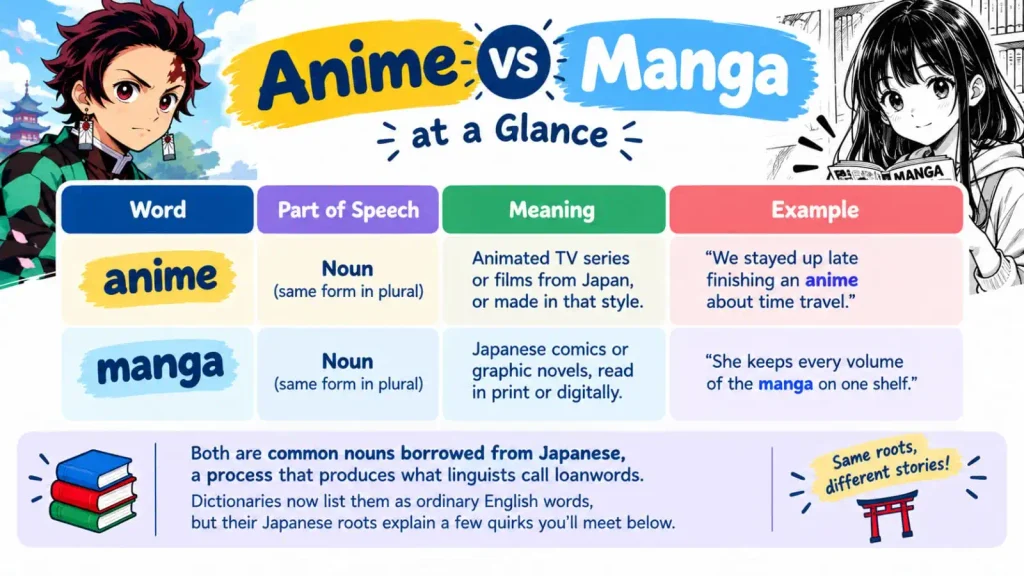
Both are common nouns borrowed from Japanese, a process that produces what linguists call loanwords. Dictionaries now list them as ordinary English words, but their Japanese roots explain a few quirks you’ll meet below.
What Does “Anime” Mean?
Anime is Japanese animation: TV series, feature films, and streaming releases produced by an anime studio and watched on a screen. In Japan, the word is simply a short form of “animation” and covers cartoons from anywhere in the world. English narrowed it. Say “anime” to an English speaker, and they will usually hear animation made in Japan, or in that distinctive style: long story arcs, dramatic action, full voice casts. Most people pronounce it “AN uh may.”
Examples in real sentences:
- “I’m halfway through a new anime, and I refuse to read any spoilers.”
- “Our team lunch turned into a debate about which Studio Ghibli movie is the best anime ever made.”
- “Is that an anime or a Western cartoon? The art style is hard to place.”
- “The anime adds a soundtrack and voice acting that the printed story never had.”
Where you’ll see it: streaming menus, social media captions, film club flyers, and convention schedules.
What Does “Manga” Mean?
Manga is the Japanese word for comics. In English, it refers to Japanese comics and graphic novels. Unlike a typical Western comic book, a manga volume is traditionally read from right to left. Many series are serialized one chapter at a time in magazines such as Weekly Shonen Jump, then collected into volumes.
A creator who writes and draws a series is called a mangaka, and print editions are usually black and white. As with anime, the Japanese word is broader than the English one. Pronunciations vary, and both “MAHN guh” and “MANG guh” are common. Remember that manga lives on the page; that one idea is the core of anime vs manga.
Examples in context:
- “I finished the latest manga volume on the train and missed my stop.”
- “The library added a full shelf of manga, plus a few light novel tie ins.”
- “Each manga chapter runs about twenty pages, so it fits into a lunch break.”
- “The mangaka said in an interview that the ending took three full drafts.”
Where you’ll see it: bookstores, libraries, reading apps, book club lists, and product reviews.
Key Differences Between Anime vs Manga
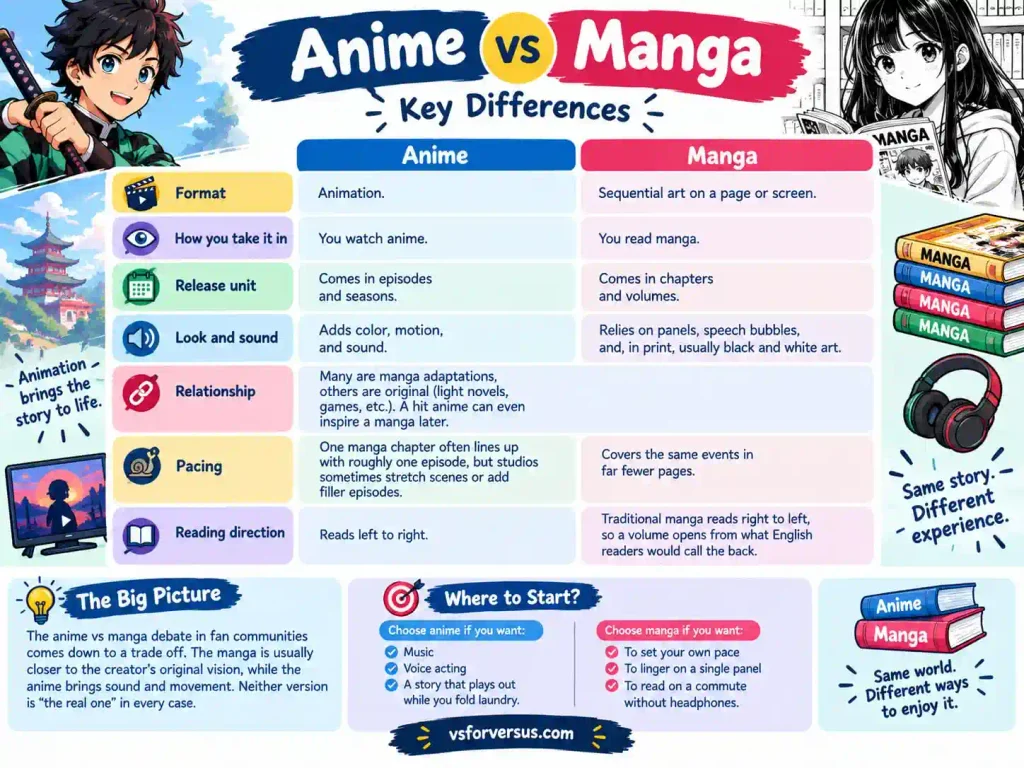
- Format: Anime is animation. Manga is sequential art on a page or screen.
- How you take it in: You watch anime and read manga.
- Release unit: Anime comes in episodes and seasons. Manga comes in chapters and volumes.
- Look and sound: Anime adds color, motion, and sound. Manga relies on panels, speech bubbles, and, in print, usually black and white art.
- Relationship: Many anime are manga adaptations, which makes the comic the source material. Others are original productions; some come from light novels or games, and a hit anime can even inspire a manga later.
- Pacing: One manga chapter often lines up with roughly one episode, but studios sometimes stretch scenes or add filler episodes so the show doesn’t catch up to the comic.
- Reading direction: Traditional manga reads right to left, so a volume opens from what English readers would call the back.
That pacing point explains a common complaint from fans partway through a long series: the anime moves slowly, while the manga covers the same events in far fewer pages. Neither version is “the real one” in every case. The comic is usually closer to the creator’s original vision, while the animation brings sound and movement. The anime vs manga debate in fan communities mostly comes down to that trade off.
Deciding where to start? Choose anime when you want music, voice acting, and a story that plays out while you fold laundry. Choose manga when you want to set your own pace, linger on a single panel, or read on a commute without headphones.
How to Remember the Difference
Anime vs manga gets blurry when you’re writing quickly, so lean on a pair of letters: Anime = Animated. Manga = Made of pages. If a sentence needs something on a screen, use anime. If it needs something you flip through, use manga.
A second check takes two seconds: if you can press pause, it’s anime; if you can turn the page, it’s manga. Verbs follow the same logic. Watch the screen, read the page.
How Anime vs Manga Work in English Sentences
This is where the anime vs manga question turns from pop culture into grammar. Four rules cover almost every situation, and few fan guides mention them.
Plural. Japanese nouns generally don’t mark the plural, and English kept that habit for these two words. Linguists call this a zero plural. Write “I own three manga” and “She likes several anime.” You’ll see “animes” and “mangas” in casual posts, but standard usage prefers the unchanged form. Sheep and deer work the same way (see irregular plurals). If you write for a publication, check its style guide, since a few make their own calls.
Capitalization and italics. Use lowercase for both unless the word starts a sentence or appears inside a title. Many publications no longer italicize either word, since both are established English.
General vs specific. In a general sense, both behave like mass nouns: “I love anime” and “Manga is booming in libraries.” For one title, add an article: “That anime made me cry” or “I’m reading a manga about chefs.”
Verb pairing. The natural verbs, known as collocations, are watch, stream, and binge for anime, and read, collect, and borrow for manga. People also say “the manga” or “the anime” as shorthand for one series’ printed or animated version, as in “The manga is darker than the anime.” The same pattern shows up in watch vs see vs look at.
Even experienced writers slip here, usually on the plural. The urge to tack on an “s” is strong because nearly every other English noun takes one, so “animes” sneaks into emails, captions, and drafts from fluent writers. Another slip is “anime cannon” for “anime canon.” Canon means officially part of the story; a cannon is a weapon. Comment threads move fast, and spellcheck stays silent because both are real words. For more pairs like this, see canon vs cannon.
Common Mistakes with Anime vs Manga
Most anime vs manga errors fall into three buckets: the wrong verb, the wrong plural, and stray capital letters.
| Wrong | Correct | Why |
| “I watched the manga last night.” | “I read the manga last night.” | Manga is read, not watched. |
| “She reads anime on her tablet.” | “She watches anime on her tablet.” | Anime is animation. |
| “I own ten animes.” | “I own ten anime.” | The plural doesn’t change. |
| “Manga is a kind of TV show.” | “Manga is a kind of comic.” | This is a format mix up. |
| “That scene is anime cannon.” | “That scene is anime canon.” | Canon means officially part of the story. |
| “Anime and Manga are fun.” | “Anime and manga are fun.” | No capitals mid sentence. |
Few slips cost as much as Dana’s library order, but they still matter. In a product listing, tagging a DVD set as manga sends shoppers to the wrong aisle and generates returns. In an essay on Japanese pop culture, writing that an author “watched the manga” tells a professor you may not have done the reading. And in a workplace email, “please stock more anime for the winter display” invites a polite correction from the bookstore manager.
Quick Quiz: Anime or Manga?
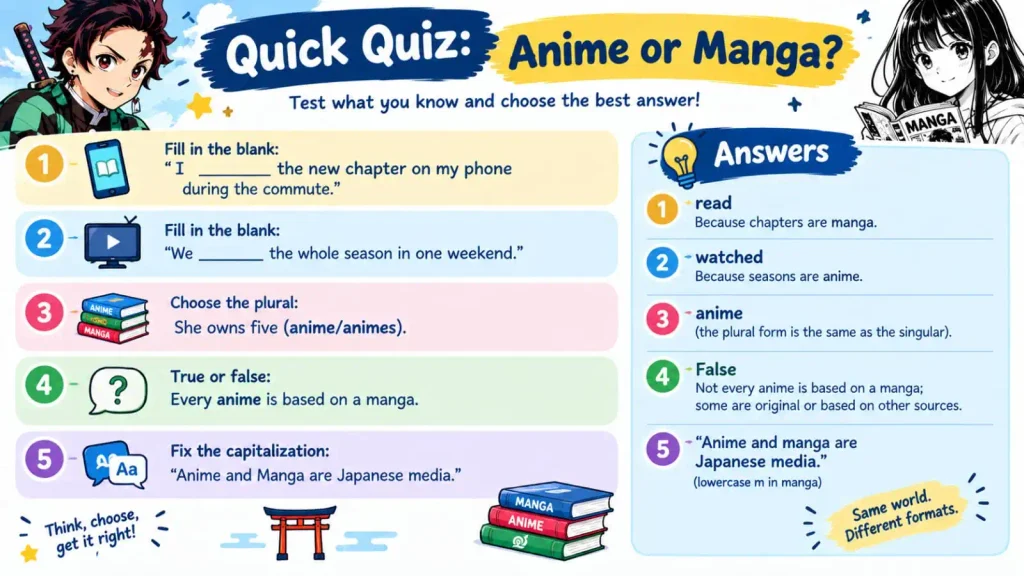
- Fill in the blank: “I ______ the new chapter on my phone during the commute.”
- Fill in the blank: “We ______ the whole season in one weekend.”
- Choose the plural: “She owns five (anime/animes).”
- True or false: every anime is based on a manga.
- Fix the capitalization: “Anime and Manga are Japanese media.”
Answers: (1) read, because chapters are manga. (2) watched, because seasons are anime. (3) anime. (4) False; some anime are original or based on other sources. (5) “Anime and manga are Japanese media.”
Anime vs Manga: Frequently Asked Questions
What is the difference between anime vs manga?
Anime is Japanese animation that you watch, and manga is Japanese comics that you read. The two are closely linked because many anime are adapted from manga.
Is anime based on manga?
Often, but not always. Many anime adapt manga, light novels, or games, while others are original productions. Occasionally, a popular anime inspires a manga afterward.
Can you watch manga or read anime?
In standard usage, no. You read manga and watch anime, because the verb follows the format.
Is anime plural or singular?
Both. Anime keeps the same form in the plural: one anime, two anime. Manga works the same way.
Do you capitalize anime and manga?
No. Write anime and manga in lowercase unless the word starts a sentence or sits inside a title.
Should I read the manga or watch the anime first?
Either order works. Manga is usually quicker to finish and stays closer to the creator’s original work, while anime adds sound and motion. If you’re partway through a long anime and the pacing drags, you can often switch to the manga near your current point, but check a chapter to episode guide first so you don’t skip or repeat story. However you settle it for a particular series, enjoying both is a perfectly good answer.
Final Thoughts
Anime is the one you watch, and manga is the one you read. Everything else follows from that difference in format: the plural stays the same, both words stay lowercase mid sentence, and each pairs with its own verb. Whether the question is anime vs manga on a book club order, in an essay, or in a text to a friend, you now know which word fits. Pick one, or better yet enjoy both, and use the related guides above to tackle the next confusable pair.
To read more: https://vsforversus.com/aloud-vs-allowed/

Marcus is a former product manager turned comparison writer who spent eight years testing tools and gadgets before quitting to write full-time. He specializes in breaking down tech and software matchups into plain-English verdicts, with a soft spot for buying guides nobody else wants to write.