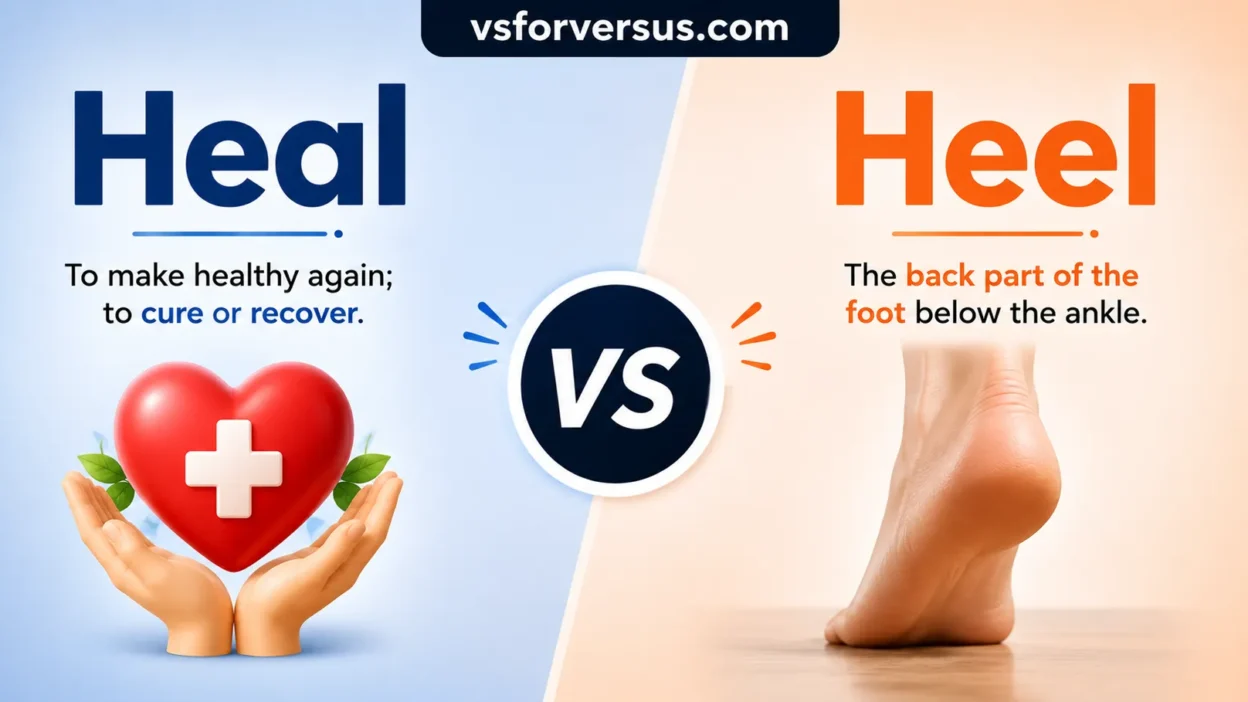
Heal vs heel may sound exactly alike, but they point to completely different ideas. Heal is a verb that means to recover from an injury, illness, or emotional pain, or to make something healthy again. Heel, in contrast, is a noun that usually refers to the back part of the human foot or the bottom part of a shoe.
It can also describe a person who behaves badly, depending on the context. So, when comparing heal vs heel, remember that heal is connected with recovery, while heel is connected with the foot or footwear. Knowing this simple distinction can help you avoid a common spelling mistake in everyday writing.
Quick Answer
Heal is a verb meaning to recover or repair, as in “the wound will heal.” Heel is a noun referring to the back part of the foot or shoe (or a verb meaning to follow closely), as in “my heel hurts” or “the dog learned to heel.”
The two words are homophones; they sound exactly alike but are never interchangeable, and this is not a regional or American versus British spelling difference; it’s simply a common homophone mix up that happens to writers everywhere.
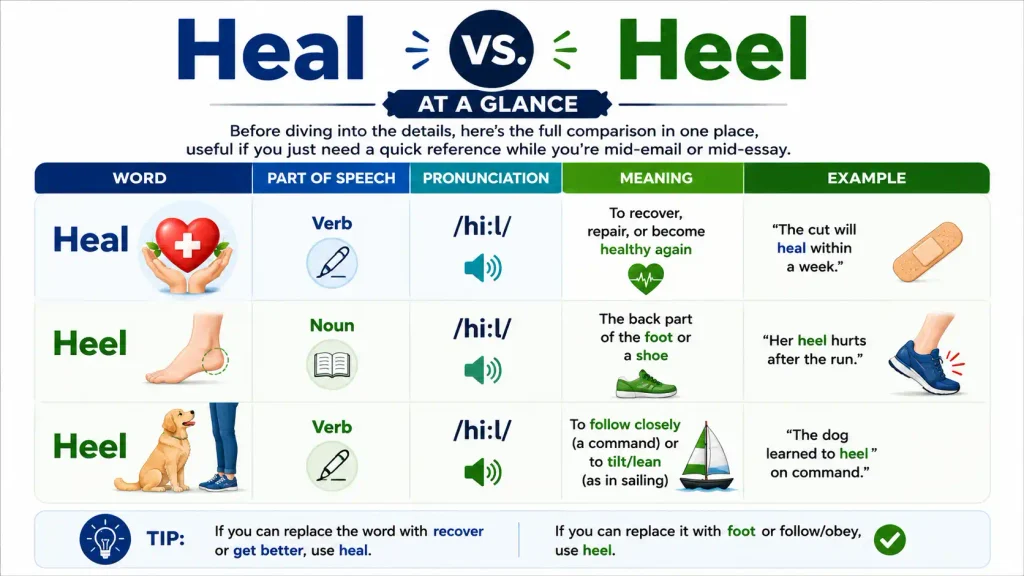
Heal vs Heel at a Glance
Before diving into the details, here’s the full comparison in one place, useful if you just need a quick reference while you’re mid email or mid essay.
| Word | Part of Speech | Pronunciation | Meaning | Example |
| Heal | Verb | /hiːl/ | To recover, repair, or become healthy again | “The cut will heal within a week.” |
| Heel | Noun | /hiːl/ | The back part of the foot or a shoe | “Her heel hurts after the run.” |
| Heel | Verb | /hiːl/ | To follow closely (a command) or to tilt/lean (as in sailing) | “The dog learned to heel on command.” |
Both words are pronounced identically; that shared sound is exactly why the confusion happens in the first place.
What Does “Heal” Mean?
Heal is a verb. It describes the process of returning to health, wholeness, or a better state, physically, emotionally, or even metaphorically. When something heals, it’s improving or repairing itself, often over time.
Like most regular verbs, heal changes form depending on tense: heal (present), healed (past), healing (present participle). You’ll never see “healed” confused with heel, since the two diverge the moment you conjugate them; the mix up only happens in the base form.
Examples:
- “The doctor said the sprain should heal in about four weeks if I stay off it.”
- “After the argument, it took months for the friendship to fully heal.”
- “She spent the summer trying to heal from burnout, mostly by sleeping and hiking.”
- “Sports journalism leans on the word constantly too, as in, ‘The ankle needs to heal before the player returns for the playoffs.'”
You’ll see heal most often in medical writing, personal essays about recovery or loss, therapy and wellness content, and professional emails discussing recovery from illness, injury, or a difficult project. It’s a word about process, something getting better, not a physical object you can point to.
What Does “Heel” Mean?
Heel is primarily a noun. Its most common meaning is the back part of the human foot, or the corresponding raised part of a shoe. It also has a secondary noun sense, an informal way to describe someone dishonest or unpleasant, and it functions as a verb in a couple of specific situations: commanding a dog to walk closely beside you, or describing a boat tilting to one side in the wind.
Its plural, heels, is where the mistake shows up most in casual writing (“high heals” instead of “high heels”), so it’s worth double checking that specific word whenever you’re writing about shoes. And if you’ve ever dealt with a sharp pain under your foot, you may have run into the medical term heel spur, a small calcium deposit on the heel bone, which is another common, entirely medical context where the word appears correctly as a noun.
Examples:
- “I twisted my heel stepping off the curb, and it’s been sore ever since.”
- “These heels looked great in the store, but they’re murder after an hour of standing.”
- “The trainer spent weeks teaching the rescue dog to heel instead of pulling on the leash.”
- “Poor time management turned out to be the real Achilles’ heel of the entire project.”
Key Differences Between Heal and Heel
Once you see the pattern, the heal vs heel distinction becomes second nature. Here’s the breakdown:
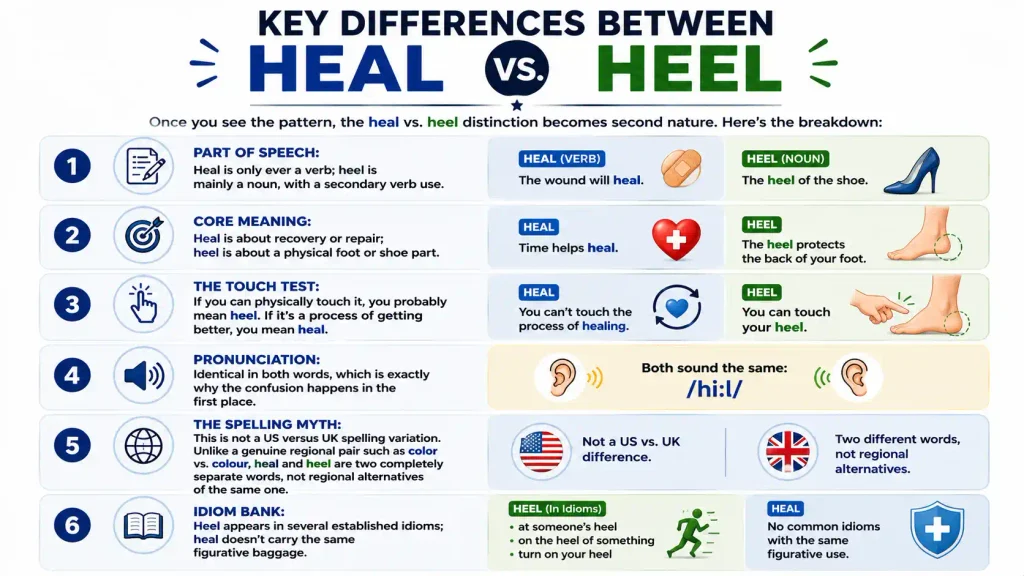
- Part of speech: Heal is only ever a verb; heel is mainly a noun, with a secondary verb use.
- Core meaning: Heal is about recovery or repair; heel is about a physical foot or shoe part.
- The touch test: If you can physically touch it, you probably mean heel. If it’s a process of getting better, you mean heal.
- Pronunciation: Identical in both words, which is exactly why the confusion happens in the first place.
- The spelling myth: This is not a US versus UK spelling variation. Unlike a genuine regional pair such as color vs colour, heal and heel are two completely separate words, not regional alternatives of the same one.
- Idiom bank: Heel appears in several established idioms; heal doesn’t carry the same figurative baggage.
Idioms and Phrases Using “Heel”
Because heel shows up in so much figurative English, it’s worth knowing these common phrases:
- Achilles’ heel, a critical weakness, even in someone otherwise strong. “Public speaking was his Achilles’ heel.”
- Well heeled, wealthy or affluent. “The neighborhood was full of well heeled retirees.”
- Dig in your heels: to stubbornly refuse to change your position. “She dug in her heels and wouldn’t move the deadline.”
- Down at heel: shabby or run down in appearance. “The old theater looked a bit down at heel these days.”
For more figurative language like this, see our full idioms and phrases guide.
Memory Trick: How to Remember Heal vs Heel?
If the definitions haven’t quite stuck yet, try these two anchors:
- Heal → Health. Both words start with the same four letters: H-E-A-L. If you’re talking about getting healthier, you want heal.
- Heel → Feet. Both words contain a double “E,” just like the feet the word describes.
And if you want one simple test to run every time: can you touch it, or does it recover? Touchable things a shoe, a foot, a dog at your side take heel. Things that improve over time, a wound, a relationship, a system after an update, take heal.
Common Mistakes with Heal vs Heel
Here are the most frequent real world heal vs heel slip ups, side by side with the correct version:
| ❌ Incorrect | ✅ Correct |
| My heal hurts after the marathon. | My heel hurts after the marathon. |
| The wound will heel in a few days. | The wound will heal in a few days. |
| She bought new high heals for the party. | She bought new high heels for the party. |
| We’re confident the system will heel itself after the update. | We’re confident the system will heal itself after the update. |
That last one is worth sitting with; it’s a near exact echo of the email that started this whole article. One letter is the difference between a sentence that reads as polished and one that reads as a careless mistake in front of a client.
Quick Quiz: Test Yourself on Heal vs Heel
Try filling in the blanks before checking the answers below.
- My cut will ______ within a week. (heal / heel)
- She wore high ______ to the wedding. (heals / heels)
- The dog was trained to ______ beside its owner. (heal / heel)
- Time can ______ even the deepest emotional wounds. (heal / heel)
- His constant excuses were his team’s Achilles’ ______. (heal / heel)
Answers: 1. heal, 2. heels, 3. heel, 4. heal, 5. heel
Frequently Asked Questions
What is the difference between heal and heel?
Heal is a verb meaning to recover or repair, while heel is a noun for the back of the foot or shoe (and occasionally a verb meaning to follow closely). Understanding heal vs heel comes down to remembering that one describes a process and the other describes a physical part or position.
Is heel a verb or a noun?
Heel is primarily a noun, but it does function as a verb in two specific contexts: commanding a dog to walk closely, or describing a boat tilting in the wind.
Is heal an American spelling of heel?
No, this is a common misconception, but it’s not accurate. Heal and heel aren’t regional spelling variants of one word; they’re two entirely separate words that simply sound the same everywhere English is spoken.
Can heal ever be used as a noun?
Not in standard English. Heal functions only as a verb. If you’re describing a physical thing, a body part, an object, a position, you always want the noun heel instead.
What does “well heeled” mean?
Well heeled is an idiom meaning wealthy or affluent. It likely traces back to being able to afford good quality shoes, though the phrase today has nothing to do with footwear directly.
How can I remember when to use heal or heel?
Remember that heal relates to health, since both start with the same four letters, while heel relates to feet, since both words contain a double E.
Why doesn’t spellcheck catch heal/heel mistakes?
Spellcheckers only flag words that are misspelled. Since both heal and heel are correctly spelled, legitimate English words, your software has no way of knowing you meant the other one. The mistake has to be caught by a human reading for meaning.
Final Thought
At the end of the day, heal vs heel isn’t about memorizing a complicated rule; it’s about building one quick habit. Pause for half a second, ask whether you mean a physical foot part or a process of recovery, and let that decide the spelling.
Once that habit clicks, you’ll stop second guessing it entirely, and your writing will read exactly as carefully and correctly as you intended, whether you’re writing about a healing wound or a pair of heels.
To read more: Freshman vs Freshmen: The Ultimate Correct Usage Guide 2026