
Choosing between freshman vs freshmen becomes easy once you know whether you are talking about one student or more than one. Freshman is the singular form, used for one student who is in their first year of high school, college, or another educational program.
Freshmen is the plural form, referring to two or more first year students. For example, you might say, “She is a freshman at the university,” but “The freshmen attended orientation together.”
The important difference between freshman and freshmen is simply number: freshman means one first year student, while freshmen means multiple first year students. Using the correct form makes your writing clearer and grammatically accurate.
Quick Answer
Freshman is the singular noun (one first year student), and freshmen is the plural noun (two or more first year students), the same pattern as man and men. When the word describes a group, class, or event, though, as in “freshman class” or “freshman mixer“, it stays singular because in that role it functions as an adjective, and adjectives in English don’t take a plural form.
It’s also worth noting: this is a grammar distinction, not a spelling variation; both spellings are correct, they just apply to different situations.
Freshman vs Freshmen at a Glance
| Word | Part of Speech | Meaning | Common Context | Example |
| Freshman | Noun (singular) / Adjective | One first-year student, or describes a group/event | Admissions emails, essays, event flyers, casual conversation | “She’s a freshman this year.” / “The freshman orientation starts at 9 a.m.” |
| Freshmen | Noun (plural only) | Two or more first-year students | Group descriptions, news articles, admissions reports | “The freshmen spent all morning moving into the dorms.” |
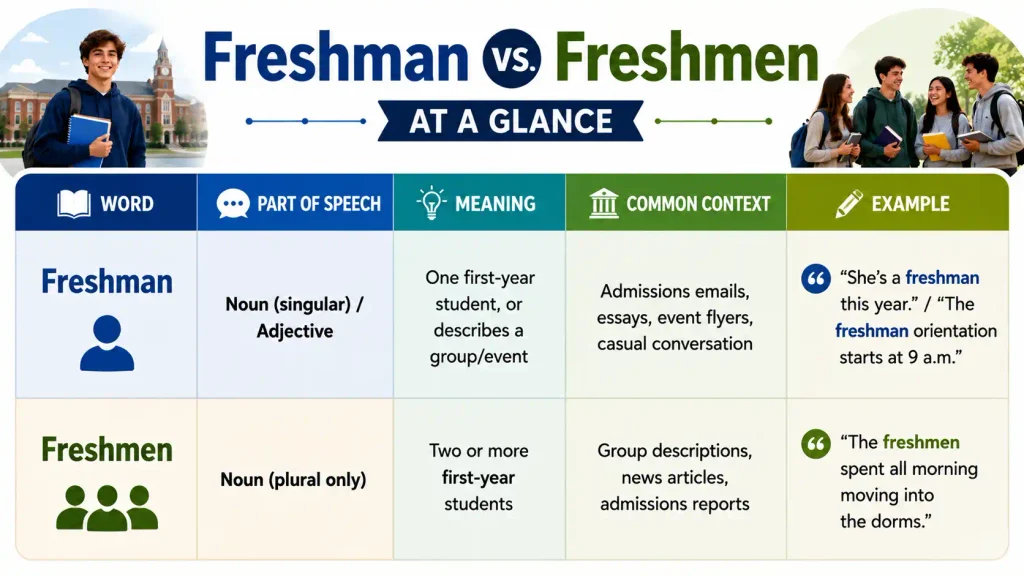
These two words look almost identical, but lining them up side by side makes the pattern easy to see: the same irregular plural logic behind person vs people and woman vs women.
What Does “Freshman” Mean?
Freshman refers to a student in their first year of high school, college, or a university program. It’s singular when used as a plain noun, and it also doubles as an adjective describing something that belongs to that first year group.
- “My roommate is a freshman, and he’s already talking about switching majors.”
- “Can you forward me the freshman orientation schedule? I lost the email.”
- “We’re throwing a Freshman Mixer Friday night; bring snacks.”
- “Looking back, my freshman year was mostly just figuring out where the good coffee was.”
You’ll see freshman most often in admissions emails, event flyers, casual conversation about someone’s grade level, and personal essays reflecting on that first year; it’s the more flexible half of the freshman vs freshmen pair, since it can work as either a noun or an adjective.
Notice, too, that it’s always “freshman year,” never “freshmen year”; the adjective form doesn’t change even when the year involved thousands of students.
What Does “Freshmen” Mean?
Freshmen is strictly a plural noun; it never functions as an adjective. Use it whenever you’re talking about two or more first year students as a group of individuals, not as a label for an event or category.
- “All the freshmen showed up early for the welcome session.”
- “A few freshmen from my building are in my chemistry lecture.”
- “The freshmen posted way too many move in photos this week.”
- “Admissions is expecting around 1,600 incoming freshmen this fall.”
In practice, freshmen shows up most in group descriptions, admissions reports, campus news articles, and everyday conversation about a whole cohort rather than one person. That’s the simpler half of the freshman vs freshmen distinction: strictly plural, strictly a noun. If you can swap in “students” and the sentence still makes sense, freshmen is almost always the right choice.
Freshman vs Freshmen, Key Differences
- Number: freshman is singular; freshmen is plural.
- Part of speech: freshman can work as a noun or an adjective; freshmen is a noun only.
- Group and event names stay singular: “Freshman Class,” “Freshman Mixer,” and “Freshman Friday” are all correct, never “Freshmen Class.”
- “Freshman year,” not “freshmen year”: even when describing an entire cohort’s experience, the adjective form stays singular.
- Capitalization: capitalize only when it’s part of a proper title or named event (like “Freshman Orientation Day”); lowercase it in ordinary sentences.
- Pronunciation is identical, which is exactly why this pair trips people up more in writing than in speech; your ear can’t catch the difference, so your eyes have to.
- The rule isn’t a rigid law: English doesn’t have one formal standard for how attributive (adjective like) nouns behave in the plural, and plural attributive nouns have become more common over time in general usage.
- “Freshman” as an adjective has simply stayed singular by long standing convention, not because some grammar authority mandated it.
Memory Trick: How to Never Mix Up Freshman and Freshmen?
The Man/Men Rule, the simplest anchor: one man becomes freshman, and many men become freshmen. If you already know that pattern, you already know the core of it.
The Adjective A Trick: for group and event names, remember that the a in freshman stands for adjective. Whenever the word is describing something (a class, a mixer, a schedule), keep the a spelling, no matter how many people are involved.
The Other Class Years Test: this one comes straight from how people naturally reason it out in conversation: if “Sophomores Mixer” or “Seniors Mixer” sounds wrong to you, then “Freshmen Mixer” is wrong for the same reason. Swap in another class year, trust your ear, and apply the same logic to freshman.
Common Mistakes With Freshman and Freshmen
These are the errors that come up most often when people mix up freshman vs freshmen in real writing:
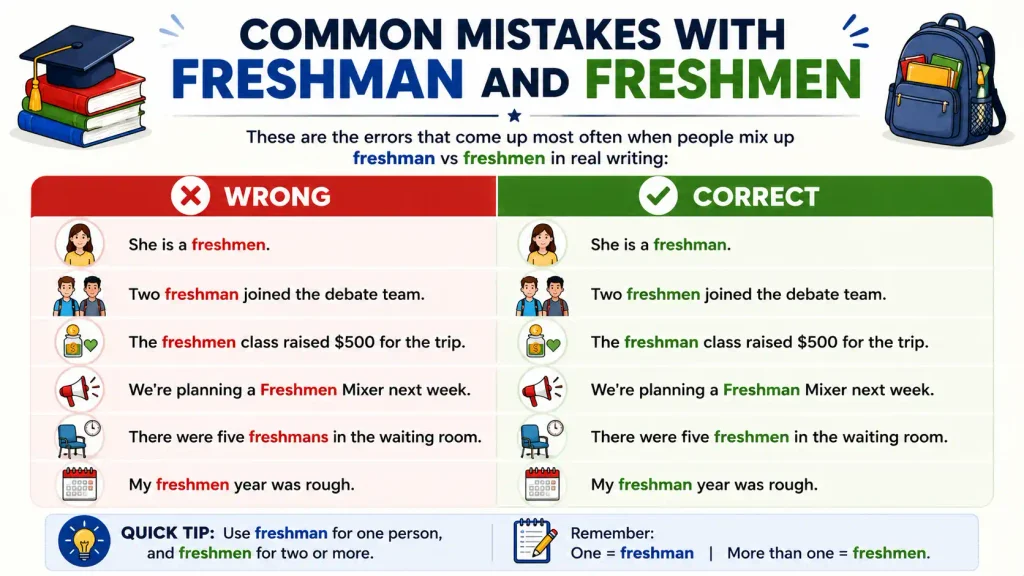
| ❌ Wrong | ✅ Correct |
| She is a freshmen. | She is a freshman. |
| Two freshman joined the debate team. | Two freshmen joined the debate team. |
| The freshmen class raised $500 for the trip. | The freshman class raised $500 for the trip. |
| We’re planning a Freshmen Mixer next week. | We’re planning a Freshman Mixer next week. |
| There were five freshmans in the waiting room. | There were five freshmen in the waiting room. |
| My freshmen year was rough. | My freshman year was rough. |
One small but useful note: because both words trace back to “man,” some schools, employers, and style guides now prefer first year student(s) as a gender neutral option. Neither choice is wrong; it depends on the tone and audience of what you’re writing.
Freshman Beyond the Classroom
The freshman vs freshmen distinction isn’t limited to the classroom. You’ll see the same singular/plural logic show up in unexpected places:
- “Freshman 15”, the informal, and often exaggerated, term for weight gain during a student’s first year of college.
- “Freshman senator” or “freshman congressman”, used for newly elected officials, regardless of their actual age.
- “XXL Freshman Class”, a well known annual hip-hop feature that highlights rising artists, borrowing the school term directly.
In every one of these cases, the same rule applies: singular for one person or as a descriptor, plural only when referring to multiple individuals as a group.
Quick Quiz: Test Yourself
- Fill in the blank: “She’s a ___ at State University.” (freshman/freshmen)
- Fill in the blank: “The ___ all moved into the dorms this week.” (freshman/freshmen)
- True or False: “Freshmen Class” is the correct spelling.
- Which is correct: “Freshman Mixer” or “Freshmen Mixer”?
- Fill in the blank: “Is 9th grade considered ___ year?” (freshman/freshmen)
(Answers: 1. freshman, 2. freshmen, 3. False, 4. Freshman Mixer, 5. freshman)
Frequently Asked Questions
Here are quick answers to the questions people ask most often about freshman vs freshmen.
Is freshman singular or plural?
Freshman is singular; it refers to one first year student.
What is the plural of freshman?
The plural is freshmen, following the same irregular pattern as man becoming men.
Is it “freshman class” or “freshmen class”?
“Freshman class” is correct. In this phrase, freshman is acting as an adjective, and adjectives don’t take a plural form in English, regardless of how many students are in the class.
Is it “Freshman Mixer” or “Freshmen Mixer”?
“Freshman Mixer” is correct. Freshman functions as an adjective here, and adjectives stay singular no matter how many people are involved; for the same reason it’s “Freshman Class,” not “Freshmen Class.”
Is freshman vs freshmen a spelling issue or a grammar issue?
It’s a grammar issue, not a spelling variation. Both freshman and freshmen are correctly spelled words; which one is “correct” depends entirely on whether you mean one student, multiple students, or a group/event name.
Is freshman gender neutral?
Freshman is used for students of any gender in American English, though “first year student” is a common gender neutral alternative in formal or institutional writing.
What comes after freshman in school terms?
Sophomore, then junior, then senior, the standard four year progression used in US high schools and colleges.
Final Thoughts
The freshman vs freshmen debate isn’t really about spelling at all; it’s about recognizing how the word is working in a sentence. Use freshman for one student or to describe a group, class, or event; use freshmen only when you’re naming multiple students as individuals.
Keep the man/men pattern and the adjective trick in mind, and you’ll never have to reprint another flyer over it.Once freshman vs freshmen clicks, the same logic will make sense of similar irregular pairs you run into down the road.
To read more: Forest vs Forrest: The Definitive Guide to the Correct Spelling (2026)