
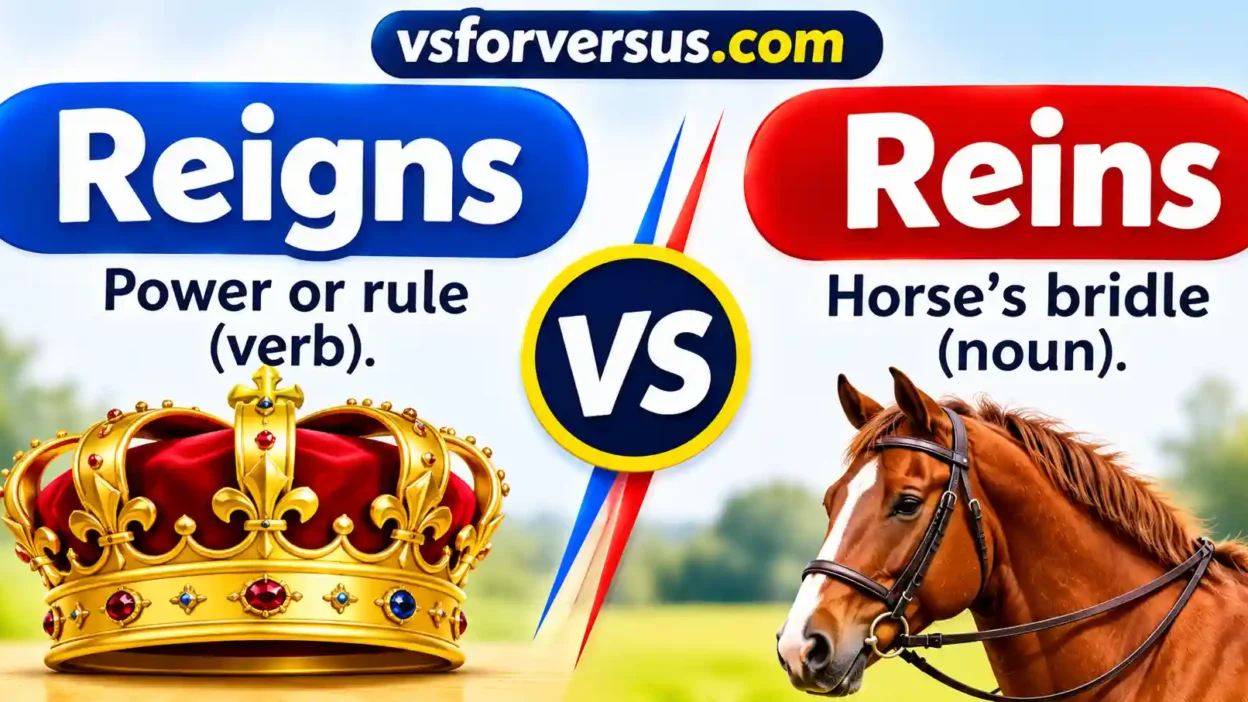
Reigns vs Reins is a homophone pair that trips up even careful writers, because the two words sound exactly the same and spellcheckers accept both.
The confusion is easy to understand because each word relates to power and control, yet they fit very different contexts. Reigns is the verb or noun related to ruling as a king, queen, or leader, as in “the queen reigns over the kingdom” or “a long reign.” Reins, on the other hand, are the straps used to guide and control a horse, and they appear in the popular idiom “take the reins,” meaning to take charge.
Many writers mix them up in that idiom. In this guide, you’ll learn the correct usage, common mistakes to avoid, and clear examples that make the right choice easy every time.
Quick Answer:
Reigns vs reins comes down to ruling versus controlling. Reigns means to rule as a monarch does, and reins are the straps that steer a horse or, figuratively, control over something. The two words share one pronunciation, /reɪnz/. Write reigns when someone rules, and reins when someone guides, holds, or restrains.
Picture a project manager three weeks into a new job. She closes an email to her director with, “Thanks for giving me free rein on the rollout.” By afternoon, a colleague has hit reply all with a cheerful correction. Her plan is solid, yet the thread is now about the spelling, and her first month as the person in charge has started with a joke at her expense.
That is the real cost of this mix up. A deal or a grade rarely hangs on it, but the slip drags attention away from what you meant, in the emails, essays, and captions where you most wanted to sound sure of yourself.
Reigns vs Reins at a Glance
Reins vs reigns, side by side:

| Word | Part of Speech | Meaning | Example |
| reigns | verb (third person singular); plural noun | rules as a monarch; periods of rule | “Chaos reigns in our group chat every Friday.” |
| reins | plural noun; verb (third person singular) | straps used to steer a horse; control or restraint | “Our new manager takes the reins on Monday.” |
The verb and noun forms line up like this:
| Base | s form | Past | ing |
| reign | reigns | reigned | reigning |
| rein | reins | reined | reining |
Both words do double duty as nouns and verbs, which is why the verb reigns and the plural noun reins can look like twins on the page. A quick pronunciation note: all of these words rhyme with “plane” and “train,” so your ear will never settle the question for you.
What Does “Reigns” Mean?
The meaning of reign most people learn first is the royal one: to rule with sovereign power, or the period during which someone rules. The word first shows up in English in the 1200s, from Latin regnum, a word that shares its root with regal, according to Dictionary.com’s word history. As a noun, it names a stretch of time (the queen’s reign). Add an s, and you get either the plural noun (two reigns) or the verb form for a singular subject (she reigns).
Examples you might actually write:
- “Our school has reigned as district debate champion three years running.”
- “Chaos reigns in the office whenever the printer jams.”
- “Historians still argue over whether the early years of his reign were peaceful or just quiet.”
- “My essay compares the reigns of two Tudor monarchs.”
- “Nobody expected the underdogs to reign over the league for a full decade.”
Common contexts: history essays, sports headlines (the reigning champion), political reporting, and fiction. The figurative uses follow the same royal logic: reign supreme means to dominate, and a reign of terror is a period of ruling by fear.
What Does “Reins” Mean?
In riding, a rein is a long, narrow strap attached to a horse’s bridle and used to steer. Riders usually hold two, a left and a right, so the noun is almost always plural. The word first appears in the 1300s, from Latin retinēre, “to hold back,” which explains how it grew into a metaphor for restraint. As a verb, rein in means to hold something back.
Here are some everyday uses of reins:
- “She gathered the reins, sat tall, and nudged the horse into a walk.”
- “Starting Monday, Dana takes the reins of the marketing team.”
- “We need to rein in travel costs before the audit.”
- “He handed over the reins of the family business at seventy.”
- “My sister has held the reins of our group project since the first meeting.”
Common contexts: riding, leadership handovers, budgets, parenting, and politics. If a sentence is about guiding, holding back, or passing control to someone else, rein is almost certainly the word.
Key Differences Between Reigns vs Reins
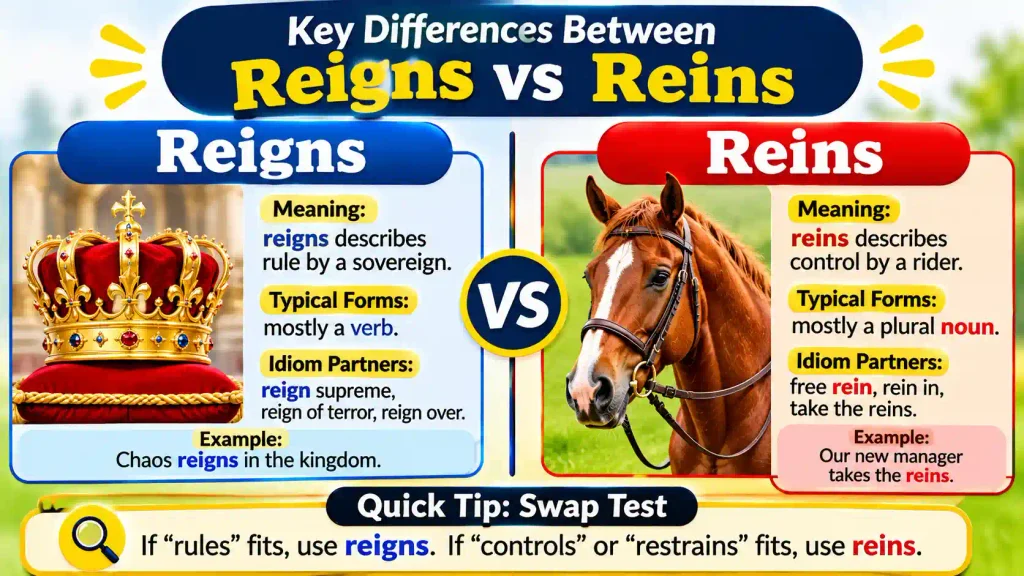
- Meaning: reigns describes rule by a sovereign; reins describes control by a rider or leader.
- Image: a throne versus a horse’s bridle.
- Typical forms: reins is mostly a plural noun, while reigns is mostly a verb.
- Idiom partners: reign forms go with supreme, of terror, and over; rein forms go with free rein, rein in, and take the reins.
- Swap test: if “rules” fits, use reigns. If “controls” or “restrains” fits, use reins. When you are stuck on reigns vs reins, this one test settles most sentences.
Idiom Cheat Sheet:
| Phrase | Correct spelling |
| give someone free (or full) ___ | rein |
| ___ in spending, or ___ in your temper | rein (reined in, not reigned in) |
| take, hold, or hand over the ___ | reins |
| ___ supreme | reign (reigns supreme) |
| ___ of terror | reign |
| the ___ing champion | reign (reigning) |
Bookmark this table, or print it for your desk. It covers most real world cases.
A Third Look Alike: Rain
Reign and rein share their sound with a third word, rain, which makes the trio a classic set of homophone examples. Our guide to rain vs reign vs rein covers all three. Anything that falls or pours down, literally or figuratively, takes the a spelling. Fire and compliments can both rain down, but never “reign down.” A king’s rule is a reign, a horse’s strap is a rein, and falling water is rain. When you are unsure, ask which job the sentence needs done.
Memory Trick
Start with a rider. Slack reins give the horse freedom, which is free rein. Tight reins hold it back, which is rein in. Reins belong to the rider, and a reign belongs to a ruler.
Add a spelling cue (a mnemonic) if you like: the silent g in reign nods to regal. No g, no royalty. And when you are stuck, run the swap test from the list above and try “rules” versus “controls” in the sentence. Mnemonics for reigns vs reins work best when you pick one and use it every time, so choose the rider image and stick with it. Want more tricks like this? See our roundup of homophone mix ups.
Common Mistakes Reigns vs Reins
Plenty of other pairs trip people up the same way, and our commonly confused words hub collects them. For this pair, these six slips are the ones to watch:
| ❌ Wrong | ✅ Correct | Why | |
| 1 | She reigned in her emotions. | She reined in her emotions. | Holding back is a horse image, so it takes rein. |
| 2 | We need to reign in costs. | We need to rein in costs. | Rein in means to restrain. |
| 3 | He was given free reign over the project. | He was given free rein over the project. | The phrase comes from loosening a horse’s reins. |
| 4 | She took the reigns of the company. | She took the reins of the company. | Taking control means taking the reins. |
| 5 | The king’s reins lasted thirty years. | The king’s reign lasted thirty years. | A period of royal rule is a reign. |
| 6 | Pizza reins supreme on Fridays. | Pizza reigns supreme on Fridays. | Dominating like a ruler takes reign. |

Even experienced writers slip here. A reader once wrote to Writer’s Digest to say that major publications seemed to use the two words as if they were one. A columnist for a legal newspaper once posted online that an article she was editing used both words correctly, and she celebrated it as a happy day. If professionals notice, you are in good company.
The reason is mechanical. Both are real words, so spellcheck and autocorrect stay silent. Only you can match the spelling to the meaning, so reread any sentence with either word before you hit send.
A thirty second proofread helps. Search your draft for “rein” and “reign,” read each sentence aloud with “rules” or “controls” in its place, and check every idiom against the cheat sheet above.
Quick Quiz
Try these five. Each one tests reigns vs reins in disguise.
- The queen’s ___ lasted forty years. Answer: reign. It names a period of rule.
- We need to ___ in spending this quarter. Answer: rein. It means to restrain.
- Give her free ___ on the design. Answer: rein. It means freedom, from the horse image.
- The jockey tightened the ___ before the final turn. Answer: reins. They are the horse’s straps.
- She ___ over the department for two decades. Answer: reigned. It means ruled.
In Your Own Writing
Business: Reigns vs reins shows up often in leadership and budget language. “Rein in costs,” “take the reins,” “hold the reins,” and “hand over the reins” are everyday workplace phrases, and “reign in” and “free reign” are two slips worth hunting for before you send a report.
Academic: “The reign of Elizabeth I” and “reigning monarch” are both correct, and so is “the reigns of successive kings” when you mean several rulers. Ruling means reign; restraining means rein.
Editing and legal drafting: Style conscious readers notice free reign quickly, so the standard spelling protects your credibility in formal documents.
Social media: Captions travel fast and rarely get proofread. “Reign supreme” and “reins” in a post about taking charge are worth a second look before you share. A quick rule for captions: if the post is about someone ruling or dominating, it is reign; if it is about holding back or handing over control, it is rein.
FAQ
Is it “free rein” or “free reign”?
“Free rein” is the standard spelling. It comes from loosening a horse’s reins to give it freedom. “Free reign” is common but widely treated as an error, so use “free rein” in professional writing.
Is it “rein in” or “reign in”?
“Rein in” is correct. It means to restrain, and the past tense is “reined in.” “Reign in” is a frequent mix up, as in “reign it in,” but a monarch’s rule has no place in this phrase.
Do I write reigns or reins when someone takes charge?
Reins. Someone who takes charge takes the reins, like a rider gathering the straps. Reigns belongs to rulers: a queen reigns, and chaos can reign over a messy office.
Are reign vs rein homophones?
Yes, reign, rein, and rain are homophones, all pronounced /reɪn/. Their plural and verb forms (reigns, reins, rains) sound identical too. Only context tells them apart in speech, which is why the mix up is so common in writing.
Is “reigns” a noun or a verb?
Reigns is mostly a verb: the third person singular of reign, as in “the champion reigns.” It is also the plural noun, as in “the reigns of two kings.” The related noun reins is nearly always plural.
Is it “reign supreme” or “rein supreme”?
“Reign supreme.” Something that dominates is likened to a ruler on a throne, so the royal spelling applies. “Rein supreme” is a misspelling.
What is the easiest way to remember reigns vs reins?
Picture a rider: reins steer, so use reins for control and restraint. Use reigns when a ruler rules. If you are unsure, swap in “rules” or “controls” and see which fits.
Final Thoughts
Reigns vs reins is really one question: is someone ruling, or controlling? A king reigns, and a rider holds the reins. Hold on to the rider image, use free rein every time, and give any idiom a quick check before you publish. The spelling is a small detail, but it tells readers you pay attention to the words you choose. Keep the cheat sheet handy, and the next time a colleague writes “free reign,” you will know exactly how to correct it kindly.
To read more: No One vs Noone: Which Spelling Is Correct? 5 Proven Rules

Marcus is a former product manager turned comparison writer who spent eight years testing tools and gadgets before quitting to write full-time. He specializes in breaking down tech and software matchups into plain-English verdicts, with a soft spot for buying guides nobody else wants to write.