
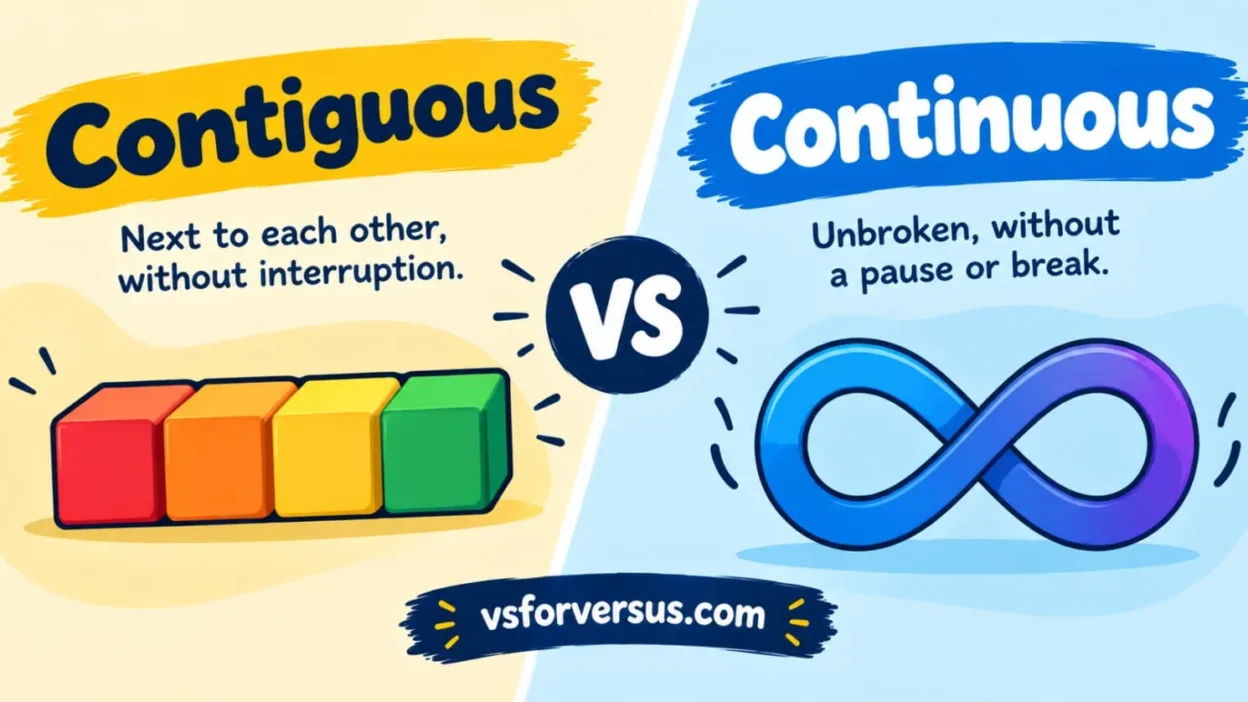
Contiguous vs Continuous these two words look and sound alike enough that even confident writers swap them without noticing, yet each one describes a very different kind of connection. Both suggest things being linked, but the nature of that link is what separates them.
Contiguous describes things that share a common border or are physically touching, without necessarily being part of the same whole, as in “the contiguous United States” or “two contiguous rooms.” Continuous, on the other hand, describes something that goes on without interruption or gaps, whether in time or space, as in “continuous rainfall” or “a continuous line.”
In short, contiguous is about touching neighbors, while continuous is about an unbroken flow. In this article, we’ll explore the origins of both terms, their correct usage, and clear examples to help you choose the right word every time.
Quick Answer:
Contiguous means touching or sharing a border with something else, as in the 48 contiguous states. Continuous means unbroken or without interruption, as in continuous rain. A quick test for contiguous vs continuous: contiguous needs a neighbor, and continuous needs no gap.
Contiguous vs Continuous at a Glance
| Word | Part of Speech | Meaning | Example |
| contiguous | adjective | touching or sharing a boundary with something else | Our two offices are contiguous, so we cut a door through the shared wall. |
| continuous | adjective | unbroken in time, sequence or extent | I’ve had a continuous headache since Tuesday. |
Say them aloud and only one consonant changes: con TIG yoo us versus con TIN yoo us. On the page, it is a single letter, g versus n, which is exactly why a tired writer’s autopilot so often picks the wrong word.

What Does Contiguous Mean?
Contiguous describes things that touch or share a border: two countries with a line between them on a map, or two rooms with one shared wall. The word comes from the Latin contiguus, meaning touching or bordering upon. You may also meet contiguously and contiguity, and the opposite is noncontiguous.
Notice the relationship built into the word. Something is contiguous to something else, so you need at least two things in the picture. Here is how it sounds in real writing:
- “Can you book contiguous seats? I don’t want the team split across three rows.”
- “The county approved the rezoning because all three parcels are contiguous to the existing industrial park.”
- “The allocator couldn’t find a contiguous block of memory that large, so the job crashed.”
- “Hawaii and Alaska are not part of the contiguous United States.”
You will meet the word most often in geography, property, maritime law (the “contiguous zone” just beyond territorial waters), and computing.
What Does Continuous Mean?
Continuous describes something unbroken, whether in time, sequence, or extent. If you could press pause and find a gap, it isn’t continuous. The word comes from the Latin continuus, meaning hanging together, and gives us continuously and continuity. The opposites are discontinuous and intermittent.
Unlike contiguous, continuous can describe a single thing standing alone. A hum, a fence, or a habit can be continuous without a second object in the sentence. Some examples:
- “I’ve had a continuous headache since Tuesday, so I’m booking the appointment.”
- “Her team treats continuous improvement as a habit, not a quarterly project.”
- “The fence runs in a continuous line from the road down to the creek.”
- “Height and weight are continuous variables; the number of siblings is not.”
Continuous shows up in business writing, science and statistics, and any everyday description of something that goes on without a pause.
Where You’ll See Each Word at Work
Each field below has a favorite, and seeing the words in context makes the choice easier.
Law and maritime writing. Treaty language and Coast Guard reports refer to the “contiguous zone,” the strip of sea next to a country’s territorial waters. The zone touches the territorial sea, so contiguous is the only word that fits. Nobody would call it a continuous zone.
Property and planning. Listings, zoning notes, and development proposals lean on contiguous: contiguous lots, contiguous acreage, contiguous units. Land that touches can be built on as one site, so buyers watch for the word. A listing that promises contiguous units is promising shared walls, not just a nearby floor.
Computing. In programming, contiguous memory and contiguous arrays mean data stored in neighboring slots. Continuous integration is something else: a workflow in which code is built and tested automatically with every change. One term describes layout, the other describes process, and mixing them in documentation sends readers hunting for the wrong thing.
Statistics and science. A continuous variable can take any value in a range, like temperature. A contiguous segment of a data series is a stretch of neighboring points. Blur the two in a methods section and a reviewer will say so.
Business and everyday life. Continuous service, continuous coverage, and continuous learning all describe things that go on without a break. When the sentence is about an ongoing process, continuous is usually your word.
Key Differences Between Contiguous vs Continuous
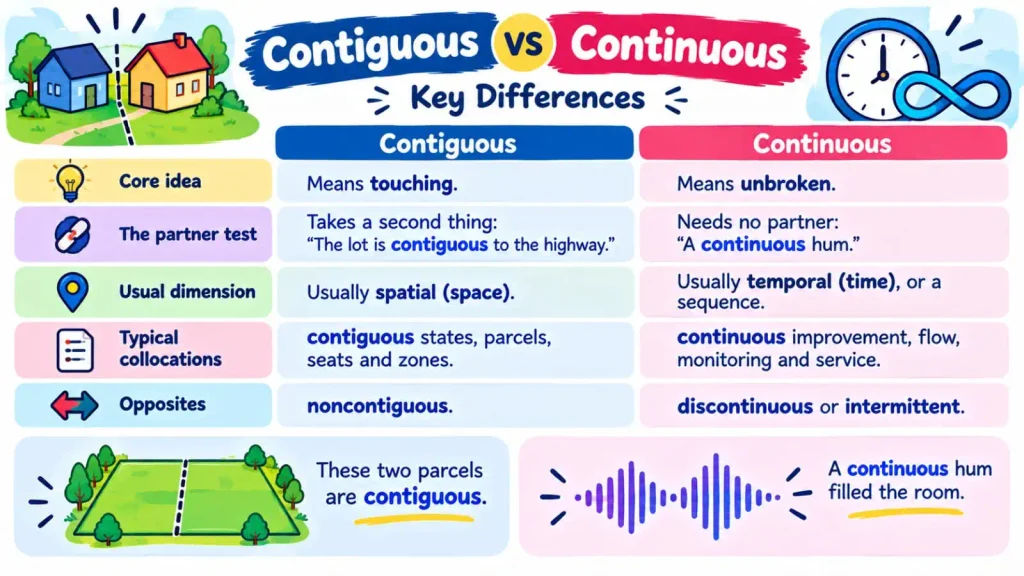
Here is how contiguous vs continuous breaks down in practice:
- Core idea: Contiguous means touching. Continuous means unbroken.
- The partner test: Contiguous naturally takes a second thing: the lot is contiguous to the highway. Continuous needs no partner: a continuous hum.
- Usual dimension: The difference between contiguous and continuous is usually spatial versus temporal. Contiguous leans toward space; continuous leans toward time or sequence.
- Typical collocations (word partners): contiguous states, parcels, seats and zones; continuous improvement, flow, monitoring and service.
- Opposites: noncontiguous versus discontinuous or intermittent.
When the Two Words Overlap
Real dictionaries are messier than any tidy rule. Dictionary.com lists a sense of contiguous that means adjacent in time, as in contiguous events, and even one that means near without actually touching. It also lists a sense of continuous that covers an unbroken spatial row, such as a continuous row of warehouses. The split between space and time is a strong default, not a law, and the contiguous vs continuous line blurs in a few edge cases.
Where the two overlap, choose by emphasis. If your point is that the pieces touch, write contiguous. If your point is that nothing interrupts, write continuous. A row of warehouses sharing walls is contiguous; a row you can walk along without hitting a gap is continuous. Same row, different question: is the reader wondering “do these touch?” or “does this stop?”
Even experienced writers slip here. Take “the 48 contiguous states,” a phrase that runs in respected newspapers every week. Usage authority Bryan Garner has pointed out its odd logic: Rhode Island doesn’t touch 47 other states. The phrase works because everyone knows what it means, not because it’s exact. Swapping in continuous wouldn’t help. The technically precise word is contiguous, though few readers would thank you for it. Fast typing causes its own slips: the first five letters of the two words match, and autopilot finishes whichever one it likes.
How to Remember the Difference
Pick whichever trick suits you:
- Contact. Contiguous and contact both involve touching.
- Neighbors. Contiguous and neighbors both contain a g, and neighbors are the classic contiguous pair.
- Continue. If something keeps going without stopping, it’s continuous.
- The quilt. The patches sit contiguous to one another; the thread running through them is continuous.
- The train. Coupled cars are contiguous. A nonstop service is continuous.
Common Mistakes with Contiguous vs Continuous
Here are the slips that turn up most in emails, reports, and chat messages:
| Wrong | Right | Why |
| “We’re committed to contiguous improvement.” | “We’re committed to continuous improvement.” | Improvement is a process over time, not a matter of touching. |
| “I booked continuous seats so we can sit together.” | “I booked contiguous seats so we can sit together.” | Seats that touch are contiguous. |
| “The contagious states share a border.” | “The contiguous states share a border.” | Contagious means spreading, as with illness. It is a different sound alike trap. |
| “I worked six continuous Saturdays.” | “I worked six consecutive Saturdays.” | The days between are breaks, so the Saturdays follow one another rather than run unbroken. |
Don’t confuse these with their cousins:
- Continual means happening again and again, with pauses. See [Continual vs Continuous].
- Consecutive means one after another in order. See [Consecutive vs Successive].
- Adjacent means next to or near, but not necessarily touching. See [Contiguous vs Adjacent].
Quick Quiz
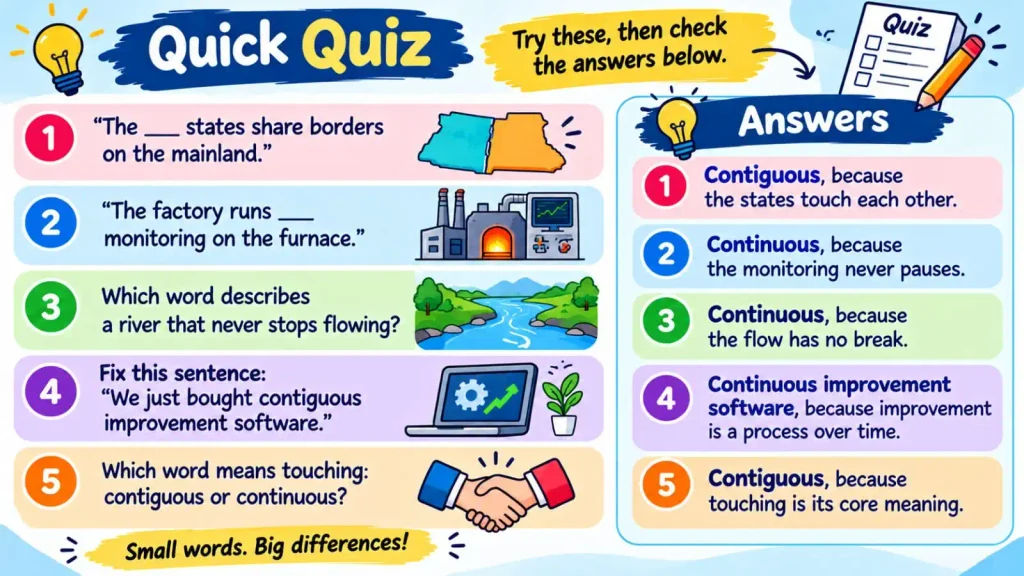
Try these, then check the answers below.
- “The ___ states share borders on the mainland.”
- “The factory runs ___ monitoring on the furnace.”
- Which word describes a river that never stops flowing?
- Fix this sentence: “We just bought contiguous improvement software.”
- Which word means touching: contiguous or continuous?
Answers: 1. Contiguous, because the states touch each other. 2. Continuous, because the monitoring never pauses. 3. Continuous, because the flow has no break. 4. Continuous improvement software, because improvement is a process over time. 5. Contiguous, because touching is its core meaning.
FAQ
Contiguous vs continuous: what is the difference?
Contiguous means touching or sharing a border with something else, such as neighboring states or adjoining offices. Continuous means unbroken or uninterrupted, such as continuous rain or continuous improvement. Contiguous needs a neighbor; continuous needs no gap.
Can contiguous and continuous be used interchangeably?
Mostly no. Contiguous and continuous overlap in a few edge cases, like a row of connected buildings, but each has a clear default. Use contiguous when pieces touch and continuous when nothing interrupts. If a reader could fairly ask “touching or unbroken?”, pick the word that answers that question.
What are contiguous states?
The contiguous states are the 48 states, along with Washington, D.C., that sit together on the North American mainland and share land borders. Canada cuts Alaska off from them, and the Pacific Ocean does the same for Hawaii.
Is contiguous the same as adjacent?
Contiguous and adjacent are close but not identical. Contiguous usually implies touching or a shared boundary, while adjacent more loosely means next to or near. Two houses with a gap between them are adjacent but are rarely called contiguous.
What is the difference between contiguous and consecutive?
Contiguous describes things that touch in space. Consecutive describes things that follow one after another in order, such as consecutive days or consecutive page numbers.
In game rules or contracts, does contiguous mean the same as continuous?
Not always. Contiguous emphasizes pieces that touch, so it can describe a connected cluster, while continuous suggests one unbroken line or span. When a rulebook or contract hinges on the word, check how that document defines it, because a short label rarely settles edge cases.
How do you remember contiguous vs continuous?
Link contiguous to contact and neighbors, and link continuous to continue. If the point is touching, choose contiguous. If the point is no break, choose continuous.
Related Confusable Words
If this pair of easily confused words finally clicked, these similar sounding ones are next:
- [Continual vs Continuous]
- [Contiguous vs Adjacent]
- [Consecutive vs Successive]
- [Contagious vs Contiguous]
- [Present Continuous Tense]
- [Commonly Confused Words: The Full List]
Final Thoughts
The whole topic fits in one question: do the pieces touch, or is there simply no break? If they touch, write contiguous. If nothing interrupts, write continuous. Next time a lease, a report, or a seating chart needs the right word, think of Priya and settle that question first. Do that, and the contiguous vs continuous choice is made.
Keep the memory tricks close, too: contiguous goes with contact and neighbors; continuous goes with continue. Dictionaries do blur the line at the edges, so when the context is high stakes, such as a contract or a rulebook, rely on the document’s own definition. For everything else, this one distinction will carry you.
To read more: Aloud vs Out Loud: What’s Shocking the Difference?2026

Marcus is a former product manager turned comparison writer who spent eight years testing tools and gadgets before quitting to write full-time. He specializes in breaking down tech and software matchups into plain-English verdicts, with a soft spot for buying guides nobody else wants to write.