

Dialogue vs Dialog writers often assume the shorter spelling is a mistake, but this pair proves them wrong. Both spellings are real and appear in respected publications, yet each tends to live in a different corner of the English speaking world and the digital world.
Dialogue is the traditional and most widely accepted spelling, used for conversations between people, exchanges in novels, plays, and films, and formal discussions between groups or nations. Dialog, on the other hand, is a shorter variant common in American English, especially in computing, where a “dialog box” is a small window that prompts users to respond. Choosing between them depends on your audience, your subject, and the style guide you follow.
In this article, we’ll explore the origins of both spellings, their regional preferences, and clear examples to help you use each one confidently.
Quick Answer
Dialogue and dialog are two spellings of the same word, and the dialogue vs dialog choice comes down to context. Dialogue is the standard spelling for a conversation between people, whether in real life, a novel, or a film. Dialog is the standard spelling in the computing phrase dialog box, and British English leans toward dialogue for both meanings.
Dialogue vs Dialog at a Glance
Table: Dialogue vs dialog compared by part of speech, meaning, and example.

| Word | Part of Speech | Meaning | Example |
| dialogue | Noun; also a verb | A conversation between people, spoken or written; formal talks between groups | The dialogue in that film sounds like real people talking. |
| dialog | Noun (variant spelling) | Most often a pop up window that asks for input; occasionally a variant of “dialogue” | A dialog box asked me to save the file before closing. |
Both words are pronounced the same way, which is why the confusion lasts: nothing in your ear tells you which spelling to type.
What Does “Dialogue” Mean?
“Dialogue” is a noun for a conversation between two or more people, spoken or written. Merriam Webster also covers the conversational element of a book, play, or film, and it lists “to dialogue” as a verb, though many editors prefer “hold a dialogue” or simply “talk” in formal writing.
In real writing, it sounds like this:
- Fiction: “My editor says the dialogue in chapter three reads like two people reciting a manual.”
- Screenwriting: “The screenplay dialogue is sharp, but the third act drags.”
- Business: “Let’s open a dialogue with the vendor before we escalate this to legal.”
- Public life: “Residents and city staff have kept up a steady dialogue about the new bike lanes.”
“Dialogue” turns up in fiction manuscripts, film scripts, news stories about negotiations, and workplace emails about talking something through. If you write fiction, our guide to dialogue tags covers the next step. The word also works for formal talks between groups, as in “the two unions agreed to enter dialogue,” where it signals a serious attempt to understand each other rather than a casual chat.
What Does “Dialog” Mean?
“Dialog” began as a variant spelling of “dialogue,” and it still appears that way, especially in American writing. Today, though, its home territory is technology. A dialog box, also called a dialog window, is a small pop up that asks you to confirm, choose, or type something, and Merriam Webster gives “dialog box” its own entry. A modal dialog blocks the rest of the screen until you respond.
Examples you might actually write:
- “When the dialog box appears, click Save before you close the file.”
- “The error showed up in a dialog window, and I dismissed it before reading it.”
- “Too many pop up dialogs make visitors leave the page.”
- “The senator called for a national dialog on housing costs.” (An acceptable variant in American news writing, though “dialogue” is the safer choice.)
“Dialog” lives in software documentation, interface copy, developer notes, support articles, and release notes. Even in tech, it is usually “dialog box,” so you rarely need the word on its own. Developers meet it in code too, where the HTMLelement carries no “ue,” and matching that spelling keeps your documentation consistent with what people see on screen.
Key Differences Between Dialogue vs Dialog
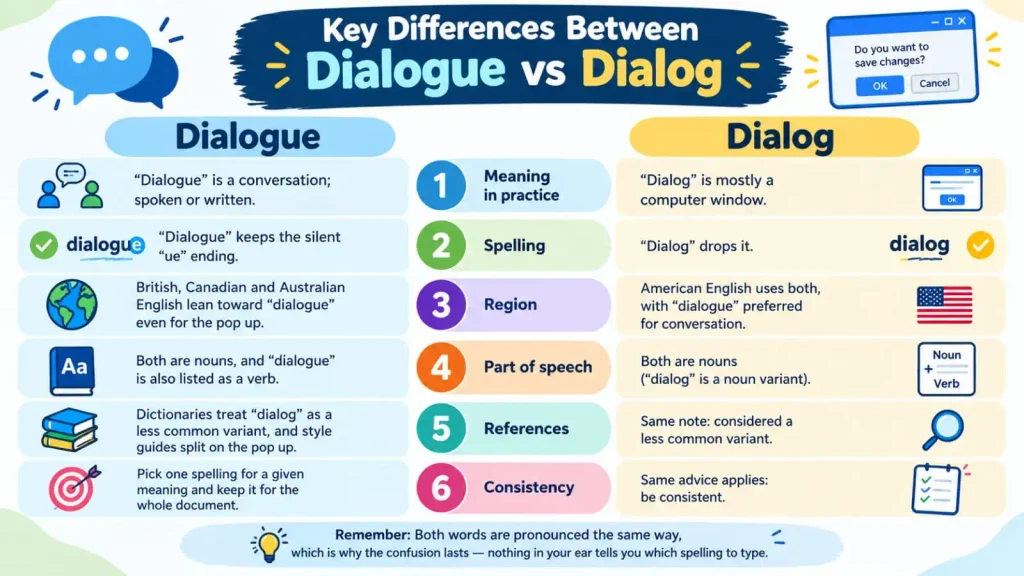
The dialogue vs dialog differences come down to six points:
- Meaning in practice: “dialogue” is a conversation; “dialog” is mostly a computer window.
- Spelling: “dialogue” keeps the silent “ ue” ending; “dialog” drops it.
- Region: British, Canadian, and Australian English lean toward “dialogue” even for the pop up. American English uses both, with “dialogue” preferred for conversation.
- Part of speech: both are nouns, and “dialogue” is also listed as a verb.
- References: dictionaries treat “dialog” as a less common variant, and style guides split on the pop up (see the next section).
- Consistency: pick one spelling for a given meaning and keep it for the whole document.
What Dictionaries and Style Guides Say
Writers who search dialogue vs dialog often need a source to point to, so here is where the major references stand.
| Source | What it says |
| Merriam Webster | Lists “dialogue” first, with “dialog” as a less common variant, and gives “dialog box” its own entry. |
| Chicago Manual of Style | Uses “dialogue” in its own text but makes an exception for “dialog box.” |
| AP Stylebook | Recommends “dialogue” for every meaning, including the computer window. |
Chicago’s editors note that Merriam Webster treats “dialog” as a secondary variant, which makes it standard English that writers may use according to preference. Newsrooms and publishers follow their own house guides, so check yours before you file or submit.
Which Spelling for Which Kind of Writing?
Applying the dialogue vs dialog rule is easiest when you match it to the document in front of you:
- Workplace email: write “dialogue” for any conversation, as in “I’d welcome a dialogue about the timeline.” It reads as polished in every region, and nobody will wonder whether it is a typo.
- Academic essays: use “dialogue,” including for Plato’s dialogues or classroom discussion. If your instructor names a style guide, follow its spelling.
- Screenplays and fiction: “dialogue” is the convention in screenwriting books and publishing, so a script that uses “dialog” may look unusual to an agent or editor.
- Software and UI copy: use “dialog” for the pop up, as in “Confirm your choice in the dialog that appears,” and keep the same form across every button, tooltip, and help page.
Is It an American vs British Spelling Thing?
Partly, but not in the way most people assume. British English leans toward “dialogue” for everything, including the computer window, although “dialog box” is the technical norm worldwide and some UK and Australian writers still favor “dialogue box.”
The American picture is more mixed, and the useful split there is by meaning rather than geography: “dialogue” for conversation, “dialog” for the box. So the dialogue vs dialog decision matters most when you write for an international audience or about software for a US readership.
The pattern extends to other words ending in “ ogue.” British English writes catalogue, analogue, and monologue. In the US, many of these get shortened, so “catalog” and “analog” are widely used. Shorter “ og” spellings trace partly to nineteenth century American spelling reform campaigns, while “dialog” took off with computing in the 1980s.
A few words stay “ ogue” almost everywhere, including demagogue, pedagogue, and synagogue. For more pairs like these, see our guides to American vs British spelling and catalog vs catalogue.
Common Mistakes (and a Slip Even Experienced Writers Make)
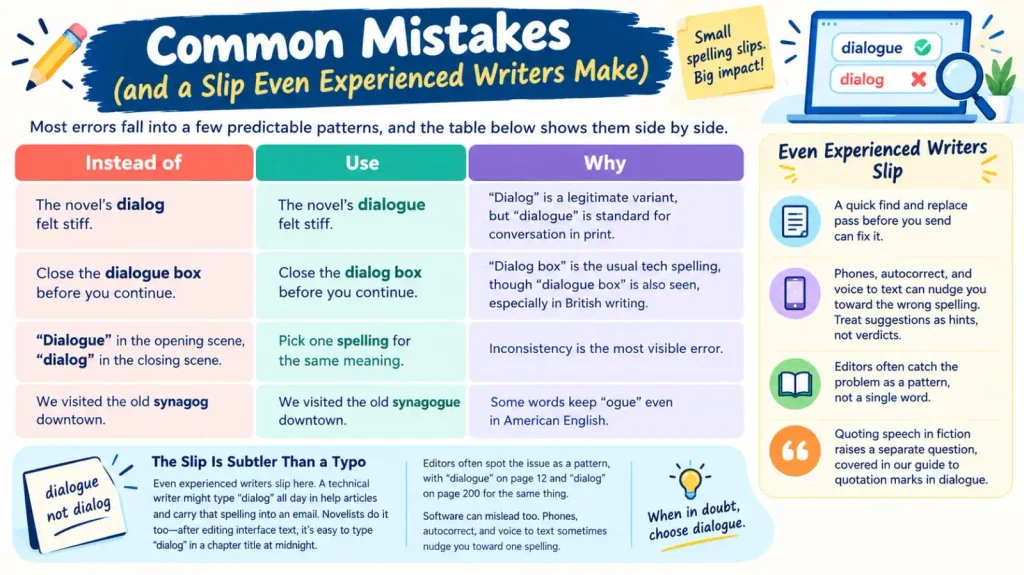
Most errors fall into a few predictable patterns, and the table below shows them side by side.
| Instead of | Use | Why |
| The novel’s dialog felt stiff. | The novel’s dialogue felt stiff. | “Dialog” is a legitimate variant, but “dialogue” is standard for conversation in print. |
| Close the dialogue box before you continue. | Close the dialog box before you continue. | “Dialog box” is the usual tech spelling, though “dialogue box” is also seen, especially in British writing. |
| “Dialogue” in the opening scene, “dialog” in the closing scene | Pick one spelling for the same meaning | Inconsistency is the most visible error. |
| We visited the old synagog downtown. | We visited the old synagogue downtown. | Some words keep “ ogue” even in American English. |
Even experienced writers slip here, and the slip is subtler than a typo. A technical writer who types “dialog” all day in help articles can carry that spelling straight into an email about a client conversation.
Novelists do it too: after an afternoon editing interface text, it is easy to type “dialog” in a chapter title at midnight. Editors often catch the problem as a pattern rather than a single word, with “dialogue” on page 12 and “dialog” on page 200 for the same thing. A quick find and replace pass before you send fixes it.
Software can mislead too. Phones, autocorrect, and voice to text sometimes nudge you toward one spelling. One reader on a proofreading site’s blog described using voice to text, noticing that the phone would not offer “dialogue,” and wondering whether he had misspelled it. Treat suggestions as hints, not verdicts. Quoting speech in fiction raises a separate question, covered in our guide to quotation marks in dialogue.
Quick Quiz: Dialogue or Dialog?
Test yourself with five quick questions, then check the answers below.
- “Click OK when the ___ box appears.”
- “The ___ between the two characters revealed their motives.”
- Which word is almost always spelled with “ ogue,” even in American English: catalog, analog, or demagogue?
- A report uses “dialogue” in paragraph one and “dialog” in paragraph four for the same conversation. What is the problem?
- You are writing interface copy for a US software product. Which spelling do you use for the pop up?
Answers:
- dialog. It is the standard computing spelling.
- dialogue. It describes a conversation between people.
- Demagogue. The other two are often shortened in American English.
- Inconsistent spelling. Choose a single form for the same meaning.
- dialog. It follows interface and documentation conventions.
Frequently Asked Questions
Is dialogue or dialog correct?
Both are accepted spellings, but the dialogue vs dialog decision depends on context. Use “dialogue” for conversation and “dialog” for computer windows.
Are dialogue and dialog the same word?
Yes. Dialogue and dialog share an origin and a pronunciation, and they differ mainly in spelling and typical use. Dialog is the shorter spelling variant that became attached to computer windows.
Is dialog an American spelling?
Both spellings appear in American English, but dialog mostly shows up in tech writing and in some journalism. For conversation, dialogue is still the standard American choice.
Is dialogue the British spelling?
Yes. British, Canadian, and Australian English lean toward dialogue in all contexts, including computer windows, and dialogue is also standard for conversation in American English.
Why is it “dialog box” and not “dialogue box”?
Technology writing settled on the shorter form, helped by early computer interfaces. British sources often keep “dialogue box,” so follow the convention your readers expect.
Is it wrong to use “dialog” for a conversation?
Not exactly. Dialog is an accepted variant for conversation, and some American outlets use it, but dialogue is the safer choice in essays, fiction, and professional email.
Can “dialogue” be used as a verb?
Yes. Dialogue works as a verb, as in “we dialogued with the vendor,” though many editors prefer “talk” or “hold a dialogue” in formal writing.
Final Thoughts
When dialogue vs Dialog trips you up again, remember the one line rule: if people are talking, write dialogue; if a window is popping up, write dialog box. Both are accepted spellings of the same word, so the real mistake is not choosing the “wrong” one but switching between them in the same document. Stay consistent, follow your style guide, and your readers, in London or anywhere else, will notice the content rather than the spelling.
To read more: Contiguous vs Continuous: The Ultimate Guide to 5 Confusing Differences

Marcus is a former product manager turned comparison writer who spent eight years testing tools and gadgets before quitting to write full-time. He specializes in breaking down tech and software matchups into plain-English verdicts, with a soft spot for buying guides nobody else wants to write.