
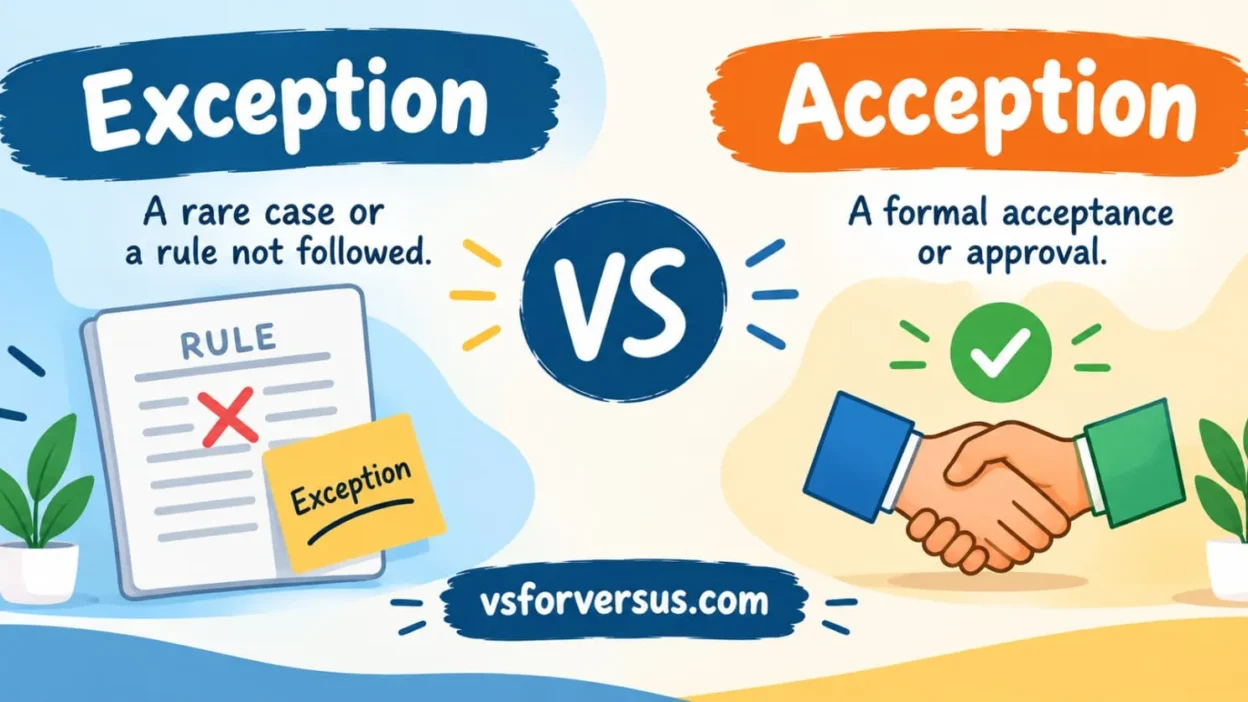
Exception vs Acception in few spelling slips look as convincing as this one, partly because “acception” resembles real words like “acceptance” and “acceptable,” which makes it feel legitimate at a glance. In reality, only one of these two terms belongs in standard modern English.
Exception is the correct word, referring to something that is left out, doesn’t follow a general rule, or stands apart from the usual pattern, as in “every rule has an exception” or “she made an exception for late submissions.” Acception, on the other hand, is not a recognized word in everyday English; it survives only as an obscure, archaic term for the accepted meaning of a word, and most readers will treat it as a typo for “exception” or “acceptance.”
Because the two share similar sounds, the mix up often slips past quick proofreading. In this article, we’ll clarify where the confusion comes from, explain the correct usage, and share clear examples to help you avoid this mistake.
Quick Answer:
Exception vs acception has a simple verdict: “exception” is the correct word for a case that does not follow a rule, as in “one exception to the policy.” “Acception” is a rare, archaic word for the accepted sense of a word and, in older writing, for acceptance. A writer who means a special case should choose “exception” every time.
Exception vs Acception at a Glance
The whole comparison fits in one table. The last two rows matter because the word people meant is often “exception” or “acceptance,” and some readers are really after the rarer “acceptation.”
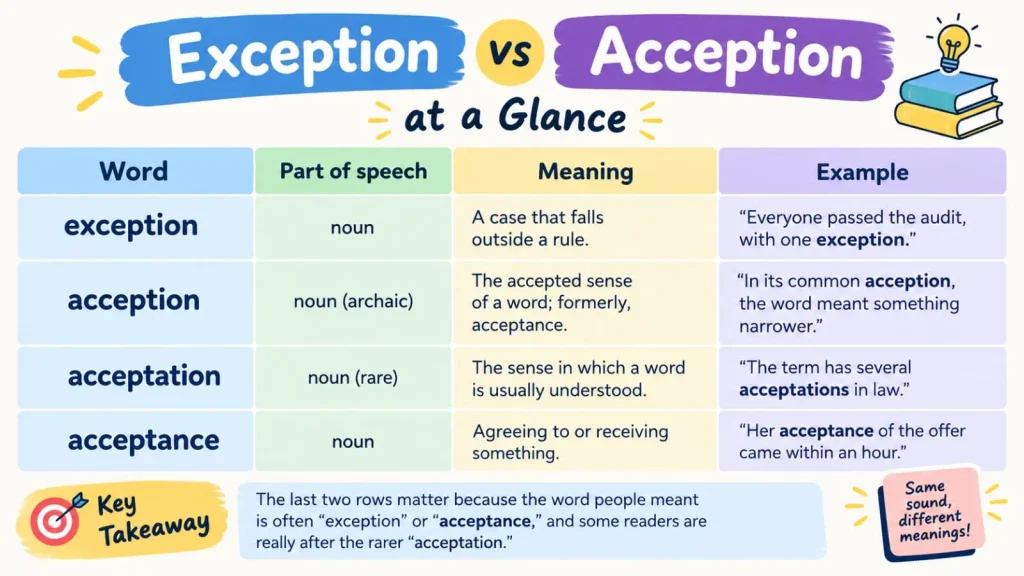
| Word | Part of speech | Meaning | Example |
| exception | noun | A case that falls outside a rule | “Everyone passed the audit, with one exception.” |
| acception | noun (archaic) | The accepted sense of a word; formerly, acceptance | “In its common acception, the word meant something narrower.” |
| acceptation | noun (rare) | The sense in which a word is usually understood | “The term has several acceptations in law.” |
| acceptance | noun | Agreeing to or receiving something | “Her acceptance of the offer came within an hour.” |
What Does “Exception” Mean?
The exception meaning is simple: a person, thing, or case that falls outside a general rule or statement. It’s a noun from the same family as “except,” the word in “everyone except Tom.” In real writing, it sounds like this:
- “Our team meets every Monday, but this week is an exception because of the holiday.”
- “I stopped drinking coffee after noon, except the occasional decaf.”
- “Late work loses a letter grade; medical emergencies are the only exception.”
- “The script crashed because the file import threw an exception.”
The word turns up in a handful of fixed phrases. People make an exception, ask for an exception to the rule, and write policies that apply without exception. Reports single out a lone department “except” marketing, and signs on office doors announce “no exceptions.” Linguists call these stock phrases collocations, and they’re exactly where the wrong spelling tends to creep in, because the writer is typing on autopilot.
Keep an eye on two neighbors as well. “Exceptional” means outstanding, and “acceptable” means good enough. Neither belongs in this comparison, but both can pull your fingers toward the wrong spelling mid sentence.
What Does “Acception” Mean?
Now for the acception meaning, which is narrow and old. Dictionaries label the word rare or archaic. It named the sense in which a word is accepted or understood, and in older English it could also stand for acceptance. Today it survives mostly in older books, in writing about language or philosophy, and occasionally in a crossword clue that asks for something old fashioned.
- “In its strict acception, the term referred only to licensed physicians.”
- “The essay separates three acceptions of the word ‘nature.’”
- “Older grammar books speak of a word’s common acception.”
None of these sounds like modern workplace writing. If your sentence is about a rule, a policy, a deadline, or a special case, this isn’t your word. Stuck on exception vs acception in an everyday sentence? The rare word isn’t secretly fine. It’s wrong.
The two words are near homophones. Said slowly, their first syllables differ a little; said quickly, they can blur together, which may be one reason the words get swapped when people write by ear.
Acception vs Acceptation
Writers who need the “sense of a word” meaning today usually reach for “acceptation,” a rare word you’ll still find in dictionaries. For the idea of agreeing to something, use “acceptance.” Whichever you need, think twice before choosing the older form.
Key Differences Between Exception vs Acception
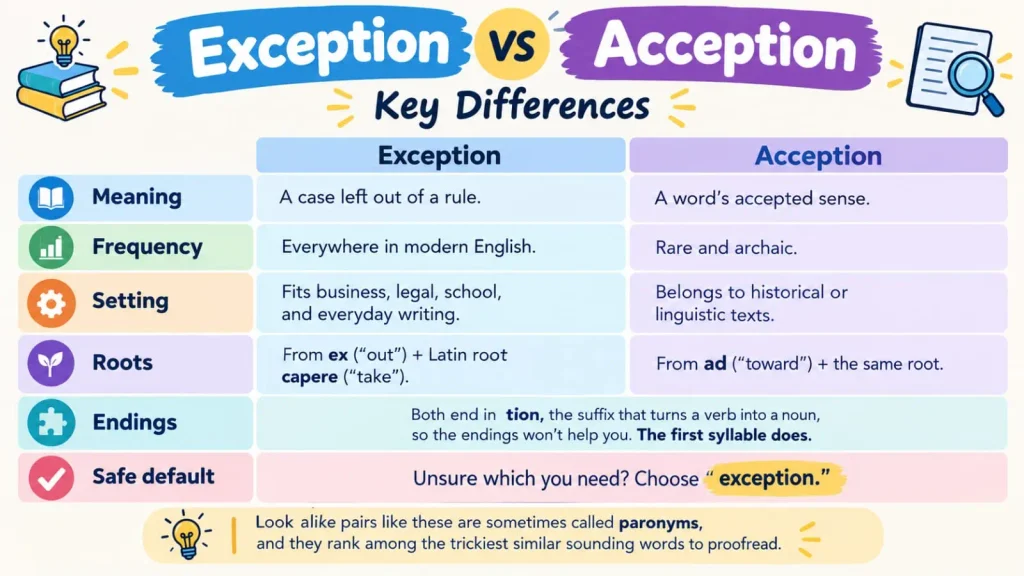
- Meaning: “exception” is a case left out of a rule; “acception” is a word’s accepted sense.
- Frequency: “exception” is everywhere in modern English; “acception” is rare and archaic.
- Setting: “exception” fits business, legal, school, and everyday writing; “acception” belongs to historical or linguistic texts.
- Roots: “exception” comes from ex (“out”) plus the Latin root capere (“take”); “acception” comes from ad (“toward”) plus the same root.
- Endings: both end in tion, the suffix that turns a verb into a noun, so the endings won’t help you. The first syllable does.
- Safe default: unsure which you need? Choose “exception.”
Look alike pairs like these are sometimes called paronyms, and they rank among the trickiest similar sounding words to proofread.
How to Remember the Difference?
Two tricks settle exception vs acception for good.
Trick one: look inside the word. “Exception” contains “except,” as in “everyone except Tom.” If the sentence is about leaving something out, the word you need has “except” tucked inside it.
Trick two: remember the Latin story. Both words trace back to capere, “to take.” Their closer ancestors are excipere (“take out”) and accipere (“take to oneself”). Add ex (“out”), and you get something taken out of the rule: an exception. Add ad (“toward,” which becomes ac before a c), and you get the idea of taking something in, the family behind “accept” and “acceptance.”
The rule of thumb fits on a sticky note: left out? Exception. Taken in? Accept , as in “accept” or “acceptance.”
Want it on your desk? Grab the printable cheat sheet with the decision rule, both tricks, and four pairs of wrong and right sentences.
Common Mistakes (Wrong vs Correct)
Most exception vs acception errors fall into a few predictable settings. The table below shows what they look like in real documents and how each one tends to land with a reader.
| Setting | Wrong | Correct | How it reads |
| Contract clause | “Payment is due within 30 days, with the acception of invoices under $50.” | “Payment is due within 30 days, with the exception of invoices under $50.” | Careless where precision is the point |
| HR policy | “There are no acceptions to the dress code.” | “There are no exceptions to the dress code.” | Undercuts the very rule it states |
| Student essay | “The trend held across all five schools, with one acception.” | “The trend held across all five schools, with one exception.” | Reads as a spelling lapse and can cost points |
| Cover letter | “Could you make an acception for my start date?” | “Could you make an exception for my start date?” | Spotlights the one sentence where you ask a favor |
| Thank you email | “Thank you for your quick acception of my proposal.” | “Thank you for your quick acceptance of my proposal.” | Wrong word for the idea of agreeing |
Look at the last row: sometimes the word you meant was never “exception” at all. When “acception” shows up in a sentence about agreeing to something, the fix is “acceptance.” If agreeing is what you meant, the real choice is acceptance vs exception: acceptance takes something in, and exception leaves something out. Strictly speaking, this kind of slip is a malapropism, a real word with a similar sound standing in for the one you meant, though most readers will simply see a typo.
Quick Quiz: Exception or Acception?
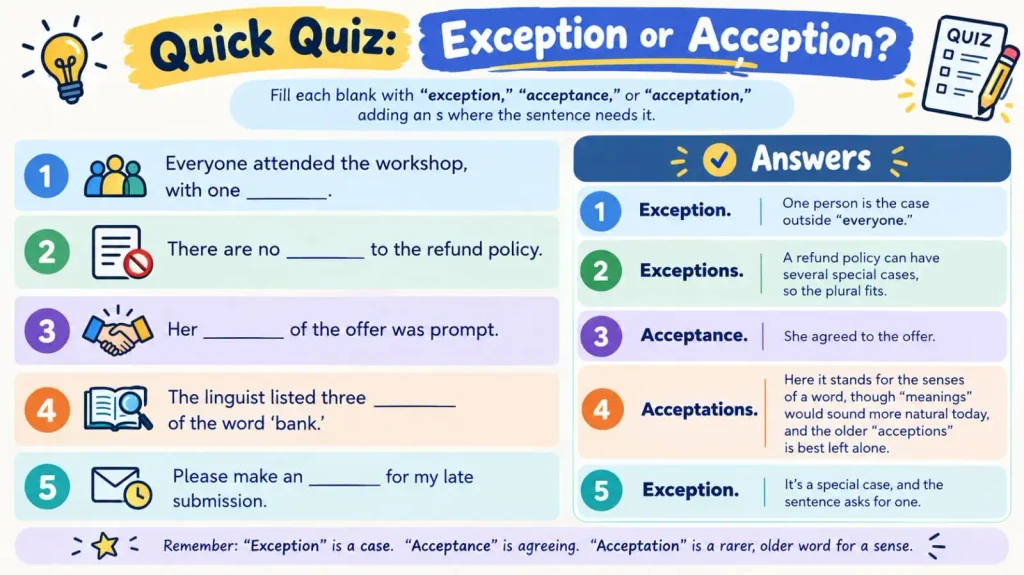
Fill each blank with “exception,” “acceptance,” or “acceptation,” adding an s where the sentence needs a plural. Answers follow the list.
- “Everyone attended the workshop, with one ______.”
- “There are no ______ to the refund policy.”
- “Her ______ of the offer was prompt.”
- “The linguist listed three ______ of the word ‘bank.’”
- “Please make an ______ for my late submission.”
Answers:
- Exception. One person is the case outside “everyone.”
- Exceptions. A refund policy can have several special cases, so the plural fits.
- Acceptance. She agreed to the offer.
- Acceptations. Here it stands for the senses of a word, though “meanings” would sound more natural today, and the older “acceptions” is best left alone.
- Exception. It’s a special case, and the sentence asks for one.
FAQ
Is acception a real word?
Yes. “Acception” is a genuine English word, though rare and archaic. It once named the way a word is understood and, in older writing, stood for acceptance. In everyday writing, it usually reads as a misspelling of “exception” or “acceptance.”
Exception vs acception: which one should I use?
Use “exception” whenever you mean a special case or something left out of a rule. “Acception” belongs to historical and linguistic writing, and even there most modern writers prefer “acceptation.” Nothing in a normal email, essay, or policy calls for the rare word.
What does acception mean?
Acception historically referred to a word’s accepted meaning, and older writers sometimes used it for plain acceptance. Modern English has other words for both ideas: “meaning,” “sense,” “acceptation,” and “acceptance.” That’s why “acception” itself now appears mostly in older texts.
What is the difference between exception vs acceptance?
An exception is a case left out of a rule: “everyone passed, with one exception.” Acceptance means agreeing to or receiving something: “her acceptance of the offer.” Think of one as leaving something out and the other as taking something in.
Why do people write “acception” instead of “exception”?
“Acception” and “exception” look and sound alike, and writers often follow the familiar accept/acceptance pattern instead of the meaning they intend. Fast typing blurs the opening syllable even further. The result is a real word in the wrong place, which makes it easy to miss.
Is “with the acception of” correct?
No. “With the acception of” is incorrect; the standard phrase is “except,” as in “All departments hit their targets, except marketing.” For alternatives, “except for,” “apart from,” and “other than” work in most settings.
Exception vs Acception: “Exception” is the correct word for something that doesn’t follow the usual rule, as in “every rule has an exception,” while “acception” is not a standard modern English word and is usually just a misspelling of “exception” or “acceptance.”
Related Confusable Words
If this pair tripped you up, these guides may help:
- Accept vs except: the verb and the preposition that sound almost alike.
- Expect vs except: anticipating something versus leaving it out.
- Exception vs exemption: a special case versus a formal release from a duty.
- Acceptance vs acceptation: the everyday word versus its rarer cousin.
- Commonly confused words: the full list of look alike pairs.
- Other ways to say “except for”: formal alternatives for reports and emails.
Final Thoughts
Exception vs acception is settled once you know what each word does. Use “exception” for a case that falls outside a rule, and treat “acception” as a rare, archaic word you rarely need. Look for “except” inside the word, search your draft for the wrong spelling before you send it, and your next cover letter won’t have the problem Priya’s did.
To read more: Empathetic vs Empathic: What’s the Difference and Which Should You Use?2026

Elena covers lifestyle and consumer comparisons — everything from mattresses to meal kits — drawing on a background in market research. She’s known for digging past marketing copy to find the one detail that actually decides a purchase, and for admitting when two options are basically a coin flip.