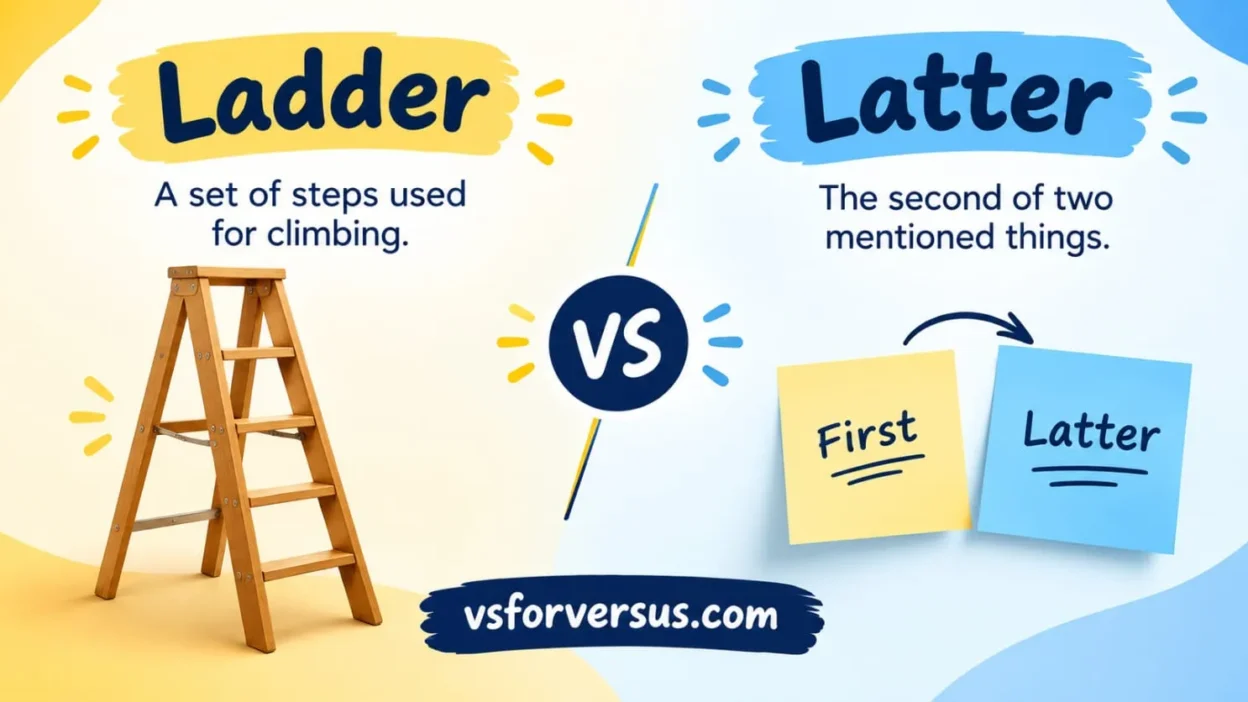
Ladder vs Latter mix up a piece of climbing equipment with a word about order, and a sentence can fall apart quickly, which is exactly why this pair deserves a closer look. They share most of their letters and a similar rhythm when spoken fast, but they belong to separate worlds completely.
Ladder names a physical tool, a frame with rungs that lets you move up or down, and it also appears in expressions like “the career ladder” or “the social ladder.” Latter is a word of comparison and sequence: it points to the second of two options already named, as in “between the red and the blue one, I’ll take the latter,” and it can also describe the closing stage of a period, like “the latter part of the week.”
Since spellcheckers accept both, only careful reading will catch the slip. Ahead, we’ll trace each word’s origin, show how to use it properly, and give examples that make the choice easy.
Quick Answer:
Ladder is a noun for a tool with rungs that people climb. Latter means the second of two things already mentioned, and the word for the first of those two things is former. In any ladder vs latter choice, write “ladder” for something to climb and “latter” for the second option; “ladder” never means the first option.
At a Glance: Ladder, Latter, Former and Later
The whole difference fits in one table. Two extra words are included, since they cause most of the real trouble.
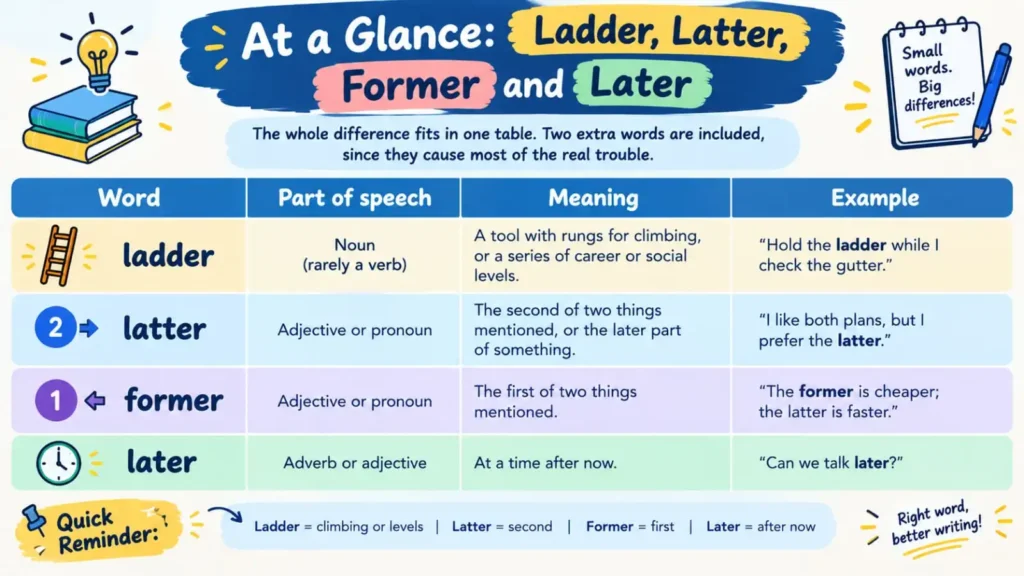
| Word | Part of speech | Meaning | Example |
| ladder | Noun (rarely a verb) | A tool with rungs for climbing, or a series of career or social levels | “Hold the ladder while I check the gutter.” |
| latter | Adjective or pronoun | The second of two things mentioned, or the later part of something | “I like both plans, but I prefer the latter.” |
| former | Adjective or pronoun | The first of two things mentioned | “The former is cheaper; the latter is faster.” |
| later | Adverb or adjective | At a time after now | “Can we talk later?” |
What Does “Ladder” Mean?
A ladder is a structure with two side rails joined by rungs, used for climbing up or down. It is an ordinary countable noun: you can buy one, borrow one, or lean one against a wall. In everyday use, it sounds like this:
- “Can you hold the ladder while I clear the gutters?”
- “Our landlord left a rickety ladder in the garage, and I’m not trusting it.”
- “She climbed the corporate ladder faster than anyone in her cohort.”
- “Careful with those tights; one snag and they’ll ladder.” (This verb use is mostly British.)
You will meet this word in home repair, firefighting and safety notices, and in figurative phrases such as the career ladder and the property ladder. Rankings borrow it too, as in a club tennis ladder. Underneath, the idea never changes: a way to move from one level to another. That physical picture is why, in the ladder vs latter pairing, “ladder” is the easier word to hold in your head.
What Does “Latter” Mean?
“Latter” points backward, a job grammarians call anaphoric reference. It works only when the reader already knows which two things you mean, and it names the second one. Major dictionaries, including Merriam Webster and Cambridge, give this latter meaning and add a second sense: the later part of something, as in “the latter half of the year.” These examples put the latter in a sentence, in situations you will recognise:
- “We could meet Tuesday or Thursday. Thursday works better, so let’s do the latter.”
- “Both candidates interviewed well, but the latter gave clearer examples.”
- “Sales dipped in spring and recovered in the latter half of the year.”
- “I read the summary and the full report, and honestly the latter was worth the time.”
You will find it in workplace emails, reports and academic comparisons, where it saves repeating a long phrase. It leans formal. One caution: use “last” when you are choosing among three or more items. Some dictionaries accept broader use of “latter,” but many style guides prefer “last” because readers can see exactly which item you mean.
Is “Ladder” Ever the First Option?
No. “Ladder” never means the first of two things. The word you want is “former.”
Here is the pair in action: “Of the two flights, the former leaves at six and the latter at nine.” Each word makes sense only next to the other. For the full rundown, see our guide to former and latter.
So why do people reach for “ladder”? Memory tells you there is a word for the first item, and “ladder” sounds so much like “latter” that it slides into the gap. That is a failure of recall rather than grammar, and the trick below fixes it. The ladder vs latter mix up is really a missing partner problem.
Key Differences Between Ladder vs Latter

- Meaning: a ladder is a climbing tool; “latter” is the second of two.
- Part of speech: a noun versus an adjective or pronoun.
- Needs a reference? “Latter” does, because two items must come first. “Ladder” stands alone.
- Tone: “ladder” is everyday; “latter” is a little more formal.
- Partner word: “latter” pairs with “former.” “Ladder” has no partner.
- Spelling cue: double d versus double t.
Do Ladder and Latter Sound the Same?
Often, yes, if you speak American English. In many American accents, the middle consonant in both words becomes the same quick tap of the tongue, which linguists call a flap. That makes the two words near homophones, and sometimes true homophones. Many British accents keep the d and t distinct.
In IPA notation, the textbook pronunciations are /ˈlædər/ for ladder and /ˈlætər/ for latter, but that is not what many people say out loud. Native speakers trip on the ladder vs latter choice too, so learners are not the only ones. They picked up both words by ear long before they learned to spell them, so the written forms are separate things to memorise, and the ear offers no help at the keyboard. Don’t trust your ear when you write. Decide by meaning, then spell the word to match.
How to Remember the Difference?
The simplest ladder vs latter mnemonic works on the pair and covers both words at once:
- Former = First
- Latter = Last (both start with “La” and both contain a T)
For the other word, notice that “ladder” has “add” tucked inside it, so you add one rung at a time as you climb. This part is a personal aid, so use it only if it clicks for you.
Then run a two second test whenever you hesitate: can you climb it? Write “ladder.” Are you pointing back to the second of two things? Write “latter.” Are you pointing back to the first? Write “former.”
Common Mistakes: Wrong vs Correct
These are the mix ups that turn up most in real drafts.
- Wrong: “Between the soup and the salad, I’ll have the ladder.” Correct: “…I’ll have the latter.”
- Wrong: “The ladder is cheaper, but the latter is faster.” (ladder standing in for the first option) Correct: “The former is cheaper, but the latter is faster.”
- Wrong: “He leaned the latter against the wall.” Correct: “He leaned the ladder against the wall.”
- Wrong: “I’ll call you latter.” Correct: “I’ll call you later.”
- Wrong: “Of tea, coffee and juice, I chose the latter.” Correct: “…I chose the last.” Or better, name the drink.
Even experienced writers slip here. This is the kind of error that can survive three read throughs, because the eye sees a real word and moves on. Autocorrect and voice dictation make it worse, since they swap one valid word for another without a flag.
Latter vs Later vs Last
These three get tangled easily, so a quick reference helps. “Later” is about time, and later vs latter goes deeper on that pair. “Latter” points back to the second of two things. “Last” is the final item of three or more, and last vs latest covers its own confusion. When a sentence introduces two options, the safest pairing is “former” and “latter.” With a longer list, switch to “first” and “last.” All three belong to the family of commonly confused words that spellcheck cannot catch.
Quick Quiz

Test yourself on ladder vs latter and its partner words, then check below.
- “We need a taller ___ to reach the gutter.”
- “Both cafés were good, but the ___ (the first one) had better coffee.”
- “I couldn’t decide between the train and the bus, so I took the ___ (the second one).”
- “In the ___ half of the match, the home team surged.”
- Which of these three words can never refer to one of two options: former, latter or ladder?
Answers: 1. ladder (the thing you climb). 2. former (first of two). 3. latter (second of two). 4. latter (the later part of the match). 5. ladder.
Frequently Asked Questions
What is the real difference between ladder vs latter?
A ladder is a noun: a physical climbing tool, or a series of levels. “Latter” refers to the second of two things already mentioned. The two words share only a similar sound and a few letters.
Is it “the latter” or “the ladder”?
Write “the latter” when you mean the second of two options. “The ladder” always refers to the climbing tool and never works as an option.
Is “ladder” ever used for the first of two options?
No. “Ladder” never means the first of two things. The word for the first option is “former.”
What is the opposite of latter?
The opposite of “latter” is “former.” “Former” names the first of two items, and the two words almost always appear together.
Do ladder and latter sound the same?
Yes, in many American accents, because the middle consonant of both words becomes a quick flap. Many British accents keep “ladder” and “latter” apart. Either way, choose by meaning rather than sound.
Can I use latter with more than two things?
“Latter” is clearest with exactly two items. For three or more, “last” is safer, although some sources accept the broader use of “latter.”
What is the difference between latter and later?
“Later” refers to time after now (“I’ll call you later”). “Latter” points back to the second of two things or to the later part of something (“the latter half”).
Final Thoughts
The ladder vs latter mix up lasts because two valid words sound alike and spellcheck stays quiet. One test settles it: if you can climb it, it’s a ladder, and if you’re pointing back to the second of two things, it’s the latter. Keep “former” ready for the first option, save “last” for longer lists, and read important drafts aloud before they go to a client, a professor or a hiring manager. Two seconds of checking costs far less than a delayed deposit, and once the pair clicks, you’ll rarely need the trick again.
To read more: Empathetic vs Empathic: What’s the Difference and Which Should You Use?2026

Elena covers lifestyle and consumer comparisons — everything from mattresses to meal kits — drawing on a background in market research. She’s known for digging past marketing copy to find the one detail that actually decides a purchase, and for admitting when two options are basically a coin flip.