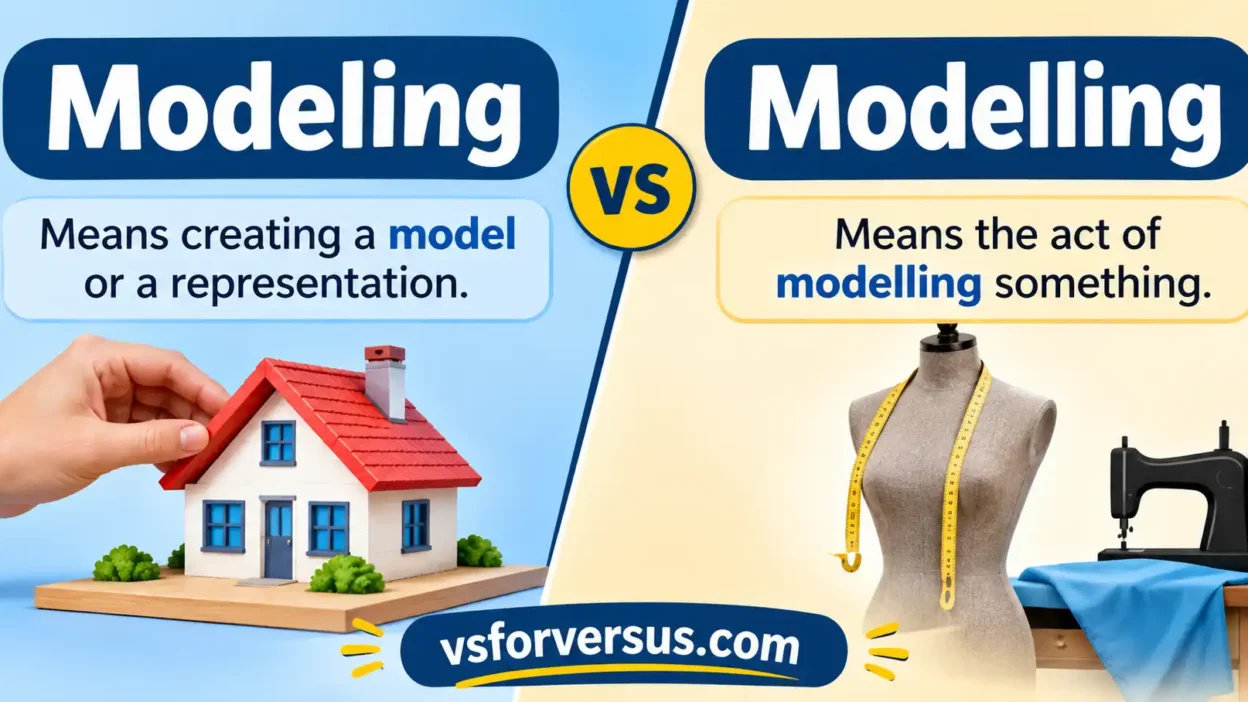
Modeling vs Modelling are same word, two spellings, and no difference in meaning: that surprises people who assume a doubled letter must signal something special. Both forms describe the act of making a model, posing for a camera, or representing something in a simplified form, and each is correct in the right part of the world.
Modeling is the standard American spelling, with a single “l,” as in “she is building a financial modeling course for her team.” Modelling is the standard British, Australian, and Commonwealth spelling, with a double “l,” as in “he started a career in fashion modelling in London.”
The split follows the same pattern as “traveling” and “travelling,” so learning one pair helps with many others. In this article, we’ll look at the spelling rule behind the extra letter, regional preferences, and practical examples to help you choose the right form for your readers.
Quick Answer:
Modeling and modelling are two spellings of the same word, meaning the act of creating a representation of something, or of posing and wearing clothes for display. Modeling (one L) is standard in American English, while modelling (two Ls) is standard in British, Australian, and most other Commonwealth English. The modeling vs modelling choice depends only on the reader’s region.
Modeling vs Modelling at a Glance
Each spelling works as a present participle, a gerund, and a noun, so think of them as spelling variants of a single word. Only the orthography (the technical term for spelling conventions) differs. The table below sums up modeling vs modelling for every related form.

| Word | Part of Speech | Meaning | Example |
| modeling (US) | present participle, gerund, noun | creating a representation of something, or posing and wearing clothes for display | We’re modeling next year’s demand in a spreadsheet. |
| modelling (UK) | present participle, gerund, noun | the same meaning as modeling, spelled the British way | We’re modelling next year’s demand in a spreadsheet. |
| modeled (US) | past tense, past participle | the past form of the verb model | She modeled for a local label in college. |
| modelled (UK) | past tense, past participle | the past form of the verb model, spelled the British way | She modelled for a local label at university. |
| modeler (US) | noun | a person who builds or works with models | Our lead modeler caught the error. |
| modeller (UK) | noun | a person who builds or works with models, spelled the British way | Our lead modeller caught the error. |
What Does “Modeling” Mean?
“Modeling” is the standard American English spelling. It comes from the verb model, and it works as a present participle (“she is modeling”), as a gerund (“modeling takes patience”), and as a noun or modifier (“a modeling contract”). The meaning never changes: creating a representation of something, or posing and wearing clothes for display. And if you are wondering how to spell modeling in American English, it is one L: m o d e l i n g.
In everyday American writing, it sounds like this:
- “I’ve been modeling part time since sophomore year, and finals week is brutal.”
- “Can you start modeling the Q3 revenue scenarios before Friday’s budget meeting?”
- “3D modeling took me three tutorials to figure out, and now I can’t stop.”
- “Teachers are role modeling kindness whether they mean to or not.”
The word turns up most in fashion, data modeling, financial modeling, 3D modeling, and education. American publishers, universities, and software companies treat it as the default. A US startup’s Slack channel might ask, “Who owns the data modeling for the new dashboard?” while a university department email announces a seminar on climate modeling. Either way, the one L spelling signals an American house style.
What Does “Modelling” Mean?
In British, Australian, New Zealand, and Irish English, “modelling” is the standard spelling. Canadian spelling leans the same way. Grammarians note that Canadians prefer the double L forms, although single L forms appear about a third of the time. Part of speech and meaning match modeling exactly.
British and Commonwealth writers use it just as naturally:
- “She’s balancing modelling work with a degree at Leeds, and her timetable is chaos.”
- “Our team is modelling flood risk for the new riverside development.”
- “Fashion modelling looks glamorous online, but the hours are long.”
- “Teachers are role modelling good behaviour whether they mean to or not.”
Typical contexts include fashion modelling, climate modelling, statistical modelling, and engineering or architecture work. A UK bank’s internal memo might say, “Financial modelling support is needed for the audit,” while a Sydney agency’s job ad asks for experience in commercial modelling. Both signal a British or Commonwealth house style.
What Is the Difference Between Modeling vs Modelling?
- Meaning: none. Both spellings cover fashion, science, finance, design, and teaching.
- Region: modeling is the American English spelling. Modelling is the British English spelling, standard across most of the Commonwealth and the usual lean in Canada.
- Spelling pattern: one L versus two Ls, carried through modeled vs modelled and modeler vs modeller.
- Pronunciation: identical, so your ear cannot help you decide.
- Correctness: neither is a typo, but mixing both in one document is an inconsistency.
Which Spelling Should You Use?
The modeling vs modelling decision depends on your audience, whatever the topic. Ask three quick questions: Who is reading? Where will this be published? Does a style guide already exist? A house style from a client, journal, or employer settles it on the spot. For a truly international audience, follow the publisher’s home country and stay with it. Freelancers who write for clients in several countries can keep one saved template per variant, so the right spelling is in place before the first draft.
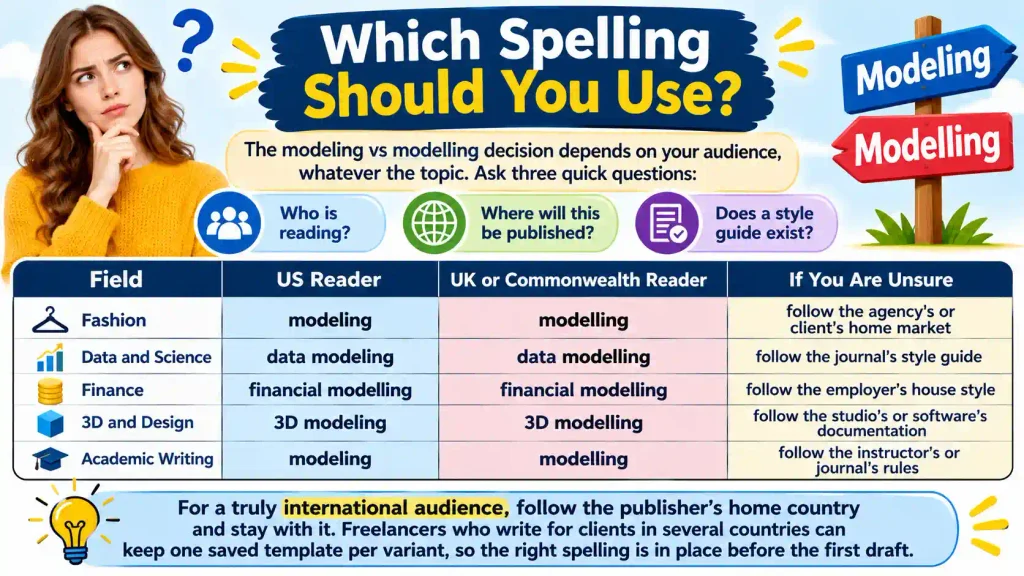
| Field | US reader | UK or Commonwealth reader | If you are unsure |
| Fashion | modeling | modelling | follow the agency’s or client’s home market |
| Data and science | data modeling | data modelling | follow the journal’s style guide |
| Finance | financial modeling | financial modelling | follow the employer’s house style |
| 3D and design | 3D modeling | 3D modelling | follow the studio’s or software’s documentation |
| Academic writing | modeling | modelling | follow the instructor’s or journal’s rules |
Searching for modelling vs modeling instead gives the same answer: let your reader’s region decide. For the wider pattern behind this choice, see our guide to American vs British spelling.
Why Americans Write One L (The Doubled L Rule)
Adding ing or ed to a verb is a form of inflection, and English handles the final L differently on each side of the Atlantic. British English doubles it before a suffix, which gives modelling, travelling, and labelling. American English follows a different double consonant spelling rule: it doubles the final consonant only when the stress falls on the last syllable, as in compel and compelled.
Model is stressed on the first syllable (MOD el), so American writers simply add the suffix and get modeling and modeled. Two L forms were standard in American English until the early twentieth century, and the change belongs to a wider push toward simpler American spellings, a movement often linked to Noah Webster. Some verbs changed later. Cancel and label still produce double L spellings in American writing now and then, but modeling has settled almost entirely on one L.
Once you see the pattern, modeling vs modelling stops feeling arbitrary. It is one of many US vs UK spelling differences that follow a rule rather than a whim. If the same L question comes up in other words, our guides on labelled vs labeled, traveling vs travelling, and canceled vs cancelled walk through each case.
A Memory Trick
Try this: US = Use one L. Americans keep one, and everyone else keeps both. For a second hook, picture the extra L in modelling as a letter most of the English speaking world never gave up.
Because both spellings sound the same, you cannot rely on your ear. A one line rule is what settles modeling vs modelling when you are writing in a hurry, such as replying to an email on your phone.
Common Mistakes (Wrong vs Correct)
Five slips turn up again and again in emails, essays, and CVs.
- Mixing spellings in one document
- ❌ “My portfolio covers two years of modelling and one of financial modeling.”
- ✅ “My portfolio covers two years of modelling and one of financial modelling.”
- Mismatched forms
- ❌ “She modeled for years before becoming a full time modeller.”
- ✅ “She modelled for years before becoming a full time modeller.”
- Wrong spelling for the reader (US journal submission)
- ❌ “We are modelling hospital capacity under three scenarios.”
- ✅ “We are modeling hospital capacity under three scenarios.”
- Treating the spellings as different meanings
- ❌ “Use modeling for science and modelling for fashion.”
- ✅ “Both spellings cover every meaning, so let the reader’s region decide.”
- Changing an official name (UK course listing)
- ❌ “Our graduates are trained in Unified Modelling Language.”
- ✅ “Our graduates are trained in Unified Modeling Language.” The Object Management Group titles its specification with one L, and that spelling stays even in UK text.
Where Even Experienced Writers Slip
The trap is that both spellings look correct on their own, so even careful editors read straight past them. The eye reads for meaning, and neither word looks wrong. The usual culprits are a spell checker quietly set to the wrong country, a paragraph pasted from a US vendor’s documentation into a UK report, or a long file edited by two people with different habits. By the time anyone checks modeling vs modelling, the mix has usually spread into headings, captions, and the file name.
How to Keep Your Spelling Consistent
Spelling consistency is mostly a matter of setup. A few habits catch nearly every slip.
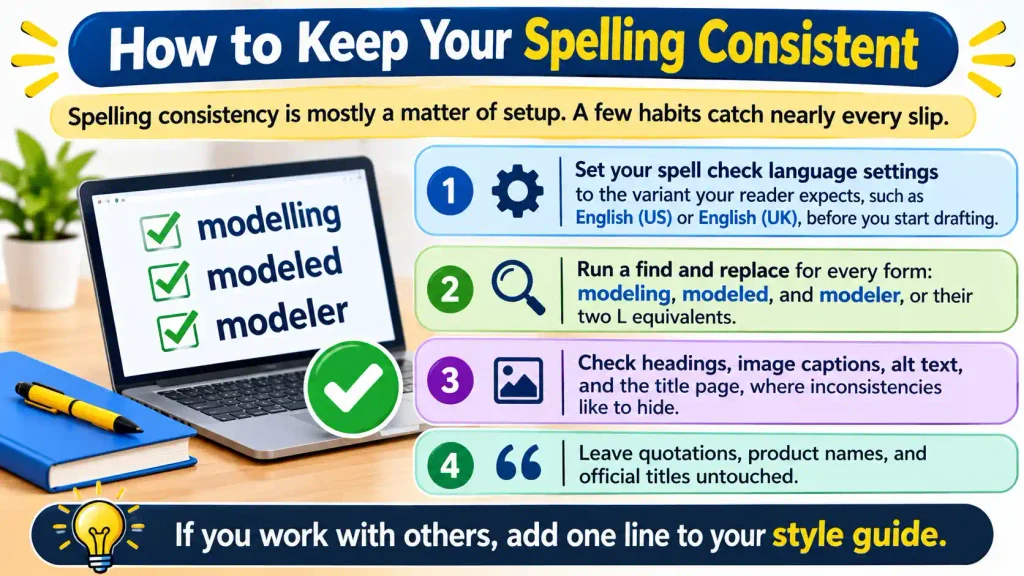
- Set your spell check language settings to the variant your reader expects, such as English (US) or English (UK), before you start drafting.
- Run a find and replace for every form: modeling, modeled, and modeler, or their two L equivalents.
- Check headings, image captions, alt text, and the title page, where inconsistencies like to hide.
- Leave quotations, product names, and official titles untouched.
If you work with others, add one line to your style guide stating which variant the team uses.
Mini Quiz: Modeling or Modelling?
- You are emailing a client in Boston about a “financial ___ workshop.” Which spelling fits? Answer: modeling.
- You are submitting a paper to a UK journal: “Mathematical ___ of disease spread.” Answer: modelling.
- Spot the problem: “She modeled in Paris and now works in fashion modelling.” Answer: the spellings are mixed, so pick modeled and modeling or modelled and modelling, and stick to it.
- A UK university course list names “Unified ___ Language.” Answer: Modeling, because the official name keeps one L.
- Your readers are mostly in Canada. Which spelling is the safer lean? Answer: modelling.
Frequently Asked Questions
Is it modeling or modelling?
Both modeling and modelling are correct. For modeling vs modelling, the deciding factor is region: use modeling for American readers and modelling for British and most Commonwealth readers.
Is modelling spelled with one L or two?
Modelling is spelled with two Ls in British, Australian, and most other Commonwealth English. The American spelling, modeling, uses one L.
Is modelling British or American English?
Modelling is the British English spelling. It is also standard in Australia, New Zealand, and Ireland, and it is preferred in Canada.
Is modeling wrong in the UK?
Modeling is not wrong, but it looks like an American spelling, and UK editors usually change it to modelling. British readers will understand it, yet a British audience expects two Ls.
Do Canadians spell it modeling or modelling?
Most Canadian writers prefer modelling, although modeling appears often enough that neither will confuse anyone. Follow your publisher’s style guide if one exists.
Is it modeled or modelled?
Use modeled in American English and modelled in British English. The same oneh L or two L rule applies to every form, so keep modeling and modeler on the same side as the past tense you choose.
Which should I use on my CV or LinkedIn profile?
Match the country of the employer or the audience you most want to reach, and keep every form consistent across the document, including job titles like financial modeler or modeller.
Final Thought
Modeling vs modelling mean the same thing, so the only real question is who is reading. Use one L for American audiences and two Ls for British, Australian, and most Commonwealth audiences, then carry that choice through modeled and modelled and through modeler and modeller. With a rule like “US = Use one L,” modeling vs modelling takes ten seconds to settle. Set your spell checker to the right country, run one find and replace before you hit send, and your writing will look careful whichever spelling you pick.
To read more: Mag vs Clip: What’s the Shocking Difference (and Which Word Should You Use)?2026