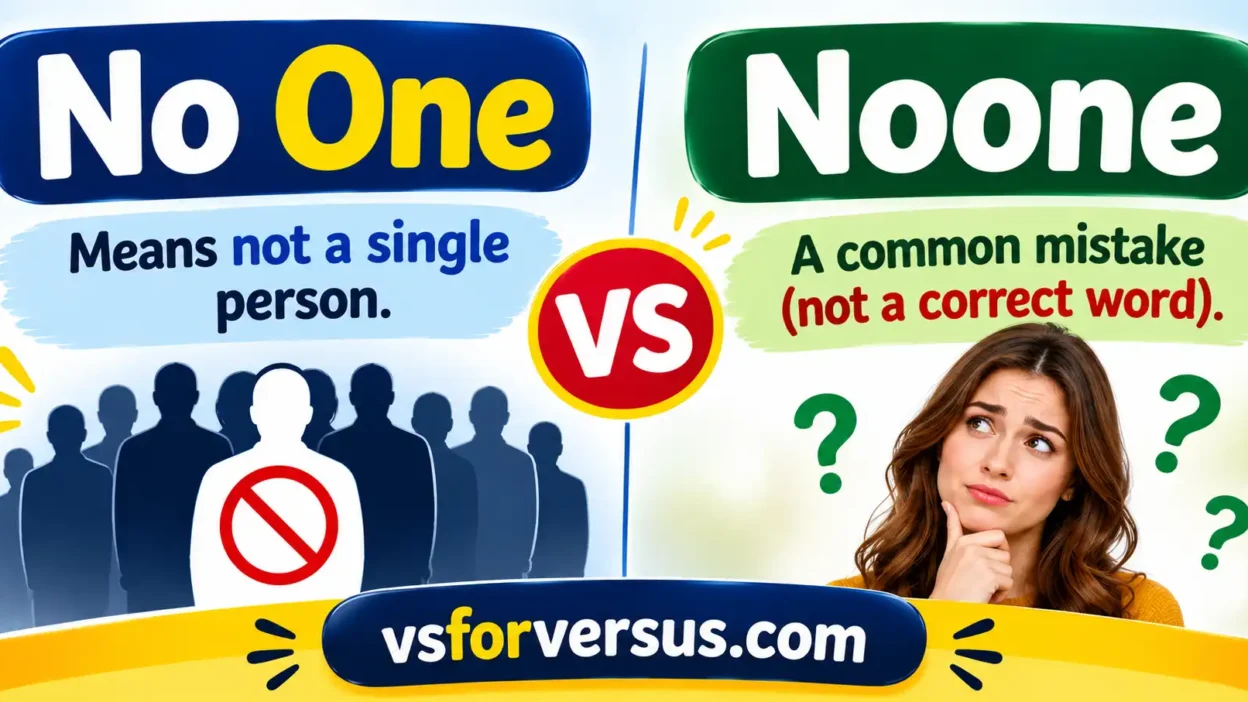
No One vs Noone is a small spelling question that causes more trouble than most writers expect, especially when typing quickly or sending a message on a phone. The two versions look nearly identical, and a missing space is easy to overlook, yet only one is accepted in standard English.
No one is the correct form, written as two words, and it is an indefinite pronoun meaning “nobody” or “not a single person,” as in “no one saw the mistake.” Noone is not a valid word in dictionaries; it mostly appears as a typo, a surname, or a brand name. In this guide, you’ll learn the correct usage, the difference from the hyphenated “no one,” common mistakes to avoid, and simple examples that make the right choice easy every time.
Quick Answer:
“No one” is the correct spelling: two words meaning “nobody” or “not a single person.” “Noone” is a misspelling in standard English, and “no one” is a less common hyphenated variant found mainly in British English. In the no one vs noone choice, American English uses “no one.”
Here is each term in the box, defined:
- No one: an indefinite pronoun that refers to people only and means “not a single person.” It is grammatically singular.
- No one: the same pronoun with a hyphen. Style guides disagree about it, so the two word form is the safe default.
- Noone: not a standard word. It is a common misspelling of “no one,” though it also exists as a surname.
No One vs Noone vs No One: Quick Comparison
| Word | Part of Speech | Meaning | Example |
| no one | Indefinite pronoun | Nobody; not a single person | No one answered the phone after six. |
| no one | Indefinite pronoun (variant spelling) | Same as “no one” | No one had told the team about the change. |
| noone | Not a standard word (misspelling) | No standard meaning; the writer almost always intends “no one” | Noone had told the team. (incorrect) |

“Noone” does exist as a surname, and some people use it as a username, but it is not a spelling of the pronoun.
Why “Noone” Feels Right (But Isn’t)
The mistake is more logical than it looks. Most of us absorbed a pattern early. Some one fused into someone, any one into anyone, and every one into everyone. Even no body became nobody. Linguists call these closed compounds because the parts joined with no space left. Reach the end of that line and your brain expects no one to close up as well, giving you no one. [LINK: someone vs some one]
English never finished the pattern. Nobody became a single word, but its twin stayed an open compound, written with a space, and the two word form is the standard spelling today. Speech makes things worse: said aloud, the two words blur into one smooth sound, and only in writing do you have to remember the gap. That mismatch is why the no one vs noone confusion keeps resurfacing in essays, emails, and chat messages.
Even experienced writers slip here. A copy editor typing fast in a team chat, a manager answering messages on a phone, a student racing a deadline: any of them can produce “noone” without noticing, because the word looks plausible and some spellcheckers may let it pass, since Noone is also a surname. Making this slip doesn’t mean you can’t spell. It means your pattern recognition is working a little too hard.
No One: Meaning and Usage
“No one” is an indefinite pronoun, sometimes called a negative pronoun, that refers to people and means “not a single person.” Its meaning matches that of “nobody.” It can act as a subject or an object, and it is grammatically singular. Here are examples from the places writers actually use it:
- Email: No one has replied to the budget thread yet.
- Essay: No one can fully explain the result without more data.
- Chat: Honestly, no one warned me the exam would be this long.
- Social post: The thread went quiet because no one wanted to be the first to disagree.
- News style: No one from the council was available for comment on Tuesday.
For possession, add an apostrophe and an s: the last parking spot is no one’s. Because the pronoun is singular, agreement stays simple. Pair it with “is,” “knows,” or “has,” never “are,” “know,” or “have.”
One wrinkle is worth knowing. When a noun follows, the two words do separate jobs, as in “No one person can fix this alone.” Here “one” stresses a single individual, so the space carries real meaning.
Is “Noone” a Word?
No. “Noone” isn’t standard spelling for the pronoun meaning “nobody.” Think of it as a common spelling mistake, in the same family as “alot” for “a lot.” It is legitimate only as a name: a surname, a username, or a handle. Everywhere else, replace it with “no one.”
Real world slips look like this:
- ❌ Noone told me the meeting had moved. → ✅ No one told me the meeting had moved.
- ❌ I trust noone with my passwords. → ✅ I trust no one with my passwords.
- ❌ lol noone is reading this thread. → ✅ lol no one is reading this thread.
If a boss, a professor, or a client will read your writing, count “noone” as an error.
Where the Slip Costs You Most
The error is small, but its cost depends on the audience. In a cover letter, a visible typo can undercut a strong first impression. In a client email, it suggests nobody proofread. In an exam, a grader may deduct for spelling even when the argument is sound. Casual chats are where the habit forms, so give formal messages a second look.
Key Differences at a Glance
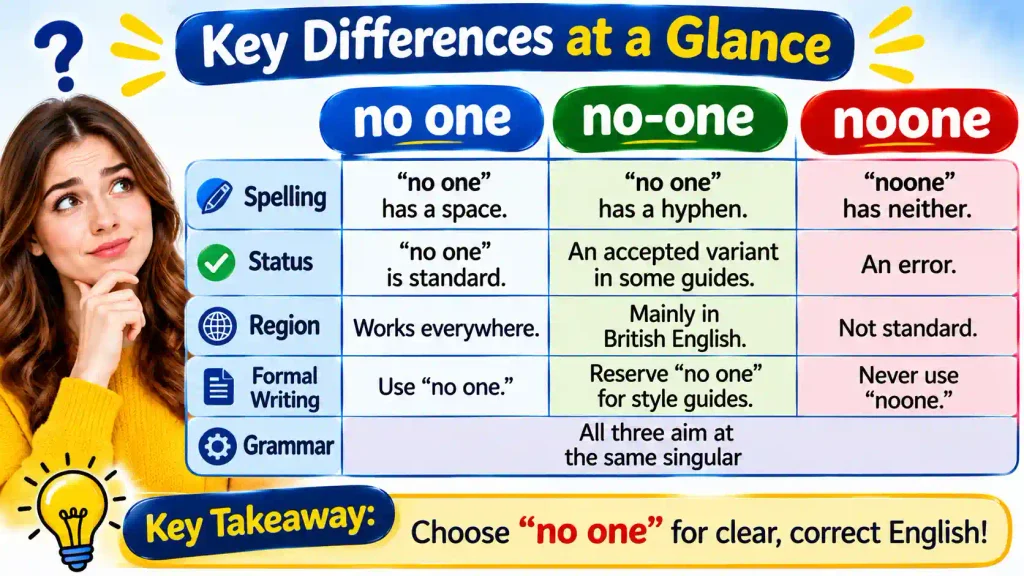
- Spelling: “no one” has a space, “no one” has a hyphen, and “noone” has neither and isn’t standard.
- Status: “no one” is standard, “no one” is an accepted variant in some guides, and “noone” is an error.
- Region: “no one” works everywhere, while “no one” turns up mainly in British English.
- Formal writing: use “no one,” reserve “no one” for style guides that ask for it, and never use “noone.”
- Grammar: all three aim at the same singular pronoun, so in the no one vs noone choice, spelling is the whole story.
No One vs Nobody vs None
Two nearby words add to the confusion. “Nobody” means the same as “no one” and is written as one word, and both are correct. “Nobody” sounds a touch more conversational, while “no one” reads as slightly more neutral in emails and reports. [LINK: nobody vs none]
“None” works differently because it points to a defined group or to things. Compare “No one answered the survey” with “None of the managers answered the survey.” The first covers people in general, and the second singles out a group. For objects, English reaches for “nothing”: “Nothing was left on the table.”
Common Mistakes: Wrong vs Correct
Whether the writer is a student or a senior manager, these slips tend to travel together. The no one vs noone error comes first, but the others follow close behind.
- ❌ Noone from the team replied. → ✅ No one from the team replied.
- ❌ No one are available this afternoon. → ✅ No one is available this afternoon.
- ⚠️ No one knew about the policy change. (fine in British English, but out of place in a US business memo) → ✅ No one knew about the policy change.
- ❌ No one was left on the bookstore shelf, so I ordered online. → ✅ Nothing was left on the bookstore shelf, so I ordered online.
- ❌ It was noones fault. → ✅ It was no one’s fault.
- Pronoun agreement: “No one brought their laptop” is how many people say it, and singular “they” is widely accepted. If a strict editor will review your work, reword it: “No one brought a laptop.”
Quick Quiz:
- Which is correct: “Noone knew the answer” or “No one knew the answer”?
- Answer: No one knew the answer.
- Fill in the blank: “I told ___ about the surprise party.” (no one / noone)
- Answer: no one.
- Choose the verb: “No one (know/knows) where the keys are.”
- Answer: knows.
- Which word can replace “no one” without changing the meaning?
- Answer: nobody.
- Fix this sentence: “Noone were at the meeting.”
- Answer: No one was at the meeting.

FAQ
Is “noone” a real word?
“Noone” is a real word in standard English. In the no one vs noone debate, the correct pronoun is “no one,” and “noone” is a misspelling, though it does exist as a surname.
Is “no one” one word or two?
“No one” is two words. “Someone,” “anyone,” and “everyone” are single words, but “no one” keeps its space.
Is it “no one” or “no one”?
“No one” is the standard spelling. “No one” is a less common hyphenated variant found mainly in British English, so choose “no one” unless a style guide says otherwise.
Does “no one” take “is” or “are”?
“No one” is singular, so it takes “is.” Write “no one is,” “no one knows,” and “no one has.”
What’s the difference between “no one” and “nobody”?
“No one” and “nobody” mean the same thing. “Nobody” is one word and slightly more conversational, while “no one” is two words and reads a little more neutral.
Do I use “his” or “their” after “no one”?
After “no one,” “their” is common in everyday and modern writing. If an editor or instructor prefers strict agreement, reword the sentence to avoid the pronoun.
Final Thoughts
Your brain isn’t failing when it types “No One vs Noone”; it is following a pattern that English never completed. That makes no one vs noone a small, fixable habit rather than a flaw in your writing. Keep the space, remember the nobody swap, and run one quick search before you hit send. A single gap costs nothing, and it tells every reader you took care.
To read more: Modeling vs Modelling: Which Spelling Is Ultimate Correct?2026

Elena covers lifestyle and consumer comparisons — everything from mattresses to meal kits — drawing on a background in market research. She’s known for digging past marketing copy to find the one detail that actually decides a purchase, and for admitting when two options are basically a coin flip.