
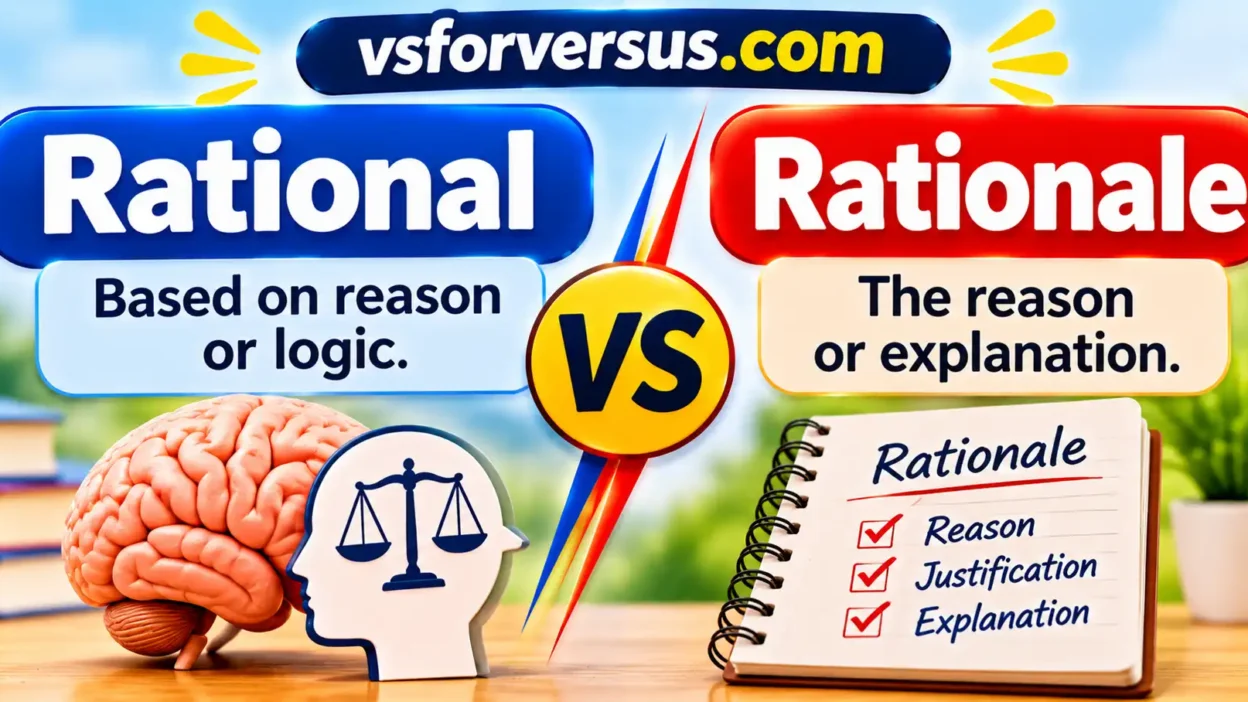
Rational vs Rationale looks like a simple suffix difference, yet it creates real confusion because the two words share a root but work as different parts of speech. Adding that final “e” changes how a sentence has to be built.
Rational is an adjective meaning sensible, logical, and based on reason, as in “she made a rational decision after reviewing the facts.” Rationale, on the other hand, is a noun meaning the reasoning or explanation behind a choice, as in “the manager explained the rationale for the new policy.” Writers often use “rational” where “rationale” is needed, especially in reports and proposals.
In this guide, you’ll learn the correct usage, the pronunciation difference, common mistakes to avoid, and clear examples that make the right choice easy every time.
Quick Answer:
Rational vs rationale comes down to part of speech. Rational is an adjective meaning logical or based on reason, as in “a rational decision.” Rationale is a noun meaning the reasons behind a decision or action, as in “the rationale for the decision.” Use rational to describe something, and use rationale to name the reasons.
Rational vs Rationale at a Glance
| Word | Part of Speech | Meaning | Example |
| rational | Adjective | Logical; based on reason rather than emotion | “Taking the earlier train was the rational choice.” |
| rationale | Noun | The reasons behind a decision, action or belief | “I’d love to hear the rationale behind the new schedule.” |
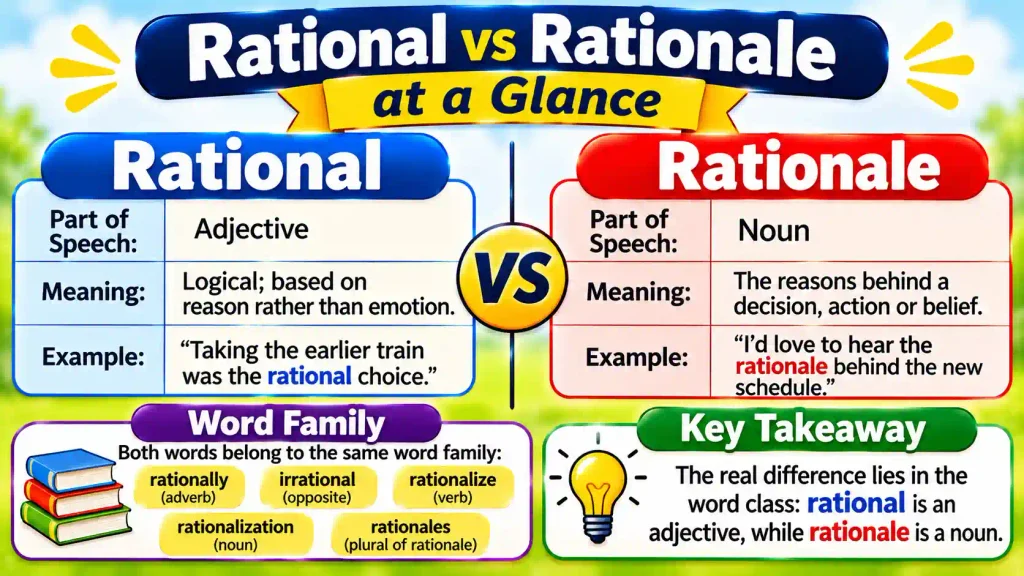
Both words belong to the same word family, which also includes rationally (adverb), irrational (the opposite), rationalize (verb), rationalization (noun), and rationales (the plural of rationale). All of them trace back to the Latin ratio, often translated as “reason,” which explains why the two main words feel like cousins. The real difference lies in the word class: rational is an adjective, while rationale is a noun.
The Five-Second Test: Which Word Do I Need?
When you’re stuck mid-sentence, run these checks in order:
- Swap in “the reasons.” If the sentence still works, you need rationale. “I’d like to understand the reasons for the delay” becomes “the rationale for the delay.”
- Try “very” in front. “Very rational” sounds fine. “Very rationale” doesn’t. If “very” fits, choose rational.
- Look at the slot. A pattern like “a ___ plan” needs an adjective, so it’s rational. A pattern like “the ___ for the plan” needs a noun, so it’s rationale.
When a rational vs rationale question comes up in your own draft, the first test settles most cases on its own.
What Does “Rational” Mean?
The core meaning of rational is logical, reasonable, and guided by clear thinking rather than impulse. It’s an adjective, so it describes people, choices, explanations, and arguments. Close synonyms include logical, reasonable, and sensible; the opposite is irrational. The -al ending is a common adjective suffix, as in logical and practical, which is one more clue that this word describes things.
Four examples of rational in a sentence:
- “I waited a day before replying, because I wanted to stay rational and not fire back an angry email.”
- “Honestly, the rational move was to renew the lease, but I wanted the loft.”
- “A rational buyer would compare three quotes before signing anything.”
- “In math, a rational number is any number you can write as a fraction of two whole numbers, like 3/4.”
Look for it in talk about decisions, behavior and math, and in pairings like rational choice, rational thinking and rational explanation.
What Does “Rationale” Mean?
Rationale means the set of reasons behind a decision, action, or belief. As a noun, it names something instead of describing it. It tends to appear in formal or documented settings, usually followed by for or behind, and its plural is rationales. Useful rationale synonyms include reasoning, justification, grounds, and logic, though none of them carries quite the same formal, documented feel.
Four examples of rationale in a sentence:
- “Could you walk me through the rationale behind moving the launch to March?”
- “Applicants must include a one-page rationale for the funding they’re requesting.”
- “The introduction sets out the rationale for studying sleep in teenagers.”
- “I read the whole thread, and I still don’t get the rationale for this rule change.”
It lives in research proposals, project memos, lesson plans, policy announcements and performance reviews, anywhere someone has to explain why.
A Rationale Doesn’t Have to Be Rational
Most guides skip one twist. A rationale is simply the reasoning someone offers, and that reasoning can be weak, one-sided, or invented after the decision was already made. Rational describes whether the thinking holds up; rationale only names the thinking.
Compare: “Management’s rationale for the cuts sounded tidy on paper, but the decision itself wasn’t rational.” Both words appear, doing different jobs, and the sentence makes sense precisely because they aren’t the same thing.
The verb rationalize belongs to this story too. To rationalize is to build a convincing-sounding rationale for a choice you’ve already made: “She rationalized the purchase by calling it an investment.” The noun rationalization works the same way, and both words carry a hint of excuse-making, a useful reminder that a rationale and a rational choice are separate ideas.
Key Differences Between Rational vs Rationale

The short version of rational vs rationale, in bullets:
- Part of speech: rational is an adjective; rationale is a noun.
- Job in the sentence: rational describes something; rationale names the reasons.
- Typical partners: a rational choice, person, or explanation versus the rationale for or behind something.
- Sound: stress falls on the first syllable of rational and the last syllable of rationale.
- Can they be swapped? No. Swapping them breaks the grammar of the sentence, not just its meaning.
Which Word Fits Your Writing Situation?
These are commonly confused words, so it helps to see them where people actually write. The table below shows how rational vs rationale plays out in four everyday settings.
| Context | Using rationale | Using rational |
| Academic | “Chapter two explains the rationale for using interviews instead of surveys.” | “The model assumes that consumers are rational decision-makers.” |
| Workplace | “Can you share the rationale behind the new approval process?” | “Let’s find a rational way to split the workload.” |
| “Thanks for explaining. I see the rationale now.” | “That sounds like a rational plan to me.” | |
| Social media | “Not mad about the price hike, but the rationale in the announcement is thin.” | “Nobody is rational at 2 a.m. on a sale night.” |
One more tip for students and researchers: in proposals and lesson plans, “Rationale” is often a section heading. That section answers “why does this matter?”, so it needs the noun. A bare adjective rarely works as a heading, which is a handy clue if a template ever leaves you unsure.
Easy Ways to Remember the Difference
The extra E. Rationale carries an extra E at the end, and reason, the thing it names, has an E tucked inside. If you’re naming reasons, make sure the word has its E.
The -al family. Rational ends in -al, like logical and practical, which are also describing words. If you’re describing, keep it short.
The sound cue. Say the words aloud. The stressed “-nal” at the end of rationale is the signal that you’re naming a thing: if you hear the stress land on the last syllable, you need the noun. The same trick works for another pair where a final E changes the sound, moral vs morale, and it ties back to the broader adjective vs noun distinction.
How to Pronounce Rational vs Rationale?
Pronunciation is another clue, and it’s why rational vs rationale is often easier to catch by ear than on the page. Rational puts the stress on the first syllable: RASH-uh-nul. Rationale moves the stress to the last: rash-uh-NAL. That final stressed syllable rhymes with morale, so when you hear it, someone is naming reasons. Before a presentation or a meeting, say the sentence aloud once. Your ear will often notice a wrong word before your eye does.
Common Mistakes with Rational vs Rationale
Even experienced writers slip here. When you’re typing fast, your fingers reach for the shorter, more familiar word, and when you proofread your own work, your brain reads what you meant instead of what you wrote.
Spell check rarely rescues you, since both words are valid. A useful habit before you send anything important: search the document for “rational” and check each hit against the rational vs rationale test from earlier. It takes under a minute and catches the swaps your eyes skip. The table below shows the errors that appear most often:

| # | Incorrect | Correct | Why It’s Wrong |
| 1 | ❌ “The rational for this rule is unclear.” | ✅ “The rationale for this rule is unclear.” | The sentence needs a noun here. |
| 2 | ❌ “She’s a very rationale thinker.” | ✅ “She’s a very rational thinker.” | An adjective is needed before “thinker.” |
| 3 | ❌ “I’d like to understand the rational behind the decision.” | ✅ “I’d like to understand the rationale behind the decision.” | “Behind the” introduces a noun: the reasons. |
| 4 | ❌ “Please provide a rational for your request.” | ✅ “Please provide a rationale for your request.” | “A ___ for” asks for a noun. |
| 5 | ❌ “That was a rationale decision, so I’m not worried.” | ✅ “That was a rational decision, so I’m not worried.” | “Decision” is a noun, so it needs an adjective. |
| 6 | ❌ “The two reports gave different rationals.” | ✅ “The two reports gave different rationales.” | The plural noun is rationales. |
Quick Quiz: Rational or Rationale?
Fill in each blank, then check your answers below.
- Please explain the ______ behind your decision.
- I tried to stay ______ even though the deadline moved again.
- The committee asked for a written ______ for the budget increase.
- After comparing all three quotes, switching was the only ______ option.
- Which is correct? (a) a rational plan (b) a rationale plan
Answers: 1. rationale. 2. rational. 3. rationale. 4. rational. 5. (a), because plan is a noun and needs an adjective in front of it.
Rational and Rationale FAQs
What is the difference between rational and rationale?
Rational is an adjective meaning logical or reasonable, as in “a rational decision.” Rationale is a noun meaning the reasons behind a decision, as in “the rationale for the change.” One describes, and the other names, so rational vs rationale is really a part-of-speech question, and the two can’t be swapped.
Is rationale a noun or an adjective?
Rationale is a noun. It names the set of reasons behind a decision, belief, or action, as in “the rationale for the policy.” If you need an adjective meaning logical or sensible, use rational instead. A quick check: “very” fits rational but never rationale.
Can you say “rational for” instead of “rationale for”?
No. “Rational for” is a common error. Because rational is an adjective, it needs a noun to describe and can’t stand alone after “the.” Write “the rationale for the decision” instead. Reserve rational for phrases like “a rational choice” or “a rational explanation.”
Is rationale the same as reason?
They overlap, but they aren’t identical. A reason is a single cause or motive. A rationale is the full line of reasoning behind a decision, often laid out more formally. Several reasons together can form your rationale, which is why proposals and reviews ask for a rationale.
Can a rationale be irrational?
Yes. A rationale is simply the reasoning someone gives, and that reasoning can be flawed, biased, or invented after the fact. Rational describes whether the thinking holds up. So a person can offer a polished rationale for a choice that still isn’t rational.
What is the plural of rationale?
The plural is rationales, as in “The two teams gave different rationales for the delay.” Rationale is an adjective, so it has no plural. The only exception is mathematics, where “the rationals” occasionally appears as shorthand for rational numbers.
Words Often Confused with Rational vs Rationale
Two neighbors cause trouble too. Reasonable is about what seems fair or sensible to other people, while rational is about logic. Likewise, reason is a single cause, while a rationale is the full set of reasons. If your writing involves judgment calls, our guide to reasonable vs rational is worth a look.
You may also like these related pairs: moral vs morale, affect vs effect, and principal vs principle.
Final Thought
If you remember only one thing, remember this: rational describes, and rationale names. When you’re describing a choice, a person or a plan, you need the adjective rational. When you’re pointing at the reasons behind it, you need the noun rationale. Once the pattern clicks, you’ll start spotting it in job posts, school handouts and long reports, and you’ll fix it before anyone else sees it.
And keep the twist in your back pocket. A rationale can be thin, biased, or built after the fact, so the next time you’re weighing rational vs rationale, ask yourself whether you’re describing the thinking or naming it. Get that right, and a memo like Dana’s goes out clean. Bookmark this page for the next time a draft gives you pause.
To read more: Reigns vs Reins: What’s the Shocking Difference? 2026

Marcus is a former product manager turned comparison writer who spent eight years testing tools and gadgets before quitting to write full-time. He specializes in breaking down tech and software matchups into plain-English verdicts, with a soft spot for buying guides nobody else wants to write.