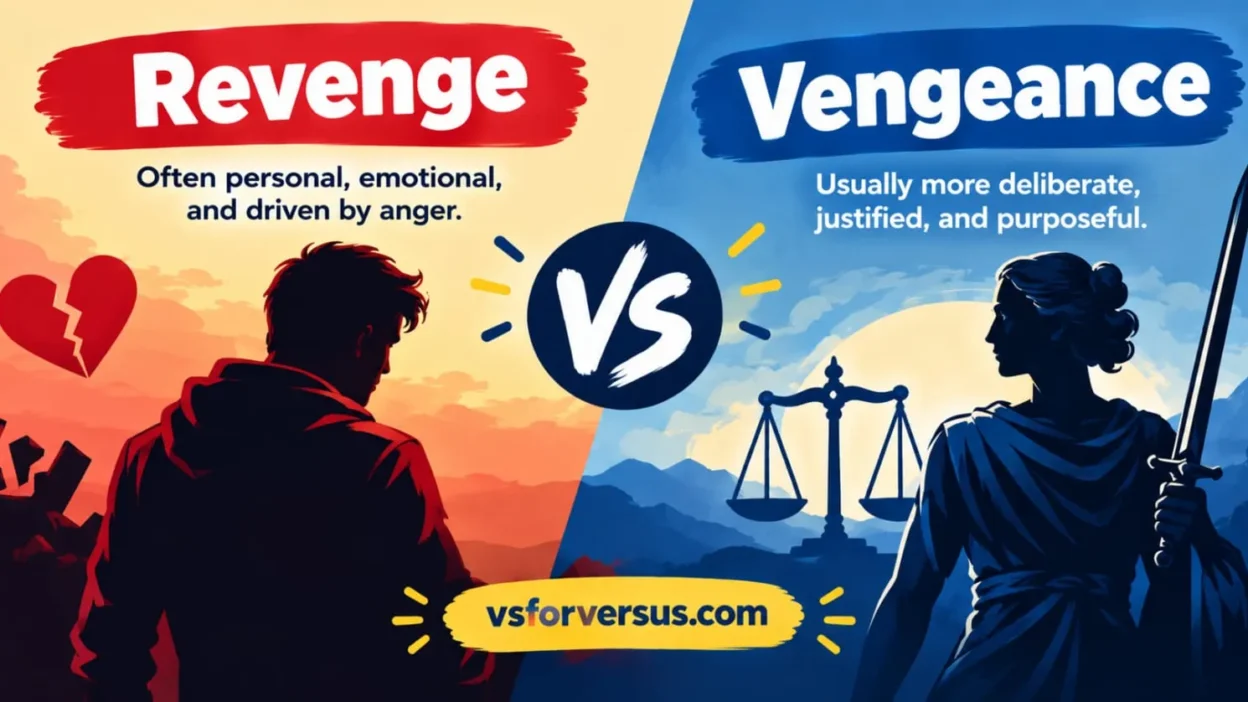
Revenge vs Vengeance are two English words that are often used interchangeably, yet they carry subtle differences in tone and usage. Revenge refers to the act of hurting or harming someone in return for a wrong they have done, often driven by personal, emotional motives, as in “he wanted revenge for the insult.”
Vengeance, on the other hand, carries a stronger and more formal tone, often implying a serious or severe punishment inflicted as retribution, as in “vengeance was finally served.” While revenge is commonly used in everyday, casual conversation, vengeance appears more frequently in literature, religious texts, and dramatic contexts. Both words express the desire to punish wrongdoing, but their intensity and usage set them apart in English.
Quick Answer
Revenge and vengeance both mean retaliation for a wrong, but they differ in tone and formality. Revenge is personal, informal, and often emotional, the word you’d use in conversation, fiction, or casual writing. Vengeance is broader, more formal, and often carries a sense of justice, morality, or higher authority the word you’d reach for in legal, literary, biblical, or dramatic contexts. Both words are nouns; neither is commonly used as a verb, which is what “avenge” is for.
Revenge vs Vengeance at a Glance
Before going deeper, here’s the full revenge vs vengeance comparison in one place:
| Word | Part of Speech | Meaning | Example |
| Revenge | Noun (rarely verb) | Personal, informal act of retaliation, often emotional | “She wanted revenge after being passed over for the promotion.” |
| Vengeance | Noun only | Broader, formal retaliation tied to justice or moral order | “The community demanded vengeance after the scandal broke.” |
| Avenge | Verb | To take retaliatory action, often on someone else’s behalf | “He avenged his mentor’s firing by exposing the real culprit.” |
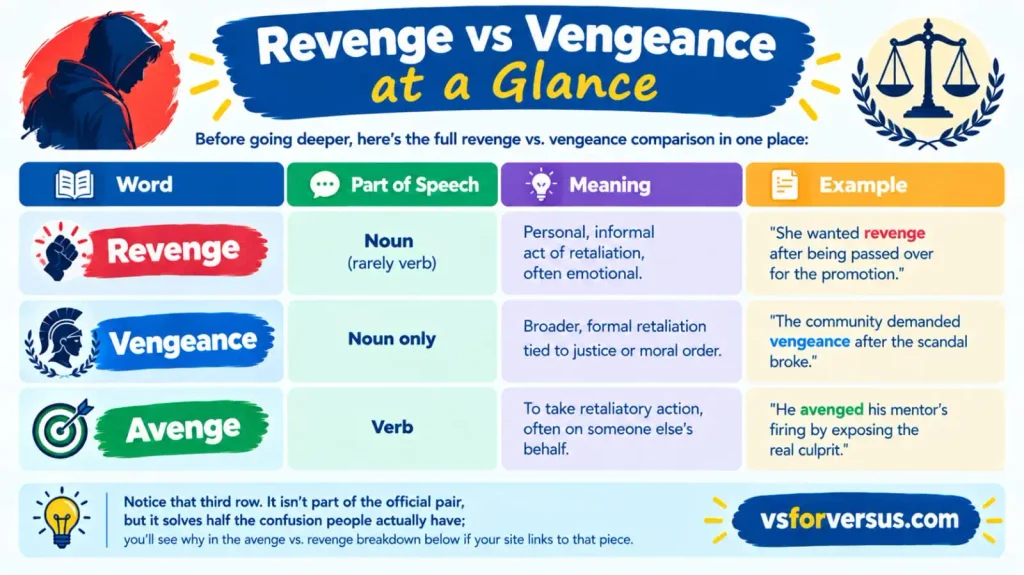
Notice that third row. It isn’t part of the official pair, but it solves half the confusion people actually have; you’ll see why in the avenge vs revenge breakdown below if your site links to that piece.
What Does “Revenge” Mean?
Revenge is the act of hurting or inconveniencing someone because they hurt you first. Working through the revenge vs vengeance pair usually starts here, since revenge is the word most people already use without thinking twice. It’s personal, specific, and usually wrapped in emotion, anger, hurt, wounded pride.
Dictionaries define revenge as inflicting harm in return for a wrong. That “in return” framing matters: revenge is about settling a score between two people, not restoring some larger sense of order.
You’ll see revenge everywhere in everyday language:
- “Honestly, I just want revenge; I don’t care if it’s petty.”
- “She left a scathing review out of pure revenge.”
- “Revenge is a dish best served cold, so I waited until the meeting to bring it up.”
- “The whole movie is basically a revenge story disguised as a heist film.”
Revenge shows up constantly in texts, group chats, personal essays, and pop culture writing. It’s the word people reach for when the motive is raw and individual: a coworker who took credit for your idea, an ex who wronged you, a friend who betrayed a confidence. It rarely shows up in formal documents, and when it does, it usually signals that the writer wants the reader to feel the emotional weight of the situation rather than its legal or moral weight.
One small side note: you may occasionally see “revengeful” used instead of the standard “vengeful.” It’s technically recognized in some dictionaries but sounds dated and slightly off to modern ears; stick with “vengeful” in your own writing.
What Does “Vengeance” Mean?
Vengeance means the same basic thing as revenge: retaliation for a wrong, but it operates on a bigger stage, which is really the heart of the revenge vs vengeance divide. Where revenge is one person settling a personal score, vengeance often implies punishment delivered on behalf of something larger: a community, an institution, a moral or divine order.
It’s the word of courtrooms, scripture, and sweeping literary plots; think of the entire genre of Elizabethan revenge tragedy, like Shakespeare’s Hamlet, where the driving force is framed as a matter of honor and cosmic justice, not petty payback.
Some natural examples:
- “The victims’ families said they weren’t seeking vengeance, just accountability.” (legal/formal register)
- “Vengeance is mine, saith the Lord.” (biblical register)
- “After the layoffs, the market came back with a vengeance.” (idiom, note this only works with vengeance, not revenge)
- “The trilogy’s final act is a slow, deliberate reckoning, vengeance against the empire that destroyed her home.” (literary register)
Professional writing is where this distinction matters most. In legal memos, formal reports, or academic essays on literature and ethics, vengeance signals seriousness and moral weight, while revenge can sound flippant or even unprofessional in the same context. That’s exactly the mistake the junior associate made in the opening story.
If you’re also unsure how to handle similar formality calls elsewhere in your writing, our guide to formal vs informal vocabulary walks through more examples like this one.
Key Differences Between Revenge vs Vengeance
The revenge vs vengeance choice ultimately comes down to connotation, the emotional shading a word carries beyond its literal dictionary meaning, rather than any strict grammar rule. Here’s the breakdown:
- Formality: Revenge is casual and conversational; vengeance is formal, literary, or institutional.
- Scope: Revenge is personal, one-on-one; vengeance often represents a broader, collective, or moral response.
- Tone: Revenge reads as emotional or even petty; vengeance reads as justified or righteous.
- Typical contexts: Revenge fits dialogue, social media, personal essays, and everyday storytelling. Vengeance fits legal writing, religious texts, academic analysis, and dramatic or elevated prose.
- Grammar: Both are nouns. Neither is comfortably used as a verb; that job belongs to “avenge.”
Memory Trick: How to Remember Which Is Which
Here’s a simple anchor: vengeance sounds like “judgment”; both are longer, weightier words, and both belong in formal, serious contexts. Revenge is short and sharp, just like the impulse behind it: quick, personal, and reactive.
For a second layer: vengeance shares a root with “vindicate” (from the Latin vindicare, meaning to claim or avenge). That shared root explains why vengeance still carries a whiff of justice being restored, while revenge carries no such implication; it’s just about getting even.
Common Mistakes with Revenge vs Vengeance
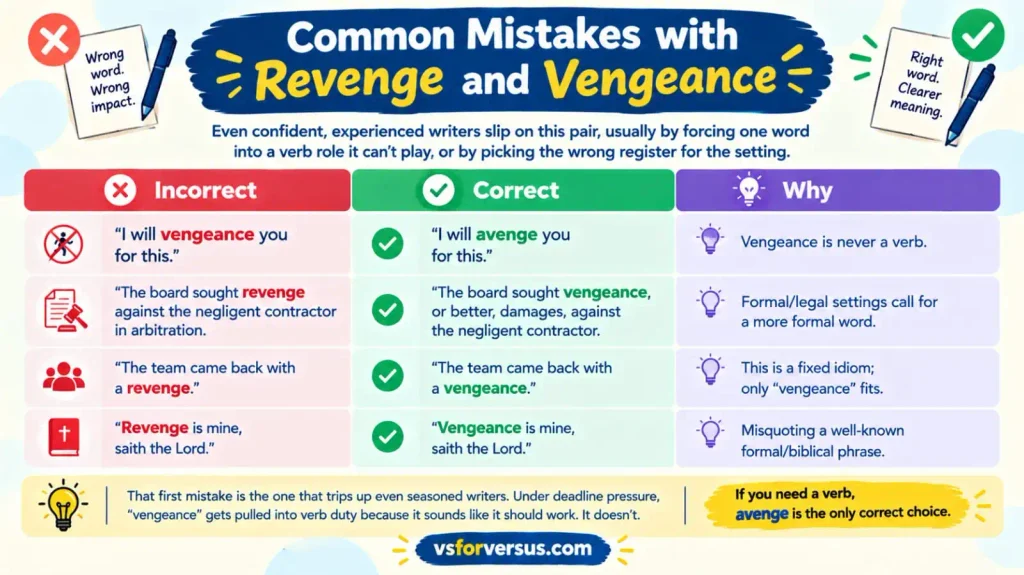
Even confident, experienced writers slip on this pair, usually by forcing one word into a verb role it can’t play, or by picking the wrong register for the setting.
| ❌ Incorrect | ✅ Correct | Why |
| “I will vengeance you for this.” | “I will avenge you for this.” | Vengeance is never a verb. |
| “The board sought revenge against the negligent contractor in arbitration.” | “The board sought vengeance, or better, damages, against the negligent contractor.” | Formal/legal settings call for a more formal word. |
| “The team came back with a revenge.” | “The team came back with a vengeance.” | This is a fixed idiom; only “vengeance” fits. |
| “Revenge is mine, saith the Lord.” | “Vengeance is mine, saith the Lord.” | Misquoting a well-known formal/biblical phrase. |
That first mistake is the one that trips up even seasoned writers. Under deadline pressure, “vengeance” gets pulled into verb duty because it sounds like it should work. It doesn’t. If you need a verb, “avenge” is the only correct choice.
Quick Quiz: Revenge or Vengeance?
Test yourself before moving to the FAQ:
- Fill in the blank: “He returned to the office with a ___.” (vengeance)
- Which is correct: “I will revenge you” or “I will avenge you”? (avenge)
- Which word fits a courtroom context: “The victim’s family sought ___ through the justice system”? (vengeance)
- True or false: Vengeance is commonly used as a verb. (False)
- Fill in the blank: “___ is a dish best served cold.” (Revenge)
Frequently Asked Questions
What is the difference between revenge and vengeance?
Revenge is personal and informal, usually driven by emotion between two people. Vengeance is broader and more formal, often implying justice, morality, or a higher authority. This is the core of the revenge vs vengeance distinction, and it’s about tone more than strict dictionary meaning.
Is vengeance a stronger word than revenge?
Not stronger exactly, heavier and more formal. Vengeance carries more moral or institutional weight, while revenge feels more immediate and personal.
Is vengeance more formal than revenge?
Yes. Vengeance belongs in legal writing, literature, religious texts, and formal essays; revenge belongs in everyday speech, casual writing, and personal storytelling.
Can you say “seek vengeance”?
Yes, “seek vengeance” is a correct, natural collocation. It leans more formal than “seek revenge,” so it’s best used in contexts where that weight fits.
Are revenge and vengeance interchangeable?
Mostly in meaning, but not in tone. Working through revenge vs vengeance examples side by side shows that swapping them rarely creates a grammar error, but it can create a tone mismatch; using “revenge” in a legal brief, for instance, can sound careless. For similar close calls, see our full confusable word pairs guide.
Is vengeance ever used as a verb?
No. Vengeance is strictly a noun. If you need a verb form for this concept, use “avenge”, as in “she avenged her brother’s death.” For a deeper look at how these three words relate, check avenge vs revenge vs vengeance.
Bottom Line
Choose revenge when the moment is personal, casual, or emotional: everyday speech, texts, fiction dialogue. Choose vengeance when the moment calls for weight, formality, or a sense of justice being restored, legal writing, literature, or anything institutional.
Both are nouns; if you need a verb, reach for avenge. Get comfortable with that one distinction, and you’ll never send back a memo with a red pen correction on it.
To read more: “Pyjamas vs Pajamas: What’s the Shocking Difference? 2026”

Marcus is a former product manager turned comparison writer who spent eight years testing tools and gadgets before quitting to write full-time. He specializes in breaking down tech and software matchups into plain-English verdicts, with a soft spot for buying guides nobody else wants to write.