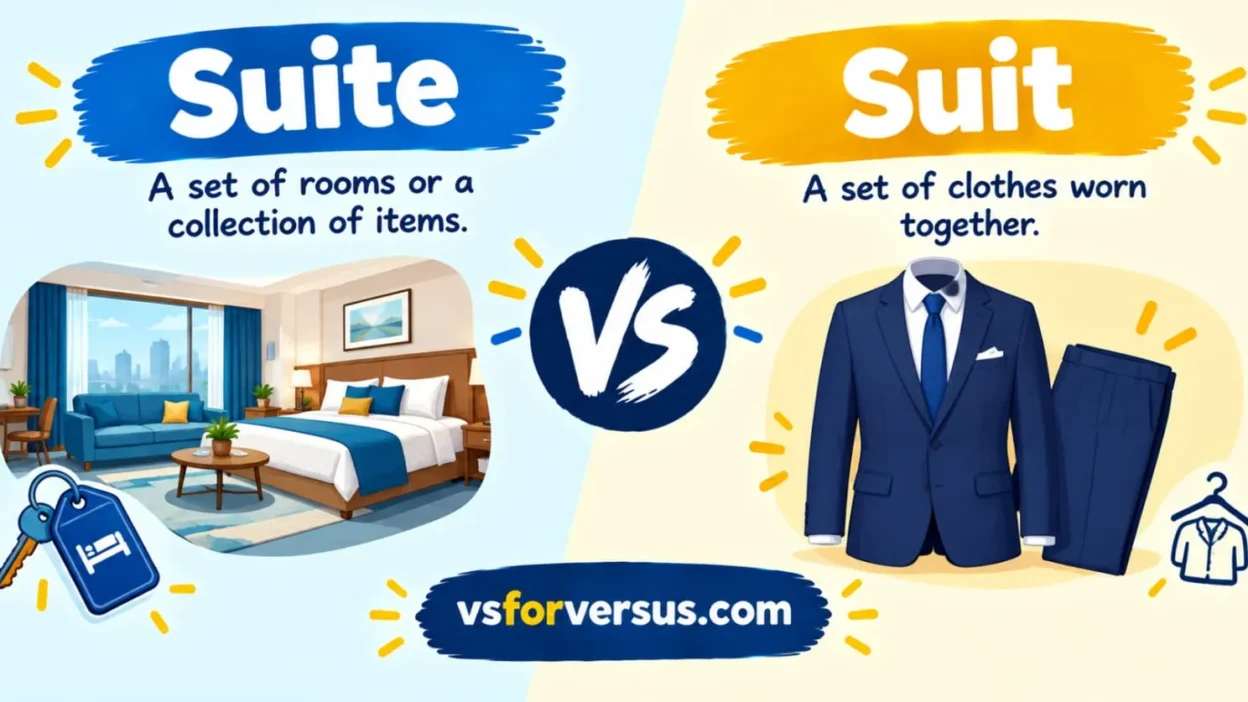
Suite vs Suit are homophones, meaning they sound identical when spoken, yet their meanings and spellings differ completely. A suite refers to a set of connected rooms, such as a hotel suite, or a collection of related items, like a furniture suite or a software suite.
A suit, on the other hand, has multiple meanings: it can refer to a matching set of formal clothing, such as a business suit, a legal case, as in a lawsuit, or one of the four categories in a deck of cards, such as the suit of hearts.
Despite their identical pronunciation, mixing up their spellings is a common English mistake, so paying attention to context is essential to know which word truly fits the sentence.
Quick Answer
suite vs suit are both nouns that look nearly identical but sound and mean completely different things. Suit is pronounced “soot” (rhyming with boot) and refers to a matching set of clothes, a legal case, or a card deck category; it can also work as a verb meaning “to fit or be convenient.”
Suite is pronounced “sweet” and refers to a set of connected rooms, a group of musical pieces, or a bundle of software tools. Use suit for clothing or lawsuits, and suite for hotel rooms or software bundles; that one letter, one sound gap is the whole suite vs suit story.
Suite vs Suit at a Glance
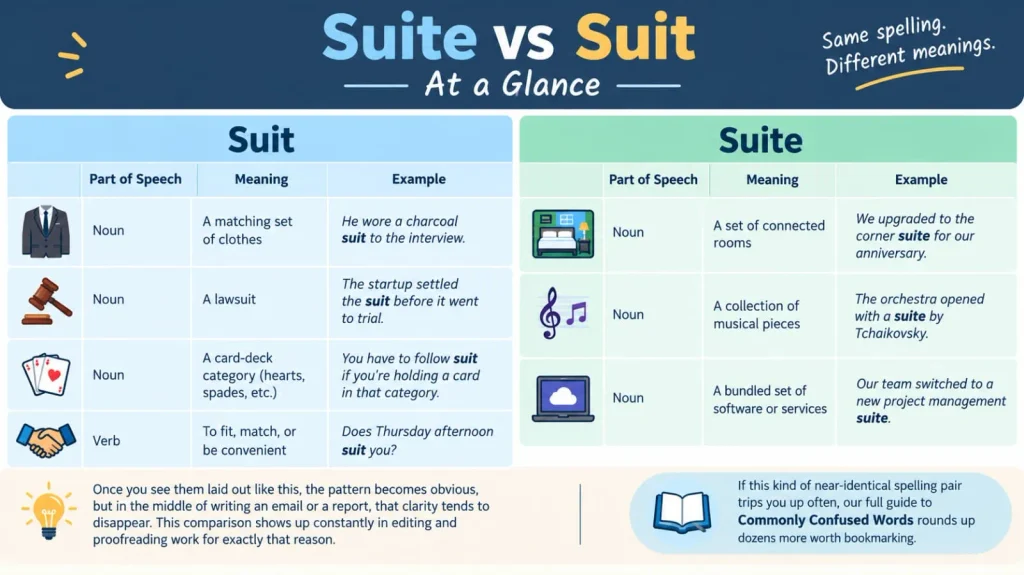
Before digging into the details, here’s a quick reference table that lays out the suite vs suit distinction side by side.
| Word | Part of Speech | Meaning | Example |
| Suit | Noun | A matching set of clothes | He wore a charcoal suit to the interview. |
| Suit | Noun | A lawsuit | The startup settled the suit before it went to trial. |
| Suit | Noun | A card-deck category (hearts, spades, etc.) | You have to follow suit if you’re holding a card in that category. |
| Suit | Verb | To fit, match, or be convenient | Does Thursday afternoon suit you? |
| Suite | Noun | A set of connected rooms | We upgraded to the corner suite for our anniversary. |
| Suite | Noun | A collection of musical pieces | The orchestra opened with a suite by Tchaikovsky. |
| Suite | Noun | A bundled set of software or services | Our team switched to a new project management suite. |
Once you see them laid out like this, the pattern becomes obvious, but in the middle of writing an email or a report, that clarity tends to disappear. This comparison shows up constantly in editing and proofreading work for exactly that reason.
If this kind of near identical spelling pair trips you up often, our full guide to Commonly Confused Words rounds up dozens more worth bookmarking.
What Does “Suit” Mean?
Suit can function as either a noun or a verb, and both uses are common in everyday and professional writing.
As a noun, it most often refers to a matching set of clothes, typically a jacket paired with trousers or a skirt. It’s also shorthand for a lawsuit, and it names one of the four categories in a standard card deck (hearts, clubs, diamonds, spades). Used as a verb, though, suit takes on a completely different job: it means to fit, match, or be convenient for someone.
Here are a few examples that reflect how the word actually shows up in real writing:
- “I need to buy a new suit before the wedding; mine doesn’t fit anymore.”
- “The company is facing a suit from a former contractor over unpaid invoices.”
- “In bridge, you’re required to follow suit whenever you can.”
- “Honestly, working from home suits me a lot better than the commute ever did.”
You’ll see suit most often in business and professional writing, including dress codes, interview prep, and workplace emails about what to wear to a client meeting. It also shows up in legal writing and news coverage, from civil suits to settlement announcements, and in casual scheduling language, where “does that time suit you?” is a staple of everyday email and text exchanges.
On top of that, it appears constantly in card game instructions and strategy guides, where following suit is a core rule rather than just a figure of speech.
Since suit shows up so often in legal and professional writing, it’s worth also brushing up on Affect vs Effect, another pair that trips people up in exactly that context.
What Does “Suite” Mean?
Suite is only ever a noun; it doesn’t have a verb form, and it refers to a set of things grouped: rooms, musical pieces, or software.
Its most familiar use is in hospitality, where a hotel suite means a set of connected rooms, often with its own separate living area. Musicians use it differently: a suite is a sequence of instrumental pieces designed to be performed as one continuous work. In tech or business writing, the word shifts again: a suite becomes a bundled collection of tools or services sold together as a single package.
Real world examples:
- “We booked the honeymoon suite for our first night as a married couple.”
- “The pianist closed the recital with a suite of Chopin nocturnes.”
- “Our new apartment has an en suite bathroom, which was the whole reason we picked it.”
- “The company migrated everyone to a cloud based office suite last quarter.”
You’ll run into suite most often in travel and hospitality writing, including hotel confirmations, Airbnb listings, and travel blog posts. It also shows up in real estate listings describing multi room layouts, in arts and music journalism, and in tech or SaaS marketing copy describing bundled products. If you’re describing anything that comes as a connected set rooms, songs, or software suite is almost always the word you want.
Booking travel or writing hospitality copy often brings up another easy slip; check out our guide to Its vs It’s for a common one.
Key Differences Between Suite vs Suit
Here’s the fastest way to keep the two straight:
- Pronunciation: Suit sounds like “soot”; suite sounds like “sweet”, despite looking like near twins on the page.
- Part of speech: Suit can be a noun or a verb; suite is a noun only, full stop.
- Core meaning: Suit covers clothing, legal cases, and card categories; suite covers rooms, music collections, and software bundles.
- Spelling difference: Just one silent “e” separates them, but that single letter changes both sound and meaning entirely.
- Never interchangeable: No context allows one to substitute for the other, even though they’re often typed as if they could.
Technically, suit and suite aren’t true homophones, since their vowel sounds are genuinely different, but they’re commonly mistaken for one, which is exactly why the mix up is so persistent. Pronunciation also varies a little by region: some English speakers say “suit” closer to “soot,” while others land closer to “newt” or “toot.” Whichever way you say it, though, “suite” always keeps its “sweet” sound.
Even experienced writers slip here, usually under deadline pressure; it’s an easy typo to make because both words are common, both are spelled almost identically, and neither one “looks wrong” at a glance. Spellcheck won’t catch it either, since both are real words.
Memory Trick: How to Never Mix Up Suite vs Suit Again
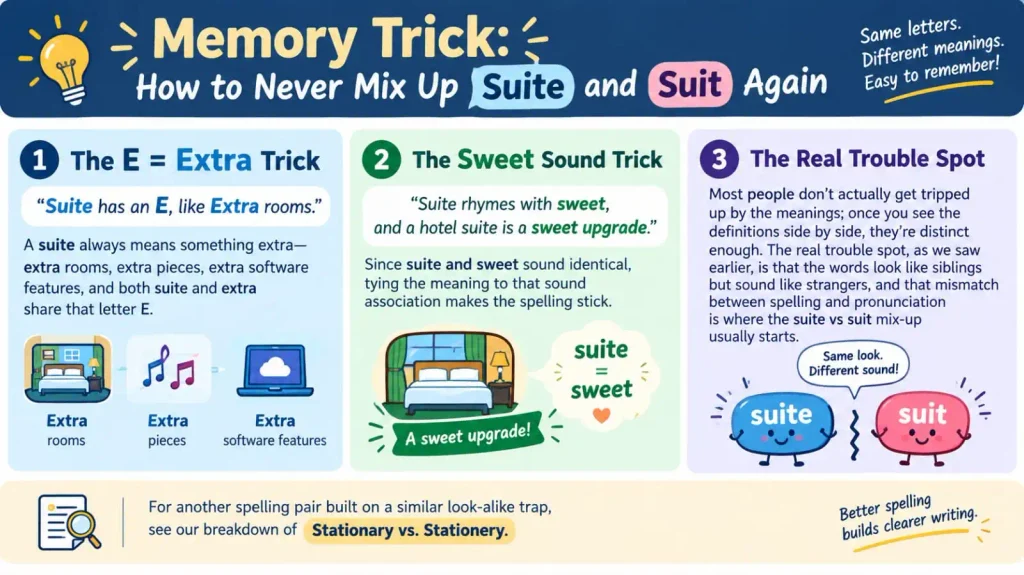
The simplest way to lock this in: “Suite has an E, like Extra rooms.” A suite always means something extra extra rooms, extra pieces, extra software features, and both suite and extra share that letter E.
If you’re more of an ear first learner, try this instead: “Suite rhymes with sweet, and a hotel suite is a sweet upgrade.” Since suite and sweet sound identical, tying the meaning to that sound association makes the spelling stick.
Most people don’t actually get tripped up by the meanings; once you see the definitions side by side, they’re distinct enough. The real trouble spot, as we saw earlier, is that the words look like siblings but sound like strangers, and that mismatch between spelling and pronunciation is where the suite vs suit mix up usually starts.
For another spelling pair built on a similar look alike trap, see our breakdown of Stationary vs Stationery.
Common Mistakes with Suite vs Suit
Here are the errors that show up most often in real writing, emails, essays, and social posts alike:
| ❌ Wrong | ✅ Correct | Why |
| “I’m filing a lawsuite against them.” | “I’m filing a lawsuit against them.” | Legal action is always suit, “lawsuite” isn’t a real spelling. |
| “Let’s follow suite and match their offer.” | “Let’s follow suit and match their offer.” | This idiom comes from card games and never takes an “e.” |
| “The bride wore a beautiful white suite.” | “The bride wore a beautiful white suit.” | Clothing is always suit, never suite. |
| “We stayed in the honeymoon suit.” | “We stayed in the honeymoon suite.” | Hotel rooms are always suite, never suit. |
| “Does 3pm suite you?” | “Does 3pm suit you?” | The verb form (to fit or work for someone) is always suit. |
Notice how both “lawsuite” and “follow suite” involve adding an “e” that doesn’t belong; that’s the single most common error pattern in this whole comparison, and it’s worth double hecking anytime you write either phrase.
Quick Quiz: Test Your Suite vs Suit Knowledge
Try filling in the blanks before checking the answers below.
- The lawyer filed a ___ against the landlord over the broken lease. (suit)
- They upgraded to the presidential ___ at the hotel for their anniversary. (suite)
- True or false: “Follow suite” is the correct spelling of the card-game idiom. (False, it’s “follow suit”)
- Which of the two words can also function as a verb? (suit)
- The company bundled all its editing tools into one software ___. (suite)
If you got all five right, you’ve officially mastered the suite vs suit distinction, and you’re already ahead of plenty of professional writers.
Frequently Asked Questions
Is it “follow suit” or “follow suite”?
It’s always “follow suit.” The phrase comes from card games, where matching the category already in play is called following suit. “Follow suite” is a very common misspelling, but it isn’t correct in any context.
Is it “lawsuit” or “lawsuite”?
“Lawsuit” is correct, no “e” at the end. This is one of the most frequent errors in the suite vs suit comparison, likely because “suite” simply looks more familiar to the eye.
Why does “suite” sound like “sweet” instead of matching its spelling?
“Suite” comes from French, where it originally described a sequence of things following one another. English kept the French pronunciation intact, which is why it rhymes with “sweet” rather than sounding the way it’s spelled.
Do “suit” and “suite” have the same pronunciation?
No, and this is really the heart of the suite vs suit confusion. “Suit” is pronounced like “soot,” rhyming with boot, while “suite” is pronounced like “sweet.” They look nearly identical but sound nothing alike.
What’s the difference between a hotel suite and a hotel suit?
There’s no such thing as a “hotel suit”; that’s simply a misspelling of “hotel suite,” which refers to a set of connected rooms, often including a separate living area. A suit, meanwhile, only ever refers to clothing or a legal case, never to a room.
What is a software suite?
A software suite is a bundled collection of related programs sold or used together; an office suite, for example, bundles word processing, spreadsheets, and presentation tools into one package.
Can “suit” vs “suite” appear in the same sentence?
Yes, easily: “He put on his suit before heading up to the hotel suite for the reception.” Each word keeps its own distinct meaning, even sitting side by side.
Final Thoughts
At the end of the day, suite vs suit comes down to one small letter carrying a lot of weight. Suit means clothing, a lawsuit, or a card category, and it can also work as a verb. Suite means a set of connected rooms, musical pieces, or software tools, and it only ever works as a noun.
If you remember that suite has an extra letter for something extra, and that it sounds like sweet, you’ll rarely mix them up again. When in doubt, picture the scene: a business suit for the boardroom, a hotel suite for the honeymoon. Once that image sticks, so will the spelling.
To read more: “Shelf vs Shelve: The Ultimate Guide to the Confusing Difference 2026”

Marcus is a former product manager turned comparison writer who spent eight years testing tools and gadgets before quitting to write full-time. He specializes in breaking down tech and software matchups into plain-English verdicts, with a soft spot for buying guides nobody else wants to write.