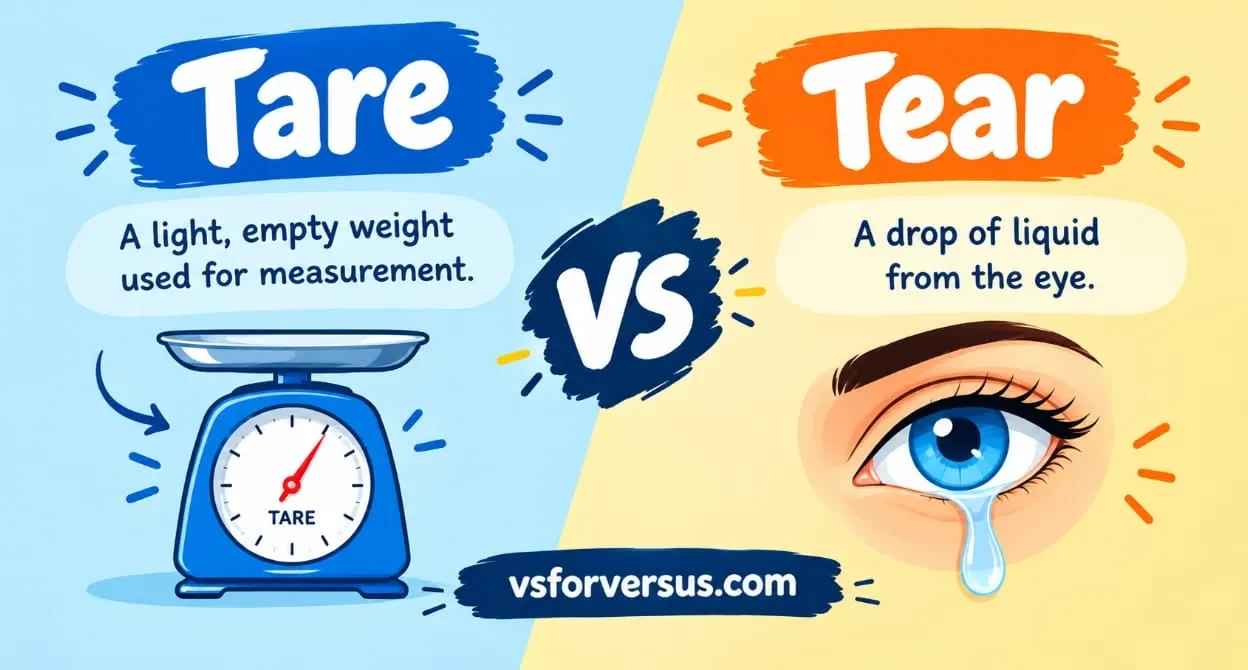
Tare vs Tear these two words look similar but have completely different meanings. Tare (Stars) means bright points of light that shine in the night sky. They are far away, but they appear to us as small glowing dots.
Tear means a drop of water that falls from the eyes because of sadness, joy, or strong emotions. It shows what a person is feeling inside, whether it is grief or happiness. In this article, we will explain the meanings of both words, “Tare” and “Tear,” in a simple way, so you can easily understand the difference between them.
Quick Answer
Tare is a noun (and sometimes a verb) meaning the weight of empty packaging, which gets subtracted from gross weight to calculate net weight; for example, “the scale’s tare button.” Tear functions as both a noun and a verb, meaning to rip something apart, or as a noun for a drop of liquid produced when crying.
Tare and tear (meaning “to rip”) are pronounced the same and rhyme with “bear,” while tear (meaning the liquid from crying) rhymes with “ear”; despite the shared sound, these are unrelated words with separate origins.
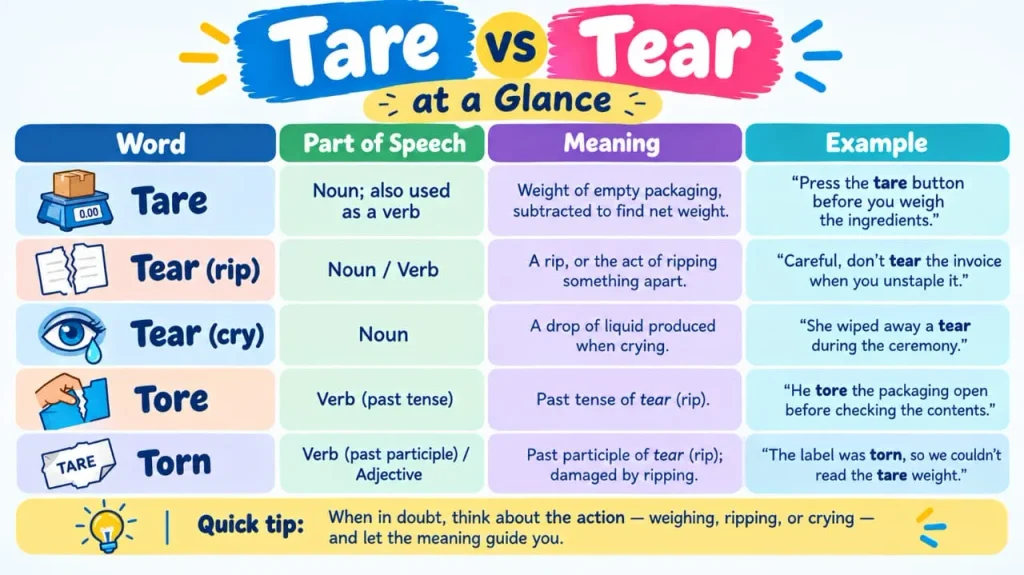
Tare vs Tear at a Glance
Before digging into definitions, here’s the full picture in one place, including the two forms people forget belong to this pair at all.
| Word | Part of Speech | Meaning | Example |
| Tare | Noun; also used as a verb | Weight of empty packaging, subtracted to find net weight | “Press the tare button before you weigh the ingredients.” |
| Tear (rip) | Noun / Verb | A rip, or the act of ripping something apart | “Careful, don’t tear the invoice when you unstaple it.” |
| Tear (cry) | Noun | A drop of liquid produced when crying | “She wiped away a tear during the ceremony.” |
| Tore | Verb (past tense) | Past tense of tear (rip) | “He tore the packaging open before checking the contents.” |
| Torn | Verb (past participle) / Adjective | Past participle of tear (rip); damaged by ripping | “The label was torn, so we couldn’t read the tare weight.” |
Tare vs Tear Pronunciation Guide
This is the part that trips people up most, so it deserves its own quick reference table instead of getting buried in a paragraph.
| Word | Rhymes With | Sounds Like |
| Tare | bear, fair | /tɛər/ |
| Tear (rip) | bear, fair | /tɛər/ |
| Tear (cry) | ear, peer | /tɪər/ |
Notice that tare and tear as rip are actually the odd pair out here; they’re the ones that sound identical. Tear as crying is the version that breaks the pattern.
What Does “Tare” Mean?
At its core, tare refers to the weight of a container, wrapper, or vehicle when it’s empty. Subtract that number from the gross weight, the full, loaded weight, and you get the net weight: the actual product you’re paying for or shipping. Tare is primarily a noun, but it’s also used as a verb meaning to zero out a scale so it ignores the packaging weight (“tare the scale before adding the flour”).
You’ll run into tare constantly in a few specific fields:
- Shipping and e commerce: “The tare weight of the pallet was deducted before billing.”
- Cooking and baking: “Tare your kitchen scale before adding the flour so you only measure the ingredient itself.”
- Automotive and freight: “The truck’s tare weight, its weight with an empty trailer, determines how much cargo it can legally carry.”
- Laboratory work: “The chemist tared the empty beaker so the reading would reflect only the sample.”
Tare also has a lesser known meaning as a type of vetch, a weedy plant found in grain fields, a sense you’re unlikely to need in everyday writing, but worth knowing if you ever come across it in an older text or a biblical reference.
What Does “Tear” Mean?
Tear does double (technically triple) duty. As a verb, it means to rip or pull something apart by force. As a noun, it can mean either the rip itself or, in an entirely separate sense, a drop of liquid from crying, and that second noun sense is pronounced differently from the first two.
Real world examples:
- Everyday damage: “I caught my sleeve on the doorknob and put a tear in my favorite jacket.”
- The idiom “wear and tear”: “The office chairs are showing normal wear and tear after five years.”
- Medical and injury contexts: “The MRI confirmed a small tear in her rotator cuff.”
- Emotional writing: “He didn’t say a word, but I saw a tear in his eye.”
That medical usage is worth calling out specifically. Terms like “SLAP tear” (a shoulder injury) or “meniscus tear” (a knee injury) show up constantly in insurance claims, physical therapy notes, and patient communications. If you work in healthcare admin or write about fitness, this is a spelling you’ll use often, and it’s always t-e-a-r, never tare.
Tare vs Tear: The Full Picture
Here’s where the tare vs tear question gets genuinely tricky, and where most explanations stop short. The confusion usually isn’t really about tare versus tear as a standalone pair; it’s about the full verb paradigm: tear (present), tore (past), and torn (past participle or adjective).
Tare’s verb form stays simple and regular: tare, tared, taring, no irregular twists. Tear, on the other hand, conjugates irregularly, the same way many Old English verbs do:
“I tear open the mail every morning. Yesterday, I tore open three overdue bills. By the time I finished, the envelopes were completely torn.”
Because tore and torn don’t visually or phonetically resemble tare, people rarely confuse those forms directly. But once you’re already unsure about tare vs tear, it’s easy to wonder whether “tare” might secretly belong to that same conjugation chain. It doesn’t; tare and tear remain two entirely separate words that just happen to sound alike.
Why Do Tare vs Tear Sound the Same?
This is the part most word pair explainers skip, and it’s genuinely useful context: tare and tear aren’t related at all. Tare traces back to trade and commerce terminology with roots in Arabic and Dutch, entering English through international shipping and merchant traditions. Tear, meaning to rip, comes from Old English “teran,” part of a much older Germanic verb family that also gave us words like “wear.”
They landed on the same pronunciation purely by coincidence. English is full of these accidental collisions, where two unrelated words happen to sound alike; linguists call this a homophone relationship.
To make things one degree stranger, tear as crying is a heteronym: same spelling as tear as rip, but a different pronunciation and a completely separate meaning. So technically, you’re not choosing between two sounds; you’re choosing between three meanings packed into two spellings.
Key Differences: Tare vs Tear
- Meaning: Tare refers to packaging or container weight; tear refers to ripping, or to a drop of liquid from crying
- Part of speech: Tare is primarily a noun (also used as a verb, as in “tare the scale”); tear functions as both a noun and a verb
- Pronunciation: Tare and tear (rip) both rhyme with “bear”; tear (cry) rhymes with “ear”
- Word origin: Entirely unrelated word families, despite the shared sound
- Typical context: Tare shows up in shipping, cooking, and measurement; tear shows up in descriptions of damage, injury, or emotion
Memory Trick: How to Remember Tare vs Tear
Try this: “TAre means TAke away the weight.” Both words start with the same two letters, and tare’s entire job is to be subtracted, or “taken away,” from a gross weight to find the net.
For the pronunciation side, use this line: “A tear you can’t see still rhymes with bear. A tear you can see rhymes with ear.” Tare and the rip related tear are the invisible, unremarkable sounding pair; the crying tear is the one that stands out.
Common Mistakes with Tare vs Tear
Even experienced writers slip here, especially in fast typed emails or invoices. Autocorrect won’t catch the swap, and spellcheck won’t either, since both words are spelled correctly; it just isn’t the correct word for the context.
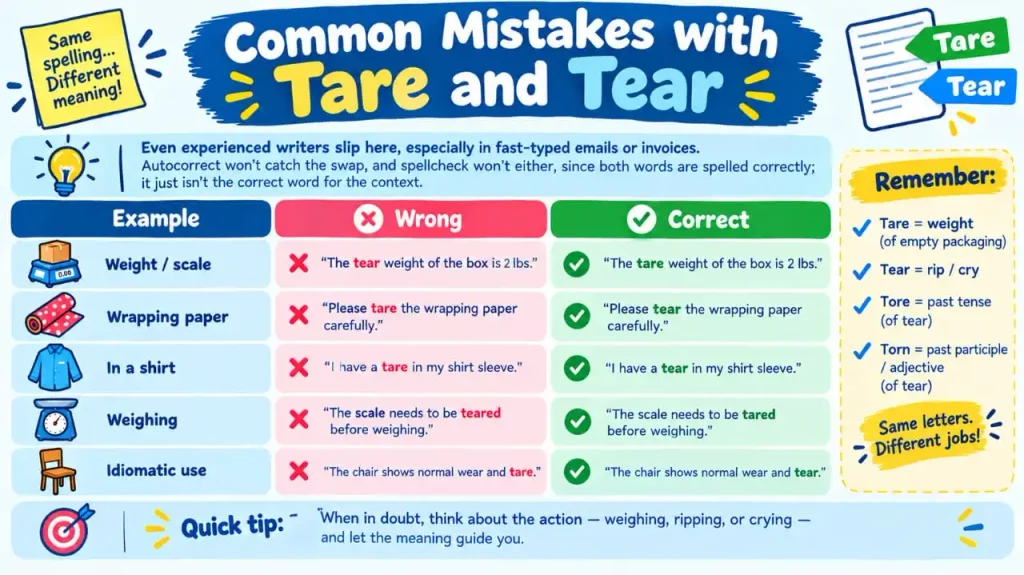
| ❌ Wrong | ✅ Correct |
| “The tear weight of the box is 2 lbs.” | “The tare weight of the box is 2 lbs.” |
| “Please tare the wrapping paper carefully.” | “Please tear the wrapping paper carefully.” |
| “I have a tare in my shirt sleeve.” | “I have a tear in my shirt sleeve.” |
| “The scale needs to be teared before weighing.” | “The scale needs to be tared before weighing.” |
| “The chair shows normal wear and tare.” | “The chair shows normal wear and tear.” |
That last one, “wear and tare”, is one of the most common versions of this mistake in professional writing, because the idiom is spoken far more often than it’s written, and the ear alone can’t tell you which spelling belongs there.
Quick Quiz: Test Yourself on Tare vs Tear
- “Before weighing the flour, remember to ___ the scale.” (tare)
- “She noticed a ___ in her jacket sleeve.” (tear)
- “The shipment’s ___ weight was printed on the invoice.” (tare)
- “He ___ the envelope open without a letter opener.” (tore)
- “A single ___ rolled down his cheek.” (tear)
Frequently Asked Questions
What is tare weight?
Tare weight is the weight of a container or package when empty. It’s subtracted from the gross (total) weight to calculate the net weight of the actual contents.
Is tare the past tense of tear?
No. Tare and tear are unrelated words. The past tense of tear (meaning to rip) is tore, and its past participle is torn. Tare has its own separate, regular verb form: tared.
How do you pronounce tare?
Tare is pronounced to rhyme with “bear” or “fair”, the same way tear is pronounced when it means “to rip.”
Is it “wear and tare” or “wear and tear”?
The correct idiom is “wear and tear,” describing gradual damage from normal use. “Wear and tare” is a common misspelling.
What is a SLAP tear?
A SLAP tear is a shoulder injury, specifically a tear in the labrum, the cartilage ring around the shoulder socket. It’s always spelled tear, never tare.
Why do tare and tear sound the same if they’re unrelated words?
It’s a coincidence. Tare comes from trade and commerce terminology, while tear (to rip) comes from an old Germanic verb root. English contains many such homophones, unrelated words that happen to share a pronunciation.
Final Thought
At the end of the day, tare vs tear is your measurement word: packaging, scales, shipping, net weight. Tear is your action and emotion word: ripping, damage, injury, or crying. If you remember nothing else, remember this: tare takes weight away, while tear pulls something apart. Once that distinction clicks, you’ll never second guess a shipping label or a recipe again.
To read more: “Supposedly vs Supposably: Which Is Correct? The Shocking Truth”2026

Marcus is a former product manager turned comparison writer who spent eight years testing tools and gadgets before quitting to write full-time. He specializes in breaking down tech and software matchups into plain-English verdicts, with a soft spot for buying guides nobody else wants to write.