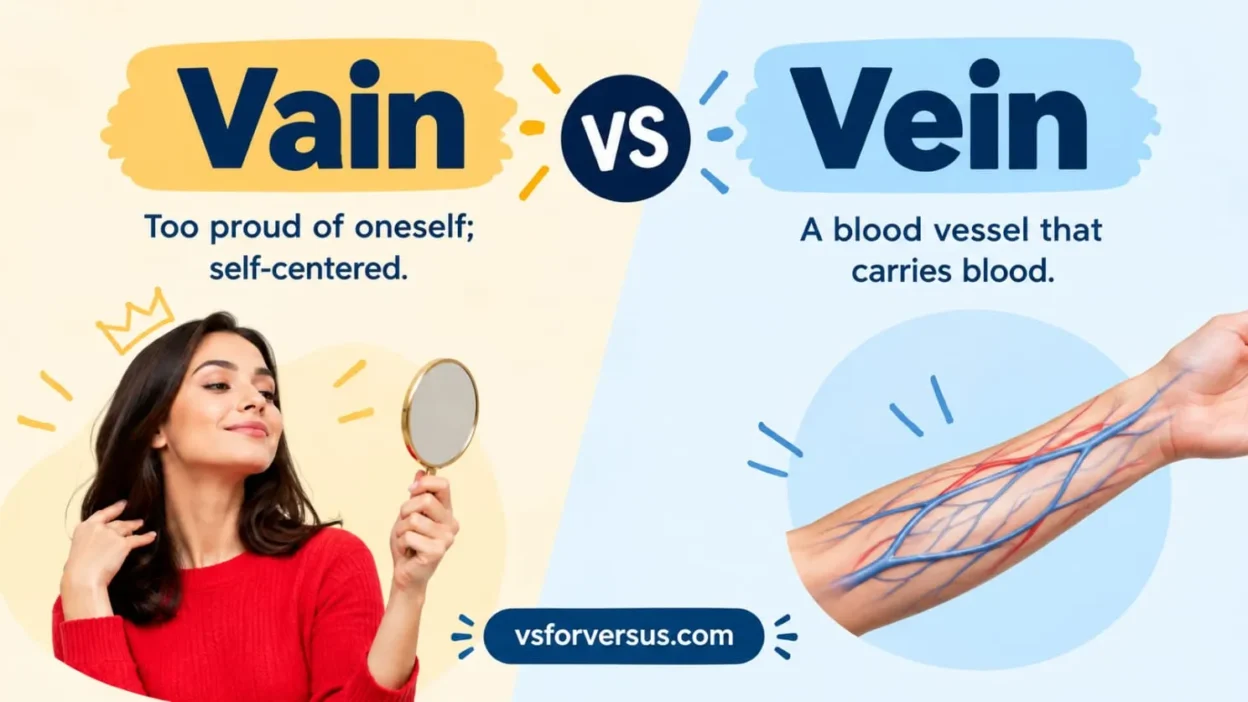
Vain vs Vein these two words sound almost the same, but their meanings are completely different. Vain refers to someone who thinks too highly of their own looks or abilities, showing excessive pride in themselves. It describes a person’s overly self admiring or conceited nature.
On the other hand, Vein refers to one of the tube like structures inside the human body that carries blood back toward the heart. It plays a vital role in keeping our circulatory system functioning properly. This piece breaks down both terms, “Vain” and “Vein,” in an easy to follow way to help you understand how they differ.
Quick Answer
Vain vs vein are homophones that sound identical but mean completely different things. Vain is an adjective meaning excessively proud, or, in the fixed phrase “in vain”, unsuccessful. Vein is a noun that refers to a blood vessel, a mineral streak in rock, or a distinctive style, as in “in the same vein.” The fastest way to settle vain vs vein in a sentence is this: if you need an adjective, use vain; if you need a noun, use vein.
Vain vs Vein at a Glance
| Word | Part of Speech | Meaning | Example |
| Vain | Adjective | Excessively proud; or unsuccessful/futile (as in “in vain”) | She was too vain to admit she’d read the directions wrong. |
| Vein | Noun | A blood vessel; a mineral streak in rock; a distinctive style or mood | The nurse found a vein on the first try. |
| Vane | Noun | Short for weathervane; a blade or fin that catches wind or fluid | The old vane on the barn roof still creaks in a storm. |
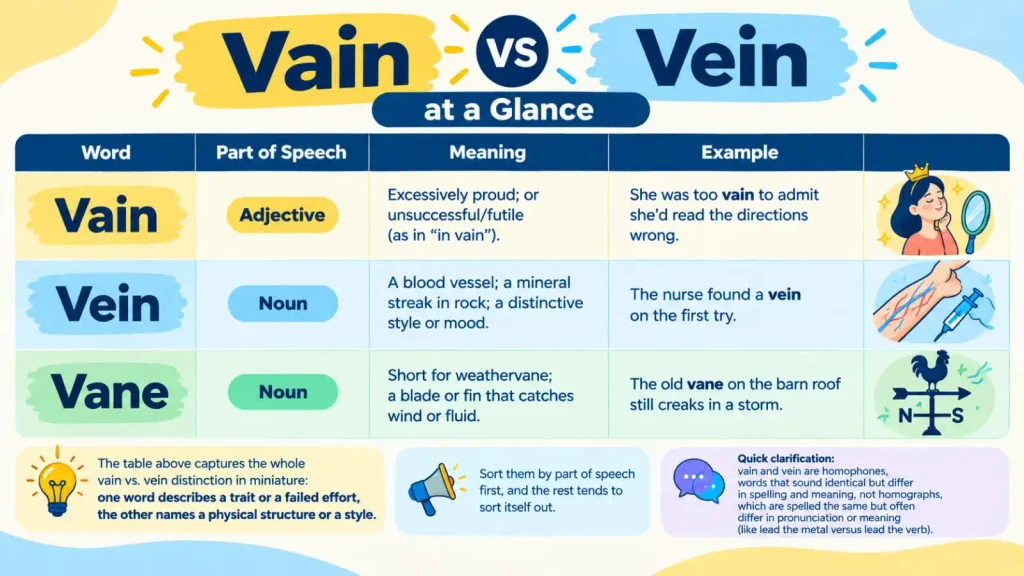
The table above captures the whole vain vs vein distinction in miniature: one word describes a trait or a failed effort, the other names a physical structure or a style. Sort them by part of speech first, and the rest tends to sort itself out.
One quick clarification while we’re here: vain and vein are homophones, words that sound identical but differ in spelling and meaning, not homographs, which are spelled the same but often differ in pronunciation or meaning (like lead the metal versus lead the verb). Getting that distinction straight makes the rest of this guide easier to follow.
What Does “Vain” Mean?
Vain is always an adjective. It carries two related meanings: excessive pride in your looks or abilities, or, in the idiom “in vain”, a lack of success despite real effort. The word traces back to the Latin vanus, meaning empty or worthless, which is the root of both modern senses: a vain person is preoccupied with an “empty” self image, and a vain effort ends up empty handed.
- “He’s too vain to ever admit he’s lost the argument.”
- “We searched the parking garage for twenty minutes, all in vain; the car was two blocks over.”
- “The board argued that the lawsuit was pursued in vain, since the contract had already expired.”
- “She caught herself checking her reflection again and laughed at how vain she’d become since the new job.”
You’ll see vain most often in personality descriptions, in the fixed idiom “in vain,” and in slightly more formal writing, performance feedback, op eds, and essays where a writer wants to describe wasted effort or self regard in one word.
It’s also common in narrative and biographical writing, where a character’s vanity is used to explain their choices, or in news coverage that describes a rescue, a negotiation, or a campaign as having failed despite genuine effort.
The word even has pop culture staying power: Carly Simon’s 1972 hit “You’re So Vain” leaned entirely on this one adjective’s meaning, self absorption, to build an entire song around it, which is part of why the word still feels so instantly recognizable decades later.
What Does “Vein” Mean?
Vein is always a noun, and it covers more ground than most people expect. Literally, it’s a blood vessel. Figuratively, it describes a mineral deposit in rock or a recognizable style, tone, or mood running through something.
The word comes from the Latin vena, meaning simply “blood vessel”, the same root behind medical terms like venous and intravenous, which is a handy anchor if you ever need to double check the spelling on the fly.
- “The phlebotomist had to try two different veins before she got a usable sample.”
- “Geologists confirmed the site sits on a vein of copper ore worth pursuing.”
- “His latest essay continues in the same sardonic vein as his last book.”
- “After the workout, the veins in his forearms were more visible than usual.”
Vein shows up constantly in medical and health writing, in geology, and in the idiom “in the same vein,” which writers use when comparing a new piece of work, comment, or idea to something that came before it in tone or style.
It’s a common word in fitness and wellness content, too, bloggers and coaches describing visible veins after a workout, or clinicians explaining a procedure to a patient, which is exactly the kind of fast typed content where the vain/vein typo tends to slip through unedited.
What Does “Vane” Mean?
There’s a third word most explanations skip entirely: vane. It’s a noun, and it’s only ever short for “weathervane” or a similar blade that redirects wind or fluid, a turbine vane, for instance.
- “The vane on the church spire pointed due north all morning.”
- “Engineers adjusted the turbine’s vane angle to improve efficiency.”
Vane is never an adjective and never has anything to do with blood or pride, which makes it easy to rule out once you know it exists, but easy to guess wrong if you’ve never seen it written down. It’s the least common of the three words in everyday writing, which is exactly why it trips people up: most readers have heard “weathervane” spoken far more often than they’ve seen it spelled, so when the moment comes to write it, the wrong homophone feels just as plausible.
Key Differences Between Vain vs Vein
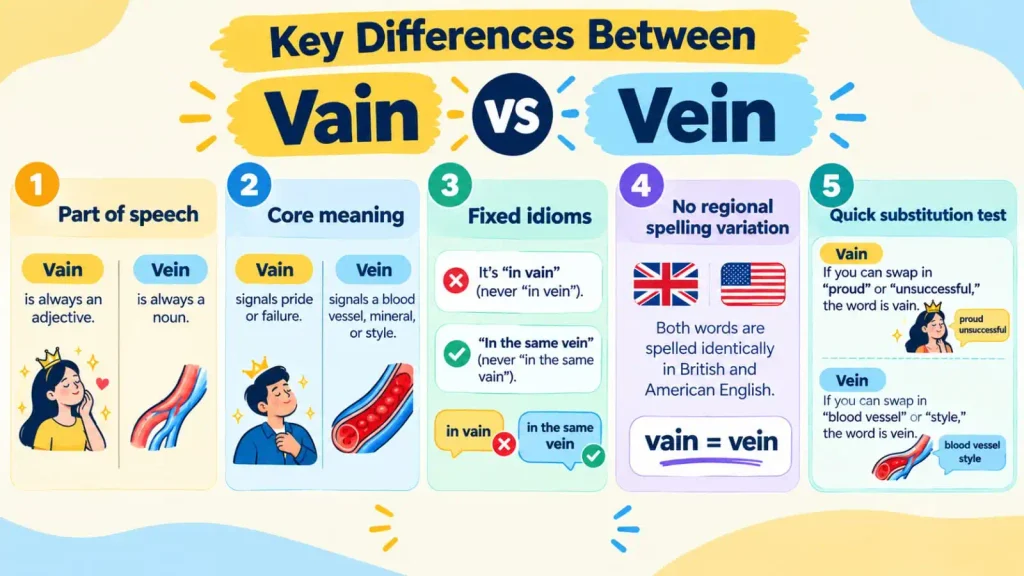
- Part of speech: vain is always an adjective; vein is always a noun
- Core meaning: vain signals pride or failure; vein signals a blood vessel, mineral, or style
- Fixed idioms: it’s “in vain” (never “in vein”) and “in the same vein” (never “in the same vain”)
- No regional spelling variation: both words are spelled identically in British and American English
- Quick substitution test: if you can swap in “proud” or “unsuccessful,” the word is vain; if you can swap in “blood vessel” or “style,” the word is vein
Memory Trick: How to Remember Vain vs Vein
The quickest fix for vain vs vein isn’t a rhyme; it’s a grammar check. Vain isn’t even a noun. If your sentence needs a thing (a subject or object), it cannot be “vain.” That single test resolves most real world mistakes, including the “in vein” email typo above.
For a visual backup, try this:
- Vain → Vanity. Both begin with “Va,” and both are about pride.
- Vein → Vessel. Both begin with “Ve,” and both refer to something in the body; picture an IV line running straight into a vein.
Hang onto both anchors, and pausing over vain vs vein should become rare.
Common Mistakes with Vain vs Vein
| Incorrect | Correct | Why |
| Their search for the missing dog was in vein. | Their search for the missing dog was in vain. | “In vain” is a fixed idiom meaning without success. |
| The doctor found a vain in his arm. | The doctor found a vein in his arm. | The sentence needs a noun, a blood vessel. |
| She’s so vein about her new car. | She’s so vain about her new car. | The sentence needs an adjective, pride. |
| The sequel continues in the same vain as the original. | The sequel continues in the same vein as the original. | “In the same vein” is a fixed idiom about style. |
Why Do Even Native Speakers Mix These Up?
This isn’t just a beginner’s mistake. On an old language forum thread, a group of fluent adult English speakers spent an entire discussion debating whether “in the same vein” or “in the same vain” was correct, and initially split on the answer, before someone ran the phrase through a searchable database of published English and found nearly twenty real uses of “vein” and zero of “vain.” Even people who write for a living needed evidence to settle it.
The slip shows up in casual writing too. On a hobbyist forum, a knowledgeable collector describing a rare coin wrote that a discovery was “very much in that same vain”, a small, confident aside from someone who clearly knew the subject cold, with the spelling quietly wrong and nobody catching it.
Another poster in the same thread second guessed himself afterward. He admitted he’d always assumed “vain” was correct, until someone pointed out that vain isn’t even a noun, and therefore can’t fill that slot in the sentence at all.
Notice the pattern with vain vs vein: it rarely trips up people who don’t know the words. It trips up people who know exactly what they mean to say and trust their ear instead of double checking the spelling.
If it can slip past a forum full of people who spend their free time debating word origins, it can slip into your next email too, which is exactly why the grammar check above is worth keeping in your back pocket.
Quick Quiz, Test Yourself
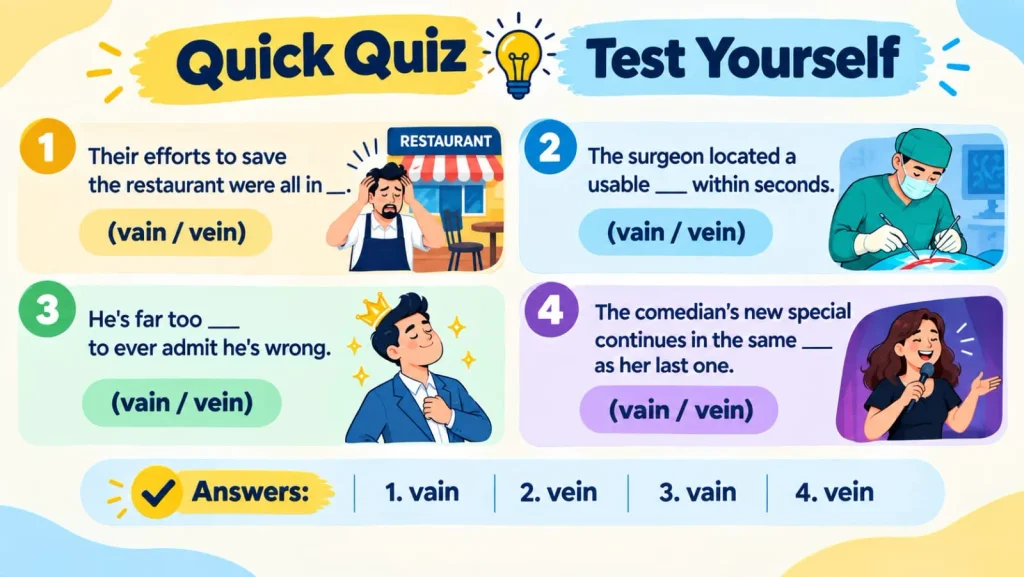
- Their efforts to save the restaurant were all in ___. (vain / vein)
- The surgeon located a usable ___ within seconds. (vain / vein)
- He’s far too ___ to ever admit he’s wrong. (vain / vein)
- The comedian’s new special continues in the same ___ as her last one. (vain / vein)
Answers: 1. vain, 2. vein, 3. vain, 4. vein
Frequently Asked Questions
Is it “in vain” or “in vein”? It’s always “in vain,” meaning without success or without achieving the intended result. “In vein” is a common misspelling that shows up even in professional writing, usually because the writer is typing quickly and relying on how the phrase sounds rather than how it’s spelled.
Is it “in the same vein” or “in the same vain”? “In the same vein” is correct. It describes a similar style, tone, or mood as something mentioned earlier, and since vain is never a noun, it grammatically can’t fill that role in the phrase, no matter how natural it sounds out loud.
What is the difference between vain, vein, and vane? Vain is an adjective meaning proud or unsuccessful. Vein is a noun for a blood vessel, a mineral streak in rock, or a distinctive style. Vane is a noun that only refers to a weathervane or a similar blade that redirects wind or fluid, and it never overlaps in meaning with the other two.
Why do vain and vein sound the same? They’re homophones, words that sound identical but come from different origins and carry unrelated meanings. English has hundreds of these pairs, and pronunciation converging over centuries while spelling stayed fixed is usually the underlying cause.
What part of speech is vain? Vain is always an adjective. It never functions as a noun, which is the quickest way to catch a misuse: if the sentence needs a thing rather than a description, vain is the wrong choice.
Is vain always a negative word? Almost always, yes. It implies excessive pride or a wasted effort, though writers sometimes use it with a lighter, teasing tone to describe a friend’s harmless vanity rather than a genuine character flaw.
Final Thoughts
At the end of the day, vain vs vein comes down to one quick grammar habit, not blind memorization. Vain is always an adjective; it means excessively proud, or, in the fixed phrase “in vain,” unsuccessful/futile. Vein is always a noun; it means a blood vessel, a mineral streak in rock, or a distinctive style or mood, as in “in the same vein.”
And if a third word ever sneaks into the confusion, vane is also a noun, but it means only short for weathervane, a blade or fin that redirects wind or fluid, never anything to do with pride or blood.
To read more: Tare vs Tear: What’s the Amazing Difference? (2026)

Marcus is a former product manager turned comparison writer who spent eight years testing tools and gadgets before quitting to write full-time. He specializes in breaking down tech and software matchups into plain-English verdicts, with a soft spot for buying guides nobody else wants to write.