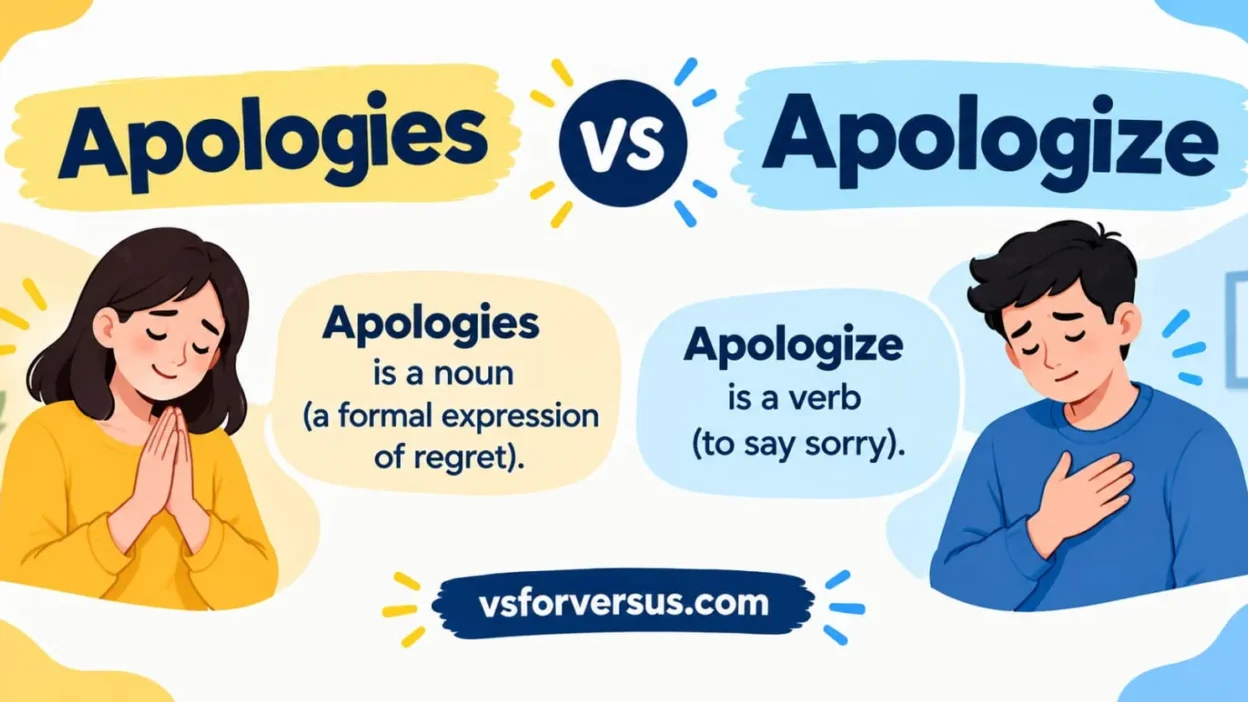
Apologies vs Apologize at first glance, these words seem interchangeable, but each one plays a distinct grammatical role. Apologies works as a plural noun referring to expressions of regret for a mistake or wrongdoing, as in “please accept my apologies.” It’s typically used when formally acknowledging fault.
Meanwhile, apologize functions as a verb describing the act of expressing regret or saying sorry for something one has done, such as in “I want to apologize for being late.” The key difference lies in usage: one names the act, the other performs it. By the end of this piece, you’ll be able to pick the right form without a second thought.
Quick Answer
“Apologies” is the plural noun referring to the words or expression of regret itself, as in “Please accept my apologies.” “Apologize” is the verb meaning to say or express that you’re sorry, as in “I apologize for the delay.” Choose apologize when you’re describing the act of saying sorry, and apologies when you’re referring to the actual words or gesture of regret.
Apologies vs Apologize at a Glance
Before diving into the details, take a look at this side by side breakdown of apologies vs apologize:
| Word | Part of Speech | Meaning | Example |
| Apologize | Verb | To express regret or say sorry for something | “I apologize for the delay.” |
| Apologies | Plural noun | The words or expressions of regret themselves | “Please accept my apologies.” |
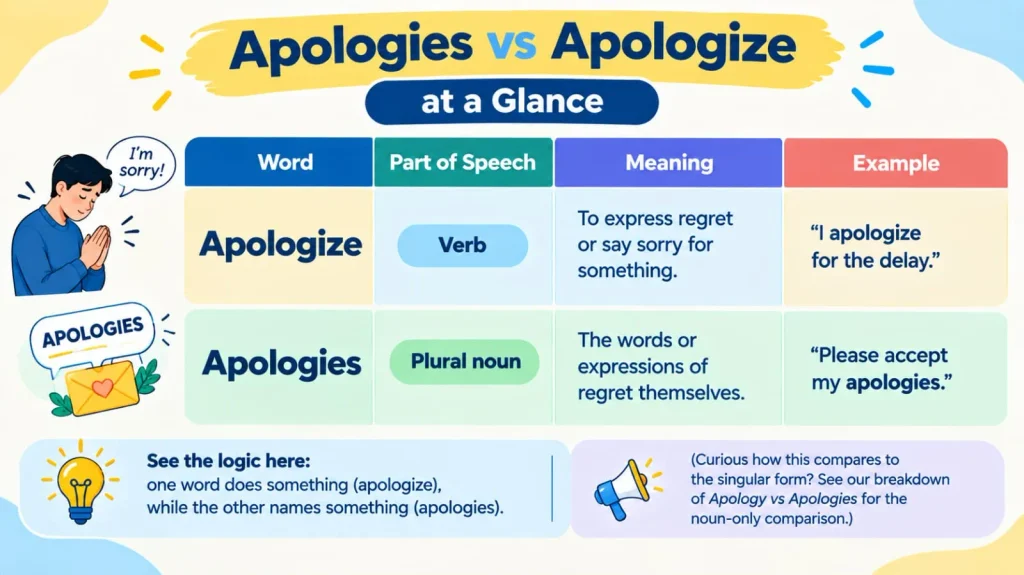
See the logic here: one word does something (apologize), while the other names something (apologies). Keep that distinction in mind as we look at each word individually.
What Does “Apologize” Mean?
“Apologize” is a verb. It describes the action of expressing regret, something a person actively does, usually paired with a subject and often followed by “for” or “to.” It also changes form depending on tense: “apologize” (present), “apologized” (past), and “apologizing” (the ing, or progressive, form used when the action is ongoing or described as a habit).
In everyday writing, it shows up like this:
- “She apologized for missing the meeting, but honestly, it happened twice that week.”
- “I want to apologize for how I handled that customer call yesterday.”
- “He still hasn’t apologized, and it’s been three weeks.”
- “Can you apologize to your sister before we leave?”
- “He’s been apologizing all morning, and honestly, it’s starting to feel excessive.”
You’ll see “apologize” most often in workplace emails (“I apologize for the confusion”), spoken conversation, and personal messages where someone is directly taking responsibility.
It’s also common in academic and ESL writing, where students are often taught to use “apologize” as the go to verb for formal regret, even when a more casual “sorry” would fit the tone better. This is the verb half of the apologies vs apologize equation, the doing word, not the thing itself.
What Does “Apologies” Mean?
“Apologies” is a plural noun; it refers to the actual expression of regret, the words or gesture itself, rather than the act of delivering them. It usually follows a possessive (“my,” “our,” “his”) or an article (“the”), which makes it a countable noun in this context: you can have “one apology” or “several apologies,” depending on how many separate instances of regret are being referenced.
In practice, you’ll see it used like this:
- “Please accept my apologies for the delayed shipment.”
- “My apologies, I completely missed your message from Tuesday.”
- “The airline issued formal apologies to everyone stranded overnight.”
- “He sent his apologies through a mutual friend instead of calling directly.”
- “Our sincerest apologies for any inconvenience this has caused.”
“Apologies” tends to show up in more formal or written contexts, business correspondence, official statements, and polished emails. It reads slightly more composed than “I’m sorry” or “I apologize,” which is exactly why so many professional writers reach for it when tone matters.
Think of “sorry” as the casual cousin of this word pair: it’s a near synonym for both apologize and apologies, but it carries none of the formal weight either one does.
Key Differences Between Apologies vs Apologize
Here’s the fastest way to keep apologies vs apologize straight:
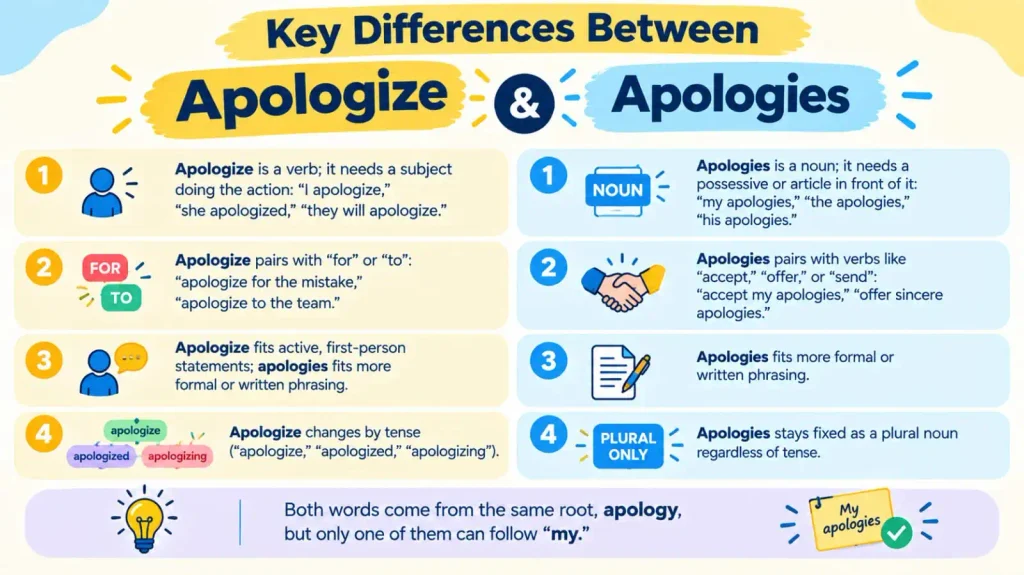
- Apologize is a verb; it needs a subject doing the action: “I apologize,” “she apologized,” “they will apologize.”
- Apologies is a noun; it needs a possessive or article in front of it: “my apologies,” “the apologies,” “his apologies.”
- Apologize pairs with “for” or “to”: “apologize for the mistake,” “apologize to the team.”
- Apologies pairs with verbs like “accept,” “offer,” or “send”: “accept my apologies,” “offer sincere apologies.”
- Apologize fits active, first person statements; apologies fits more formal or written phrasing.
- Apologize changes by tense (“apologize,” “apologized,” “apologizing”); apologies stays fixed as a plural noun regardless of tense.
- Both words come from the same root, apology, but only one of them can follow “my.”
Memory Trick: How to Remember the Difference?
Here’s a simple mnemonic that sticks: Apologi ZE means you DO it; the “z” buzzes into motion, like an action happening in real time. Apologie S is what you SEND; the “s” stands for the Set of words you’re handing over.
So:- ize = action in progress. ies = the item you’re delivering. If your sentence needs a doer, reach for “apologize.” If it needs a thing being offered or accepted, reach for “apologies.”
Common Mistakes with Apologies vs Apologize
Even experienced writers slip here, especially under deadline pressure, when the sentence structure changes mid thought, and the wrong form slips through before you catch it. Here are the most common errors and their corrections:
| ❌ Wrong | ✅ Correct |
| “I apologies for the mistake.” | “I apologize for the mistake.” |
| “Please accept my apologize.” | “Please accept my apologies.” |
| “She apology to the whole team.” | “She apologized to the whole team.” |
| “My apologize for being late again.” | “My apologies for being late again.” |
| “He apologizes yesterday for the error.” | “He apologized yesterday for the error.” |
| “We are apology for the delay.” | “We apologize for the delay.” |
Look closely, and you’ll notice the same slip in every wrong example: the noun form got dropped into a spot that needed a verb, or vice versa. That’s the entire apologies vs apologize confusion in a nutshell; it’s rarely about not knowing what the words mean, and almost always about which slot in the sentence each one belongs in.
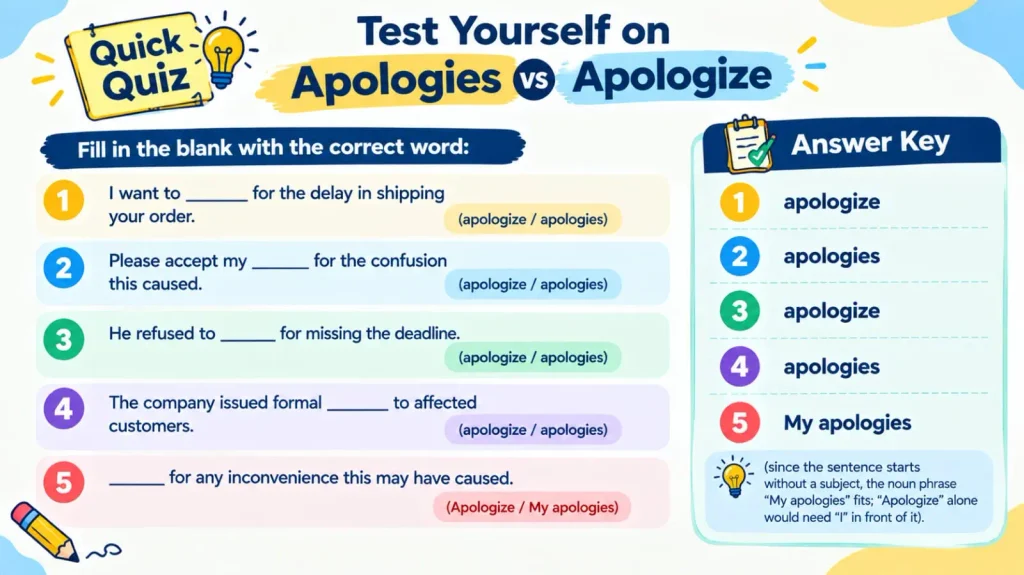
Quick Quiz: Test Yourself on Apologies vs Apologize
Fill in the blank with the correct word:
- “I want to ___ for the delay in shipping your order.” (apologize / apologies)
- “Please accept my ___ for the confusion this caused.” (apologize / apologies)
- “He refused to ___ for missing the deadline.” (apologize / apologies)
- “The company issued formal ___ to affected customers.” (apologize / apologies)
- “___ for any inconvenience this may have caused.” (Apologize / My apologies)
Answer key: 1. apologize, 2. apologies, 3. apologize, 4. apologies, 5. My apologies (since the sentence starts without a subject, the noun phrase “My apologies” fits; “Apologize” alone would need “I” in front of it).
Frequently Asked Questions
Is it “apologies” or “apologize”?
It depends on the sentence. Use “apologize” when you need a verb describing the act of saying sorry (“I apologize”). Use “apologies” when you need a noun referring to the actual expression of regret (“my apologies”).
What is the difference between apology, apologies, and apologize?
“Apology” is the singular noun (one instance of saying sorry), “apologies” is its plural form (multiple instances, or the formal plural used in phrases like “please accept my apologies”), and “apologize” is the verb form describing the action itself.
Is “apologies” a formal word?
Yes, relatively. “Apologies” tends to sound more composed and professional than “sorry” or even “I apologize,” which is why it shows up so often in business emails and official statements.
How do you say sorry professionally?
In professional writing, “I apologize for…” works well when you’re taking direct responsibility, while “Please accept my apologies for…” sounds slightly more formal and is common in customer service or client facing communication.
Can you say “my apologizes”?
No, this is a common error. “Apologize” is a verb and can’t take the possessive “my” in front of it. The correct phrase is “my apologies,” using the noun form.
Is “apologize” a verb or a noun?
“Apologize” is always a verb, and it’s the core of the entire apologies vs apologize distinction. The noun forms are “apology” (singular) and “apologies” (plural).
Final Thought
At its core, apologies vs apologize comes down to one simple test: does your sentence need a doer or a thing? If someone is actively saying sorry, reach for the verb, apologize. If you’re naming the actual words or gesture of regret, reach for the noun, apologies. Once that distinction clicks, you’ll never freeze at the cursor again; you’ll just write the sentence, send it, and move on.
To read more: Vain vs Vein: What’s the Ultimate Difference (2026)

Marcus is a former product manager turned comparison writer who spent eight years testing tools and gadgets before quitting to write full-time. He specializes in breaking down tech and software matchups into plain-English verdicts, with a soft spot for buying guides nobody else wants to write.