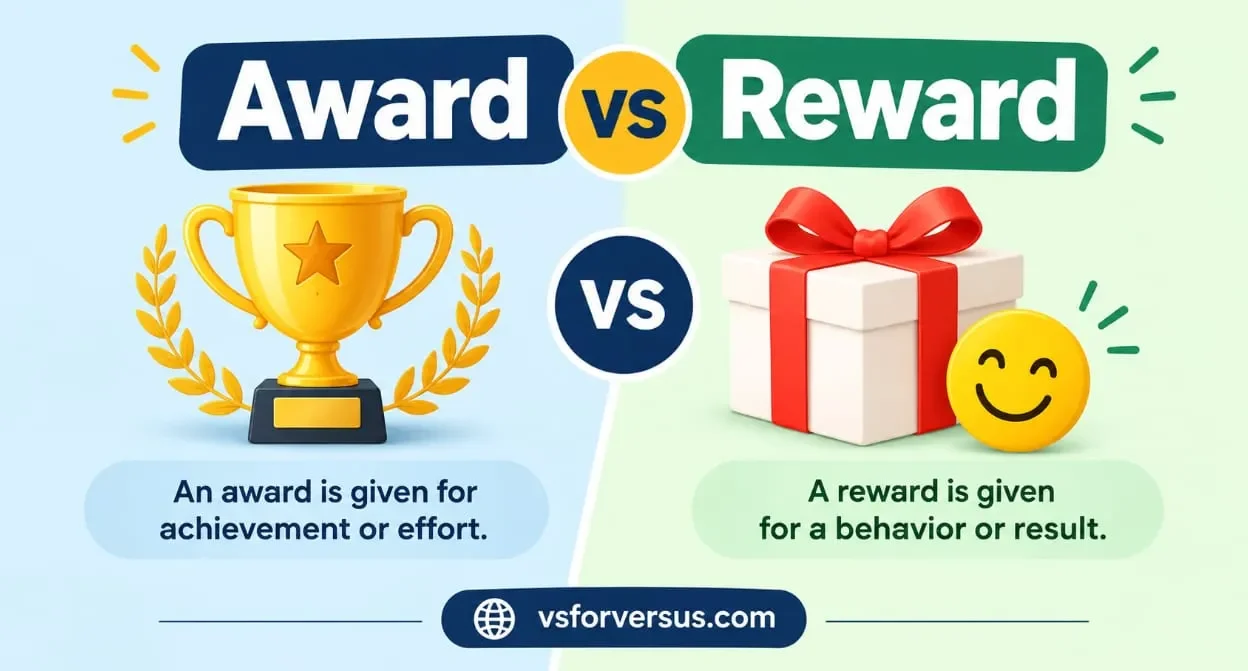
Award vs Reward is a topic that many people often confuse, since both words are used to acknowledge someone’s effort, yet their actual meaning and purpose are quite different. An Award is something given to a person as official recognition for an outstanding achievement, talent, or performance, and it is usually presented in a formal setting like a ceremony, competition, or event.
A Reward, on the other hand, is given as an incentive or token of appreciation for good behavior, hard work, or completing a task, without necessarily needing any formal occasion. While both words are connected to recognizing effort, their context and purpose make them different from one another. In this article, we’ll explore these differences in detail.
Quick Answer
An award is a formal prize or honor given to recognize a specific achievement, usually decided by a judge, committee, or organization; think medals, trophies, or scholarships. A reward is something, often money or a gift, given in return for effort, good behavior, or service, and it tends to be more personal or informal; think a bonus or a thank you gift.
In an award vs reward comparison, the short version is: awards are judged and formal, while rewards are earned and often spontaneous.
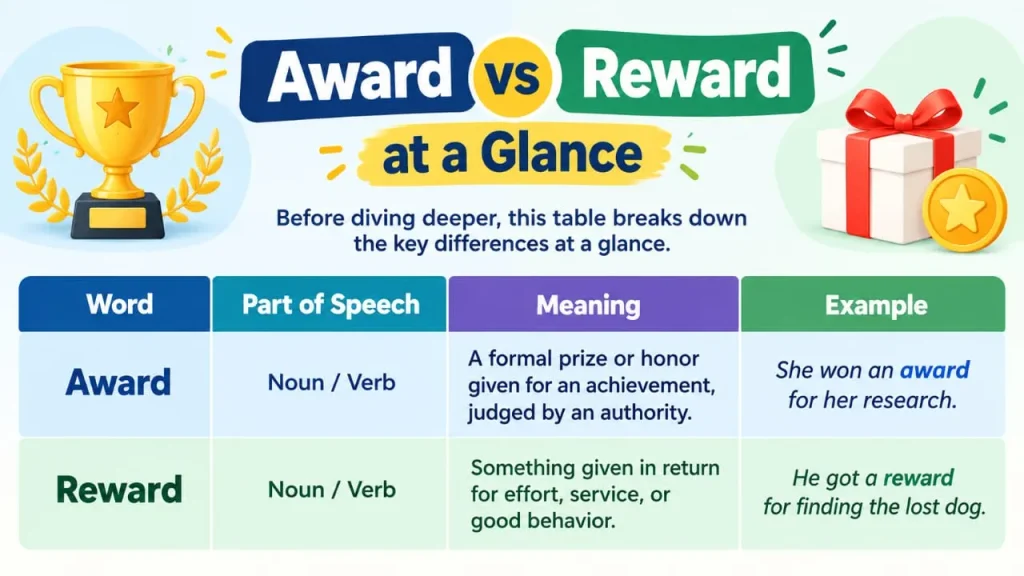
Award vs Reward at a Glance
Before diving deeper, this table breaks down the key differences at a glance.
| Word | Part of Speech | Meaning | Example |
| Award | Noun / Verb | A formal prize or honor given for an achievement, judged by an authority | She won an award for her research. |
| Reward | Noun / Verb | Something given in return for effort, service, or good behavior | He got a reward for finding the lost dog. |
What Does “Award” Mean?
An award is a mark of formal recognition, usually a trophy, medal, certificate, or title, given after someone or something is judged against a set of criteria. Awards are rarely handed out casually; they typically involve a nomination, a panel, or a scoring process.
Understanding how nouns and verbs work in English helps here too, since award shifts meaning slightly depending on its part of speech.
Award works as both a noun and a verb. As a noun, it’s the thing itself (“she received an award”). As a verb, it describes the act of granting it (“the judges awarded her first place”).
A few natural examples:
- “Congratulations on the Innovation Award; the whole department is proud of you.”
- “The scholarship committee awarded her a full ride based on her thesis.”
- “He didn’t win the award, but being nominated still felt like a win.”
- “The court awarded the plaintiff $50,000 in damages.”
You’ll see award most often at an award ceremony, in competitions, academic recognition, legal contexts (“awarded custody,” “awarded damages”), and formal workplace programs like Employee of the Year. Award synonyms in these settings include “honor,” “prize,” and “distinction”, all of which carry that same sense of formal, judged recognition.
What Does “Reward” Mean?
A reward is something given in exchange for a specific action, effort, or piece of information. It doesn’t need a panel of judges, a manager, a parent, or even you can hand one out on the spot. Rewards are often more flexible than awards: they can be a monetary reward like cash or a bonus, or something non monetary like a gift card, extra time off, or a kind word.
Like award, reward can be a noun or a verb: “She got a reward” versus “the company rewarded her loyalty with a bonus.”
Natural examples of reward in use:
- “Thanks for covering my shift, dinner’s on me as a reward.”
- “There’s a $200 reward for anyone who finds the missing laptop.”
- “I rewarded myself with a lazy Sunday after finishing the report.”
- “Employees are rewarded with points they can redeem for gift cards.”
Reward shows up constantly in a workplace reward system, loyalty programs (“earn reward points”), informal gestures, pet training, and everyday self talk (“treat yourself as a reward”). Common reward synonyms include “incentive,” “bonus,” and “payoff”, words that all point to something earned in direct response to an action, rather than judged on merit.
Key Differences Between Award vs Reward
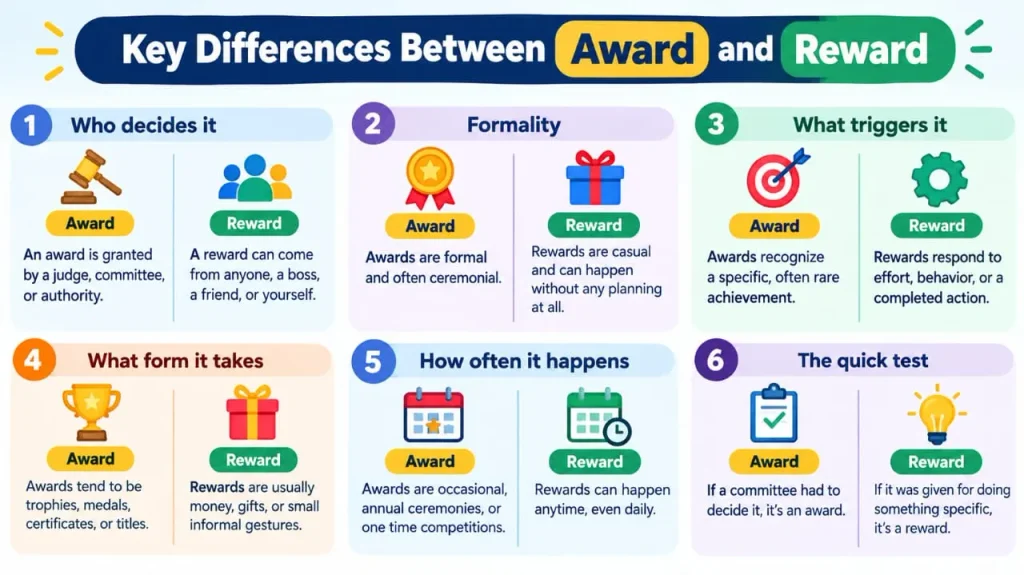
The differences break down into six scannable points:
- Who decides it: An award is granted by a judge, committee, or authority. A reward can come from anyone, a boss, a friend, or yourself.
- Formality: Awards are formal and often ceremonial. Rewards are casual and can happen without any planning at all.
- What triggers it: Awards recognize a specific, often rare achievement. Rewards respond to effort, behavior, or a completed action.
- What form it takes: Awards tend to be trophies, medals, certificates, or titles. Rewards are usually money, gifts, or small informal gestures.
- How often it happens: Awards are occasional, annual ceremonies, or one time competitions. Rewards can happen anytime, even daily.
- The quick test: If a committee had to decide it, it’s an award. If it was given for doing something specific, it’s a reward.
Award vs Reward vs Prize
There’s a third word that often gets folded into this conversation: prize. A prize is something won through direct competition or chance, like a raffle or a contest; think “first prize” in a bake off. The distinction matters because all three words overlap in meaning but not in mechanism:
- Award, given based on judged merit (a panel decides).
- Reward, given in exchange for effort or behavior (anyone can give it).
- Prize, won through competition or luck (there’s a contest structure).
A lottery jackpot is a prize, not an award, because no one judged your merit; you just got lucky. A trophy for winning a chess tournament could be called either a prize or an award, since both a competition and a judged outcome are involved. If you’re curious how this trio compares to other commonly confused sets, our guide on commonly confused English words covers several similar patterns.
Memory Trick to Never Mix Them Up Again
If you only remember one thing from this article, make it this: Award = Authority decides. Reward = Response to what you did.
Both words start differently, and that difference is your cue. “Award” shares its first syllable with “authority”; someone official is judging. “Reward” contains “re,” as in a reaction or response to something you already did. When you’re not sure which word fits, ask yourself: was this judged, or was it earned? Judged means award. Earned means reward.
Is It an Award or a Reward? Quick Reference
Still unsure in the moment? These everyday situations show how the line falls:
| Situation | Award or Reward? |
| Winning an Olympic medal | Award |
| Getting cash for returning a lost wallet | Reward |
| A scholarship for top grades | Award |
| Credit card cashback points | Reward |
| An Employee of the Year plaque | Award |
| A manager buying lunch for a job well done | Reward |
| Winning a Nobel Prize | Award |
| Treating yourself to coffee after a workout | Reward |
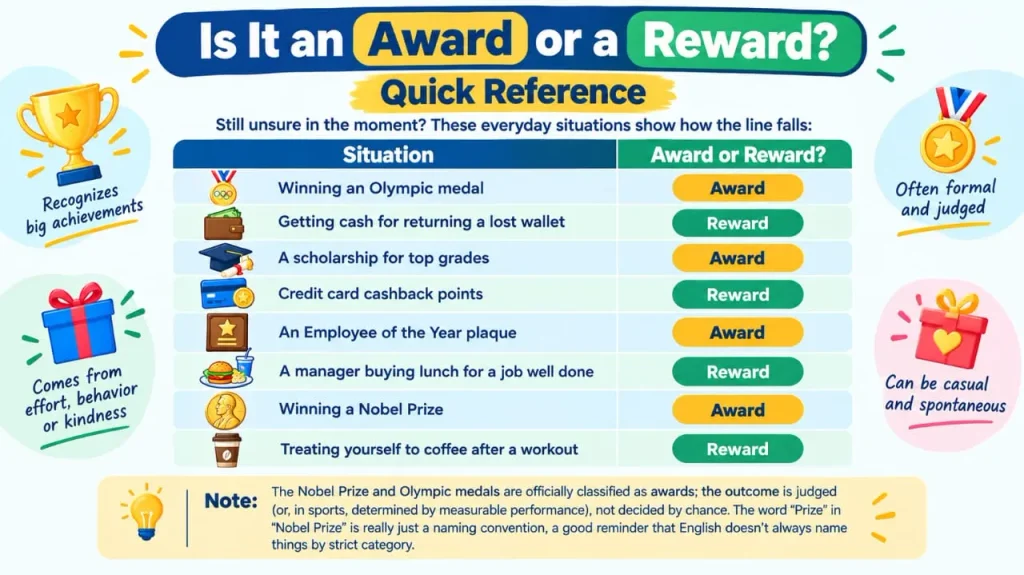
Note: The Nobel Prize and Olympic medals are officially classified as awards; the outcome is judged (or, in sports, determined by measurable performance), not decided by chance. The word “Prize” in “Nobel Prize” is really just a naming convention, a good reminder that English doesn’t always name things by strict category.
Common Mistakes with Award vs Reward
Even experienced writers slip here, especially in fast typed emails or Slack messages, where “reward” and “award” get swapped without anyone noticing until it’s already sent.
| Incorrect | Correct |
| “She was rewarded the Nobel Prize for her research.” | “She was awarded the Nobel Prize for her research.” |
| “He got an award for finding the lost dog.” | “He got a reward for finding the lost dog.” |
| “The company gives out monthly awards for good behavior.” | “The company gives out monthly rewards for good behavior.” |
| “I want to reward myself an Oscar this year.” | “I want to win myself an Oscar award this year.” |
Notice the pattern: the wrong version usually swaps a formal, judged outcome (Nobel Prize, Oscar) with the casual word, or swaps a behavior based bonus with the formal one.
Reading the sentence back and asking “was this judged, or was it earned?” catches almost every version of this mistake. It’s a quick habit, and one worth keeping, especially in resumes, cover letters, and any writing where precision reflects credibility.
Why Even Native Speakers Mix These Up?
Something is reassuring for anyone learning English: this isn’t just an ESL problem. Native speakers debate award vs. reward casually all the time, often relying on gut feeling rather than a strict rule.
Ask a handful of fluent English speakers to define the difference, and you’ll get answers that circle the same idea, formal recognition versus something earned, without anyone citing an actual rule.
That’s because the confusion isn’t really about grammar. Both words describe “getting something good in exchange for doing something”; the overlap is conceptual, not structural. Even editors and copywriters occasionally pause to double check which word fits, especially when a company’s own internal documents use the two terms inconsistently.
If you’ve ever paused mid sentence wondering which one to use, you’re in good company; this is a nuance issue, not a sign that your English needs work.
Award vs Reward in Professional Writing
This confusion shows up most often in three places: workplace emails, HR announcements, and academic or essay writing. In an email announcing an employee reward program, using “award” instead sets the wrong expectation; readers may picture a plaque instead of a cash bonus.
In an essay discussing motivation theory, swapping the two muddies your argument about intrinsic versus extrinsic incentives. And in HR documentation, an inconsistent award vs reward distinction can create real confusion about what employees are actually owed, as Priya’s story at the start of this article shows.
When precision matters contracts, performance reviews, and official communications take the extra few seconds to pick the word that matches what’s actually being given.
Quick Quiz: Award or Reward?
Test yourself with these five sentences. Answers are below.
- She received an ______ for her outstanding research.
- The dog was given a treat as a ______ for sitting.
- He was ______ the contract after months of negotiation.
- Employees who refer new hires get a cash ______.
- The film won three ______ at the ceremony.
Answers: 1. award, 2. reward, 3. awarded, 4. reward, 5. awards
Frequently Asked Questions
What is the difference between award vs reward?
An award is formal recognition judged by an authority, like a trophy or scholarship. A reward is something given in exchange for effort or behavior, like a bonus or a gift. The core of the award vs reward comparison comes down to who decides and why it’s given.
Is a bonus an award or a reward?
A bonus is a reward. It’s given in exchange for performance or effort, not judged by a panel or committee, so it falls on the informal, earned side of the line.
Is a medal an award or a reward?
A medal is almost always an award, since it’s typically judged and given after a formal competition or achievement, such as the Olympics or a military honor.
Can “reward” be used as a verb?
Yes. “Reward” works as both a noun and a verb, as in “the company rewarded her loyalty” or “he was rewarded for his patience.”
Are award and reward synonyms?
Not quite. They’re closely related and sometimes used loosely in casual speech, but they aren’t true synonyms; an award is judged and formal, while a reward is earned and often informal.
Is a scholarship an award or a reward?
A scholarship is an award. It’s granted based on judged criteria, such as grades, financial need, or merit, rather than as a direct exchange for a single action.
Final Thoughts
The award vs reward confusion isn’t a sign of weak English; it’s a genuinely fuzzy corner of the language that even native speakers navigate by instinct. The one rule worth keeping: an award is judged, and a reward is earned.
Ask that one question before you hit send: was this decided by someone official, or given in response to what I did? And you’ll pick the right word almost every time, in a résumé, an email, or a casual conversation.
To read more: Armor vs Armour: The Ultimate Frustrating (2026)

Marcus is a former product manager turned comparison writer who spent eight years testing tools and gadgets before quitting to write full-time. He specializes in breaking down tech and software matchups into plain-English verdicts, with a soft spot for buying guides nobody else wants to write.