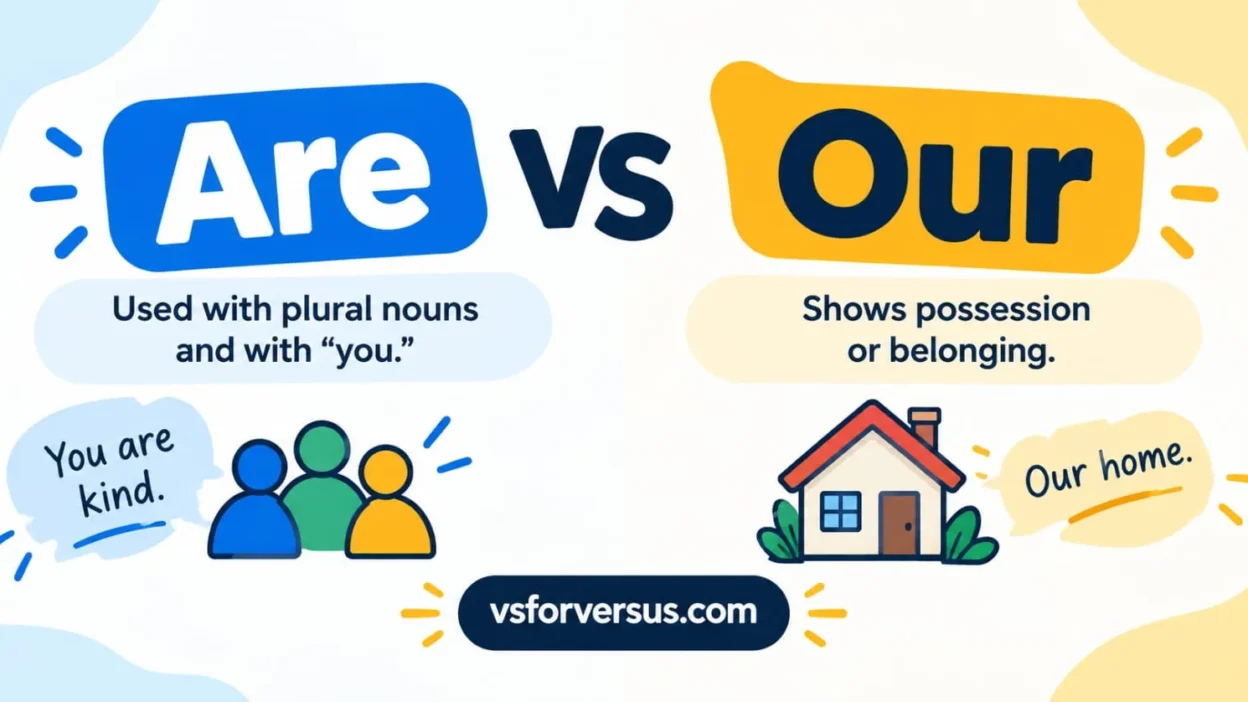
Are vs Our confusing these two words is one of the most common mistakes writers make, and getting it wrong can instantly make your content look unpolished. Are is a verb, the present tense form of “to be”, used with plural subjects or “you,” showing existence or state, as in “they are here.”
Our, however, is a possessive adjective that shows ownership shared by the speaker and others, like in “our goals” or “our future.” While one describes action or being, the other simply shows belonging. Mastering this small difference can sharpen your grammar instantly and help your writing read more naturally, clearly, and confidently no more second guessing which one fits.
Quick Answer
“Are” is a verb, the present tense form of “to be,” used with you, we, and they (as in “They are ready”). “Our” is a possessive adjective meaning “belonging to us” (as in “Our office is downtown”). The two sound alike when spoken quickly, which is why they’re often confused in writing, but they belong to completely different parts of speech and are never interchangeable.
Are vs Our at a Glance
Before digging into the details, here’s the core comparison in one place, useful as a quick reference any time you’re unsure which word your sentence needs.
| Word | Part of Speech | Meaning | Example |
| Are | Verb (present tense of “to be”) | Describes existence, a state, or an action | They are running late for the call. |
| Our | Possessive adjective (determiner) | Shows something belongs to “we” | Our call starts at 3 p.m. |
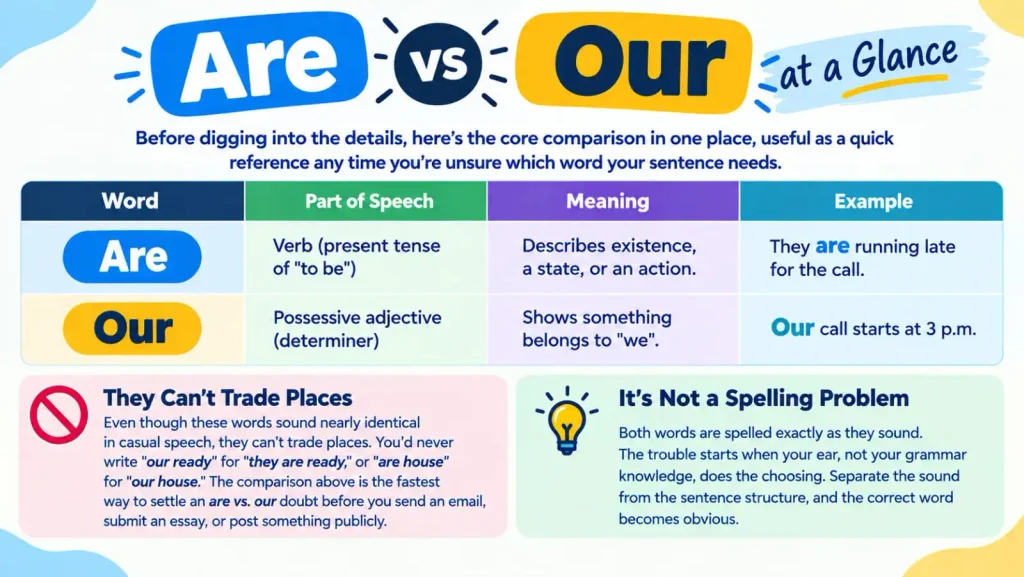
Even though these words sound nearly identical in casual speech, they can’t trade places. You’d never write “our ready” for “they are ready,” or “are house” for “our house.” The comparison above is the fastest way to settle an are vs our doubt before you send an email, submit an essay, or post something publicly.
This isn’t really a spelling problem; both words are spelled exactly as they sound. The trouble starts when your ear, not your grammar knowledge, does the choosing. Separate the sound from the sentence structure, and the correct word becomes obvious.
When to Use “Are”
“Are” is a linking verb, the present tense form of “to be” used with you, we, and they. It’s the plural (and second person singular) counterpart to “am” and “is,” and also works as a helping verb in progressive tenses (“we are working,” “they are leaving”).
Examples in natural, everyday writing:
- Are you free for a quick call this afternoon? (casual message)
- We are finalizing the budget and will circle back by Friday. (workplace email)
- My roommates are driving me up the wall lately, honestly. (social media post)
- Students are expected to submit their drafts by midnight. (academic instructions)
Common contexts: “are” shows up most in questions (“Are you coming?”), current state statements (“They are exhausted”), and progressive tense constructions (“We are launching next week”).
If your sentence needs a verb to connect a subject to an action or condition, “are” is almost always your answer. Quick cross check: “are” pairs with plural subjects and “you”; a singular subject (“he,” “she,” “it”) needs “is” instead.
When to Use “Our”
“Our” is a possessive adjective, sometimes called a possessive determiner, showing ownership by a group that includes the speaker. It sits directly before a noun and answers “whose?”
Examples in natural, everyday writing:
- Can you send over our client list before the meeting? (workplace request)
- Our flight got delayed again, third time this month. (casual complaint)
- This paper argues that our understanding of the topic is incomplete. (academic writing)
- We finally painted our kitchen, and it looks incredible. (social media caption)
Common contexts: you’ll see “our” most often in business writing (“our team,” “our client,” “our recommendation”), casual talk about shared belongings (“our house,” “our plans”), and formal writing where authors are referenced collectively (“our findings show”).
Because “our” always precedes a noun, check whether a noun immediately follows the word in question; if it does, “our” is likely correct.
Are vs Our vs Hour, The Third Word Nobody Mentions
There’s a third word tangled up in this confusion too: “hour.” Depending on your accent, “our” and “hour” can sound almost identical, and “our” can drift toward “are” as well, a three way pronunciation collision, not just a two word problem.
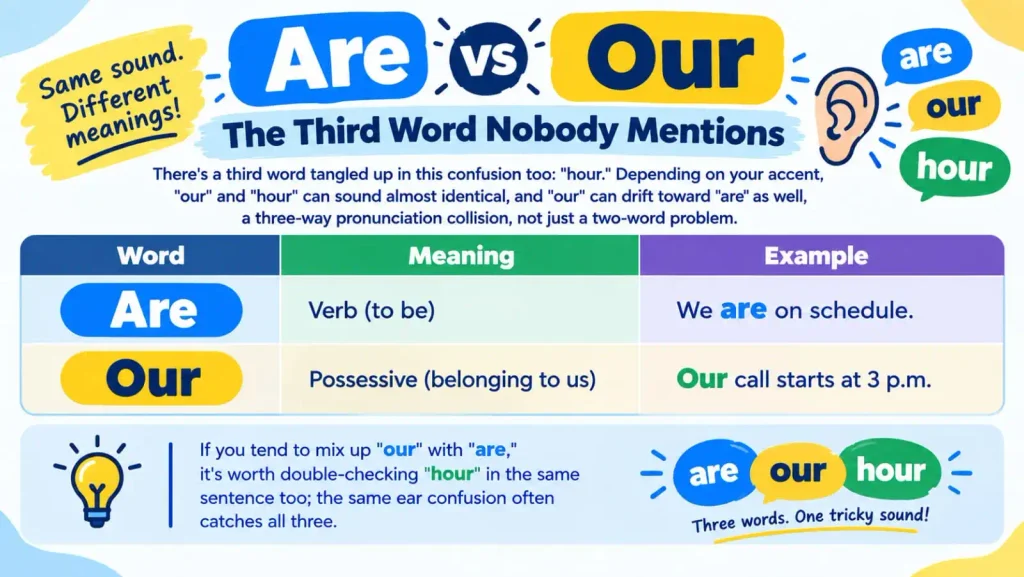
| Word | Meaning | Example |
| Are | Verb (to be) | We are on schedule. |
| Our | Possessive (belonging to us) | Our schedule is tight. |
| Hour | Unit of time (60 minutes) | The meeting runs one hour. |
If you tend to mix up “our” with “are,” it’s worth double checking “hour” in the same sentence too; the same ear confusion often catches all three.
Key Differences Between Are and Our
- Part of speech: “are” is a verb; “our” is a possessive adjective, a completely different grammatical role.
- Function: “are” links a subject to an action or state; “our” shows that something belongs to a group including the speaker.
- Quick test: try swapping the word with “is.” If the sentence still makes sense, you need “are.” If not, try inserting a noun right after it; if that reads naturally, “our” is correct.
- Never interchangeable: no sentence context allows “are” and “our” to substitute for each other, despite how similar they sound out loud.
- Sound overlap is the real culprit: in casual, fast, or accented speech, both words can collapse toward a similar vowel sound, which is why the written mix up happens so often even among confident writers.
Why Do People Actually Mix These Up?
Here’s the part most guides skip: the are vs our confusion usually isn’t about not knowing the grammar rule. It’s about how the words sound. Linguists call pairs like this near homophones, words that sound almost, but not quite, identical.
In quick, casual speech, “our” often gets pronounced closer to “are,” especially in American English, which means your ear and your fingers can betray you even when your brain knows the rule perfectly well.
Autocorrect and speech to text tools make it worse. When you’re typing fast or dictating a message, predictive software tends to favor the more frequent word, and “are” is used far more often than “our” in everyday English, so it gets suggested even when “our” is what you meant.
This is exactly what happened to Maya, who dictated part of her email between meetings while the software quietly swapped the word for her.
Even experienced writers and editors slip on this one under deadline pressure; it’s a speed error, not an intelligence error. If it helps, think of it less like a grammar mistake and more like a typo: your brain knew the right word, but your fingers (or your phone) got there first.
Memory Trick to Remember Are vs Our
Here’s a visual trick borrowed from an elementary school teacher: picture a small smiley face tucked inside the “o” of our, a little face representing “us,” since “our” is all about shared ownership. Whenever you see that “o,” think “ownership.”
For “are,” use this shortcut instead: Are and action both start with A, and “are” is the word that shows action or a state of being.
Quick recap:
- O is for ownership → our
- A is for action/state → are
Keep this pairing in mind next time you’re proofreading, and the right choice becomes almost automatic.
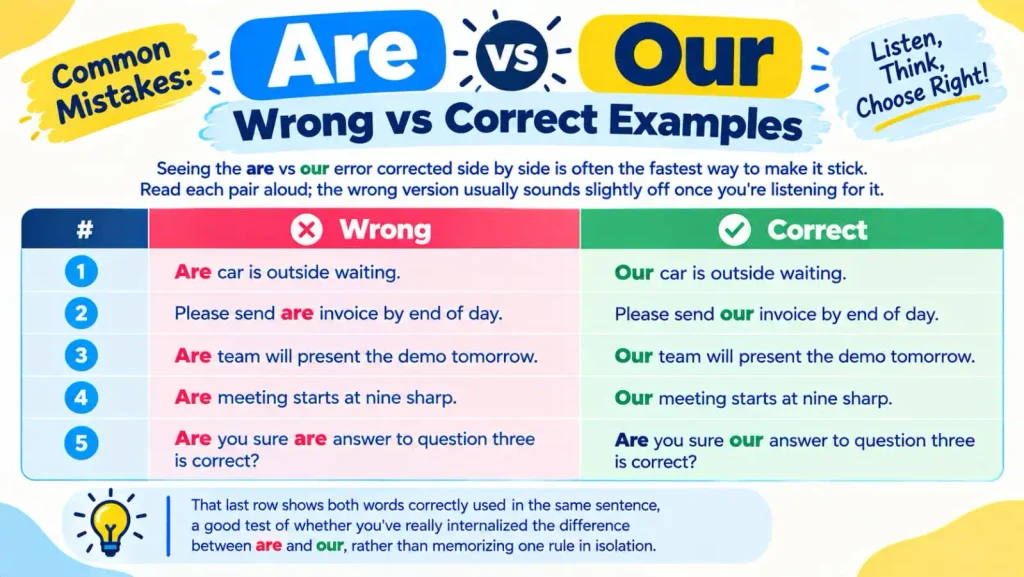
Common Mistakes: Are vs Our Wrong vs Correct Examples
Seeing the are vs our error corrected side by side is often the fastest way to make it stick. Read each pair aloud; the wrong version usually sounds slightly off once you’re listening for it.
| ❌ Wrong | ✅ Correct |
| Are car is outside waiting. | Our car is outside waiting. |
| Please send are invoice by end of day. | Please send our invoice by end of day. |
| Are team will present the demo tomorrow. | Our team will present the demo tomorrow. |
| Are meeting starts at nine sharp. | Our meeting starts at nine sharp. |
| Are you sure are answer to question three is correct? | Are you sure our answer to question three is correct? |
That last row shows both words correctly used in the same sentence, a good test of whether you’ve really internalized the difference between are and our, rather than just memorizing one rule in isolation.
Quick Quiz: Test Yourself
Fill in each blank with “are” or “our.”
- ___ you coming to the party tonight?
- This is ___ house, not theirs.
- ___ plan needs a few small changes before Monday.
- They ___ genuinely excited about the trip.
- ___ these ___ shoes by the door?
(Answers: 1. Are 2. our 3. Our 4. are 5. Are / our)
Frequently Asked Questions
When should I use “are” instead of “our”? Use “are” whenever your sentence needs a verb to state a condition, ask a question, or link a subject to an action, for example, “They are ready” or “Are you coming?” If the sentence is showing possession instead, you need “our.”
Can “our” ever function as a verb? No. “Our” is only a possessive adjective. If your sentence needs a verb, “are” (or another form of “to be”) is the correct choice.
Why does autocorrect or speech to text keep changing “our” to “are”? Predictive software favors the more statistically common word when context is ambiguous, and “are” appears far more frequently in everyday English than “our.” This is one of the most common sources of the are vs our error in texts and dictated messages, so it’s worth proofreading anything typed quickly on a phone.
What’s the fastest way to check whether are or our is correct? Try replacing the suspect word with “is.” If the sentence still works, “are” is correct. If it doesn’t, insert a noun right after the word; if that reads naturally, “our” is correct.
How can I help a student or child stop confusing are and our? Teach “are” and “our” side by side using contrasting sentences, like “We are driving to the game” next to “Our car needs gas.” Pairing a verb example with a possessive example in the same lesson helps the distinction stick faster than memorizing definitions alone.
Is “are” or “our” used with “we”? Both “are” and “our” can follow “we,” but they do different jobs: “We are ready” uses “are” as the verb, while “Our plans are set” uses “our” to show that the plans belong to the group.
Final Thoughts
At the end of the day, Are vs Our, this mix up comes down to two simple definitions worth remembering. Are is a verb, the present tense form of “to be,” used to state an action, a condition, or ask a question. Our is a possessive adjective, meaning “belonging to us,” and it always comes right before a noun in a sentence.
Once you understand these two meanings, the rest is just practice. Read your sentence aloud, and use the quick “is” swap or the noun insert test whenever you’re unsure. If a verb fits there, use are; if you mean ownership, use our. Trust your eyes over your ears once the two words start to sound alike in speech.
To read more: Apologies vs Apologize: What’s the Ultimate Difference? 2026

Marcus is a former product manager turned comparison writer who spent eight years testing tools and gadgets before quitting to write full-time. He specializes in breaking down tech and software matchups into plain-English verdicts, with a soft spot for buying guides nobody else wants to write.