
Armor vs Armour this pair isn’t about different meanings at all, but rather a matter of regional spelling. Armor is the American English spelling, referring to protective covering worn or used to guard against physical harm, such as in battle or combat. You’ll find this version in US published books, news, and websites.
Armour, on the other hand, is the British English spelling of the same word, commonly used across the UK, Australia, Canada, and other English speaking countries outside the US. Both words carry identical meaning and pronunciation; the only distinction lies in spelling convention based on location.
Knowing which one to use often depends simply on your target audience’s country and preferred English style.
Quick Answer
Armor vs Armour mean the same thing: a protective covering, used literally (like body armor) or figuratively (like emotional armor). The only difference between them is regional spelling: Armor is standard in American English, while Armour is standard in British, Canadian, Australian, and most other varieties of English.
Neither spelling is incorrect; the right choice depends on your audience, and the goal is simply staying consistent once you pick one.
Armor vs Armour at a Glance
Before going deeper, here’s the core comparison in one place:
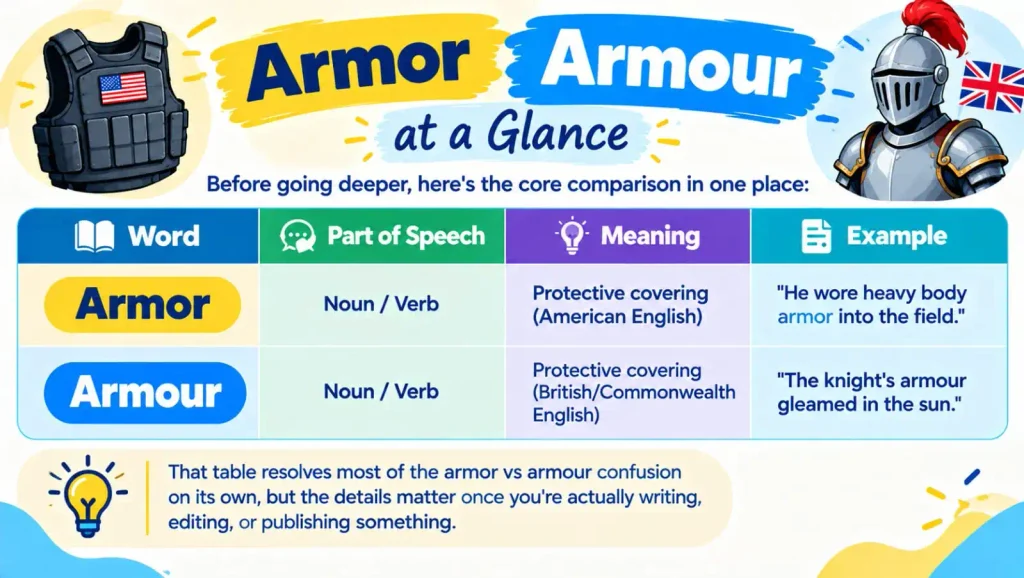
| Word | Part of Speech | Meaning | Example |
| Armor | Noun / Verb | Protective covering (American English) | “He wore heavy body armor into the field.” |
| Armour | Noun / Verb | Protective covering (British/Commonwealth English) | “The knight’s armour gleamed in the sun.” |
That table resolves most of the armor vs armour confusion on its own, but the details matter once you’re actually writing, editing, or publishing something.
What Does “Armor” Mean?
Armor is the American English spelling of a noun (and verb) referring to a protective covering, physical or figurative. It’s the standard spelling across US publications, American fiction, and most US based software, gaming, and business content.
A few natural examples of how it shows up in real writing:
- Military/literal: “The convoy rolled out at dawn, soldiers in full body armor.”
- Business email: “This new firewall update adds another layer of armor against phishing attempts, worth rolling out company wide.”
- Verb form: “She spent the drive home mentally armoring herself for the conversation she knew was coming.”
- Academic/essay: “The essay argued that Achilles’ armor functioned as a symbol of both protection and pride in Homer’s narrative.”
- Gaming/product copy: “Level up your character’s armor rating before taking on the final boss.”
“Armor” dominates in American newspapers, US based tech and gaming companies, and American fiction, unless the author is deliberately evoking a British or historical setting.
What Does “Armour” Mean?
Armour is the British and Commonwealth spelling of the identical word, same meaning, same grammar, just an extra “u.” It’s the standard across the UK, Canada, Australia, India, South Africa, and most other English speaking regions outside the United States.
Real world examples:
- Historical/literal: “The museum’s new exhibit features a full suit of 15th century armour.”
- News/journalism style: “Investigators confirmed the vehicle’s reinforced armour absorbed most of the blast.”
- Verb form: “The regiment armoured its vehicles before the border crossing.”
- Fiction/fantasy: “Her armour still bore the crest of the fallen northern kingdom.”
Writing for a UK client, editing a manuscript set in Britain, or publishing content aimed at Australian or Canadian readers all call for “armour”; using “armor” instead can read the same way a misplaced comma does: technically understandable, but slightly off to the trained eye.
This same “or” versus “our” split runs through a whole family of US vs UK spelling variants; think color/colour or favor/favour, so once you understand the logic behind armor vs armour, you’ve essentially cracked the code for dozens of other spelling pairs at once.
Where Did the Spelling Difference Come From?
The word traces back to the Latin armatura, which passed into Old French as armure and carried the “u” into Middle English. Both British and American English used “armour” for centuries. The split happened in 1828, when American lexicographer Noah Webster published his dictionary and deliberately trimmed the “u” from a long list of words, colour, honour, favour, and armour among them, as part of an effort to simplify spelling and create a distinct American standard.
Britain never adopted the change, and most Commonwealth countries followed Britain’s lead rather than Webster’s. That editorial decision, made nearly two centuries ago, is the entire reason this armor vs armour debate exists today.
Key Differences Between Armor vs Armour
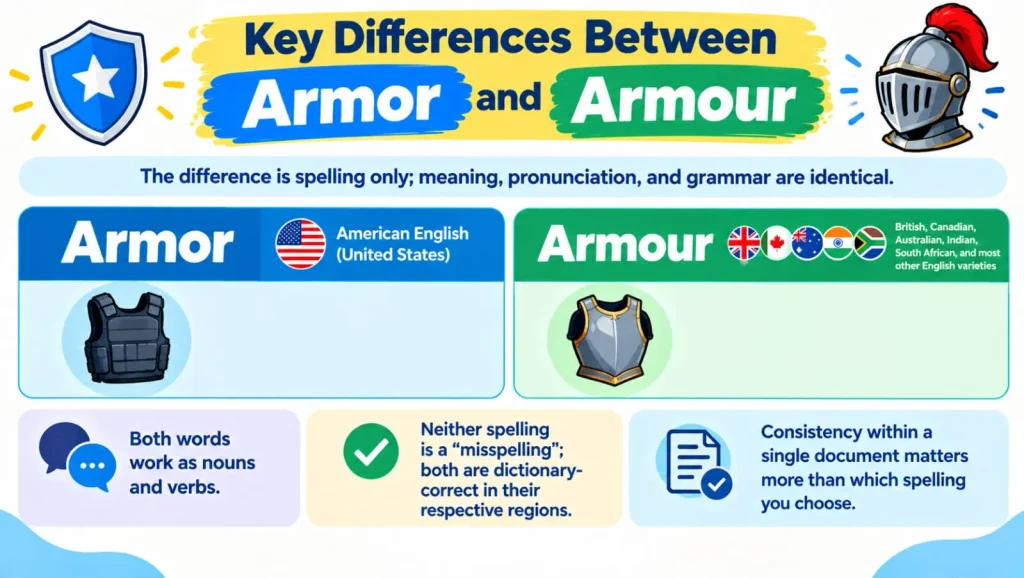
- The difference is spelling only; meaning, pronunciation, and grammar are identical.
- Armor = American English (United States)
- Armour = British, Canadian, Australian, Indian, South African, and most other English varieties
- Both words work as nouns and verbs.
- Neither spelling is a “misspelling”; both are dictionary-correct in their respective regions.
- Consistency within a single document matters more than which spelling you choose
Memory Trick: How to Never Mix Them Up Again?
Here’s a simple way to lock this in for good: “U.S. drops the U.” If you’re writing for an American audience, remove the extra letter; you get armor. Everyone else Britain, Canada, Australia, and beyond keeps the “u,” giving you armour. Another way to remember it: think of that extra “ou” as standing for “outside the US.”
Common Mistakes with Armor vs Armour
Even experienced writers slip here, usually not because they don’t know the rule, but because they switch between style guides, clients, or writing projects without realizing their spelling has drifted.
| ❌ Inconsistent or Incorrect | ✅ Better |
| Using “armor” in one paragraph and “armour” later in the same document | Pick one spelling and use it consistently throughout the entire piece |
| Assuming “armour” is simply a typo for “armor” | Recognize both as correct, region-specific spellings |
| Trusting autocorrect blindly without checking your document’s language setting | Confirm whether your software is set to English (US) or English (UK) before accepting suggested corrections |
| Writing British dialogue with American spelling (or vice versa) in fiction | Match spelling to your narrator’s audience, or your character’s regional voice for dialect accuracy |
That autocorrect trap catches more people than you’d expect: a document set to “English (US)” will flag “armour” as wrong even when a British writer is using it correctly, which is exactly the kind of confusion that makes an armor vs armour search necessary in the first place.
This matters even more in long form writing: a novelist 200,000 words into a manuscript who suddenly notices they’ve used both spellings doesn’t need to panic or rewrite everything from scratch.
The fix isn’t picking the “correct” one; it’s running a simple find and replace to standardize on whichever spelling matches the book’s intended audience, then double checking that dialogue and chapter titles didn’t slip through.
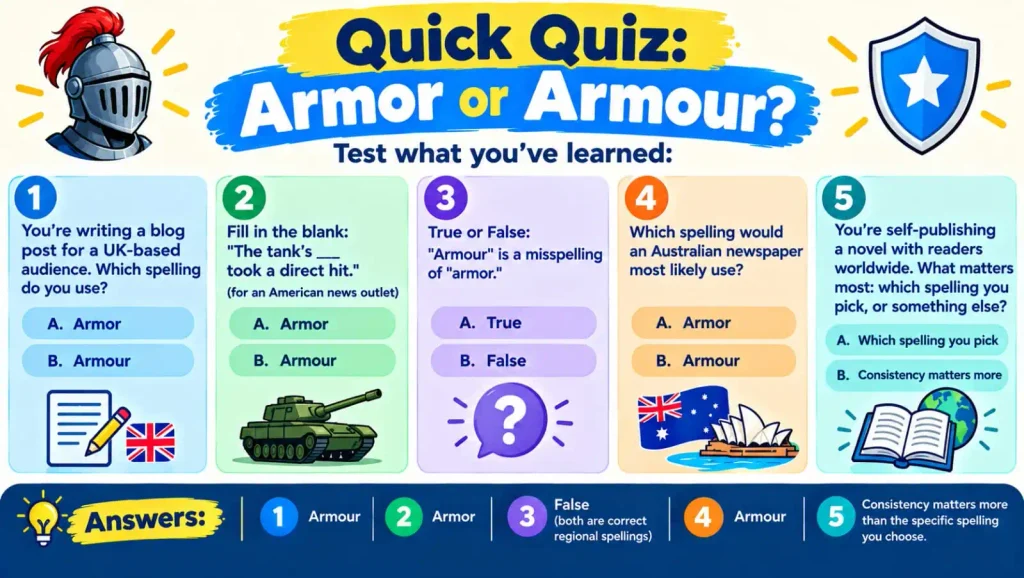
Quick Quiz: Armor or Armour?
Test what you’ve learned:
- You’re writing a blog post for a UK based audience. Which spelling do you use?
- Fill in the blank: “The tank’s took a direct hit.” (for an American news outlet)
- True or False: “Armour” is a misspelling of “armor.”
- Which spelling would an Australian newspaper most likely use?
- You’re self publishing a novel with readers worldwide. What matters most: which spelling you pick, or something else?
(Answers: 1. Armour, 2. Armor, 3. False, both are correct regional spellings, 4. Armour, 5. Consistency matters more than the specific spelling you choose.)
Frequently Asked Questions
That’s the full answer to the armor vs armour question; the FAQs below cover the specific edge cases people usually ask about next.
Is armor correct or armour?
Both are correct. “Armor” is standard in American English, while “armour” is standard in British, Canadian, Australian, and most other English varieties worldwide.
Is armour British or American?
Armour is the British spelling, also used throughout Canada, Australia, India, and most Commonwealth countries.
Do Canadians use armor or armour?
Canadians generally use “armour,” following British spelling conventions, though American influence means “armor” occasionally appears in informal or US adjacent writing.
Is “armored” or “armoured” the correct spelling?
The same regional rule applies: “armored” pairs with American spelling, and “armoured” pairs with British and Commonwealth spelling. Match whichever base word you’re already using.
Can I use armor and armour interchangeably in the same document?
Both are understood by readers everywhere, but switching between them within one piece of writing looks inconsistent. Choose a single spelling convention and apply it throughout.
Why do Americans spell it differently from the British?
Noah Webster’s 1828 American dictionary deliberately simplified a long list of British spellings, dropping the “u” from words like colour, honour, and armour, to establish a distinct American standard that Britain never adopted.
Final Thoughts
At the end of the day, armor vs armour isn’t a test of who knows “real” English; it’s a regional style choice, exactly like color/colour or honor/honour. Pick the spelling that matches your reader’s expectations, apply it consistently across the whole document, and the debate stops being a debate at all.
That’s the entire skill: not memorizing a rule, but knowing your audience well enough to make the call automatically.
To read more: Are vs Our: The Ultimate Confusing Difference (2026)

Marcus is a former product manager turned comparison writer who spent eight years testing tools and gadgets before quitting to write full-time. He specializes in breaking down tech and software matchups into plain-English verdicts, with a soft spot for buying guides nobody else wants to write.