
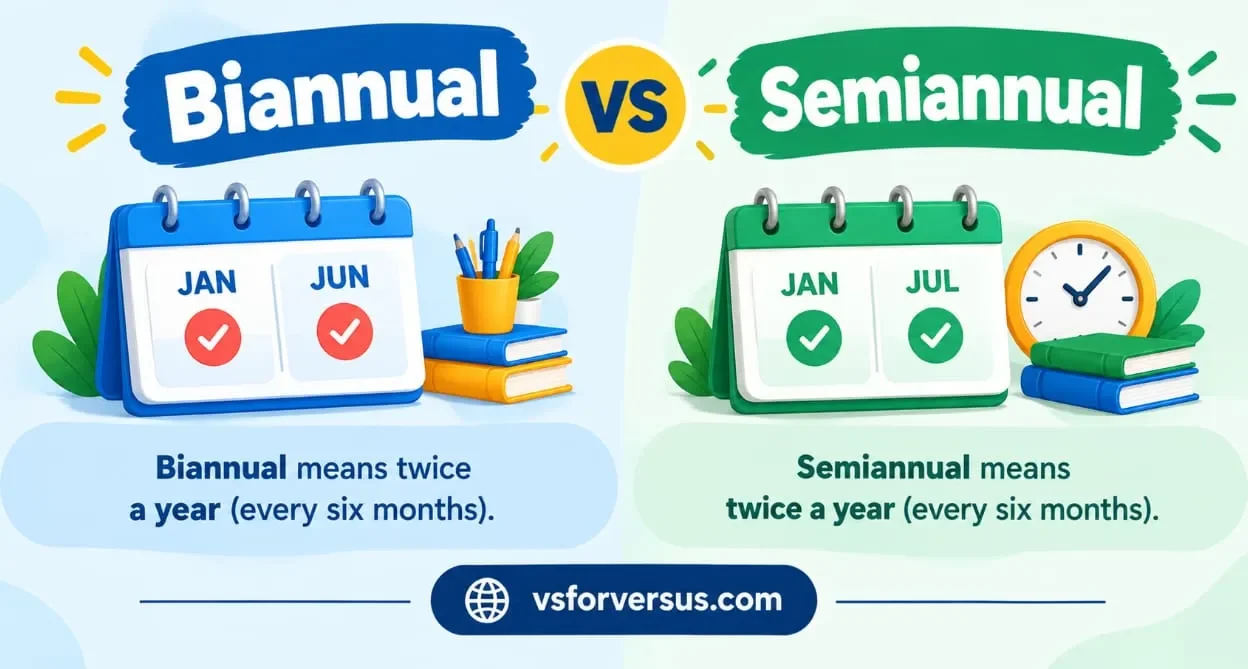
Biannual vs Semiannual is a word pair that causes a lot of confusion, mainly because both terms are often assumed to mean the same thing, when in reality their usage can vary. Semiannual clearly refers to something that happens twice a year, typically at regular six month intervals, such as semiannual reports or semiannual checkups.
Biannual, on the other hand, is a bit tricky, as it can mean twice a year in some contexts, but it is also sometimes used to mean once every two years, which overlaps with the word “biennial.” This overlapping usage makes Biannual one of the most misunderstood terms in the English language. In this article, we’ll break down these differences so you can use both words with confidence.
Quick Answer
Semiannual always means twice a year, occurring at six month intervals; there’s no ambiguity in it at all. Biannual also means twice a year on paper, but it’s commonly confused with biennial (every two years), so it carries a real risk of being misread by whoever’s on the other end of your email or contract.
That’s really the whole biannual vs semiannual question in one sentence: one word is precise, the other isn’t. The safest rule: when precision matters contracts, invoices, medical appointments, anything with a deadline attached reach for semiannual, or skip the debate entirely and simply write “every six months.”
Biannual vs Semiannual at a Glance
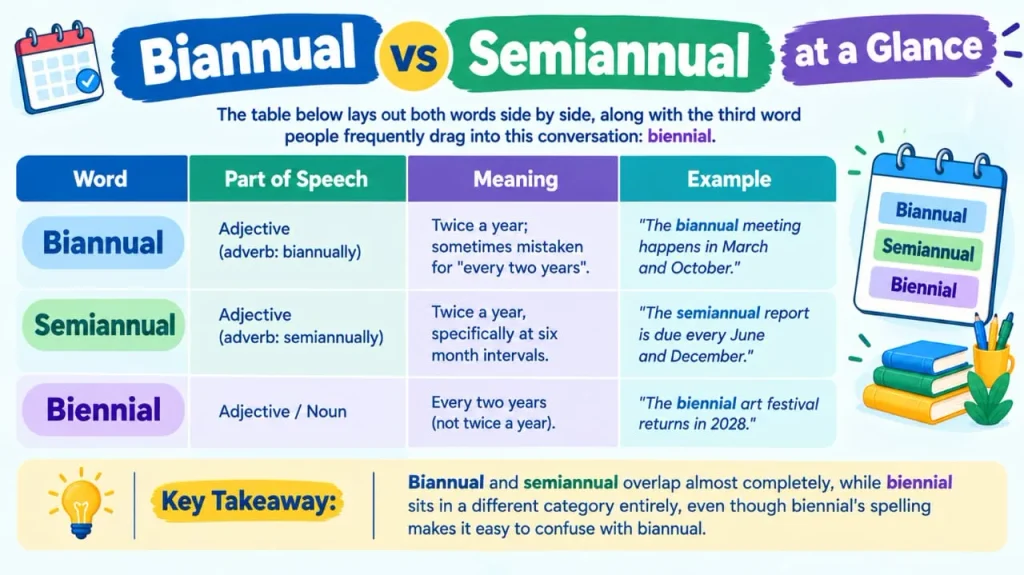
The table below lays out both words side by side, along with the third word people frequently drag into this conversation: biennial.
| Word | Part of Speech | Meaning | Example |
| Biannual | Adjective (adverb: biannually) | Twice a year; sometimes mistaken for “every two years” | “The biannual meeting happens in March and October.” |
| Semiannual | Adjective (adverb: semiannually) | Twice a year, specifically at six month intervals | “The semiannual report is due every June and December.” |
| Biennial | Adjective / Noun | Every two years (not twice a year) | “The biennial art festival returns in 2028.” |
Biannual and semiannual overlap almost completely, while biennial sits in a different category entirely, even though biennial’s spelling makes it easy to confuse with biannual. Anytime you’re weighing these two words side by side, biennial is the one quietly lurking in the background, waiting to cause the actual misunderstanding.
What Does “Biannual” Mean?
Biannual comes from the Latin prefix bi , meaning “two,” combined with annual, meaning “yearly.” Put together, it literally means “twice yearly.” As an adjective, it describes something that happens twice within a single year; the adverb form, biannually, is used less often but follows the same rule.
Examples of biannual in a sentence:
- “Heads up, the biannual team retreat got moved to April and September this year.”
- “The library holds its biannual book sale every spring and fall.”
- “Her thesis committee meets on a biannual schedule to check her progress.”
- “Under the lease agreement, the landlord conducts a biannual property inspection.”
- “We’re launching the new product line as part of our biannual collection drop.”
Common contexts: Biannual shows up most often in business scheduling (reviews, retreats, board check ins), academic publishing (journals, committee meetings), legal and rental agreements (inspections, renewals), and retail or fashion cycles, where brands talk about biannual collections or biannual sales events.
None of those examples specify when in the year the events happen, just that there are two of them. That’s fine for a casual email about a book sale, but it’s exactly the gap that causes real confusion in a lease or a contract.
What Does “Semiannual” Mean?
Semiannual breaks down just as cleanly: semi means “half,” and annual means “yearly,” so the word literally translates to “half yearly.” Unlike biannual, semiannual doesn’t carry any risk of being confused with a two year cycle. It’s locked into the six month meaning.
Examples of semiannual in a sentence:
- “Bondholders can expect their semiannual interest payment to hit accounts by June 30.”
- “I switched my car insurance to semiannual billing so I’m not getting charged every single month.”
- “Reminder: your semiannual dental cleaning is coming up next week.”
- “The finance team is finalizing the semiannual audit before the board meeting.”
Common contexts: Semiannual appears constantly in finance and banking (interest, dividends, audits), insurance and billing, and medical or dental scheduling, anywhere a precise six month rhythm actually matters to the reader. Compare these examples to the biannual ones above: there’s no guessing involved here, because the six month interval is baked into the word itself.
Semiannual or Semi Annual?
Both spellings are technically accepted, but modern American English has mostly dropped the hyphen. “Semiannual” is the standard form you’ll see in style guides and professional writing, while “semi annual” leans slightly more toward older or British usage.
The same pattern applies to biannual versus bi annual: no hyphen needed in current American style. A company memo that reads “the semiannual meeting” comes across as more current and polished than one that reads “the semi annual meeting,” even though a reader would understand either version instantly.
How Do You Pronounce Biannual vs Semiannual?
Both words are said the way they look, but the syllable stress trips people up in conversation. Biannual is pronounced by AN yoo uhl, with the stress on the second syllable. Semiannual is pronounced sem ee AN yoo uhl, with the stress landing on the third syllable.
Say them out loud a few times, and the “bi ” versus “semi ” difference becomes much easier to keep straight when you’re speaking, not just writing.
Key Differences Between Biannual vs Semiannual
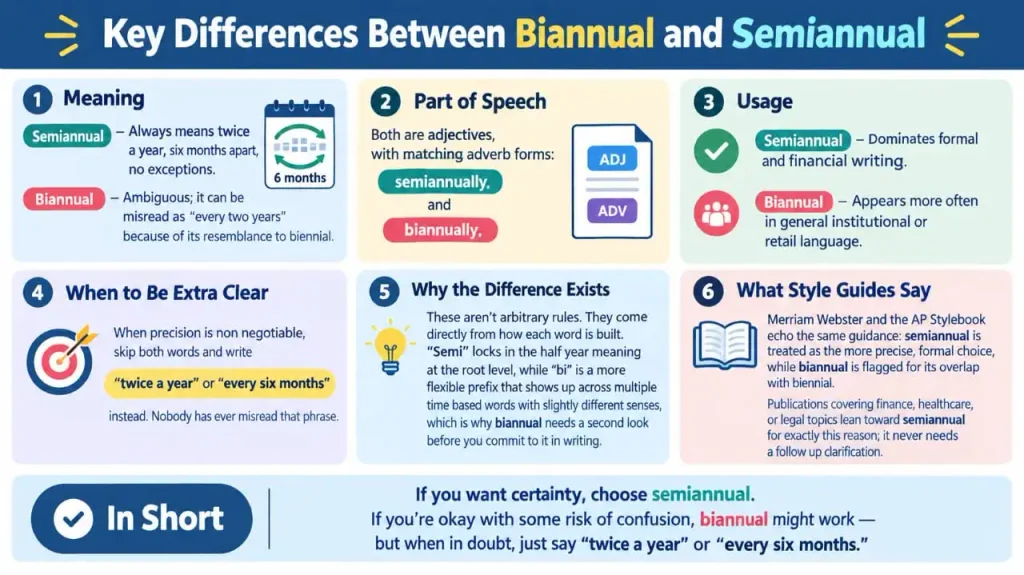
- Semiannual is unambiguous; it always means twice a year, six months apart, no exceptions.
- Biannual is ambiguous; it can be misread as “every two years” because of its resemblance to biennial.
- Both are adjectives, with matching adverb forms: biannually and semiannually.
- Semiannual dominates formal and financial writing, while biannual appears more often in general institutional or retail language.
- When precision is non negotiable, skip both words and write “twice a year” or “every six months” instead. Nobody has ever misread that phrase.
These aren’t arbitrary rules. They come directly from how each word is built. “Semi ” locks in the half year meaning at the root level, while “bi ” is a more flexible prefix that shows up across multiple time based words with slightly different senses, which is why biannual needs a second look before you commit to it in writing.
Merriam Webster and the AP Stylebook echo the same guidance: semiannual is treated as the more precise, formal choice, while biannual is flagged for its overlap with biennial. Publications covering finance, healthcare, or legal topics lean toward semiannual for exactly this reason; it never needs a follow up clarification.
Memory Trick: How to Never Mix These Up Again?
Try this to lock it in for good: SEMI has SIX; semiannual always means six months apart, guaranteed, no debate. For the trickier word, remember that BI can betray you: biannual shares its “bi ” prefix with biennial, so it’s the one worth double checking before you use it somewhere precision counts, like a contract or an invoice.
If visual memory works better for you, picture two calendars side by side: one split neatly in half at the six month mark (semiannual), and one with a big question mark hovering over it because you’re not sure if the second event is six months away or two years away (biannual). That mental image resolves most real world mix ups faster than memorizing a definition ever will.
Common Mistakes With Biannual vs Semiannual
Most biannual vs semiannual mistakes aren’t spelling errors; they’re clarity errors. The sentence is grammatically correct, but the reader still walks away unsure what was actually meant. Here’s what that looks like in practice, and how to fix it.
| ❌ Wrong or Confusing | ✅ Clearer |
| “We hold a biannual conference.” (reader assumes every two years) | “We hold a semiannual conference, every six months.” |
| Using “biannual” and “biennial” interchangeably in a contract clause | Specify directly: “occurring every two years” or “occurring twice yearly” |
| Spelling it “semi annually” in one paragraph and “semiannually” in the next | Pick one spelling, semiannually, and stay consistent throughout |
In professional documents, this isn’t just a style nitpick. A misread “biannual” clause in a lease, a billing agreement, or an employee handbook can genuinely shift deadlines, payment schedules, or review dates, which is exactly what happened to the two coworkers from the opening story. A thirty second word swap would have prevented the whole mix up.
Quick Quiz: Test Yourself
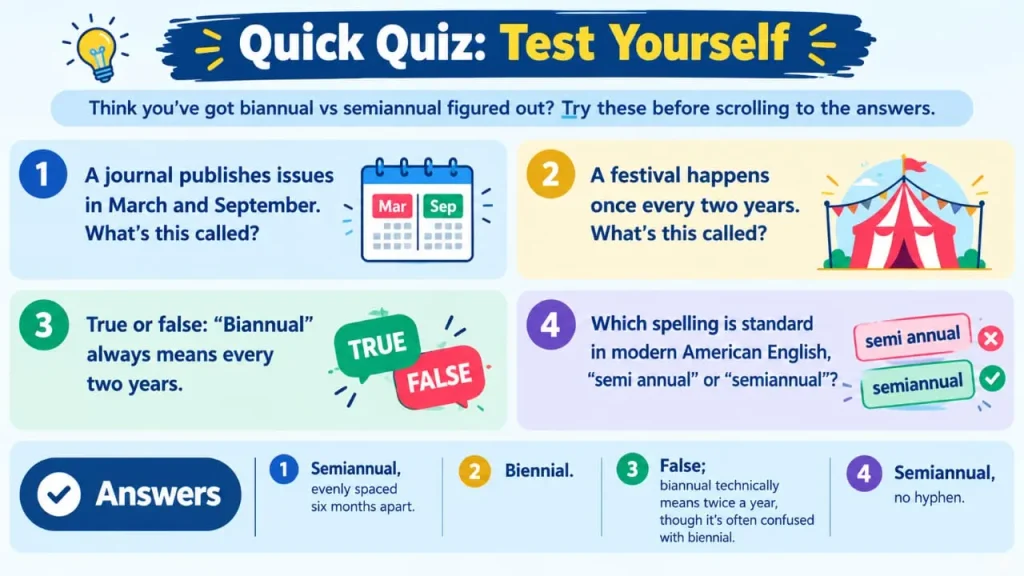
Think you’ve got biannual vs semiannual figured out? Try these before scrolling to the answers.
- A journal publishes issues in March and September. What’s this called?
- A festival happens once every two years. What’s this called?
- True or false: “Biannual” always means every two years.
- Which spelling is standard in modern American English, “semi annual” or “semiannual”?
(Answers: 1. Semiannual, evenly spaced six months apart. 2. Biennial. 3. False; biannual technically means twice a year, though it’s often confused with biennial. 4. Semiannual, no hyphen.)
Frequently Asked Questions
Does biannual mean twice a year or once every two years?
Biannual technically means twice a year, but it’s frequently confused with biennial, which means every two years, so context always matters when you see it.
What is the difference between biannual and semiannual?
They’re often used interchangeably, but semiannual is more precise: it always means twice a year at six month intervals, while biannual carries a real risk of ambiguity.
Is biannual the same as biennial?
No. Biannual means twice a year; biennial means every two years. They’re frequently mixed up because the two words look and sound so similar.
Is it “semiannual” or “semi annual”?
Both spellings are accepted, but “semiannual,” without the hyphen, is the standard form in modern American English.
What do style guides say about biannual vs semiannual?
Merriam Webster and the AP Stylebook both treat semiannual as the clearer, more formal choice, since it always means twice a year. Biannual is listed with the same meaning but flagged for its overlap with biennial, so most style guides recommend semiannual whenever exact timing needs to be unmistakable.
Which word should I use in a contract or business document?
Use “semiannual,” or better yet, spell out “every six months” to eliminate any chance of misinterpretation, especially where deadlines or payments are on the line. Legal and financial documents are exactly the environments where a single misread word can trigger a real dispute, so precision beats brevity every time.
What’s another word for “twice a year”?
“Semiannual” is the clearest single word alternative. “Twice yearly” and “twice a year” work well too, and they’re impossible to misread.
Final Thoughts
The biannual vs semiannual debate isn’t really about grammar rules. It’s about picking the word that won’t get misread six months, or two years, from now. Semiannual is your safest bet whenever timing actually matters, since it always means twice a year, six months apart.
Biannual is fine for casual, low stakes writing, but it’s worth a second thought anywhere precision counts, and when in doubt, “every six months” beats either word.
To read more: Beside vs Besides: The Essential Guide to Avoid Costly Mistakes (2026)

Marcus is a former product manager turned comparison writer who spent eight years testing tools and gadgets before quitting to write full-time. He specializes in breaking down tech and software matchups into plain-English verdicts, with a soft spot for buying guides nobody else wants to write.